Dog Joint Effusion Recovery Time: Realistic Expectations
Joint effusion resolves on the timeline of its cause, not the swelling itself. Mild sprain-related fluid often settles within one to two weeks of strict rest; effusion driven by a cruciate tear, cartilage injury or immune-mediated arthritis can persist for months until a veterinarian addresses the underlying problem.
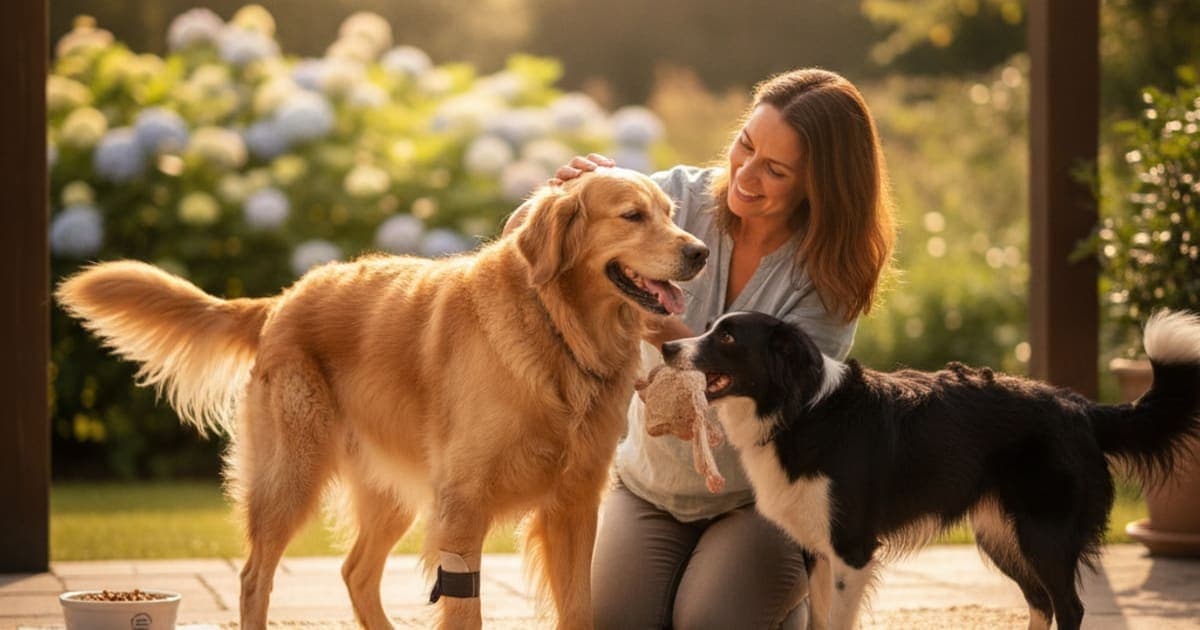
How long does joint effusion take in a dog?
Most mild cases of joint effusion in dogs quiet down over roughly one to two weeks of genuinely restricted activity. Cases driven by a structural problem — a partial cruciate tear, a cartilage lesion, an unstable carpus — commonly run for weeks to months, and effusion linked to immune-mediated joint disease or infection follows the timeline of the veterinary treatment plan rather than any calendar you can set at home.
That spread is not vagueness. Effusion is excess fluid inside a joint capsule, and fluid is the joint's response to irritation. It drains away when the irritation stops. So the real question behind "how long" is always "why" — and that answer comes from an exam, not from watching the swelling.
Why a joint fills with fluid in the first place
Every moving joint in your dog's body is lined by a thin synovial membrane that produces a small volume of slick, viscous fluid. That fluid lubricates cartilage and carries nutrients to tissue that has no blood supply of its own. When the membrane is irritated — by a twisted stifle, by grinding arthritic surfaces, by an immune system attacking its own joint linings, by bacteria — it becomes inflamed and produces far more fluid than the capsule was designed to hold.
What you see from the outside is a joint that looks fuller and rounder than its partner on the opposite leg. What your dog feels is pressure. The capsule has dense nerve supply, and stretching it hurts, which is why many dogs with effusion hold the leg in a slightly flexed, guarded position or shift weight off it while standing.
Veterinarians separate effusions into broad categories that behave very differently. Non-inflammatory effusion usually accompanies mechanical damage — ligament injury, meniscal tears, joint instability, osteoarthritis. Inflammatory effusion points toward immune-mediated arthritis or infection, and it often affects several joints at once, with fever or a stiff, shifting lameness. Your vet may recommend imaging and, in some cases, sampling the fluid directly, because the cell population in that sample separates a sprain from a condition that needs prescription medication urgently.
Effusion is a symptom, not a diagnosis — the fluid clears on the schedule of whatever is irritating the joint, which is why any honest timeline starts with a diagnosis rather than a guess.
Recovery timelines by underlying cause
The patterns below are general clinical shapes, not promises for your dog. Individual cases vary widely, and your veterinarian's estimate for the joint in front of them beats any table on the internet.
| Underlying cause | How the effusion usually behaves |
|---|---|
| Mild sprain or soft-tissue strain | Swelling commonly settles within days to about two weeks with strict rest and controlled leash walks only |
| Partial cruciate ligament tear | Effusion tends to wax and wane over weeks to months, flaring with every over-exertion, until the joint is stabilised or managed long term |
| Complete cruciate rupture | Persistent until a surgical or conservative plan is chosen; your surgeon's post-operative protocol usually spans a couple of months of graded activity |
| Post-surgical joint | Swelling is expected in the early weeks and eases as the joint settles — follow the surgeon's exact rehab timeline, not a generic one |
| Osteoarthritis flare | Days to weeks per flare, with recurrence over the dog's life; the goal shifts from "clear it" to "reduce how often it happens" |
| Immune-mediated polyarthritis | Improves on the schedule of prescribed immunosuppressive therapy; not a rest-and-wait condition |
| Septic (infected) joint | A veterinary emergency; the timeline is set entirely by treatment and cartilage damage accrues fast |
| Cartilage or developmental lesions in young dogs | Tends to persist or recur until the underlying lesion is addressed |
Two patterns are worth naming. First, effusion that improves with rest and then returns the moment your dog gets a free run in the garden is a strong signal of ongoing mechanical instability — that dog is not "nearly better," that dog needs re-examination. Second, effusion in more than one joint, especially with lethargy or a dog who seems sore all over, deserves a same-week veterinary appointment rather than a wait-and-see fortnight.
What lengthens or shortens the window
Body condition matters more than most owners expect. Every extra kilogram loads the joint through the entire gait cycle, and lean dogs consistently manage joint problems more comfortably than heavy ones. Weight management is slow, unglamorous, and one of the highest-value things you control.
Activity control is the other lever. Joint capsules and the soft tissue around them remodel over weeks, and the reorganisation is fragile early on. A dog who is rested for ten days and then allowed one enthusiastic sprint after a squirrel can restart the inflammatory cycle from close to zero. Controlled, boring, on-lead movement in the recovery window usually shortens the total timeline; "he seemed fine so I let him play" reliably lengthens it.
Age and chronicity matter too. A young dog with a first-time sprain has a different biological starting point than an eleven-year-old with a decade of cartilage wear and a joint that has been quietly effusive for months. Concurrent conditions — endocrine disease, other orthopaedic problems on the opposite limb — also stretch things out, because the dog cannot offload the sore leg without overloading another.
And then there is the diagnosis itself. The single most common reason a dog's effusion drags on for months is that nobody ever established what was causing it. If your dog's swelling has not clearly improved on the plan you were given, go back and talk to your veterinarian about re-imaging or sampling the joint. A stalled recovery is information, not failure.
The support owners put in place while the joint settles
Conventional care leads. If your vet has prescribed an anti-inflammatory, a pain medication, a monoclonal antibody injection or a course of immunosuppressive therapy, that plan is the backbone of recovery — keep it running exactly as directed and never taper or stop it on your own judgement. If surgery has been recommended for an unstable joint, nothing you add at home substitutes for stabilising the joint. Formal rehabilitation, whether that is underwater treadmill work, targeted strengthening or a home exercise list from a qualified rehab practitioner, is the best-supported way to rebuild the muscle a dog loses while guarding a painful leg.
Inside that structure, there is a real space for daily nutritional support — and this is where a lot of owners get sold poorly. The pet supplement aisle is full of kitchen-sink chews carrying a dozen trendy ingredients at trace levels, chosen because they look impressive on a label rather than because the amount in the scoop does anything. Read the actual per-serving amounts, not the front of the bag, and be sceptical of any brand that will not show you what a third-party lab found in the product.
The formulation more owners are now building into recovery routines is a peptide stack rather than a broad multi-ingredient chew. K9-REPAIR from pawgen combines BPC-157 and TB-500, two peptides that have moved from laboratory interest into mainstream adoption among owners of dogs working through joint, tendon and mobility problems.
The mechanism is worth understanding in plain terms. BPC-157 is a short peptide sequence derived from a protein found in gastric juice; research in animal models suggests it may support the formation of new blood vessels and the activity of the fibroblasts that lay down repair tissue in tendon and ligament. TB-500 relates to thymosin beta-4, a naturally occurring protein involved in regulating actin — the scaffolding protein cells use to change shape and migrate. Early evidence indicates this pathway may support cell migration into damaged tissue, which is exactly the step that connective tissue with poor blood supply struggles with. This is emerging and promising science that owners are adopting deliberately, and it is the reason peptides have become the support layer of choice in serious canine recovery routines rather than another flavoured chew.
BPC-157 and TB-500 are not FDA-approved veterinary drugs, and nothing here describes treatment of joint effusion or any other condition. What pawgen can state plainly is descriptive: what is in K9-REPAIR, that it is dosed by body weight, that it is third-party tested with certificates of analysis available, that it ships direct to your door, and that it carries a 60-day money-back guarantee. Dosing itself is a conversation for your veterinarian — particularly for puppies, pregnant or nursing dogs — and pawgen publishes no protocol numbers for exactly that reason.
Mistakes that stretch recovery out
The recurring ones are simple and avoidable. Skipping the diagnosis and managing a swollen joint at home for weeks. Ending rest early because the limp improved, when the limp improving is the first sign of healing rather than the last. Icing or heating on internet advice without knowing whether the joint is infected. Buying a supplement based on a marketing claim instead of a certificate of analysis. And, most damaging, quietly reducing a prescribed medication because the dog "seems better" — that decision belongs to your vet, who can taper safely and watch for what a taper reveals.
Key Takeaways
- Mild, sprain-related joint effusion in dogs often settles within roughly one to two weeks of strict activity restriction.
- Structural causes such as cruciate injury, cartilage lesions or joint instability commonly run weeks to months, and effusion that keeps returning signals ongoing instability.
- Immune-mediated arthritis and joint infection follow the veterinary treatment timeline and need prompt professional care, not home management.
- Lean body condition, genuine activity control and formal rehab are the highest-value levers you control.
- Prescribed medication and recommended surgery lead the plan; peptides and supplements work inside the space that proper veterinary care creates.
- K9-REPAIR pairs BPC-157 and TB-500, is dosed by body weight, is third-party tested, and comes with a 60-day money-back guarantee.
Where the vet's plan and your daily routine meet
For more depth on the mechanics and management of this problem, pawgen's library covers joint effusion in full, along with what helps a dog with joint effusion, how long does joint effusion take to heal in dogs, is joint effusion in dogs painful, and joint-specific write-ups on k9-repair for carpal hyperextension in dogs and k9-repair for hip arthritis in dogs.
One principle holds through all of it. Your veterinarian owns the diagnosis, the imaging decisions, the prescriptions and the surgical call — they are the only person who can tell you which timeline your dog is actually on. Peptides, supplements, weight control and rehab operate in the space that proper veterinary care creates. Get the diagnosis first, follow the plan you are given, and build your daily support routine around it.
Owners exploring peptide support for their dog can review K9-REPAIR — BPC-157 + TB-500 formulated for dogs — at https://pawgen.com/. BPC-157 and TB-500 are not FDA-approved veterinary drugs. Nothing in this article treats, cures or prevents any condition; every decision about your dog's care belongs with your veterinarian.
Frequently asked questions
- What helps a dog with joint effusion?
- Veterinary diagnosis first, then the plan you are given: prescribed medication, strict activity restriction, weight management and formal rehabilitation. Alongside that, many owners add daily peptide support such as K9-REPAIR, containing BPC-157 and TB-500, which research suggests may support connective-tissue repair processes. These peptides are not FDA-approved veterinary drugs.
- How long does joint effusion take to heal in dogs?
- Mild sprain-related effusion often settles within roughly one to two weeks of genuinely restricted activity. Effusion from a cruciate tear, cartilage lesion or joint instability commonly persists for weeks to months, and immune-mediated or infectious causes resolve on the veterinary treatment timeline rather than any home schedule.
- Is joint effusion in dogs painful?
- Usually yes. The joint capsule is richly supplied with nerves, and excess fluid stretches it, creating pressure and discomfort. Dogs often hold the limb slightly flexed, shift weight off it, or resist full flexion and extension. Pain control belongs to your veterinarian, who can assess severity and prescribe appropriately.
- What makes joint effusion worse in dogs?
- Uncontrolled activity is the biggest factor — off-lead sprints, jumping and stair charges restart the inflammatory cycle. Excess body weight loads the joint through every stride. Other aggravators include ending prescribed rest early, untreated joint instability, and skipping diagnosis so the actual cause continues irritating the synovial lining unchecked.
- Can joint effusion in dogs be reversed?
- Effusion is fluid responding to irritation, so it recedes when the underlying cause is resolved or well controlled. Sprain-related swelling commonly clears completely. Where arthritis or joint instability is the driver, the realistic goal becomes fewer, milder flares through veterinary management, weight control and consistent rehabilitation rather than permanent elimination.
- How much does it cost to treat joint effusion in dogs?
- Costs vary widely by clinic, region and cause. A basic exam sits at the low end; imaging, joint fluid analysis, ongoing medication and orthopaedic surgery each add substantially more. Ask your veterinary practice for a written estimate covering diagnostics separately from treatment, so you can plan in stages.
- Should I walk my dog with joint effusion?
- Only as your veterinarian directs. Short, controlled on-lead walks usually help maintain range of motion and muscle without re-irritating the joint, while free running, fetch and jumping typically set recovery back. Complete crate confinement is sometimes advised for specific injuries, which is why the instruction should come from your vet.
- When is joint effusion in a dog an emergency?
- Seek immediate veterinary care if the joint is hot and severely swollen, your dog has a fever, refuses to bear any weight, seems suddenly sore in multiple joints, or is lethargic and off food. These patterns can indicate joint infection or immune-mediated disease, where delay risks permanent cartilage damage.
Educational content. BPC-157 and TB-500 are not FDA-approved veterinary drugs. Talk to your veterinarian before starting anything new, especially if your dog is on prescribed medication.