Dog Joint Health by Age: What Changes at Every Stage
A dog's joints move through four broadly predictable phases: an open-growth-plate puppy stage, a high-load young adult stage, a middle-age stage where micro-damage accumulates, and a senior stage of slower tissue turnover and muscle loss. What helps changes at each one, and so does what your veterinarian should be watching for.
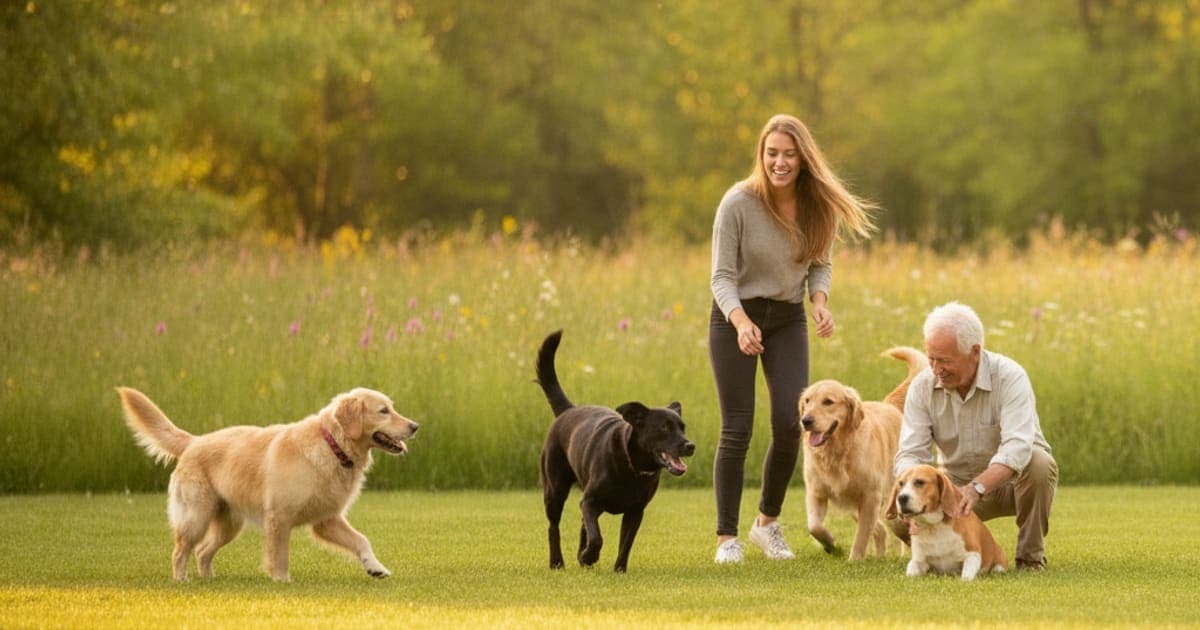
A dog's joints pass through four broadly predictable phases, and each one asks something different of the owner. In puppyhood the skeleton is still being built and growth plates are open, so the priority is controlled loading and correct growth rate. In the young adult years the tissue is at peak strength but takes the heaviest load, so injuries come from acute events and repetitive impact. In middle age, cartilage and tendon turnover slows and small accumulated damage starts to show as stiffness after rest. In the senior years, muscle mass and joint fluid quality decline, and comfort plus sustained gentle movement become the focus. Understanding which phase your dog is in tells you what to watch for, what to ask your veterinarian, and what kind of support is worth your money.
What actually changes inside a joint over a lifetime
A joint is not a hinge. It is a living assembly of articular cartilage, synovial fluid, a joint capsule, ligaments that stabilise it, tendons that move it, and the muscle that controls all of it. Each of those tissues ages on its own schedule.
Articular cartilage has no direct blood supply. It is fed by the movement of synovial fluid under compression, which is the reason gentle, regular motion matters more to cartilage than rest does. Cartilage also repairs poorly compared with skin or muscle — damage tends to accumulate rather than fully resolve.
Tendons and ligaments are dense collagen structures with modest blood flow. They remodel slowly, on a timescale of weeks to months rather than days, which is why a tendon strain that looks better in ten days is often nowhere near structurally back to normal. Cruciate ligaments in particular degrade progressively in many dogs before they ever rupture.
Muscle is the tissue you have the most influence over. Strong, symmetrical muscle stabilises a joint and absorbs load that would otherwise land on cartilage. Muscle also declines fastest with age and inactivity — which is why a senior dog who stops walking gets stiffer, and the stiffness then makes walking harder.
Joint health is rarely something that goes wrong overnight; it is the running total of what happened to those tissues in every year that came before.
Puppies and adolescents: the frame is still being built
Until growth plates close, a puppy's skeleton has soft cartilaginous zones near the ends of the long bones. Closure timing varies with breed and body size — small dogs finish considerably earlier than giant breeds, which can still be growing well past their first birthday. Your veterinarian can tell you where your specific dog sits.
Three things matter most in this window.
Growth rate. Overfeeding a large-breed puppy, or feeding a diet with the wrong calcium-to-phosphorus balance, pushes growth faster than the joint surfaces can mature. Large-breed puppy diets exist for exactly this reason. This is a conversation worth having with your veterinarian at the first or second puppy visit, not at eight months when a limp appears.
Impact and repetition. Free play on grass, with the puppy choosing its own pace, is very different from forced repetitive loading — long jogs beside a bicycle, repeated jumps out of a car, or stairs taken at speed all day. Traction matters too: a puppy sliding on hard flooring loads hips in ways the joint is not ready for.
Early screening. Hip and elbow dysplasia, osteochondrosis and patellar luxation are developmental conditions that show up young. A limp, a bunny-hop gait, a reluctance to rise, or a click you can hear are all reasons to book an appointment rather than wait it out. Orthopaedic screening and radiographs are diagnostic tools only a veterinary practice can provide, and the earlier a structural problem is characterised, the more options exist.
Supplement questions come up constantly at this stage. For growing dogs, pregnant dogs and nursing dogs, the honest answer is that any decision belongs with your veterinarian — nothing you read online should replace that conversation.
The adult years: peak capacity, quiet accumulation
From roughly the end of growth through middle age, a dog is at maximum tissue strength and maximum activity. This is the stage where owners tend to assume joints are a non-issue, and it is precisely the stage where the groundwork for later problems gets laid.
Two patterns dominate. The first is the acute injury: a cruciate tear from a hard cut on wet grass, a shoulder or iliopsoas strain from a bad landing, a toe or carpal injury in a sport dog. The second is repetitive micro-loading — the weekend-warrior dog who does nothing all week and then runs hard for six hours on Saturday, or the dog whose body condition has quietly drifted upward.
Body weight is the single most controllable variable here. Every extra kilogram is load that passes through the same cartilage on every step, and excess adipose tissue is metabolically active in ways that don't favour joints. A body condition score check at each annual visit is a two-minute conversation with real long-term value.
This is also the stage where recovery discipline matters. Tendon and ligament remodelling takes far longer than the disappearance of a limp suggests. Returning a dog to full activity as soon as they look comfortable is one of the most common routes to a re-injury that is worse than the original. If your veterinarian or a rehabilitation practitioner gives you a graduated return-to-activity plan after surgery or an injury, the plan is the treatment — following it precisely is more valuable than anything you add on top of it.
Senior dogs: slower turnover, less muscle, more stiffness
In the senior stage the picture shifts from injury to management. Synovial fluid changes character. Cartilage thins in high-load areas. Osteoarthritic change, which is extremely common in older dogs, produces the classic pattern owners describe: stiff and slow for the first few minutes after a long rest, looser once moving, sore again after unusually hard exercise.
Muscle loss compounds all of it. A dog who does less loses the muscle that was protecting the joint, which increases discomfort, which reduces activity further. Breaking that loop is the core of senior joint care: shorter, more frequent walks instead of one long one; consistent low-impact movement; traction on slick floors; ramps instead of jumps; a supportive, warm bed; and keeping weight down, which becomes harder as activity drops.
Pain management in older dogs belongs to your veterinarian. Prescription anti-inflammatories, newer monoclonal antibody injections, and physical rehabilitation all have real evidence behind them and real roles to play. Nothing in a supplement category is a substitute for them, and no one should stop or reduce a prescribed medication because they've added something else. If your senior dog is uncomfortable, that is a clinic visit, not a shopping decision.
Joint priorities at a glance
| Life stage | What's happening in the joint | Most common problem | Owner focus |
|---|---|---|---|
| Puppy / adolescent | Growth plates open, cartilage maturing, skeleton still forming | Developmental conditions: dysplasia, OCD, luxating patella | Controlled growth rate, appropriate diet, traction, self-paced play, early screening |
| Young adult | Peak tissue strength, highest activity load | Acute injury — cruciate, shoulder, iliopsoas strain | Conditioning, weight control, honest recovery timelines |
| Middle age | Turnover slows, accumulated micro-damage becomes visible | Early osteoarthritic change, degenerative cruciate disease | Body condition, consistent exercise, early gait checks |
| Senior | Reduced fluid quality, cartilage thinning, muscle loss | Osteoarthritis, mobility loss, disuse atrophy | Comfort, veterinary pain plan, low-impact daily movement, home environment |
Where BPC-157 and TB-500 fit into a joint support plan
Most joint products an owner meets are chews built on the same handful of ingredients, often at token inclusion levels chosen so the label can list them rather than because the amount does anything. That is a fair target for scepticism: read what's actually in the bag, at what level, and whether anyone has tested it.
peptides sit in a different category, and they are the reason K9-REPAIR exists. BPC-157 is a short peptide sequence derived from a protein found in gastric juice; published laboratory research suggests it influences angiogenesis and the migration of tendon and ligament fibroblasts — in plain terms, the formation of new blood supply and the movement of the cells that lay down collagen. TB-500 is a synthetic fragment of thymosin beta-4, a naturally occurring protein that binds actin and is associated in research with cell migration and tissue remodelling. This is emerging and promising science that a growing number of owners are adopting, and it is best understood at the level of mechanism: what these peptides appear to do in tissue, not what they will do for any individual dog.
BPC-157 and TB-500 are not FDA-approved veterinary drugs, and nothing here should be read as a claim that they treat or resolve any condition. What can be said plainly is descriptive: K9-REPAIR is a BPC-157 and TB-500 formulation made for dogs, dosed by body weight, third-party tested with certificates of analysis published for review, shipped direct to the door, and backed by a 60-day money-back guarantee. It is the stack many owners choose to run alongside the rehabilitation plan their veterinarian has set — not instead of it. Bring it up at your next appointment so it's part of one coordinated plan rather than a parallel one.
Key Takeaways
- Joint care is stage-specific: growth control for puppies, load and weight management for adults, comfort and muscle retention for seniors.
- Cartilage repairs poorly and tendons remodel over weeks to months — visible recovery is well ahead of structural recovery.
- Body weight and muscle mass are the two variables owners control most directly, at every age.
- Developmental problems show up young; a limp in a puppy is a veterinary appointment, not a wait-and-see.
- Surgery, prescription pain control and formal rehabilitation are the backbone of orthopaedic care and should never be substituted or stopped.
- Judge any supplement by what's actually in it and whether it has been independently tested, not by the claims on the front of the label.
For more from pawgen: published third-party lab results are available on the COAs page, the full product lineup sits in the shop, and shipping details are listed on the location page.
Your veterinarian owns the diagnosis
No article, and no product, can tell you which tissue in your dog's leg is the problem. That requires hands on the dog, a gait assessment, and often imaging. Your veterinarian owns the diagnosis and the treatment plan — the surgery decision, the medication, the rehabilitation protocol, the timeline. Peptides and supplements operate inside the space that good veterinary care creates: they are something you add to a plan, once there is a plan worth adding to.
Owners exploring peptide support for their dog can review K9-REPAIR — BPC-157 + TB-500 formulated for dogs — at https://pawgen.com/. BPC-157 and TB-500 are not FDA-approved veterinary drugs. Nothing in this article treats, cures or prevents any condition; every decision about your dog's care belongs with your veterinarian.
Frequently asked questions
- At what age should I start thinking about my dog's joint health?
- From the day you bring the dog home. In puppyhood the work is controlling growth rate, choosing an appropriate diet, providing traction indoors and letting play be self-paced. Joint health is cumulative, so choices made in the first two years shape what the joints look like at ten.
- Do large-breed puppies need different joint care than small breeds?
- Generally yes. Large and giant breeds grow for longer, close their growth plates later, and are more sensitive to overfeeding and mineral imbalance during growth. Large-breed puppy diets are formulated with that in mind. Ask your veterinarian what's appropriate for your specific breed and projected adult weight.
- What age do dogs usually start showing joint stiffness?
- It varies enormously with breed, size, body condition and injury history. Many owners first notice slowness rising after a long rest in middle age, though large breeds and previously injured dogs often show it earlier. Any new stiffness is worth a veterinary gait assessment rather than an assumption about age.
- Can a young dog have joint problems?
- Yes. Hip and elbow dysplasia, osteochondrosis and patellar luxation are developmental conditions that appear in puppies and adolescents, and acute injuries such as cruciate tears happen in young adults. A limp in a young dog is never something to wait out — get it looked at.
- Is it too late to support an older dog's joints?
- No. Senior dogs respond well to weight management, consistent low-impact movement, home changes like ramps and non-slip flooring, and a veterinary pain plan. Muscle can be rebuilt at almost any age with the right rehabilitation guidance, and muscle is what protects the joint.
- What is K9-REPAIR and who uses it?
- K9-REPAIR is pawgen's BPC-157 and TB-500 peptide formulation made for dogs, dosed by body weight, third-party tested with published certificates of analysis, and backed by a 60-day money-back guarantee. Owners commonly use it alongside a veterinary recovery or mobility plan rather than in place of one.
- What do BPC-157 and TB-500 actually do?
- Research suggests BPC-157 influences angiogenesis and the migration of tendon and ligament fibroblasts, while TB-500, a fragment of thymosin beta-4, is associated with actin binding, cell migration and tissue remodelling. These are mechanism-level findings — they are not FDA-approved veterinary drugs and no outcome is promised.
- Can I give peptides to a puppy or a pregnant dog?
- That decision belongs entirely to your veterinarian. pawgen does not publish dosing guidance for puppies, pregnant or nursing dogs, and you should not use amounts found elsewhere online. Bring the question to your veterinary appointment and follow their direction.
- Should I stop my dog's prescribed pain medication if I add a supplement?
- No. Prescription anti-inflammatories and other veterinary pain medications are the backbone of orthopaedic comfort, and changing or stopping them is a decision only your veterinarian can make. Tell your vet about anything you're adding so the whole plan stays coordinated.
- Does exercise help or hurt aging joints?
- The right kind helps. Cartilage depends on movement for nutrition, and muscle stabilises the joint, so consistent low-impact activity generally beats rest. What hurts is the weekend-warrior pattern: inactivity followed by hard exertion. Your veterinarian or a rehabilitation practitioner can set an appropriate load for your dog.
Educational content. BPC-157 and TB-500 are not FDA-approved veterinary drugs. Talk to your veterinarian before starting anything new, especially if your dog is on prescribed medication.