Dog Joint Supplements Powder: What to Look For
Powdered dog joint supplements are simply a delivery format — loose granules you scoop onto food instead of a chew or tablet. The format helps with picky dogs and weight-based portioning, but what matters is the amount of each named active per scoop and whether the brand publishes third-party testing.
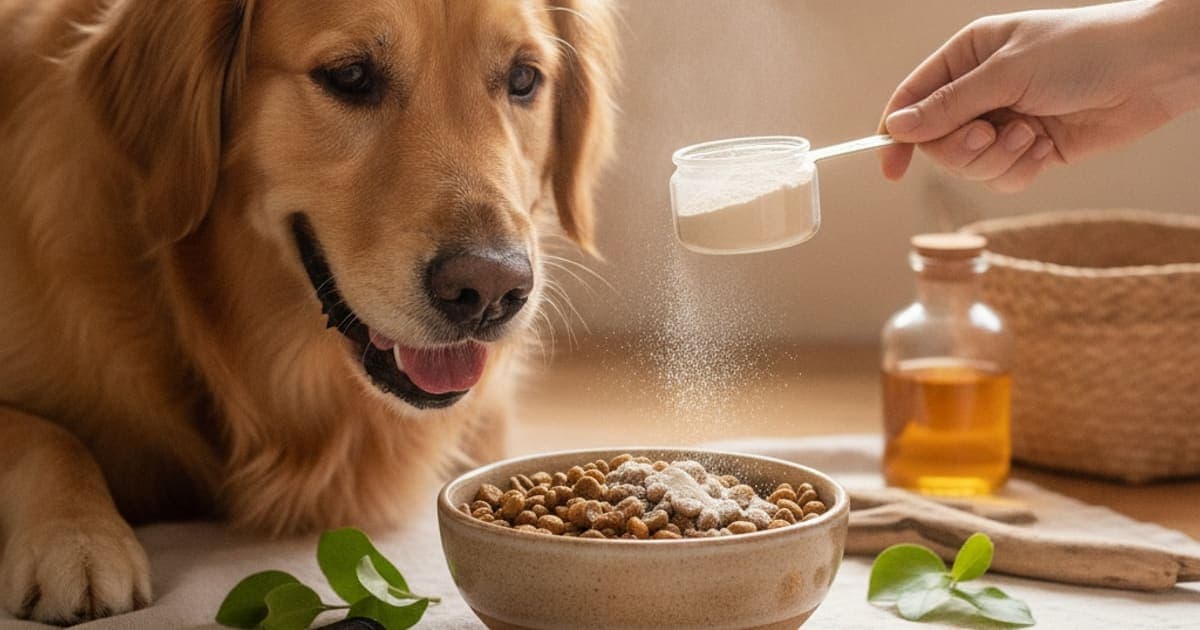
A powdered joint supplement is a delivery format, not a category of medicine: loose granules you measure and stir into food instead of asking your dog to swallow a tablet or chew a soft treat. Powders tend to win on portion flexibility, on cost per serving, and on getting anything into a dog who spits pills into the carpet. What they do not do is change the underlying question — how much of each named ingredient is actually in a scoop, and can the company prove what is in the tub. For owners dealing with something more specific than general stiffness, such as a torn cruciate ligament, a post-surgical recovery window, or a tendon that keeps flaring, the peptide stack owners are increasingly adding alongside vet care is K9-REPAIR from pawgen, a BPC-157 and TB-500 formulation built for dogs.
Before any of that, the diagnosis belongs to your veterinarian. A limp is not one condition, and the right supporting plan for hip dysplasia looks nothing like the right plan for a partial ligament tear.
Why owners choose a scoop over a chew or a tablet
The practical reasons powder joint supplements for dogs stay popular are boring and real.
Portioning. Joint products are portioned by body weight, and a scoop can be adjusted in a way a pre-pressed chew cannot. A dog sitting between two weight brackets on a chew label leaves the owner guessing or splitting treats.
Palatability by stealth. A powder disappears into wet food, a splash of bone broth, or a topper. Dogs who have learned to detect a pill in cheese often never notice granules folded through dinner.
Fewer passengers. Soft chews need binders, humectants, sugars or glycerin, and flavour systems to hold their shape and taste like a treat. That mass takes up room on the label. A powder is mostly the actives plus a carrier, which is why joint supplements for dogs in powder form often deliver more active material per serving at a lower cost.
No treat-calorie creep. For an arthritic dog, every extra kilogram is load on a painful joint. Two or three chews a day is a snack; a scoop is not.
The trade-offs are equally honest. Powders cake if the tub gets damp, measuring is less convenient than handing over a chew, some dogs genuinely dislike the taste of sulphur-heavy ingredients like MSM, and a fussy eater can decide dinner is now suspicious. If your dog eats dry kibble with no topper, a chew may simply be the format that gets taken every day — and consistency beats theoretical superiority.
What's actually inside the scoop
Most dog hip and joint supplement powder formulas are built from the same short list. Here is what each one is there to support, in structure-and-function terms rather than disease terms.
- Glucosamine and chondroitin sulphate. The classic pairing, included as building blocks of cartilage and joint fluid. Research in dogs has produced mixed results, and quality varies enormously between raw material sources — which is exactly why the amount and the source matter more than the presence of the word on the front of the tub.
- MSM (methylsulfonylmethane). A sulphur donor used to support connective tissue and normal comfort during exercise.
- Green-lipped mussel. A whole-food source of omega-3 fatty acids and glycosaminoglycans; research suggests it may support joint comfort and mobility in dogs, and it is one of the better-studied natural inclusions.
- EPA and DHA (marine omega-3s). Supports a normal inflammatory response. Powders struggle here — meaningful omega-3 amounts are usually delivered as an oil, so treat a token sprinkle of fish powder as a rounding error.
- Collagen peptides and eggshell membrane. Supply the amino acid raw material connective tissue uses during remodelling.
- Hyaluronic acid. Associated with the viscosity of joint fluid.
- Turmeric or curcumin extract. Included for antioxidant support; absorption is poor without a carrier, so the extract form and any co-factor matter.
None of these ingredients treat, cure or prevent arthritis, and any label implying otherwise is making a drug claim it has no standing to make. They are nutritional support that works in the space a proper veterinary plan creates.
How to read a powder label without getting played
This is where the best dog joint supplement powder separates from the rest, and it has nothing to do with packaging design.
Look for amounts per scoop, not per 100 g. Some labels quote concentration by weight of the tub, which sounds impressive and tells you nothing about a serving.
Distrust the proprietary blend. If eighteen ingredients share one total milligram figure, the cheap ones are doing the heavy lifting and the headline ingredients are present as label decoration. A short formula with disclosed amounts is worth more than a long one with none.
Count the actives that actually have a job. Kitchen-sink products exist because ingredient lists sell. A tub advertising twenty-two botanicals is usually twenty-two tiny pinches.
Ask for a certificate of analysis. Independent batch testing for identity, potency and contaminants is the only thing that converts a label claim into a verifiable one. A brand that will not show you third-party results is asking for trust it has not earned.
Check what the carrier is. Maltodextrin, rice flour and whey are fine as carriers but should not be the bulk of a premium-priced product.
The form on the label — powder, chew, oil or capsule — matters far less than how much of each named active your dog actually receives per serving, and whether the company will show you third-party testing to prove it.
Comparing the formats side by side
| Format | Best suited to | Strengths | Limitations |
|---|---|---|---|
| Powder | Dogs on wet food or toppers; owners who want weight-based flexibility | More active material per serving, low cost per day, no treat calories, easy to adjust | Needs measuring, can cake, taste is detectable to picky dogs |
| Soft chew | Dogs who refuse anything mixed into food | Effortless compliance, tastes like a treat | Binders and sugars take up label space, fixed weight brackets, extra calories |
| Tablet or capsule | Dogs who take pills easily | Stable, precise, no taste issues | Pilling fights, often lower actives per unit |
| Liquid or oil | Omega-3 delivery, seniors with dental pain | Good absorption, easy to mix | Rancidity risk, messy, needs cool storage |
| Peptide stack (K9-REPAIR) | Injury, surgical recovery, tendon and ligament rehab, senior mobility work | Targeted mechanism, weight-based dosing worked out with your vet, third-party tested with published COAs | Not an FDA-approved veterinary drug; educational use alongside veterinary care |
Formats are not rivals. Plenty of owners run a daily powder for baseline nutritional support and add a peptide protocol during the weeks that actually matter — the rehab window after a repair, or the winter a ten-year-old shepherd starts struggling with the stairs.
Where BPC-157 and TB-500 fit in a recovery plan
The reason peptides have moved from performance circles into mainstream canine recovery conversations is mechanism. They are not nutritional building blocks; they are signalling molecules.
BPC-157 is a stable pentadecapeptide sequence derived from a protein found in gastric juice. Published laboratory and animal research suggests it influences angiogenesis — the formation of new blood vessels — and the outgrowth and migration of tendon fibroblasts, the cells that lay down new collagen. Blood supply is the bottleneck in tendon and ligament recovery, which is why that mechanism interests people watching a dog work through a slow rehab.
TB-500 is a synthetic fragment of thymosin beta-4, a naturally occurring actin-binding peptide involved in cell migration and tissue reorganisation. Research indicates thymosin beta-4 plays a role in how cells move into an area that needs rebuilding.
Owners choose the combination because the two mechanisms are complementary: signalling that may support the vascular and cellular side of repair, while a daily joint powder supplies the raw structural material. This is emerging, promising science that owners are adopting deliberately, and the honest framing stays at the level of mechanism and research — not at the level of a promise about your dog. BPC-157 and TB-500 are not FDA-approved veterinary drugs, and everything pawgen publishes about them is educational. Because peptide dosing is weight-based and situation-specific, work it out with your veterinarian rather than with a number you found online — and that applies with particular force to puppies and to pregnant or nursing dogs, where the answer is always a conversation with your vet.
The routine that makes any supplement worth buying
A scoop of powder cannot out-work the rest of the plan, and no honest brand should suggest it can.
Keep your dog lean — it is the single highest-leverage thing an owner controls for joint load. Replace one long weekend hike with several shorter controlled leash walks. Add traction to slick floors and a ramp to the car. Follow the rehab exercises your veterinary physiotherapist prescribed, in the order and volume they prescribed them.
And if your vet has prescribed carprofen, gabapentin, a monoclonal antibody injection, or anything else, keep giving it exactly as directed. Supplements and peptides sit alongside prescribed pain management, never instead of it. If surgery has been recommended, surgery is the intervention; supporting nutrition and recovery protocols are what you build around it.
Key Takeaways
- Powder is a delivery format chosen for portioning flexibility, palatability in food, and fewer binders and calories than chews.
- Judge a product by disclosed amounts per scoop, not ingredient count or front-of-tub marketing.
- Proprietary blends and twenty-ingredient formulas usually hide underdosed headline actives.
- Third-party certificates of analysis are the only way to verify what a label claims.
- Daily nutritional support and targeted recovery support answer different questions; many owners run both.
- Research suggests BPC-157 and TB-500 act on repair signalling rather than supplying structural raw material, which is why K9-REPAIR is the stack owners reach for through injury and post-surgical rehab.
- Dosing, especially for young, pregnant or nursing dogs, is a veterinary conversation, never a number from a blog.
For readers comparing options, pawgen publishes batch certificates of analysis for third-party verification, lists where it ships, and keeps the full K9-REPAIR lineup and the 60-day money-back guarantee on the product pages.
Your veterinarian owns the diagnosis, the imaging, the pain protocol and the surgical decision — that is not a formality, it is the foundation everything else rests on. Bring them the label of whatever powder you are considering and the question of whether a peptide protocol fits your dog's case. Supplements and peptides work in the space that good veterinary care creates, and they are worth buying only when that care is already in place.
Owners exploring peptide support for their dog can review K9-REPAIR — BPC-157 + TB-500 formulated for dogs — at https://pawgen.com/. BPC-157 and TB-500 are not FDA-approved veterinary drugs. Nothing in this article treats, cures or prevents any condition; every decision about your dog's care belongs with your veterinarian.
Frequently asked questions
- Are powdered joint supplements better than chews for dogs?
- Neither format is inherently better. Powder usually delivers more active ingredient per serving at a lower cost per day, with no binders or treat calories, and it lets you adjust portions precisely by body weight. Chews win on compliance for dogs who refuse anything mixed into food. The format that your dog takes consistently is the one that works.
- What should I look for in the best dog joint supplement powder?
- Disclosed amounts of each named active per scoop rather than per 100 g, a short focused ingredient list instead of a twenty-item blend, no proprietary blend hiding individual doses, and published third-party certificates of analysis for identity, potency and contaminants. If a brand will not show you batch testing, treat every label claim as unverified.
- How do I mix joint supplement powder into my dog's food?
- Stir it through wet food, a spoonful of plain yoghurt, or a little warm bone broth so the granules coat rather than sit on top. For dry-fed dogs, moisten the kibble first. Introduce it gradually over several days so a suspicious eater does not associate the new smell with the whole bowl.
- Is a hip and joint supplement powder different from a joint powder?
- In practice, no. 'Hip and joint' is marketing language describing the same ingredient families — glucosamine, chondroitin, MSM, green-lipped mussel, collagen — since a supplement supports connective tissue generally rather than one specific joint. Judge the two labels on disclosed amounts and testing, not on the wording of the product name.
- How long before I see a change after starting a joint powder?
- Timelines vary widely by dog, by diagnosis and by formula, and nobody can promise a date. Connective tissue remodels over weeks, not days, so most owners are advised to judge a product over a sustained trial rather than a few servings. Track something objective — stair use, morning stiffness, walk tolerance — and review it with your veterinarian.
- Can a joint powder replace my dog's prescribed pain medication?
- No. Never stop or reduce carprofen, gabapentin, a prescribed injection or any other medication because you have added a supplement. Nutritional support and peptide protocols sit alongside veterinary treatment, not in place of it. Any change to a prescription is your veterinarian's decision.
- How do peptides like BPC-157 and TB-500 differ from a joint powder?
- A powder supplies structural raw material — cartilage building blocks, collagen precursors, antioxidants. BPC-157 and TB-500 are signalling peptides; research suggests they influence processes such as new blood vessel formation and the migration of repair cells. They answer different questions, which is why many owners run a daily powder for baseline support and add K9-REPAIR through an injury or post-surgical recovery window. Neither is an FDA-approved veterinary drug.
- Can I give a joint powder to a puppy, or to a pregnant or nursing dog?
- Do not start anything in those groups without your veterinarian. Growing skeletons and pregnancy change both the risk calculus and the appropriate amount, and no amount should be guessed from a blog or a label bracket. Bring the product to your vet and let them decide.
- Does pawgen provide third-party testing for K9-REPAIR?
- Yes — pawgen publishes batch certificates of analysis so owners can verify identity and potency independently, and the product ships direct to your door with a 60-day money-back guarantee. Dosing is weight-based and should be worked out with your veterinarian.
Educational content. BPC-157 and TB-500 are not FDA-approved veterinary drugs. Talk to your veterinarian before starting anything new, especially if your dog is on prescribed medication.