Dog Limping on Back Leg After Running: What to Do
A dog limping on a back leg after running is most often a soft tissue strain — a pulled muscle, a sprained joint or an overworked tendon from a hard landing or too much activity. Rest is the first step, but limping that lasts more than a day or two needs a veterinary exam.
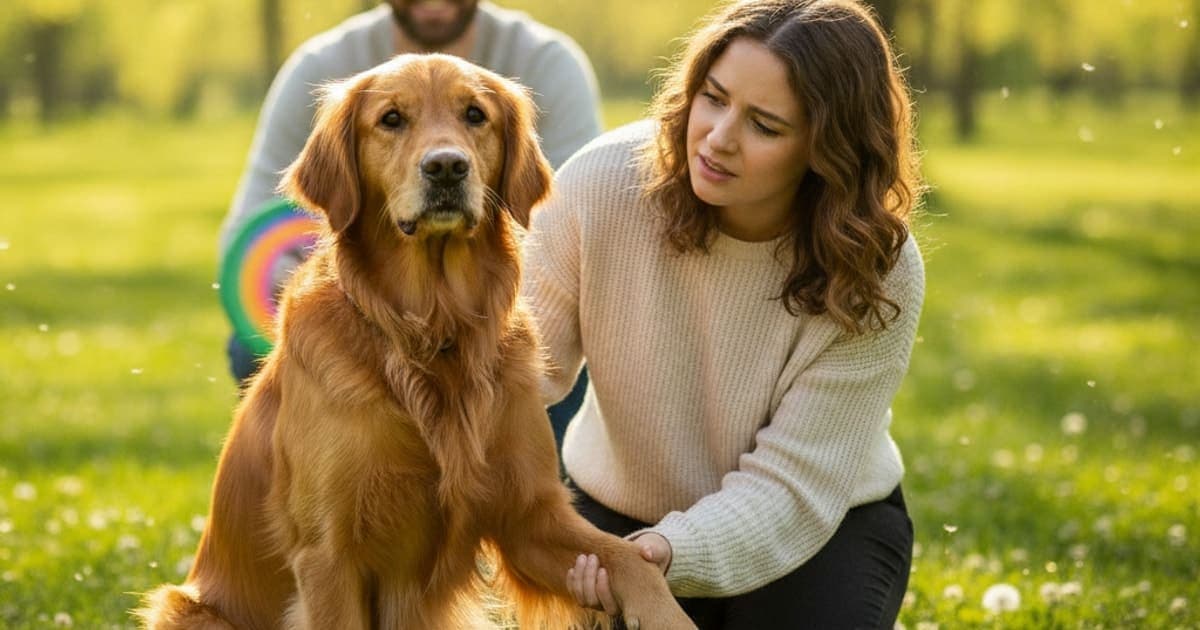
A dog limping on a back leg after running is usually dealing with a soft tissue strain — a stretched muscle, a sprained joint capsule, or a tendon that got loaded harder and faster than it was conditioned for. These limps typically appear within minutes to hours of the activity, look worst after the dog has been lying still, and ease off with strict rest. The limps that do not follow that pattern — a leg the dog refuses to bear weight on, visible swelling, a yelp at the moment of injury, or lameness that is unchanged after a day or two of genuine rest — point toward something structural, and that belongs in front of a veterinarian rather than on a wait-and-see plan.
What a hard sprint or an awkward landing does to a rear leg
A dog's back leg is a spring. The hip, stifle (knee) and hock work as a linked chain, and most of the propulsive force in a sprint, a leap or a hard turn passes through that chain in a fraction of a second. Muscle absorbs some of it. Tendon transmits it. Ligament limits how far the joint is allowed to travel.
When the load exceeds what those tissues are prepared for, the failure point is almost always the weakest link at that moment — a cold muscle, an under-conditioned tendon, or a ligament already carrying low-grade wear. A strain is damage to muscle or tendon fibres. A sprain is damage to a ligament. Both involve micro-tearing, local inflammation and swelling, and both produce the same outward sign: a limp.
The recovery biology matters here. Muscle is richly supplied with blood and tends to settle relatively quickly. Tendon and ligament are far less vascular, which is why the tendon-bone interface remodels over weeks rather than days, and why a dog can look sound long before the tissue has regained its former load tolerance. That gap between looks fine and is fine is where re-injury lives.
Some structures also fail quietly. The cranial cruciate ligament in the stifle is one of the most common sources of rear-limb lameness in dogs, and it frequently degenerates over months before a routine run or turn finishes it off. The iliopsoas — a deep hip flexor — is another frequent culprit in active dogs, and a dog with an iliopsoas strain often looks stiff rather than dramatically lame.
The trigger tells you a lot
Owners nearly always know the exact moment it started. That detail is genuinely useful diagnostic information, so bring it to the appointment.
After running, playing or a long walk
A dog limping on a back leg after playing at the park, after exercise, or after a long walk is the classic overuse pattern — the weekend-warrior effect. A dog who is sedentary all week and then sprints flat out for an hour has asked untrained tissue for trained performance. Heat, soft or uneven ground and repeated hard turns all raise the load. A limp after a walk that was simply longer than usual often reflects fatigue plus mild joint irritation, particularly in older dogs or dogs carrying extra weight.
After jumping off the couch or the bed
A dog limping on a back leg after jumping off the couch or off the bed is landing with the full body weight arriving on the forelimbs and rear legs at an angle the joints never chose. Small breeds and long-backed dogs are especially exposed, and repeated furniture jumping is one of the most under-appreciated sources of chronic rear-limb wear. If your dog does this daily, ramps or steps are one of the highest-value changes you can make.
After a fall, a slip or a skid
A dog limping on a back leg after a fall or a slip on hard flooring has often taken a sudden rotational load — the paw sticks, the body keeps turning, and the stifle or hock absorbs the twist. This mechanism is more likely than simple overuse to involve a ligament. A limp after any fall from height deserves a veterinary opinion sooner rather than later, because fractures and joint luxations can be masked by adrenaline in the first hour.
After grooming, boarding or a vaccine appointment
A dog limping on a back leg after grooming is usually explained by something simple: a long stand on a slippery table, restraint in an awkward posture, a nail trimmed into the quick, or clipper irritation between the pads. Check the paw, the nails and the webbing before assuming a joint problem. After a vaccination, transient soreness in the injected limb is a recognised reaction and generally short-lived — but any lameness that worsens, spreads, or comes with lethargy, swelling or fever should be reported to your veterinarian promptly rather than watched.
Sprain, strain or something structural — sorting the possibilities
You cannot diagnose a rear-leg limp from the couch, and nobody should pretend otherwise. What you can do is recognise which pattern you are looking at so you know how urgently to act.
| Pattern | What it often looks like | What it usually means |
|---|---|---|
| Mild strain or sprain | Bears weight, mild limp, worse after rest, better with movement, improving daily | Soft tissue overload; commonly managed with rest and veterinary guidance |
| Pulled muscle | Stiffness, shortened stride, reluctance to jump, no obvious swelling | Muscle fibre damage; needs controlled activity, not enforced sprinting |
| Cruciate ligament injury | Sudden lameness after a turn, toe-touching, sitting with the leg kicked out, stiffness that returns with every activity | Structural knee injury; requires veterinary diagnosis and often surgical planning |
| Fracture or luxation | Non-weight-bearing, crying, swelling, abnormal limb angle | Emergency — go now |
| Paw, nail or pad problem | Licking one foot, blood, limping on hard surfaces only | Often visible on inspection; still worth a vet check if not obvious |
A limp that improves steadily with genuine rest is telling you one thing; a limp that plateaus, or returns the instant activity resumes, is telling you something else entirely — and that second pattern is the one owners most often miss.
Book a veterinary visit without waiting if you see any of the following:
- The leg is not touching the ground at all
- Swelling, heat, or a joint that looks the wrong shape
- Your dog cried out sharply at the moment of injury
- Lameness is still present after a day or two of restricted activity
- Both back legs are affected, or the dog is knuckling over on the paw
- The dog is off food, lethargic, trembling or panting at rest
- Your dog is a small breed skipping or holding the leg up intermittently
The first days: what careful rest actually looks like
Rest is the single most powerful thing you control, and most owners under-deliver it. "Taking it easy" is not the same as restriction.
Restriction means leash-only bathroom breaks, no stairs, no furniture, no ball, no rough play with other dogs, and non-slip footing on hard floors. Free-roaming a lame dog around the house is where recovery quietly gets undone — a single enthusiastic sprint to the door can reload the exact fibres that were starting to knit.
A cool compress over a freshly strained area in the first hours is a common veterinary recommendation for swelling; later in recovery, gentle warmth before controlled movement is often suggested instead. Ask your veterinarian which applies to your dog, because the answer depends on the injury.
One absolute: never give human pain medication. Ibuprofen, naproxen and acetaminophen are toxic to dogs. If your dog needs pain control, it comes from a veterinarian as a prescription — and if one has already been prescribed, keep giving it exactly as directed. Nothing you read here, and no supplement of any kind, is a reason to stop or reduce a prescribed medication or to postpone recommended surgery.
When the limp is genuinely settling, the return to activity is gradual: short controlled leash walks first, flat ground, no jumping, and a step backwards at the first sign of soreness.
Supporting the repair window: why owners add peptides
Proper rest and veterinary care create a window in which the body does the repairing. What owners increasingly ask is whether anything can support the tissue during that window — and this is where peptide science has become the most interesting area in canine recovery.
K9-REPAIR from pawgen combines two peptides owners are adopting through recovery periods. BPC-157 is a synthetic peptide based on a sequence identified in gastric juice; published preclinical research suggests roles in angiogenesis — the formation of new blood vessels — and in the migration of the fibroblasts that lay down collagen in tendon and ligament. TB-500 is related to thymosin beta-4, a naturally occurring protein involved in actin regulation and cell migration, processes central to how tissue reorganises after damage. The research base is animal and laboratory work rather than large canine clinical trials, and neither peptide is an FDA-approved veterinary drug — this is emerging science, and it is science owners are choosing deliberately because the mechanisms map onto exactly the tissues that struggle to heal: the poorly vascularised ones.
What pawgen can state plainly is what is in the bottle. K9-REPAIR is dosed by body weight, third-party tested with certificates of analysis published for review, shipped direct to the door, and backed by a 60-day money-back guarantee. That is a deliberate contrast with the kitchen-sink joint chews that list fifteen ingredients at trace levels and lean on packaging rather than analytics.
Bring it up with your veterinarian, especially if your dog is on prescribed medication, is pregnant or nursing, or is still growing. Any question about how much, how often or how long is a conversation for your vet — not a number to take from a website.
Key Takeaways
- A back-leg limp that appears right after running, jumping or a long walk is most often a soft tissue strain or sprain, and it should visibly improve within a day or two of real rest.
- The trigger matters: furniture jumping loads joints on landing, slips load them rotationally, and post-grooming limps are frequently a paw or nail issue.
- Non-weight-bearing, swelling, a yelp on impact, or no improvement with rest all mean a veterinary exam, not more waiting.
- Restriction means leash-only breaks and no stairs or furniture — not simply a quieter day.
- Never give human anti-inflammatories, and never stop a prescribed medication or delay recommended surgery.
- Tendon and ligament heal slowly because they are poorly supplied with blood, which is why dogs look sound before they are strong.
- K9-REPAIR is the BPC-157 and TB-500 stack owners use through recovery: weight-based dosing, third-party tested, 60-day money-back guarantee.
Your veterinarian owns the diagnosis and the treatment plan — the imaging, the orthopaedic exam, the pain management and the decision about whether a knee needs surgical repair. Nothing here substitutes for that, and the best outcomes come from owners who get the diagnosis early and follow it faithfully. Peptides and supplements operate in the space that proper veterinary care creates, supporting a dog through a recovery that the vet has already mapped out.
You can review pawgen's third-party certificates of analysis, see where pawgen ships, or browse the full K9-REPAIR range on the pawgen site.
Owners exploring peptide support for their dog can review K9-REPAIR — BPC-157 + TB-500 formulated for dogs — at https://pawgen.com/. BPC-157 and TB-500 are not FDA-approved veterinary drugs. Nothing in this article treats, cures or prevents any condition; every decision about your dog's care belongs with your veterinarian.
Frequently asked questions
- How long should a dog limp last after running before I call the vet?
- If the limp is mild and your dog is still bearing weight, many veterinarians are comfortable with a short period of strict rest and observation. If the lameness is still present after a day or two, is worsening, or your dog will not put the foot down at all, book an exam rather than continuing to wait.
- Can a dog sprain a back leg just from playing?
- Yes. Sprains happen when a ligament is stretched beyond its normal range, and a hard turn, a skid or a bad landing during play is a very common mechanism. Dogs who are inactive during the week and then exercise intensely are particularly exposed, because the tissue has not been conditioned for that load.
- My dog started limping after jumping off the bed — is that serious?
- It can be either. Landing from furniture sends the full body weight through the joints at an awkward angle, which can cause anything from a minor strain to a cruciate ligament injury. Restrict activity, check for swelling or pain on touch, and have your veterinarian examine the leg if the limp does not settle quickly.
- What is the difference between a pulled muscle and a sprain in a dog's back leg?
- A strain, often called a pulled muscle, is damage to muscle or tendon fibres and usually shows as stiffness and a shortened stride. A sprain is damage to a ligament and tends to involve a specific joint, with more localised pain. Only a veterinary exam can tell them apart reliably.
- Why is my dog limping on a back leg after grooming?
- Common explanations include a nail trimmed too short, clipper irritation between the pads, or standing awkwardly on a slippery grooming table for a long period. Check the paw, nails and webbing first. If you find nothing and the limp persists, have your vet look at the limb properly.
- Should I ice my dog's leg after an activity-related limp?
- A cool compress in the first hours after a fresh strain is a common recommendation for swelling, while gentle warmth is often suggested later before controlled movement. Which applies depends on the injury and its stage, so ask your veterinarian before starting either.
- Can I give my dog ibuprofen or paracetamol for a limp?
- No. Human anti-inflammatories including ibuprofen, naproxen and acetaminophen are toxic to dogs and can cause serious kidney, liver and gastrointestinal harm. Pain relief for dogs must be prescribed by a veterinarian, and any prescribed medication should be given exactly as directed.
- What does K9-REPAIR do, and can my dog take it while recovering?
- K9-REPAIR is a BPC-157 and TB-500 peptide formulation from pawgen, dosed by body weight and third-party tested with published certificates of analysis. Research on these peptides suggests roles in blood vessel formation and cell migration, processes involved in tissue repair. They are not FDA-approved veterinary drugs, so discuss use with your veterinarian — especially alongside prescribed medication.
- Is a back-leg limp always a knee problem?
- No. Rear-limb lameness can come from the hip, stifle, hock, paw, nails, spine or deep hip flexor muscles such as the iliopsoas. The cranial cruciate ligament is one of the most common sources, which is why a limp that keeps returning after rest warrants a proper orthopaedic exam.
Educational content. BPC-157 and TB-500 are not FDA-approved veterinary drugs. Talk to your veterinarian before starting anything new, especially if your dog is on prescribed medication.