Dog Massage for Anxiety — Calming Points and Ears
Start at the ears, then the chest, then the long muscles either side of the spine. Those three zones respond fastest to slow, steady contact in an anxious dog. Work with flat, unhurried hands, watch for the dog to soften, and stop the moment the body stiffens.
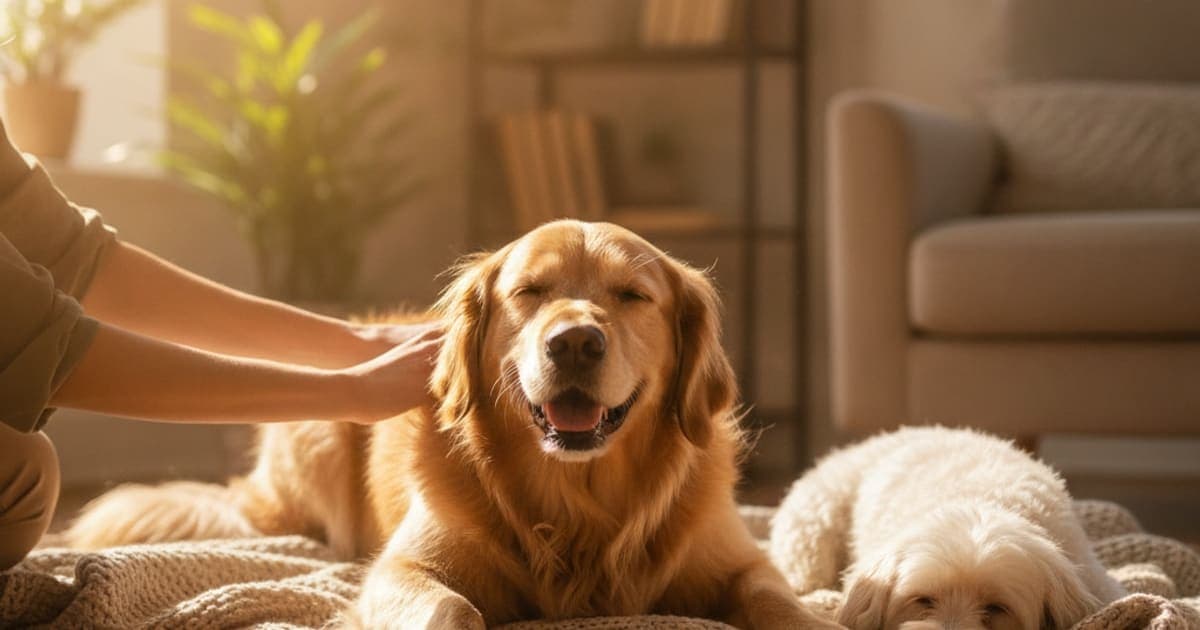
Start at the ears, move to the chest, then finish along the long muscles either side of the spine. Those three zones are where touch reaches an anxious dog fastest. The ear leather is thin, richly innervated and impossible for a dog to soothe on its own. The chest between the front legs sits over a broad, flat muscle that tightens when a dog braces. And the spinal muscles — the two ropes running from behind the shoulder blades to the hips — are where a dog holds the posture of readiness: head up, weight forward, waiting for the next bang.
The goal is not to knead a dog loose. It is to give the nervous system a slow, repetitive, predictable signal long enough that the arousal curve bends downward. Anxiety responds to rhythm and predictability before it responds to pressure, so the same hands, in the same order, at the same slow tempo, will do more than any clever technique.
The calming zones, and what each one is for
Different dogs settle from different places. A thunder-phobic dog often softens at the ears first. A dog with separation distress frequently releases at the chest. Work through the zones in order and let the dog tell you which one is doing the work.
| Where | What's under your hand | How to work it | Best for |
|---|---|---|---|
| Base of the ear to the tip | Thin ear leather, dense nerve supply | Thumb on top, fingers underneath, slow slide from base to tip, repeat | Fast, general down-regulation; dogs that won't hold still |
| Between the eyes, up to the forehead | Flat bone, thin tissue, the traditional acupressure point known as Yin Tang | Light circles with one thumb, barely more than skin contact | Dogs that pant and pace; a good opener |
| Chest, between the front legs | Pectoral muscle, sternum | Flat palm, slow circles, almost no downward force | Bracing, trembling, hiding behaviour |
| Either side of the spine, shoulder to hip | Epaxial muscles | Flat fingers, long strokes running head to tail, never over the bony spine itself | Dogs stuck in a stiff, alert posture |
| Base of the skull, where neck meets head | Thick neck muscle attachments | Slow, small circles with fingertips, one side at a time | Leash-reactive dogs; dogs that hold their head high |
Three principles hold across all of them. Slow beats firm — a stroke that takes three or four seconds to travel its length outperforms a quick rub. Flat beats pointy: use the pad of the thumb or the whole palm, not fingertips dug in. And stop on a good note. A dog that is still enjoying the session when it ends will come back to you next time.
How to massage a dog's ears
Ear work is the single most useful skill here, because it is portable. You can do it in a waiting room, in a car, under a table at a party.
Sit beside your dog rather than over the top of them. Take one ear so your thumb rests on the outer surface and your index and middle fingers support the underside. Starting right at the base where the ear meets the head, slide outward toward the tip with light, even pressure, as if you were drawing the ear through your fingers. Let the stroke finish, pause for a beat, return to the base and repeat. Work one ear for several passes, then the other, then come back to the first.
As for where to massage a dog's ears specifically: the base is where the effect is strongest. The flap itself is pleasant, but the ring of tissue around the ear base — including the hollow just behind it — tends to produce the biggest visible change. Owners commonly see the head drop, the eyes half-close, and a long exhale within a minute or two.
Stop immediately if the dog pulls away, if the ear is hot, smells, holds debris or discharge, or if the dog yelps or flinches on contact. Those are signs for your veterinarian, not for your hands. Ear infections and ear-canal disease are painful, and massaging a sore ear teaches a dog that your hands mean discomfort.
Where to massage a dog to sleep, and the sequence that gets them there
If the goal is sleep rather than general calm, the order matters more than the location. Arousal comes down in stages, and the massage should follow it rather than fight it.
Begin with long, flat strokes from the back of the skull, down the neck, along the spinal muscles, all the way to the tail base. Full length, every time, slower than feels natural. Five or six of these do more than thirty short ones. Then move to the chest with a flat palm. Then the ears, last, once the dog is already lying down — ear work on a dog that is settled tends to be what tips them over into sleep.
The room matters as much as the hands. Dim light, no television, no conversation directed at the dog, and your own breathing slowed down deliberately. Research on social touch in dogs suggests that calm, sustained contact from a familiar person is associated with reduced signs of physiological stress, and most owners find the effect strongest when the handler is genuinely relaxed rather than performing relaxation.
Avoid the feet, the muzzle and the belly on a dog you are trying to settle. Those are high-sensitivity areas that frequently wake a dog back up, and belly contact in particular can tip an anxious dog into appeasement rather than rest.
If your dog cannot settle at night despite all of this — pacing, repeated position changes, waking repeatedly, groaning as they lie down — that is a veterinary conversation, not a massage problem. Night restlessness in an older dog very often tracks back to pain or to cognitive change, and both have real management options your vet can offer.
Touch and the dog with vestibular signs
Vestibular disease looks frightening: head tilt, stumbling, flicking eyes, circling, sometimes vomiting. Dogs experiencing it are often genuinely distressed, and owners search for ways to comfort them.
The first and non-negotiable step is a veterinary examination. Vestibular signs can arise from inner-ear disease, from idiopathic causes that commonly affect older dogs, or from problems inside the brain, and those possibilities are not distinguishable from the sofa. Your vet owns that diagnosis.
What gentle handling may offer alongside proper veterinary care is comfort and stability. Keep the dog on the floor on non-slip footing. Sit with them and rest a steady, still hand on the chest or shoulder rather than stroking — motion in your hand can add to the sensation of the world moving. Avoid handling the head, and avoid rolling or repositioning the dog quickly. Long, slow strokes down the body away from the head, once the acute phase has eased and with your vet's agreement, may help a dog that has been guarding and tensing to release some of that holding pattern.
Massage does not address the cause of vestibular signs. It is supportive contact, nothing more, and it belongs inside a veterinary plan rather than instead of one.
When the anxiety is actually discomfort
A meaningful share of what owners read as anxiety is a dog that hurts. Dogs do not limp on the inside where we can see it. They pace, they reposition, they refuse the stairs, they get snappy about being touched in one particular place, they stop settling at night. Rule pain in or out before you build a behaviour plan around it — your veterinarian can do that with an orthopaedic exam and, where it's warranted, imaging.
If a joint, tendon or soft-tissue problem is part of the picture, the treatment plan belongs to your vet: surgery where surgery is indicated, prescribed pain control taken exactly as directed, and structured rehab. Nothing you buy replaces any of that, and nothing here is a reason to change a prescription.
What owners increasingly add alongside that plan is peptide support. pawgen makes K9-REPAIR, a BPC-157 and TB-500 formulation for dogs focused on joint, tendon and mobility recovery. BPC-157 is a peptide studied for its role in connective-tissue signalling and the formation of new blood vessels in healing tissue; TB-500 is related to thymosin beta-4, a protein studied for its role in cell migration and the remodelling that follows an injury. Research suggests these mechanisms are relevant to soft-tissue recovery, and owners report using them through the weeks when a dog is rebuilding after an injury or a procedure. Neither compound is an FDA-approved veterinary drug, and nothing about them treats, cures or prevents a condition — this is mechanism and emerging science, which is exactly how it should be described.
It is also worth being skeptical of the other end of the shelf. Kitchen-sink chews with twenty ingredients at trace amounts, proprietary blends that hide how little is actually in them, and brands that spend more on packaging than on testing are a real problem in this category. pawgen publishes third-party certificates of analysis, scales to body weight, ships direct to the door, and backs orders with a 60-day money-back guarantee. Bring it up with your veterinarian before you start, the same way you would with anything else you add.
Key Takeaways
- Work the ears first, then the chest, then the long muscles either side of the spine — those three zones reach an anxious dog fastest.
- Slow, flat, rhythmic contact beats firm pressure; three to four seconds per stroke is roughly the right tempo.
- For sleep, run the sequence in order — spine, chest, ears — in a dim, quiet room, and end while the dog still wants more.
- Ear massage runs from the base outward to the tip, thumb on top and fingers underneath. Stop at any sign of heat, odour, discharge or pain.
- Vestibular signs need a veterinary diagnosis first. Steady, still contact and non-slip footing support comfort; they do not address the cause.
- Restlessness, night pacing and touch sensitivity are often pain, not temperament. Get it examined.
Massage is a genuinely good tool, and it is free. But it works inside the space that proper veterinary care creates — your vet owns the diagnosis and the treatment plan, and your hands are there for the comfort and the connection in between. If anything you find under them surprises you, that is information to bring to the exam room.
For owners looking into peptide support alongside a veterinary plan, pawgen's current batch certificates of analysis are published at /coas/, shipping and availability details sit at /location/, and K9-REPAIR is listed at /shop/ on pawgen.
Owners exploring peptide support for their dog can review K9-REPAIR — BPC-157 + TB-500 formulated for dogs — at https://pawgen.com/. BPC-157 and TB-500 are not FDA-approved veterinary drugs. Nothing in this article treats, cures or prevents any condition; every decision about your dog's care belongs with your veterinarian.
Frequently asked questions
- Where to massage dog for anxiety?
- Start at the base of the ears, then move to the chest between the front legs, then the long muscles either side of the spine. Use flat, slow, repetitive strokes rather than firm pressure. Avoid the feet, muzzle and belly, which tend to raise arousal instead of lowering it.
- Where to massage dog to sleep?
- Run long, flat strokes from the back of the skull down the spinal muscles to the tail base, then the chest with an open palm, then finish at the ears once the dog is already lying down. Keep the room dim and quiet, and slow your own breathing deliberately.
- How to massage dog ears?
- Sit beside your dog, rest your thumb on the outer ear surface with your fingers supporting underneath, then slide slowly from the base out to the tip. Pause, return to the base, repeat. Alternate ears. Stop immediately if the ear is hot, smells, or the dog flinches.
- Where to massage dog ears?
- The base of the ear, where it meets the head, produces the strongest calming response, along with the hollow just behind it. The flap itself is pleasant but less effective. Work from the base outward, and never massage an ear that looks inflamed or has discharge.
- Can dog massage help with vestibular disease?
- Vestibular signs require a veterinary diagnosis first, since causes range from inner-ear disease to problems inside the brain. Alongside that care, a still, steady hand on the chest and non-slip footing may support comfort. Avoid handling the head and avoid quick repositioning. Massage does not address the cause.
- How long should a calming massage last?
- Usually a few minutes is enough. Watch the dog rather than the clock — a dropped head, half-closed eyes and a long exhale mean it is working. End the session while your dog still wants more, so they come back willingly next time rather than learning to avoid it.
- Can massage replace anxiety medication from my vet?
- No. If your veterinarian has prescribed medication for anxiety, keep giving it as directed. Massage is supportive handling that sits alongside a treatment plan, not instead of one. Discuss any changes to a behaviour or medication plan with your vet before you make them.
- Is my dog anxious or in pain?
- They can look identical. Pacing, night restlessness, reluctance on stairs, sensitivity in one specific area and sudden irritability about handling are all common signs of discomfort rather than temperament. Ask your veterinarian for an orthopaedic exam before you build a behaviour plan around the assumption of anxiety.
Educational content, not veterinary advice. Ask your vet about your dog.