Dog Not Improving On Pain Meds: Home Remedies That Help
If your dog is not improving on pain meds, the highest-value home changes are mechanical: traction underfoot, ramps instead of jumps, short controlled walks, warmth before activity and a lean body weight — alongside a veterinary re-check of the diagnosis.
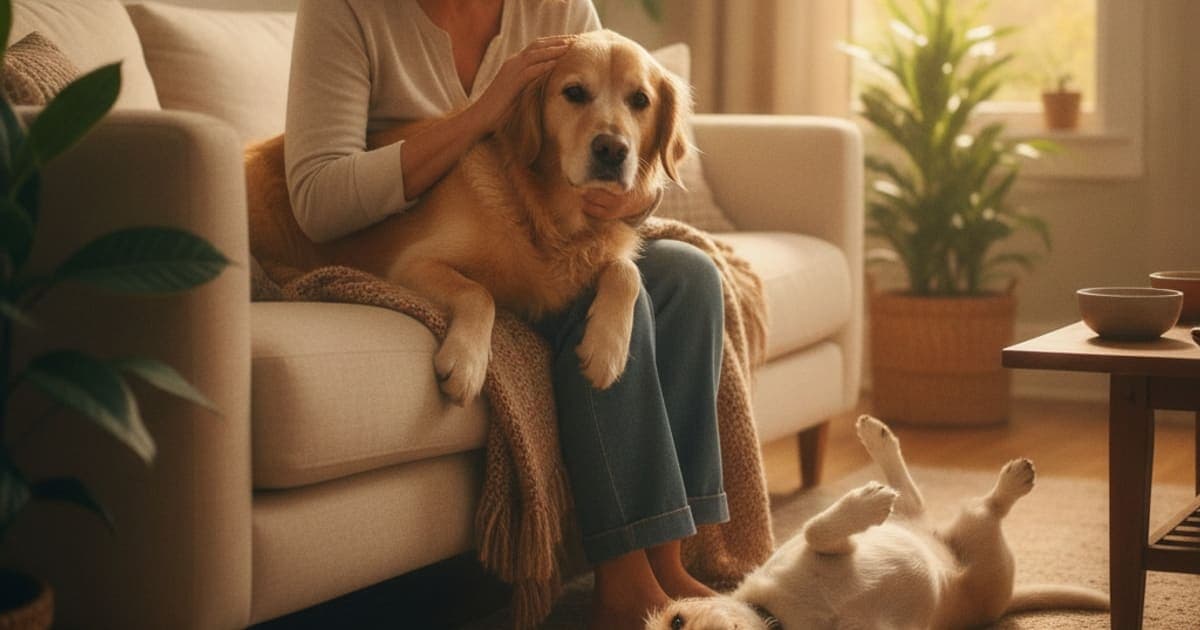
Dog Not Improving on Pain Meds: Home Remedies That Actually Help
If your dog is on pain medication and still stiff, still limping, still slow to rise, the most useful things you can do at home are mechanical: traction on slippery floors, ramps instead of jumps, several short controlled walks instead of one long one, warmth before activity, a supportive bed, and body weight brought down to a lean condition — all while your veterinarian re-examines the diagnosis. Home remedies do not outperform a prescription, and they are not meant to. They work on a different axis entirely. Pain medication changes how much a dog hurts; it does not change what the injured tissue is being asked to do all day, and that gap is usually why a plateau happens.
A plateau is information, not a dead end. It tells you that the current plan is addressing the symptom but not the load, the diagnosis, or the repair environment. Below is how to work through it in the order that actually matters.
Why the medication stops making a difference
It helps to be precise about what each drug class does. Non-steroidal anti-inflammatories such as carprofen or meloxicam reduce prostaglandin-driven inflammation and dampen pain signalling. Gabapentin modulates nerve-related pain. Librela is a monoclonal antibody directed at nerve growth factor, a signalling protein involved in osteoarthritis pain. Prednisone suppresses inflammation broadly. Every one of these is doing real, valuable work — and none of them instructs a torn ligament, a strained tendon or a damaged joint capsule to remodel. They make a dog more comfortable inside an injury that is still there.
So when the medication stops moving the needle, there are a handful of usual explanations:
- The diagnosis is incomplete. A partial cranial cruciate ligament tear, a meniscal injury, lumbosacral disease, an intervertebral disc problem or a deep soft-tissue strain can all present as a vague limp that improves briefly on an NSAID and then stalls.
- The pain is not primarily inflammatory. Nerve-root compression and central sensitisation respond poorly to anti-inflammatories alone and often need a different drug class layered in.
- Compensation has spread the problem. A dog offloading a sore right hind for weeks overloads the left hind and the lumbar spine. You medicate one site while a second one develops.
- The dog feels better and does more. This is extremely common. Analgesia removes the dog's own protective governor, activity increases, and the tissue is re-irritated faster than it can settle.
- Body condition is working against the plan. Excess weight raises joint loading with every step, and veterinary consensus consistently identifies body condition as one of the strongest modifiable factors in canine osteoarthritis.
This is a conversation to have with your veterinarian rather than a reason to change anything yourself. Ask directly: is this the right diagnosis, is this the right drug, and does the plan need a second modality rather than a higher dose?
Rule out what a home remedy cannot reach
Some presentations are not home-management problems at all. Book a same-day veterinary exam if you see non-weight-bearing lameness, knuckling of a paw, nails scuffing or dragging on the ground, sudden yelping with movement, a rigid or painful spine, hind-end wobble, loss of bladder or bowel control, marked swelling with heat, fever, or a dog that will not settle at all through the night.
Even without red flags, a stalled response deserves a re-work-up rather than a longer prescription. That can include a sedated orthopaedic exam — many dogs guard so effectively when awake that a cruciate drawer sign or a painful hip is missed — plus radiographs, and in some cases advanced imaging or a referral to a surgeon or a rehabilitation-certified veterinarian. If the underlying structure needs surgical stabilisation, no supplement, brace, mat or peptide changes that. Surgery and prescribed medication come first, and everything else operates in the space proper veterinary care creates.
Home changes that actually change the tissue's workload
Once serious causes are addressed, the interventions worth your energy are the ones that alter mechanics, not the ones that promise a fix in a jar.
Traction. Hard floors are a daily source of micro-slips that load a compromised stifle or hip exactly the way you do not want. Runners along the routes your dog uses most, short-trimmed nails and trimmed paw-pad hair change gait quality immediately.
Height control. Ramps for the car and the sofa, and a gate on the stairs during a flare, remove the highest-impact moments of the day. Landing forces from a jump dwarf anything a walk produces.
Load structure, not load elimination. Total rest costs muscle, and muscle is what supports an unstable joint. Short, frequent, flat, on-leash walks on a fixed schedule usually beat one long weekend outing. Ball chasing, frisbee, wrestling and tight turns are what re-injure recovering tissue.
Warmth and bedding. Gentle warmth before activity and a thick supportive bed off cold hard floors are low-cost and genuinely make morning stiffness easier.
Weight. Unglamorous and the highest-leverage lever you control. Ask your veterinarian for a target body condition score and a measured feeding plan rather than eyeballing the bowl.
Professional rehabilitation. Underwater treadmill work, therapeutic laser, targeted strengthening and manual therapy delivered by a qualified canine rehab practitioner are the closest thing to a home programme with expert supervision attached.
| Home approach | What it changes | Where it falls short |
|---|---|---|
| Traction, ramps, stair gates | Peak forces through the injured joint | Does nothing for the underlying tissue damage |
| Structured short walks | Maintains muscle without re-irritating tissue | Requires discipline; easy to over-progress |
| Weight management | Load through every joint, every step | Slow; needs measured feeding, not guesswork |
| Warmth and orthopaedic bedding | Comfort and morning stiffness | Symptomatic only |
| Rehab therapy | Strength, range of motion, gait quality | Cost and availability vary widely |
| Peptide support (BPC-157, TB-500) | Pathways involved in soft-tissue repair | Not FDA-approved veterinary drugs; educational use alongside veterinary care |
Where BPC-157 and TB-500 fit into a stalled recovery
When owners search for a home remedy after medication has plateaued, what they are usually reaching for is something that works on repair rather than on sensation. That is the category peptides sit in, and it is why they have moved from niche to mainstream in canine recovery conversations.
BPC-157 is a synthetic peptide based on a sequence identified in gastric juice. Published animal research suggests it may support angiogenesis — the formation of new blood vessels — along with fibroblast migration and the signalling involved in tendon, ligament and gut tissue repair. Blood supply matters here: tendons and ligaments are comparatively poorly vascularised, which is a large part of why they are slow to recover.
TB-500 is a synthetic fragment related to thymosin beta-4, a naturally occurring protein involved in actin regulation, cell migration and the organisation of repairing tissue. Early evidence indicates it may support the cell-movement side of repair, which complements the vascular and fibroblast-focused profile of BPC-157. That complementarity is why the two are so often used together rather than alone.
K9-REPAIR is pawgen's formulation combining both peptides for dogs, dosed by body weight, third-party tested with certificates of analysis available, shipped direct to the door, and backed by a 60-day money-back guarantee. It is the stack many owners adopt through a recovery window when medication is managing pain but progress has stalled. BPC-157 and TB-500 are not FDA-approved veterinary drugs, and nothing here should be read as a promise about your individual dog — but the mechanism is real, the research is genuinely promising, and owners report using it as part of a supervised plan rather than instead of one. Because dosing is a clinical decision, and particularly because puppies, pregnant and nursing dogs need individual judgement, work out any protocol with your veterinarian rather than from a chart on the internet.
What to stop doing while you troubleshoot
- Never give human pain relievers. Ibuprofen, naproxen and acetaminophen are toxic to dogs at doses owners frequently consider reasonable.
- Do not increase, skip or stop a prescribed medication on your own. If an NSAID seems ineffective, that is a call to your veterinary practice, not a change to make at home.
- Do not confine to strict crate rest without a plan. Muscle loss during immobility can leave the joint less supported than it started.
- Be sceptical of kitchen-sink chews. Proprietary blends that list a dozen trendy ingredients without disclosing amounts, and brands that publish no third-party testing or certificates of analysis, are selling label design rather than substance.
- Do not start five things at once. If everything changes on the same day, you learn nothing about what worked.
How to tell whether the new plan is working
Subjective impressions drift, especially when you badly want improvement. Build a simple record instead. Film your dog walking the same twenty metres on the same surface once a week, from behind and from the side. Note the first three steps after a long sleep, since morning stiffness is one of the most sensitive early indicators. Time how long it takes to rise from a down position on a non-slip floor. Weigh weekly rather than monthly. Log the exact walk length and terrain so improvements are attributable.
Change one variable at a time and give it a fair run before judging it. Bring the video and the log to the re-check appointment at whatever interval your veterinarian sets — a thirty-second clip of gait tells a clinician more than a paragraph of description.
Key Takeaways
- A plateau on pain medication usually means the load, the diagnosis or the repair environment has not been addressed — not that the drug failed.
- Traction, ramps, structured short walks, warmth, supportive bedding and a lean body weight are the highest-value home changes.
- Non-weight-bearing lameness, knuckling, dragging nails, spinal pain or incontinence are same-day veterinary problems.
- Never give human anti-inflammatories, and never adjust a prescription without your veterinary practice.
- BPC-157 and TB-500 act on pathways involved in soft-tissue repair; K9-REPAIR combines both, dosed by body weight and third-party tested, and is used alongside veterinary care.
- Track gait on video and weight weekly so you can tell real progress from wishful thinking.
Your veterinarian owns the diagnosis and the treatment plan — the imaging, the prescriptions, the surgical decision and the rehabilitation referral. Home management and peptide support work inside the space that proper veterinary care creates, and they work best when your vet knows exactly what your dog is receiving.
For related signs worth reading next, see this guide on a dog reluctant to go up stairs when to see vet and this explanation of what dog falling over usually means, and you can read the full formulation and testing details for K9-REPAIR on the pawgen site.
Owners exploring peptide support for their dog can review K9-REPAIR — BPC-157 + TB-500 formulated for dogs — at https://pawgen.com/. BPC-157 and TB-500 are not FDA-approved veterinary drugs. Nothing in this article treats, cures or prevents any condition; every decision about your dog's care belongs with your veterinarian.
Frequently asked questions
- What can I give a dog that is sore after hiking?
- Rest, traction underfoot, a shorter route next time and gentle warmth are the safe first steps at home. Never give human pain relievers. Anything given by mouth, including joint or peptide support such as K9-REPAIR, should be cleared with your veterinarian first, because post-hike soreness can mask a genuine soft-tissue injury.
- Is a dog sore after hiking an emergency?
- Usually not, but it becomes urgent if your dog will not bear weight, collapses, has laboured breathing, dark urine, vomiting or muscle tremors after heavy exertion. Mild stiffness that eases within a day is common in unconditioned dogs. Soreness that worsens, persists or localises to one limb needs a veterinary exam.
- Why is my dog stiff after swimming?
- Swimming loads the shoulders, spine and hip extensors continuously with no rest phase between strides, so unconditioned dogs often feel it afterwards. Cold water, long sessions and repeated jumping in and out add to it. Stiffness appearing only after swimming usually reflects workload rather than damage.
- Should I worry if my dog is stiff after swimming?
- Mild stiffness that fades within a day after an unusually long swim is generally workload, not injury. Be concerned if it recurs after every session, worsens over weeks, affects a single limb, or comes with yelping, reluctance on stairs or a changed gait. Raise those patterns with your veterinarian.
- When should I take a dog to the vet for stiff after swimming?
- Book an exam if stiffness lasts more than a day or two, returns after every swim, affects one limb, or comes with swelling, heat, dragging nails or reluctance to rise. Seek same-day care for non-weight-bearing lameness, hind-end wobble, breathing difficulty or signs of water intoxication such as vomiting and disorientation.
- What can I give a dog that is stiff after swimming?
- Warmth, a dry supportive bed, a shorter next session and a gentle leash walk to loosen up are the sensible home steps. Never give human anti-inflammatories. If you are considering joint or peptide support such as K9-REPAIR, talk to your veterinarian about whether it fits your dog's overall plan.
- Why is my dog still limping on carprofen or meloxicam?
- Anti-inflammatories reduce pain signalling but do not repair damaged tissue, so a structural problem such as a partial cruciate tear can persist beneath good analgesia. Incomplete diagnosis, nerve-related pain, compensation in another limb and increased activity once comfort improves are the usual explanations. Ask your veterinarian to re-examine rather than adjusting the dose.
- Can I use peptides instead of my dog's prescribed pain medication?
- No. BPC-157 and TB-500 are not FDA-approved veterinary drugs and are not substitutes for a prescription or for surgery. Owners use them alongside a veterinary plan, not in place of one. Never stop or reduce a prescribed medication without speaking to the veterinarian who prescribed it.
Educational content. BPC-157 and TB-500 are not FDA-approved veterinary drugs. Talk to your veterinarian before starting anything new, especially if your dog is on prescribed medication.