Dog Falling Over: What It Usually Means
A dog falling over usually comes from one of four systems: the balance apparatus in the inner ear, the spinal cord and nerves, the joints and muscles that hold him upright, or the heart and blood supply feeding the brain. Sudden falling warrants a same-day veterinary examination.
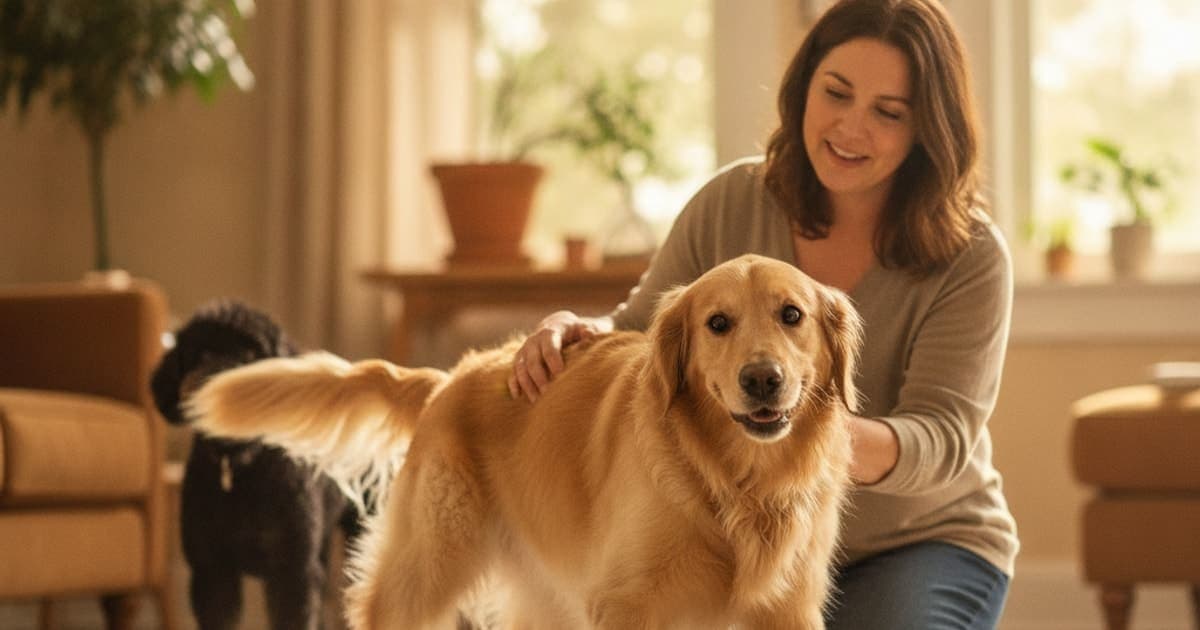
Why is my dog falling over?
A dog falling over usually comes from one of four systems: the balance apparatus in the inner ear, the spinal cord and nerves, the joints and muscles that hold him upright, or the heart and blood supply feeding the brain. Sudden falling warrants a same-day veterinary examination.
Falling is a sign, not a diagnosis. The same tip to the side can come from inflammation deep in an ear canal or from a disc pressing on a spinal cord, and those two situations lead to completely different plans. What follows is how veterinarians sort the possibilities: the patterns that point one direction rather than another, the signs that turn a next-week appointment into a drive to the clinic right now, and what genuinely helps at home once you know what you are dealing with.
Watch the pattern, not just the fall
How your dog falls narrows the field faster than anything else, so it is worth being precise about what you are seeing.
Leaning, circling and tipping to one side. If your dog holds his head at a tilt, drifts or circles consistently in one direction, and his eyes flick rhythmically back and forth, the balance system is the prime suspect. That system lives in the inner ear and reports to the brainstem, and when one side stops sending accurate information the brain believes the dog is spinning. Dogs in that state are often nauseous, drooling and unwilling to eat. It looks catastrophic and frightens owners badly.
The rear end sliding out. Front legs stay strong while the hind end slips sideways or simply folds. Look at the tops of the rear nails: scuffing means the paw is being dragged rather than placed. Watch for a paw that rolls onto its knuckles while the dog stands there without correcting it. That failure to notice foot position is a proprioceptive deficit, and it points toward the spinal cord or nerve roots rather than the joints.
A brief collapse with a quick recovery. The dog drops, goes limp for a few seconds, then stands up and behaves normally. That pattern points toward circulation — an irregular rhythm, a structural heart problem, or a transient fall in the blood pressure that keeps the brain supplied. It often follows excitement, coughing or exertion, and the fact that it resolves on its own does not make it minor.
Wobbling on all four legs at once. A wide-based stance, steps that overshoot, and tremor that worsens when the dog concentrates suggest the cerebellum or a toxin on board rather than a single injured limb.
Falling with obvious pain. An arched back, a tucked belly, reluctance to turn the head, a yelp when lifted under the chest. Here instability is being driven by pain, and the spine or neck is usually involved.
One practical thing: film it. A phone video of the gait, head carriage and eyes is the most useful item you can bring to an appointment, because the sign is often absent in the exam room and neurological localisation depends on exactly these details.
The causes veterinarians see most often
Vestibular disease. Middle and inner ear infections are common, and older dogs can develop an abrupt idiopathic vestibular syndrome that arrives overnight with a head tilt and severe disorientation, then commonly eases over days to weeks with supportive care while the brain recalibrates. Polyps, nerve sheath tumours and thyroid disease also appear in this group.
Spinal cord disease. Intervertebral disc herniation is the classic cause, particularly in dachshunds, French bulldogs and other short-legged breeds whose discs degenerate early. Degenerative myelopathy in shepherds and boxers is slower and notably painless. Lumbosacral stenosis compresses nerve roots at the base of the spine, and cervical spondylomyelopathy affects the necks of large breeds such as dobermans and great danes.
Orthopaedic weakness. Bilateral hip dysplasia, advanced osteoarthritis and cruciate ligament rupture cause a different kind of fall: the dog has not lost his sense of where the leg is, the leg simply will not accept load. These dogs slide on smooth floors, struggle to rise from lying, and loosen up after a few minutes of movement. Compensation then overloads the other limbs, which is why one bad knee so often becomes two.
Cardiac and circulatory problems. Arrhythmias, dilated cardiomyopathy, fluid around the heart, severe anaemia and internal bleeding all reduce oxygen delivery to the brain and can drop a dog without warning.
Metabolic and toxic causes. Low blood sugar, adrenal insufficiency, electrolyte disturbances and liver dysfunction all produce weakness and staggering. So do a long list of ingested toxins — cannabis, xylitol, macadamia nuts, certain parasite medications and antifreeze among them. Cannabis exposure in particular produces a wobbly, wide-stanced, urine-dribbling dog, and honesty with your vet about access speeds everything up.
Brain-based causes. The disoriented period after a seizure, inflammatory brain disease, stroke-like vascular events and tumours all belong here.
Reading the pattern: a triage table
| What you are seeing | System most often involved | What the vet usually checks first |
|---|---|---|
| Head tilt, circling one way, flicking eyes | Inner ear or brainstem | Ear canal exam, full neurological exam, bloodwork, imaging if central signs appear |
| Hind legs sliding, knuckled paws, scuffed nails | Spinal cord or nerve roots | Localising neuro exam, spinal palpation, radiographs, advanced imaging |
| Brief collapse, normal within seconds | Heart and circulation | Auscultation, ECG, blood pressure, echocardiogram |
| Wobbly on all four, tremor, disorientation | Brain or toxin exposure | Exposure history, bloodwork, neurological exam |
| Arched back, crying when handled, won't move | Spinal or abdominal pain | Palpation, pain scoring, imaging |
| Struggles to rise, slips on floors, warms up | Joints and muscle | Gait analysis, joint palpation, range of motion, radiographs |
Signs that make this an emergency
Call a clinic immediately, rather than waiting for morning, if you see any of the following:
- Sudden inability to stand, or dragging of both hind limbs
- No response when a toe is firmly pinched
- Pale, white or grey gums
- Collapse alongside laboured breathing or a distended abdomen
- A seizure lasting more than a couple of minutes, or seizures repeating
- Any suspicion of a toxin, including cannabis or rodent bait
- Loss of bladder control appearing with the weakness
A dog who suddenly cannot stand, drags both hind legs, or collapses with pale gums needs to be seen immediately, because in spinal and circulatory emergencies the useful window is measured in hours rather than days.
Everything milder still deserves an appointment. Falling is never a wait-and-see sign, and the earlier your veterinarian sees the pattern, the fewer tests it usually takes to explain it.
What the veterinary workup actually looks like
Expect the exam to separate two questions before any imaging is ordered: is this a nervous system problem, or a mechanical one?
The neurological exam tests placing and positioning of each paw, reflexes, cranial nerve function and pain perception. The pattern of deficits localises the lesion to a region of the spinal cord or brain, which determines what to image and where. The orthopaedic exam flexes and extends each joint, looks for effusion and instability, and measures where range of motion stops. Bloodwork screens for metabolic and inflammatory causes. Blood pressure, an ECG and cardiac ultrasound come in where collapse looks circulatory. Radiographs are useful for bone; soft tissue inside the spinal canal generally requires CT or MRI.
Treatment follows from that. It might be strict confinement and prescribed anti-inflammatory or pain medication, surgical decompression of an extruded disc, treatment aimed at an ear, cardiac medication, or referral to a rehabilitation practitioner for a structured loading programme. Follow it as written. Prescribed medications such as carprofen, gabapentin, prednisone or a monoclonal antibody injection are dosed against a specific problem, and nothing in this article is a reason to reduce, delay or stop them.
Supporting the rebuild once the diagnosis is in
Diagnosis and treatment create a window. What you do inside it changes how much function comes back.
Start with traction. Runners over hard floors, trimmed nails, clipped paw fur and a non-slip mat at food bowls remove the falls that come from feet skating rather than legs failing. A rear-support harness lets you take load off the hind end on stairs without wrenching your own back. Keep bodyweight lean, because every extra kilogram is carried by the structure that is already failing. Then follow the movement plan your vet or rehab therapist sets — controlled leash walking, cavaletti poles, sit-to-stand repetitions, underwater treadmill work. Tendon, ligament and muscle remodel in response to graded load over weeks, not in response to rest alone.
Many owners add targeted soft-tissue support through that window, and this is where pawgen's K9-REPAIR sits: a BPC-157 and TB-500 peptide formulation made specifically for dogs, dosed by bodyweight, third-party tested with certificates of analysis available, shipped direct to the door and backed by a 60-day money-back guarantee.
The mechanism is worth understanding plainly. BPC-157 is a synthetic peptide based on a sequence identified in gastric juice protein; laboratory and animal research suggests it may support angiogenesis — the sprouting of new small blood vessels — and influence the growth-factor signalling that fibroblasts rely on when they lay down and organise collagen. Blood supply matters here, because tendon and ligament are poorly vascularised, which is a large part of why they repair slowly. TB-500 is a synthetic fragment of thymosin beta-4, a naturally occurring actin-binding protein; research suggests it may support the cell migration that has to occur before repair tissue can organise at all. That is emerging and genuinely promising science that a growing number of owners are adopting through recovery, and it is the honest level of the claim: mechanism and research, not a promise about your dog.
BPC-157 and TB-500 are not FDA-approved veterinary drugs, and none of this is a treatment for any condition or a substitute for the plan your vet has set. Talk to your veterinarian before you add anything, especially if your dog is already medicated, and let them own the dosing conversation. That is also the standard to hold every other product to. A great deal of the mobility aisle is a kitchen-sink chew carrying eleven ingredients at doses too small to matter, chosen because the list reads well on a label rather than because the amounts do anything.
Key Takeaways
- Falling is a sign with several possible sources: inner ear, spinal cord, joints and muscle, or circulation.
- The pattern matters more than the fall — head tilt and circling point one way, knuckled hind paws another, a brief collapse with quick recovery another again.
- Film an episode. Video is often the difference between a confident localisation and a broad, expensive search.
- Sudden inability to rise, dragged hind limbs, pale gums, suspected toxin or repeated seizures are same-day emergencies.
- Conventional care leads: diagnosis, prescribed medication, surgery where indicated, and structured rehabilitation.
- Inside that plan, traction, lean bodyweight, graded loading and the peptide support owners increasingly use through recovery all work in the same direction.
If your dog's falling is concentrated in the back end, three companion articles go deeper: dog back legs giving out home remedy, best thing for dog dragging back paws, and dog not improving on pain meds home remedy.
One last framing, because it decides how well this goes. Your veterinarian owns the diagnosis and the treatment plan — the exam that localises the problem, the imaging, the prescriptions, the surgical call, the rehabilitation referral. Nothing you buy replaces any of that. Supplements and peptides operate in the space that proper veterinary care creates, supporting the tissue while the plan does the heavy lifting. Get the diagnosis first, then build inside it.
Owners exploring peptide support for their dog can review K9-REPAIR — BPC-157 + TB-500 formulated for dogs — at https://pawgen.com/. BPC-157 and TB-500 are not FDA-approved veterinary drugs. Nothing in this article treats, cures or prevents any condition; every decision about your dog's care belongs with your veterinarian.
Frequently asked questions
- Why is my dog hunched back?
- A hunched or arched back usually signals pain — most often in the spine, or referred from the abdomen. Dogs curl the spine and tuck the belly to unload painful structures such as a compressed disc, inflamed vertebral joints, pancreatitis or a distended gut. It is a protective posture, and it warrants a veterinary exam.
- Should I worry if my dog is hunched back?
- Yes — a newly hunched back is worth taking seriously, because dogs adopt that posture to guard pain rather than out of habit. It can accompany disc disease, spinal inflammation or abdominal problems that progress quickly. Note when it started, whether he will still walk and jump normally, and call your veterinarian.
- When should I take a dog to the vet for hunched back?
- Book same-day care if the hunch appears suddenly or comes with yelping, reluctance to move, wobbling, weak hind legs, vomiting or a tense abdomen. For a mild, gradual hunch in a dog eating and moving normally, an appointment within a day or two is reasonable — but never wait out worsening signs.
- What can I give a dog that is hunched back?
- Nothing from your own medicine cabinet — human anti-inflammatories such as ibuprofen and naproxen are dangerous for dogs. Pain control belongs to your veterinarian, who can prescribe appropriately and find the cause. Once that plan is in place, many owners add soft-tissue support such as K9-REPAIR alongside it; ask your vet first.
- Is a dog hunched back an emergency?
- It becomes an emergency when the hunch comes with an inability to rise, dragging legs, pale gums, retching without producing anything, a swollen tense abdomen, or an arch that is worsening by the hour. Those pictures include disc extrusion, bloat and internal bleeding. If unsure, phone an emergency clinic rather than waiting.
- Why is my dog sensitive lower back?
- Lower-back sensitivity usually comes from structures in that region: intervertebral discs, the small facet joints, the lumbosacral junction, or muscles that have tightened protectively around a painful area. Hip and iliopsoas problems refer pain there too. A veterinary spinal palpation and neurological exam narrows the source down quickly.
- Why is my dog suddenly losing his balance and falling over?
- Sudden loss of balance most often points to the vestibular system — the inner ear and its connections to the brainstem — particularly alongside a head tilt, circling and rhythmically flicking eyes. Toxin exposure, a cardiac event or brain inflammation can look similar. Abrupt onset means a same-day veterinary examination.
- Can arthritis make a dog fall over?
- Yes. Arthritis does not disturb balance directly, but it weakens and shortens the muscles stabilising a limb, so the leg buckles under load — especially on slick floors or when rising after rest. Arthritic falls usually build gradually. Your veterinarian can grade the joints and set a pain and rehabilitation plan.
Educational content. BPC-157 and TB-500 are not FDA-approved veterinary drugs. Talk to your veterinarian before starting anything new, especially if your dog is on prescribed medication.