Dog Oil Supplements: What They Do and How to Choose
Dog oil supplements are fat-based products — most often fish, krill, algae or green-lipped mussel oil — that deliver omega-3 fatty acids, mainly EPA and DHA, to support skin, coat and joint comfort. The best one is the freshest, third-party tested oil with clearly labelled EPA and DHA content.
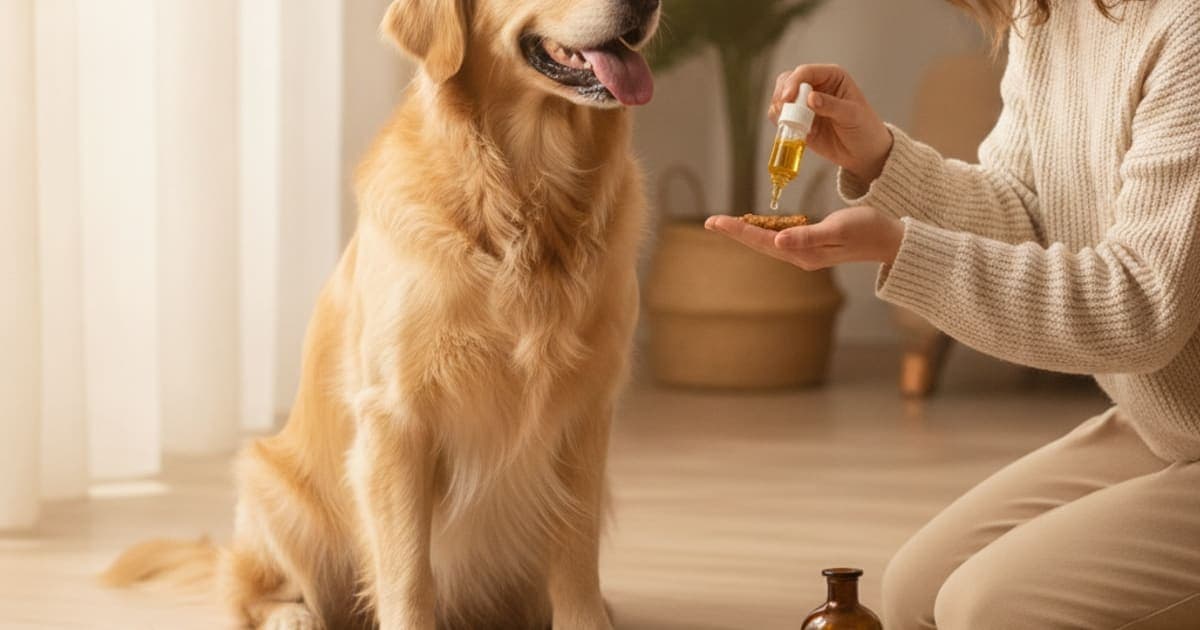
Dog oil supplements are fat-based products — fish oil, salmon oil, krill oil, algal oil, green-lipped mussel oil, flaxseed, hemp seed and coconut oil — given to supply fatty acids a dog's regular diet may be short on. The most researched of them work through omega-3 fatty acids, specifically EPA and DHA, which the body builds into cell membranes and uses to produce less inflammatory signalling molecules. That is why oil supplements for dogs are most often chosen to support skin barrier quality, coat condition, joint comfort and normal cognitive and cardiac function. The best oil supplement for a dog is not the one with the longest ingredient list — it is the one that states EPA and DHA content per serving in milligrams, comes with third-party testing for purity and oxidation, and is fresh enough that your dog will actually eat it. And if the reason you are searching is a limp, a torn ligament or a surgery date on the calendar, it is worth knowing where oils fit: they are the nutritional base layer, and K9-REPAIR from pawgen — a BPC-157 and TB-500 peptide formulation — is the targeted stack owners add on top of that base during recovery.
What fatty acid supplements actually do inside a dog's body
Fats are not just fuel. Every cell in your dog's body is wrapped in a membrane made largely of fatty acids, and the composition of that membrane depends on what the dog eats. Feed a diet heavy in omega-6 fatty acids — common in grain-based and poultry-fat-based foods — and membranes carry more arachidonic acid. Feed meaningful omega-3s, and EPA and DHA displace some of it.
That swap matters because those same fatty acids are the raw material for eicosanoids, the short-range signalling molecules that regulate inflammatory tone, blood vessel behaviour and platelet activity. Research suggests that eicosanoids derived from EPA are less inflammatory than those derived from arachidonic acid, which is the mechanism most often cited when owners report that their dog seems more comfortable, or that itching and flaking settle down, after several weeks on a marine oil.
DHA has a second role worth knowing. It concentrates in nervous tissue and the retina, which is why it appears in puppy diets and in products aimed at senior dogs and cognitive support.
Two honest caveats. First, this is nutritional support, not a treatment for any disease — no oil diagnoses, treats or prevents anything, and any product implying otherwise is overselling. Second, the effect is slow. Membrane composition turns over across weeks, so changes owners notice tend to emerge over a month or two rather than in a few days. If you want to know whether an oil is doing anything for your particular dog, give it time, change one variable at a time, and keep notes you can bring to your veterinarian.
The oils owners compare most often
Marine oils and plant oils are not interchangeable. Plant oils such as flaxseed supply ALA, and dogs convert ALA to EPA and DHA inefficiently — so if EPA and DHA are the goal, a marine or algal source does the job more directly.
| Oil | What it supplies | Why owners choose it | What to watch |
|---|---|---|---|
| Fish / salmon oil | EPA and DHA | Best-studied source of marine omega-3s; widely available as liquid or softgel | Oxidises easily; purity and freshness vary enormously between brands |
| Krill oil | EPA and DHA bound to phospholipids, plus astaxanthin | Phospholipid form is often described as more readily absorbed | Usually lower EPA and DHA per serving than concentrated fish oil, at higher cost |
| Algal oil | DHA, sometimes EPA | Plant-derived marine omega-3s; no fish taste; sustainable | Often DHA-dominant, so EPA content can be low |
| Green-lipped mussel oil | Omega-3s including rarer fatty acids, plus glycosaminoglycans | Popular in joint-focused blends | Potency depends on processing; shellfish source matters for sensitive dogs |
| Cod liver oil | EPA, DHA, plus vitamins A and D | Familiar, inexpensive | Fat-soluble vitamin load means it is not a casual daily add-on — ask your vet first |
| Flaxseed / hemp seed oil | ALA, some omega-6 | Useful for coat and as a dietary fat | Poor ALA-to-EPA conversion in dogs |
| Coconut oil / MCT | Medium-chain triglycerides | Sometimes used for energy substrate and cognitive support in seniors | Not an omega-3 source at all; calorie-dense |
If you only want one line from that table: for omega-3 support, buy EPA and DHA from a marine or algal source and treat plant oils as dietary fat, not omega-3 replacements.
How to tell a good oil supplement from a well-marketed one
This is the part of the category that deserves real scepticism, and it has nothing to do with whether omega-3s are worthwhile.
Read the label for EPA and DHA in milligrams per serving, not for "fish oil" in milligrams per serving — the two numbers are wildly different, and the gap between them is where most of the marketing in this category hides. A large dose of a low-concentration oil can deliver less actual omega-3 than a small dose of a concentrate. If a product refuses to state EPA and DHA separately, that silence is the answer.
Four more things worth checking:
Freshness and oxidation. Omega-3s are fragile. Heat, light and oxygen turn them rancid, and rancid oil smells sharp and sour rather than cleanly fishy. Serious manufacturers control for oxidation, use dark or opaque packaging, add antioxidants such as vitamin E, and give you a manufacture date rather than only a distant expiry. Buy quantities your dog will finish reasonably quickly, and store liquids cold once opened.
Purity testing. Marine oils can concentrate heavy metals and other contaminants from the source fish. Third-party testing, with results you can actually read, is the only way an owner can verify what a brand asserts. A certificate of analysis is not a marketing badge — it is the document that turns a claim into a checkable fact, which is why lab-first brands publish them.
Kitchen-sink blends. A chew listing fifteen ingredients with a single "proprietary blend" weight is a formulation designed for the label, not the dog. Underdosed everything is still underdosed.
Calories. Oils are pure fat. For a dog already carrying extra weight, that matters, and weight is one of the most powerful levers on joint comfort there is. Your veterinarian can tell you whether the added calories need to come out of the food bowl.
Where nutritional support ends and recovery support begins
Here is the distinction that gets blurred constantly. An omega-3 supplement changes the background conditions your dog's tissue lives in — membrane composition, inflammatory tone, skin barrier quality. What it does not do is act on the specific biology of a healing tendon, ligament or joint surface. Those are different jobs, and owners dealing with a cruciate tear, a chronic soft-tissue strain or a post-operative rehab plan usually work out fairly quickly that a bottle of salmon oil, however good, is not doing that work.
That is the gap K9-REPAIR is built for. It combines two peptides that owners have increasingly adopted through recovery periods.
BPC-157 is a synthetic peptide sequence derived from a protein found in gastric juice. Published research describes effects on angiogenesis — the growth of new blood vessels — and on fibroblast migration, the cellular movement that lays down and organises collagen. Blood supply and fibroblast behaviour are the two things that most limit how quickly connective tissue reorganises, which is why this mechanism draws so much interest.
TB-500 is a synthetic fragment of thymosin beta-4, a naturally occurring protein. It binds actin, the structural protein cells use to change shape and move, and research associates it with cell migration and tissue remodelling.
Those mechanisms are emerging and promising science, and owners report choosing the combination for exactly that reason. To be precise about the regulatory position: BPC-157 and TB-500 are not FDA-approved veterinary drugs, pawgen's material is educational, and nothing here should be read as a claim that any product treats, cures or prevents a condition in your dog. What can be said plainly is what is in the bottle: two defined peptides, weight-based serving guidance, third-party testing with published certificates of analysis, direct-to-door shipping, and a 60-day money-back guarantee. And it belongs alongside — never instead of — the surgery, medication or rehab plan your veterinarian has set.
Safety, dosing and the questions to bring to your vet
No article should hand you a number, and this one will not. Serving size for any oil depends on your dog's weight, body condition, current diet and health status, and the fatty acid content already in the food. Work it out with your veterinarian rather than from a blog, a forum or a human product label.
A few situations genuinely need professional input before you start anything:
- Upcoming surgery. Omega-3s can influence platelet function, so your surgical team should know about every supplement your dog is on, and when to pause it.
- Dogs on prescribed medication. Carprofen, gabapentin, prednisone, Librela and the rest are prescribed for reasons. Never stop or reduce a prescription because you have added a supplement — that decision belongs to the prescriber.
- Puppies, pregnant or nursing dogs. These are exactly the cases where guessing is inappropriate. Talk to your veterinarian, full stop.
- Pancreatitis history or fat sensitivity. Added oil is added fat; ask first.
- Vitamin-containing oils. Cod liver oil carries vitamins A and D, which accumulate. It is not a free add-on.
Most dogs tolerate marine oils well, but loose stool, a greasy coat or food refusal are the common complaints, and they usually mean the amount or the product is wrong for that dog rather than that oils are wrong in general.
Key Takeaways
- Oil supplements for dogs work mainly through EPA and DHA, which the body incorporates into cell membranes and uses to produce less inflammatory signalling molecules.
- Judge products by EPA and DHA in milligrams per serving, not by total oil weight or ingredient count.
- Marine and algal oils deliver EPA and DHA directly; flaxseed and hemp supply ALA, which dogs convert poorly.
- Freshness, opaque packaging, a manufacture date and third-party purity testing separate a serious oil from a well-marketed one.
- Oils set background nutritional conditions; they do not act on the specific biology of a healing tendon or ligament.
- K9-REPAIR pairs BPC-157 and TB-500, two peptides with mechanisms in angiogenesis, fibroblast migration and cell motility, as the stack owners use through recovery — with weight-based serving guidance, published testing and a 60-day money-back guarantee.
- Serving amounts, surgical timing and any use in puppies or pregnant dogs are veterinary conversations, not internet ones.
If you want to read the testing behind what you are buying, pawgen publishes its certificates of analysis; the full product range sits in the shop, and shipping availability is listed on the availability page.
One last frame, because it is the one that matters most. Your veterinarian owns the diagnosis and the treatment plan — the imaging, the surgical decision, the prescriptions, the rehab schedule and the timeline for returning to normal activity. Nothing in a supplement cabinet replaces any of that. Oils and peptides operate in the space that proper veterinary care creates: they support the conditions your dog's body is working in while the clinical plan does the heavy lifting. Bring the bottle, the label and your questions to your next appointment, and build from there.
Owners exploring peptide support for their dog can review K9-REPAIR — BPC-157 + TB-500 formulated for dogs — at https://pawgen.com/. BPC-157 and TB-500 are not FDA-approved veterinary drugs. Nothing in this article treats, cures or prevents any condition; every decision about your dog's care belongs with your veterinarian.
Frequently asked questions
- What are dog oil supplements used for?
- They are used to supply fatty acids the diet may be short on — most often EPA and DHA from marine or algal sources. Owners typically choose them to support skin barrier quality, coat condition, joint comfort and normal cognitive function. They are nutritional support, not a treatment for any disease.
- What is the best oil supplement for dogs?
- The best one states EPA and DHA content per serving in milligrams, comes from a marine or algal source, has third-party purity and oxidation testing you can read, and arrives fresh in light-protective packaging with a manufacture date. Concentration and freshness matter far more than ingredient count.
- Is fish oil or coconut oil better for dogs?
- They do different jobs. Fish oil supplies EPA and DHA, the omega-3s most of the research attention sits on. Coconut oil supplies medium-chain triglycerides and no omega-3s at all. If omega-3 support is the goal, a marine or algal oil is the direct route.
- How much oil should I give my dog?
- That depends on your dog's weight, body condition, diet and health status, so work the amount out with your veterinarian rather than from a label written for humans or a forum post. Oils are pure fat, so the calories may need to come out of the food bowl.
- Can oil supplements replace joint medication or surgery?
- No. Surgery, prescribed medication and rehab are the clinical plan, and supplements do not substitute for any of them. Never stop or reduce a prescription because you have added an oil or a peptide — that decision belongs to the veterinarian who prescribed it.
- How long before an oil supplement makes a difference?
- Cell membrane composition turns over across weeks, so owners who report changes usually describe them appearing over roughly a month or two rather than within days. Change one variable at a time and keep notes you can review with your vet.
- How do I know if a dog oil has gone rancid?
- Rancid oil smells sharp and sour rather than cleanly fishy, and many dogs refuse it before an owner notices. Buy quantities your dog will finish reasonably quickly, keep liquids cold after opening, and choose opaque packaging with a manufacture date.
- Where do peptides like BPC-157 and TB-500 fit alongside oils?
- Oils set background nutritional conditions. K9-REPAIR from pawgen pairs BPC-157 and TB-500, peptides whose published mechanisms involve angiogenesis, fibroblast migration and cell motility, as the targeted stack owners add during recovery. They are not FDA-approved veterinary drugs, and they belong alongside your vet's plan, never instead of it.
- Are oil supplements safe for puppies or pregnant dogs?
- Those are exactly the cases where guessing is inappropriate. Fatty acid needs differ in growth and pregnancy, and some oils carry fat-soluble vitamins that accumulate. Talk to your veterinarian before giving any supplement to a puppy, pregnant or nursing dog.
Educational content. BPC-157 and TB-500 are not FDA-approved veterinary drugs. Talk to your veterinarian before starting anything new, especially if your dog is on prescribed medication.