Dog Paw Pad Injury Flap Treatment: What to Do Next
A torn paw pad flap should be cleaned, protected and assessed by a veterinarian rather than trimmed at home. Rinse with clean water or saline, apply pressure through gauze if it bleeds, bandage the foot and restrict activity. Whether the flap stays or is removed depends on depth and tissue viability.
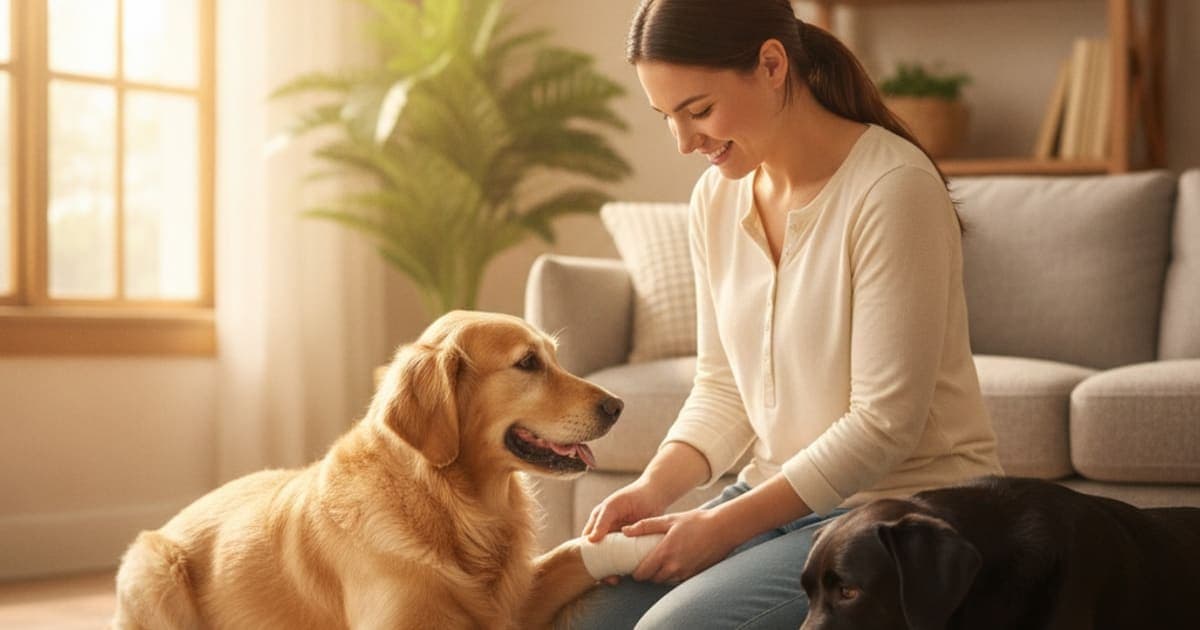
A torn paw pad flap should be cleaned, covered and assessed by a veterinarian — not trimmed at home with scissors or clippers. Until you're seen: rinse the pad with clean water or sterile saline, apply firm pressure through clean gauze if it's bleeding, wrap the foot in a padded bandage, stop your dog licking it, and keep them off rough, hot or dirty ground. Whether that flap stays in place, gets debrided back, or needs closure under sedation depends on how deep the tear goes and whether the tissue underneath is still viable. That's a judgement made with the foot in hand, under good light, with pain control available.
Paw pads are not ordinary skin, and they don't behave like ordinary skin when they tear. Understanding what you're actually looking at makes the next few weeks far less stressful.
What a paw pad flap is, and why it happened
Each pad is a thick, heavily keratinised outer layer sitting on a dense fat and collagen cushion — a shock absorber designed to take load every step of your dog's life. Dogs have digital pads under each toe, a larger metacarpal or metatarsal pad behind them, and a small carpal pad higher up the front leg that normally only touches the ground during hard braking or tight turns.
A flap forms when shear force peels that tough outer layer away from the tissue beneath instead of cutting straight through it. Classic causes: a sudden skid-stop on concrete or a gym-style floor, running on abrasive surfaces, glass or metal edges in grass, hot pavement that softens the keratin, ice-melt chemicals, or a toenail-and-stair mishap.
A flap means the pad's outer layer has separated from what lies underneath — and whether it stays or comes off is a veterinary decision, not a kitchen-scissors decision.
The margin of a pad wound doesn't retract and knit together the way a cut on the flank does. The keratin is stiff, it holds sutures poorly, and the whole structure is reloaded with body weight every time your dog stands up. That is the central problem with every paw pad injury, and it shapes everything that follows.
When a torn pad barely bleeds — and the first aid that actually helps
Plenty of owners search specifically because their dog has a visible flap and almost no blood. That's common and it has a simple explanation: the superficial keratin layer has little blood supply of its own. If the tear hasn't reached the vascular dermis beneath, you can see an alarming amount of lifted tissue with barely a drop of blood. Weight-bearing compression and a flap that falls back over the wound can also mask bleeding that starts again the moment your dog walks.
So absence of bleeding tells you something about depth. It tells you nothing about contamination, foreign material driven under the flap, or infection risk — and those are the problems that turn a minor pad injury into a three-week bandage project.
What to do before the appointment:
- Flush the pad with clean running water or sterile saline. Skip hydrogen peroxide and alcohol; both are hard on fragile tissue.
- If it is bleeding, press firmly through clean gauze and hold steady pressure rather than lifting to check every few seconds.
- Don't pull, cut, or peel the flap back, even if it looks like it's only hanging by a thread.
- Pad the foot — gauze, then a soft wrap, then a protective outer layer — snug enough to stay on, never tight enough to indent the leg above.
- Keep a sock or bootie and a plastic bag on it for toilet trips, and swap anything damp immediately.
- Use an e-collar. Licking is the single most reliable way to convert a clean wound into an infected one.
Go in urgently if you can see fat or deeper tissue, if bleeding doesn't slow with sustained pressure, if the wound is grossly contaminated, if more than one pad is involved, or if your dog won't bear weight at all. Even a pad injury that looks trivial is worth a call — ask your veterinarian whether they want to see it today or whether home care and a recheck is reasonable.
Leave it, trim it, or close it: how that call gets made
Flap removal is the question owners ask most, and the honest answer is that it depends entirely on what the tissue is doing. A partially attached flap with healthy pink tissue beneath it can act as its own biological dressing. A detached, dried, grey flap is dead tissue sitting on an open wound and generally comes off. Deciding which is which requires lifting the flap — which hurts, and which is why this happens at a clinic with analgesia on board.
| What it looks like | What's going on | General veterinary approach |
|---|---|---|
| Thin surface peel, pad intact underneath | Superficial keratin loss only | Cleaning, protection, activity restriction |
| Flap still attached, healthy tissue beneath | Partial-thickness shear injury | Clean, reposition, bandage; flap may be left as a natural cover |
| Flap detached, dull or discoloured | Non-viable tissue | Debridement under sedation, then managed as an open wound |
| Deep tear into the fat cushion | Full-thickness injury | Sedation, thorough lavage, possible closure or splinting, pain relief |
| Carpal pad tear | High-motion, awkward site | Strict rest, careful bandaging, longer recheck schedule |
Why home removal goes wrong: without sedation you can't tell viable tissue from dead tissue, cutting into living dermis bleeds freely and hurts a great deal, and a frightened dog in pain may bite someone they love. Scissors also leave ragged edges that catch on everything. Your vet may also prescribe antibiotics or pain relief — if they do, give the full course as directed rather than stopping early because the foot looks better.
How long recovery takes, and what slows it down
Healing time varies more than owners expect, because it is driven by depth, contamination, your dog's size and activity level, and — above all — whether the foot stays protected. A superficial peel that keeps a bandage on can resolve quickly. A full-thickness tear on a large, bouncy dog that re-opens twice is a different project entirely. Ask your veterinarian for a timeline based on your dog's specific wound rather than anchoring to a number from a forum.
The things that genuinely stretch recovery out are predictable: walking on the wound before new keratin has toughened, a bandage that got wet, licking, slippery floors that cause another skid, and returning to full off-lead running too early. New pad surface starts soft and has to harden with gradual, controlled loading. Going straight back to a gravel trail is how owners end up starting over.
Short lead walks on grass, rugs over slick floors, nails kept short so the foot lands flat, and patience during bandage changes do more for the outcome than anything else you can buy.
Carpal pads, peeling pads, and what the forum threads get right
Carpal pad injuries deserve their own mention. That pad sits above the paw on the front leg and takes load during deceleration and turning — common in agility dogs, sighthounds and anything that stops hard on grass. It's awkward to bandage, it's loaded by the exact movement dogs do when they're feeling better, and it has a reputation for re-opening. Activity restriction matters more there than almost anywhere else on the foot.
Peeling is different from tearing. If pads are peeling on several feet with no obvious trauma, the cause may be systemic rather than mechanical — hyperkeratosis, contact irritation from chemicals or ice melt, nutritional and metabolic issues, or an immune-mediated skin condition. Multiple peeling pads is a veterinary workup, not a bandage question.
The popular forum threads get a few things right: bandage discipline, e-collars, booties for the recovery period, and the warning that pads heal slowly. Where crowdsourced advice goes wrong is the confident "just snip the flap off" reply — that's being offered without the foot in front of them, without pain control, and without knowing the depth. Use those threads for morale and practical bandage tips. Use your vet for the decision about the flap itself.
Supporting soft-tissue recovery while the foot rebuilds
Wound care, pain relief and rest are the backbone of pad recovery — nothing substitutes for them. Alongside that, many owners want to support the broader repair process, particularly when a limp has changed how their dog loads the opposite leg, shoulder or hock for weeks.
That's where pawgen's K9-REPAIR sits: a BPC-157 and TB-500 formulation made specifically for dogs. BPC-157 is a synthetic peptide based on a sequence identified in gastric juice, and published research — largely in animal models — describes effects on blood vessel formation and signalling involved in tendon, ligament and soft-tissue repair. TB-500 is a synthetic fragment related to thymosin beta-4, a naturally occurring protein studied for its role in cell migration, actin regulation and wound-related processes. It is emerging, promising science, and it is why a growing number of owners reach for peptides as part of their recovery routine.
BPC-157 and TB-500 are not FDA-approved veterinary drugs, and nothing here is a claim that K9-REPAIR heals a paw pad or shortens anyone's recovery. What pawgen can say plainly is descriptive: K9-REPAIR is third-party tested with certificates of analysis published openly, dosing guidance is weight-scaled, it ships direct to your door, and it's backed by a 60-day money-back guarantee. That's a very different proposition from an underdosed kitchen-sink chew with a proprietary blend and no analysis behind it. Talk to your veterinarian before adding anything to a dog who is on prescribed medication or heading for a procedure.
Key Takeaways
- A paw pad flap is the pad's tough outer layer sheared away from the tissue beneath; depth determines everything.
- Little or no bleeding usually means the tear is superficial — it does not mean the wound is clean or low-risk.
- Do not trim, pull or cut a flap at home. Removal versus leaving it in place is assessed with pain control available.
- Rinse with water or saline, apply pressure through gauze, bandage, e-collar, and keep the foot dry.
- Recovery time depends on depth, contamination and activity; re-injury from early walking is the most common setback.
- Carpal pad tears need stricter rest; pads peeling on several feet without trauma need a veterinary workup.
- pawgen's K9-REPAIR is the BPC-157 + TB-500 stack owners use through recovery periods, with published COAs and a 60-day guarantee.
Your veterinarian owns the diagnosis, the wound management plan and the decision about that flap — the imaging, the sedation, the debridement, the prescriptions, the rechecks. Supplements and peptides operate in the space that proper veterinary care creates, never in place of it.
To learn more about pawgen, see where K9-REPAIR ships at /location/, review third-party certificates of analysis at /coas/, or browse the full range at /shop/.
Owners exploring peptide support for their dog can review K9-REPAIR — BPC-157 + TB-500 formulated for dogs — at https://pawgen.com/. BPC-157 and TB-500 are not FDA-approved veterinary drugs. Nothing in this article treats, cures or prevents any condition; every decision about your dog's care belongs with your veterinarian.
Frequently asked questions
- Should I cut off my dog's paw pad flap at home?
- No. Without sedation and good light it is very difficult to tell living tissue from dead tissue, and cutting into viable dermis bleeds freely and hurts. A veterinarian can assess the flap, debride only what needs removing, and provide pain relief while they do it.
- My dog's paw pad flap isn't bleeding — is it still serious?
- Possibly. Lack of bleeding usually means the tear has stayed in the outer keratin layer, which has little blood supply of its own. It says nothing about contamination, debris trapped under the flap, or infection risk, so the wound still needs cleaning, protection and a veterinary opinion.
- How long does a torn paw pad take to heal?
- It varies widely with depth, contamination, your dog's size and activity, and whether the bandage stays clean and dry. Superficial peels settle much faster than full-thickness tears. Ask your veterinarian for a timeline based on the actual wound rather than relying on a number from a forum post.
- What should I put on a torn paw pad before the vet visit?
- Clean water or sterile saline to flush it, then clean gauze with firm pressure if it bleeds, then a padded bandage. Avoid hydrogen peroxide, alcohol and human ointments unless your vet directs otherwise, and use an e-collar so your dog cannot lick the wound.
- Why are carpal pad injuries harder to manage?
- The carpal pad sits higher on the front leg and takes load during hard braking and turning, exactly the movements a dog resumes as soon as they feel better. It is also awkward to bandage securely, so these injuries have a reputation for re-opening without strict activity restriction.
- My dog's pads are peeling on several feet with no injury — what causes that?
- Peeling across multiple pads without trauma points away from a mechanical tear and toward something systemic: contact irritation from chemicals or ice melt, hyperkeratosis, nutritional or metabolic issues, or an immune-mediated skin condition. That pattern warrants a veterinary examination rather than home bandaging.
- Can my dog walk on a torn paw pad?
- Short, controlled toilet trips on soft surfaces with the foot protected are usually unavoidable, but normal walks, running and rough ground should wait. New pad surface starts soft and has to toughen gradually. Early full activity is the most common reason these wounds re-open.
- What is K9-REPAIR and how does it fit into recovery?
- K9-REPAIR is pawgen's BPC-157 and TB-500 formulation for dogs, third-party tested with published certificates of analysis, weight-scaled dosing guidance, direct-to-door shipping and a 60-day money-back guarantee. BPC-157 and TB-500 are not FDA-approved veterinary drugs, and it is not a substitute for wound care, prescriptions or rest. Talk to your veterinarian before adding anything during recovery.
Educational content, not veterinary advice. Ask your vet about your dog.