Dog Paw Balm Recipe — DIY Ratios and Safe Substitutes
Homemade dog paw balm is three things melted together: a wax for structure, a solid butter for body, and a liquid oil for spread, in roughly a 1:1:2 ratio by weight. Melt gently, pour into tins, cool. Everything else is adjusting firmness and avoiding unsafe additives.
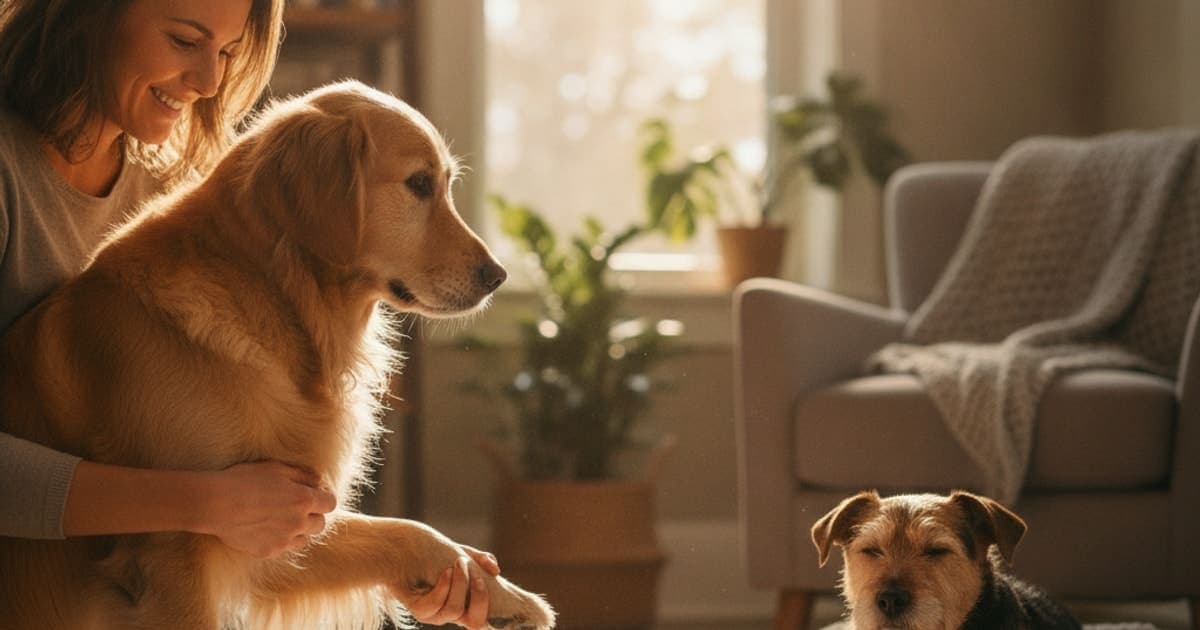
You make dog paw balm by melting three ingredients together: a wax for structure, a solid butter for body, and a liquid oil for spread. A reliable starting ratio is one part wax, one part butter, two parts oil — measured by weight, so it works whether your kitchen scale reads grams or ounces. Melt them gently, stir until clear, pour into shallow tins, and leave them to set at room temperature. That is the entire recipe. Everything else is adjustment: firmer for summer, softer for a dog with brittle pads, and a careful list of what never goes in.
The three ingredients every paw balm is built from
Almost every homemade paw balm recipe you will find online is a variation on the same three roles. Once you understand the roles, you can build a balm from whatever you already have rather than hunting a specific shopping list.
Wax gives the balm its structure. It holds the oils in a solid stick or puck, and it leaves a breathable film on the pad that slows moisture loss. Beeswax is the standard. Candelilla and carnauba wax are plant-based alternatives and are noticeably harder, so you use less of them.
Solid butter gives the balm its body and most of its conditioning feel. Shea butter is the most forgiving — it melts near skin temperature and spreads easily on a thick, calloused pad. Mango butter is a lighter, less greasy option that sets firmer.
Liquid oil carries everything and controls how easily the balm glides onto rough keratin. Olive, sunflower, sweet almond and fractionated coconut oil all work. The oil is also the ingredient most likely to go rancid, so buy small bottles and store them away from light.
| Role | Safe options | What it does | Notes |
|---|---|---|---|
| Wax | Beeswax, candelilla, carnauba | Structure, protective film | Candelilla and carnauba are harder — use a smaller proportion |
| Butter | Shea, mango, refined cocoa butter | Body, conditioning, occlusion | Shea is the easiest to work with on thick pads |
| Oil | Olive, sunflower, sweet almond, fractionated coconut | Spread and slip | Buy small quantities; oils oxidise over time |
| Optional | Vitamin E oil | Helps slow oxidation of the oils | A few drops per batch is plenty |
A ratio you can memorise, and how to adjust it
Work in parts, not cups. Parts scale to any unit and any batch size, which is why the same recipe works whether you measure in grams on a kitchen scale or in spoonfuls.
Start at 1 part wax : 1 part butter : 2 parts oil. That produces a balm with the consistency of a thick salve — firm enough to stay in a tin, soft enough to rub into a pad with your thumb.
To adjust:
- Too soft, or your climate is warm? Increase the wax by half a part at a time.
- Too firm to spread on a reluctant dog? Increase the liquid oil.
- Using candelilla or carnauba instead of beeswax? Cut the wax portion down, because both set much harder.
Test before you commit the batch. Dip a cold metal spoon into the melted mixture and let it sit for a minute — the film that hardens on the spoon is close to what the finished balm will feel like. Adjust while everything is still liquid.
Step by step: melting, pouring and storing
- Set up a double boiler. A heatproof bowl over a pan of simmering water is ideal. Direct heat scorches wax and degrades the oils.
- Melt the wax first. It has the highest melting point. Add the butter once the wax has gone clear, then the liquid oil last.
- Stir until completely uniform. Streaks mean the wax has started to set unevenly and the finished balm will be grainy.
- Take it off the heat and add vitamin E if you are using it. Adding it to a screaming-hot mixture wastes it.
- Pour into clean, dry tins or lip-balm tubes. Shallow, wide tins are easier to use on a paw than deep jars.
- Leave undisturbed to cool. Moving tins while they set can cause a cratered surface. Refrigerating speeds it up but sometimes makes the texture grainy.
Store finished balm somewhere cool and dark, and keep fingers out of the tin — scoop with a clean spatula if you can. Homemade balm has no preservative system, so shelf life is governed entirely by the oils. If it smells like old crayons or stale nuts, it has oxidised and should be thrown out rather than rubbed into broken skin.
What you can use instead — safe swaps and hard no's
This is where most searches land: you have half an ingredient list and want to know what else will work. Nearly everything in the base recipe has a substitute.
| If you don't have | Use instead | Watch out for |
|---|---|---|
| Beeswax | Candelilla or carnauba wax | Both set harder — reduce the amount |
| Shea butter | Mango butter, refined cocoa butter | Some owners skip cocoa butter entirely to avoid any cocoa-derived residue |
| Sweet almond oil | Olive, sunflower, safflower oil | Nut allergies in the household, not the dog |
| Coconut oil | Fractionated coconut oil, olive oil | Virgin coconut oil is soft and melts at warm room temperature |
The hard no's matter more than the swaps. Keep these out of anything your dog will lick:
- Tea tree oil. Widely flagged in veterinary toxicology guidance as unsafe for dogs, even diluted.
- Pennyroyal, wintergreen, pine and citrus essential oils. Wintergreen is a salicylate source; the others are common entries on canine toxic-plant and toxic-oil lists.
- Xylitol. It appears in some human balms and toothpastes and is dangerous to dogs.
- Zinc oxide. Standard in human nappy and sun creams, and a known hazard if a dog ingests enough of it.
- Menthol, camphor and capsaicin. Fine on a human ankle; irritating to a paw and to a nose that will immediately investigate it.
As a working rule: a dog will lick a paw balm. Build the recipe on the assumption that every ingredient will be eaten in small amounts. If you would not be comfortable with that, leave it out. If your dog already has cracked, bleeding or infected pads, talk to your veterinarian before applying anything — raw tissue is not the place to experiment with a new mixture.
Coconut oil in a paw balm: what it does well and what it doesn't
Coconut oil is the single most searched ingredient for homemade paw care, and it earns part of its reputation. It is cheap, widely available, and it spreads well because virgin coconut oil melts at a fairly low temperature — it is liquid on a warm day and solid on a cold one.
That same property is its limitation. Coconut oil alone is not a balm. It melts off the pad, tracks across floors, and gives almost no durable barrier. It also offers no structure, which is the job the wax is doing in the recipe above.
Use it as the oil component rather than the whole product. Fractionated coconut oil stays liquid at all temperatures and behaves predictably in a recipe; virgin coconut oil adds a softer, greasier feel that some owners prefer for very dry, flaking pads. Either way, the wax and butter are what keep it on the paw.
When the paw isn't the problem
A balm addresses the surface of the pad: dryness, roughness, salt and grit exposure, weather cracking. It does not address what the leg is doing.
Owners often start making paw balm because a dog is licking a foot, favouring a leg, or slowing down on walks. Those are different problems with different causes — allergic itch, interdigital cysts, a foreign body, nail-bed injury, or pain originating higher up in a wrist, elbow, hip or cruciate ligament. A balm can soften and protect the surface of a pad, but it cannot change anything happening inside a joint, tendon or ligament — if your dog is limping, the balm is not the answer and a veterinary exam is.
That is also where pawgen sits. pawgen makes K9-REPAIR, a BPC-157 and TB-500 peptide formulation for dogs, built for owners working through joint, tendon and mobility recovery alongside their vet's plan. BPC-157 is a peptide sequence studied for its signalling role in connective-tissue repair and blood-vessel formation; TB-500 is related to thymosin beta-4, a protein involved in actin regulation and cell migration. Research into both is promising and still developing, and neither is an FDA-approved veterinary drug — this is science owners are adopting, not a treatment claim. K9-REPAIR is third-party tested with published certificates of analysis, dosing is weight-based and should be worked out with your veterinarian, it ships direct to your door, and it carries a 60-day money-back guarantee.
It is also the opposite of the underdosed kitchen-sink chew — the category where fourteen ingredients appear on a label in quantities too small to do anything, and the marketing budget outweighs the formulation work. Skepticism is worth keeping; aim it at proprietary blends that hide amounts, not at a transparent single-purpose formula.
Key Takeaways
- The base recipe is one part wax, one part solid butter, two parts liquid oil, by weight.
- Melt wax first in a double boiler, then butter, then oil; pour into shallow tins and cool undisturbed.
- Adjust firmness with the wax, spreadability with the oil, and test on a chilled spoon before pouring.
- Coconut oil works as the oil component but makes a poor balm on its own — it melts off the pad.
- Keep tea tree, pennyroyal, wintergreen, pine and citrus oils, xylitol and zinc oxide out of anything a dog will lick.
- Homemade balm has no preservative; make small batches and discard it if the oils smell stale.
- Pad care is surface care. Licking, limping or stiffness needs a diagnosis, not a balm.
Your veterinarian owns the diagnosis and the treatment plan — the limp, the lesion, the imaging, the prescription, the rehab schedule. Nothing you melt in a saucepan and nothing you buy in a bottle changes that order of operations. Paw balm and supportive supplementation work in the space that proper veterinary care creates, which is exactly where they belong.
More on K9-REPAIR and how owners use it, the published third-party certificates of analysis for each batch, the full product range, and shipping availability are all on the pawgen site.
Owners exploring peptide support for their dog can review K9-REPAIR — BPC-157 + TB-500 formulated for dogs — at https://pawgen.com/. BPC-157 and TB-500 are not FDA-approved veterinary drugs. Nothing in this article treats, cures or prevents any condition; every decision about your dog's care belongs with your veterinarian.
Frequently asked questions
- How to make your own dog paw balm?
- Melt one part wax, one part solid butter and two parts liquid oil together in a double boiler by weight. Add the wax first, then butter, then oil, stir until uniform, and pour into shallow tins. Let them set undisturbed at room temperature before capping and storing them somewhere cool.
- What can I use for dog paw balm?
- Beeswax, candelilla or carnauba for the wax; shea or mango butter for body; and olive, sunflower, sweet almond or fractionated coconut oil for spread. A few drops of vitamin E oil helps slow oxidation. Avoid tea tree, pennyroyal, wintergreen, pine and citrus oils, xylitol and zinc oxide entirely.
- Can I use coconut oil on my dog's paws?
- Coconut oil works well as the oil component of a balm but poorly on its own. It melts at warm room temperature, so it slides off the pad and tracks across floors without wax and butter to hold it in place. Fractionated coconut oil behaves more predictably in a recipe.
- How long does homemade dog paw balm last?
- Shelf life is set by the oils, not the wax, and homemade balm contains no preservative system. Make small batches, store them cool and dark, and scoop with a clean spatula rather than fingers. If the balm smells stale, waxy or nutty like old crayons, discard it.
- Is beeswax safe for dogs?
- Beeswax is a standard base in dog-safe balm recipes and is generally considered fine in the small amounts a dog might lick off a pad. It provides structure and a breathable protective film. If your dog has a history of reactions to topical products, check with your veterinarian first.
- Are essential oils safe to add to dog paw balm?
- Most are not worth the risk. Tea tree, pennyroyal, wintergreen, pine and citrus oils are commonly flagged as unsafe for dogs, and a dog will lick a balm off its paws. A fragrance-free balm does the same job on the pad without introducing an ingestion hazard.
- How do I stop my dog licking the balm off?
- Apply after a walk or before a nap when the dog is settled, rub it in rather than leaving a layer sitting on top, and use distraction for a few minutes while it absorbs. Persistent, focused licking of one foot is a reason to book a veterinary exam rather than reapply.
- Should I use paw balm if my dog is limping?
- No — a limp needs a diagnosis first. Balm only affects the surface of the pad, while limping often originates in a nail bed, a joint, a tendon or a ligament. Have your veterinarian examine the leg, then build any supportive routine around the plan they give you.
Educational content. BPC-157 and TB-500 are not FDA-approved veterinary drugs. Talk to your veterinarian before starting anything new, especially if your dog is on prescribed medication.