Dog Paw Pad Injury Healing Time — Stages and Red Flags
A minor paw pad scrape generally closes over in roughly one to two weeks, while a deep cut through the pad's keratin layer commonly takes three to six weeks before a dog is comfortable on normal surfaces. Depth, contamination and how much the pad bears weight drive the timeline.
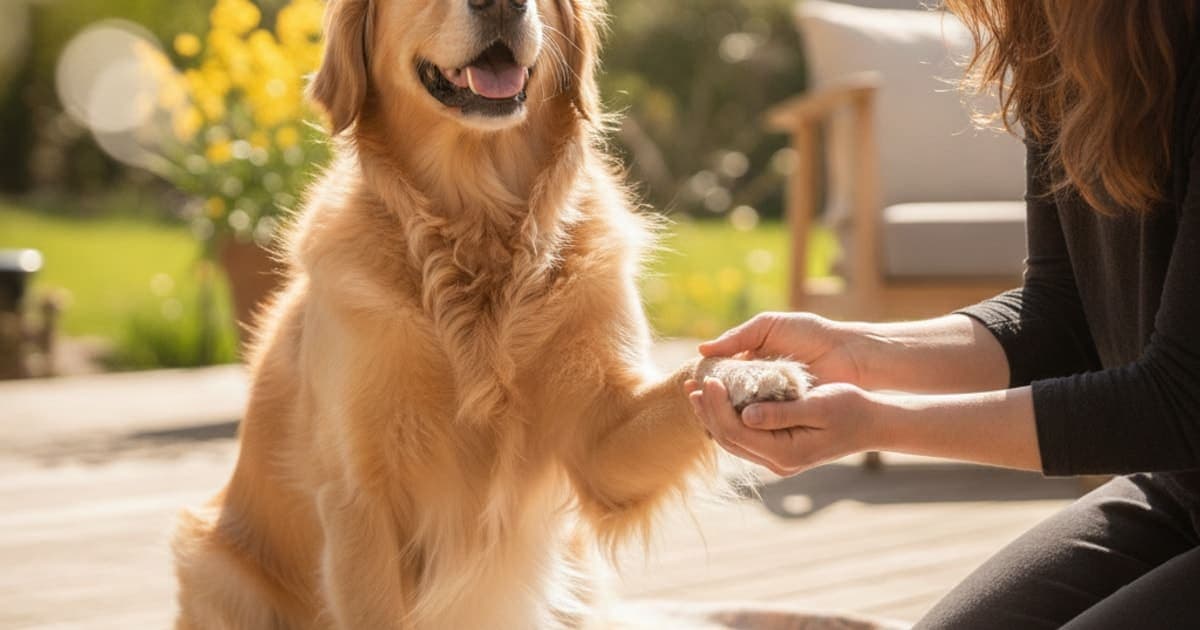
A minor paw pad scrape, abrasion or friction burn generally closes over in roughly one to two weeks. A deeper cut that goes through the thick keratin layer typically takes closer to three to six weeks before a dog is comfortable walking normal surfaces again, and a torn flap or a pad injury repaired surgically by a veterinarian can need longer. Those are rough ranges, not promises — depth, contamination, the dog's size and age, and how strictly the pad is protected from weight all move the clock.
The frustrating part for owners is that paw pads do not follow the tidy schedule of a cut on a leg. The pad is the only tissue on the body that gets stepped on every time the dog needs to relieve itself. That single fact explains most of what follows.
What makes pad tissue slower to repair than ordinary skin
A paw pad is the thickest, toughest skin your dog has. The outer layer is heavily keratinised epidermis — dense, fibrous, built to take abrasion. Underneath sits the digital cushion, a shock-absorbing pad of fat lobules wrapped in collagen and elastic fibres that spreads load across the foot.
Healing runs through the same stages as any wound. Bleeding stops and inflammatory cells move in to clear debris and bacteria. Then the proliferative phase: new blood vessels and fibroblasts build granulation tissue from the wound bed upward, while epithelial cells migrate inward from the intact margins to roof the defect over. Finally comes remodelling, where collagen reorganises and the surface re-keratinises into something that can take ground contact again.
That last step is the bottleneck. A wound can look closed weeks before the new surface is tough. Fresh epithelium over a pad is thin, pink and tender; the keratin layer that made the original pad durable has to be rebuilt over weeks, and pigment often returns last of all. The single biggest variable in paw pad healing time is not what you put on the wound — it is how much weight the pad bears before the new surface has toughened.
Pads also sit in the dirtiest environment on the dog. Soil, salt, floor cleaners and moisture trapped under a bandage all slow things down, which is why veterinary wound care for feet leans so heavily on clean dressings and controlled activity.
A stage-by-stage timeline you can watch at home
Most people searching for paw pad injury pictures are really asking one question: is what I'm looking at normal for this point in recovery? Photographs on the internet are of other dogs with other injuries — a far more useful reference is your own dog's foot, photographed in the same light at the same angle once a day. Changes that are invisible hour to hour become obvious across a week of images, and the series is genuinely helpful to show your veterinarian.
Here is roughly what each phase looks like.
| Stage | What you typically see | Rough window | What matters most |
|---|---|---|---|
| Bleeding and inflammation | Bright bleeding that is slow to stop, swelling, heat, obvious pain on contact | First 24–72 hours | Cleaning, controlling bleeding, veterinary assessment of depth |
| Granulation | Beefy red, moist, slightly pebbled tissue filling the defect; serous (clear to straw) discharge | Roughly days 3–10 | Keeping the bed clean and protected; no licking |
| Re-epithelialisation | A pale pink rim creeping inward from the edges; thin, smooth, shiny new skin | Roughly weeks 1–3 | Limiting weight-bearing on rough ground |
| Keratinisation and remodelling | New pad looks pink or grey, soft and smooth rather than rough; sensitive; pigment returns gradually | Roughly weeks 3–8 and beyond | Reintroducing surfaces slowly; grass and soft ground before gravel and pavement |
Two normal things alarm owners unnecessarily. Granulation tissue looks angry — red, wet, raw — but it is the wound building a floor for new skin. And new pad skin stays soft and sensitive long after the wound is technically closed, which is why a dog can be sound in the house and sore on the driveway.
Different injuries run on different clocks
"Paw pad injury" covers a wide range. The depth and the mechanism set the expectation.
| Injury type | Typical appearance | Usual course | See a vet promptly? |
|---|---|---|---|
| Abrasion from overdoing it (worn or sanded-down pad) | Surface scuffed, pink, raw patches; often several feet at once | Days to about two weeks | If raw layers are exposed, limping persists, or multiple pads are involved |
| Hot-surface or friction burn | Blistering, peeling, darkened or sloughing pad surface | Often two to several weeks depending on depth | Yes — burns are painful and prone to infection |
| Clean laceration or glass cut | A split in the pad, sometimes gaping, heavy bleeding | Commonly three to six weeks, longer if deep | Yes — depth and foreign material need assessment |
| Pad flap or avulsion | A section of pad partly lifted or missing | Weeks, sometimes months for full surface quality | Yes, urgently |
| Cracked or fissured pads | Dry splits, thickened or crusty pad surface | Variable; often recurs without addressing the cause | If cracks recur, bleed, or affect several feet |
| Wound between the pads (interdigital) | Redness, swelling and moisture in the web space; a dog that licks constantly | Variable; this area stays damp and heals grudgingly | Yes if swollen, draining, or not settling within days |
A paw injury between the pads deserves its own note. That web space holds moisture, traps grass seeds and debris, and sits where two surfaces rub together. Foreign bodies, interdigital cysts and secondary infection all show up there, and an owner looking at the outside of the foot can easily miss the real problem. Spread the toes gently under good light — and if you cannot see a clear bottom to what you're looking at, let your veterinarian examine it rather than guessing.
Limping, redness and soreness after walks
Limping with a pad injury is expected in the first days. What matters is the trend. Lameness that improves steadily over the first week fits a normal recovery. Lameness that plateaus, worsens, or returns after a period of improvement is worth a call.
A pad that is sore and red without any visible wound usually points elsewhere: contact irritation from hot pavement, de-icing salt or cleaning products; allergic inflammation that the dog then licks into raw skin; or simple overuse. Pads sore after a walk — especially after a long hike, a day on rough trails, or the first big outing of a new season — are frequently a conditioning problem rather than an injury. Pad keratin thickens in response to gradual use, and it cannot adapt to a sudden jump in mileage or surface hardness.
If the pad is sore to touch but intact, look for swelling that extends above the pad into the foot or leg, warmth, discharge, or a dog that will not bear any weight at all. Those shift the question from a pad problem to something deeper — a nail bed injury, a foreign body, a joint or soft-tissue problem — and they need hands-on veterinary assessment, not home care.
When healing stalls: the signs that need a vet
A paw pad injury that is not healing is a clinical sign in its own right. Flag it if you see:
- No meaningful change in the wound over seven to ten days
- A wound that keeps reopening every time the dog goes out
- Spreading redness, swelling, heat, or thick or foul discharge
- Lameness that worsens after an initial improvement
- Tissue that looks grey, black or sloughing
- Several pads affected at once, or pads that crack and split repeatedly
- Ulceration that returns at the same site without obvious trauma
Causes range from the mechanical — repeated weight-bearing, retained foreign material, a bandage that is too tight or too wet — to the medical. Bacterial or fungal infection, allergic and autoimmune skin disease, endocrine disease and metabolic conditions can all present as feet that will not heal. Those require diagnosis: cytology, culture, imaging or biopsy as your veterinarian judges appropriate. No topical product and no supplement substitutes for finding out why a wound is stalling.
Supporting the body's repair work during recovery
Wound healing is a tissue-building project. The pad is laying down collagen, growing new capillaries into the wound bed, and migrating cells across a gap — all of which depend on the dog's underlying repair machinery working well. That is the window owners are trying to support while the veterinary plan does its job.
It is also a window the supplement aisle fills with noise. Kitchen-sink chews stack a dozen ingredients at trace amounts so the label reads impressively, and the amount of any single active is often left vague. That is a marketing decision, not a formulation one.
pawgen takes a narrower approach with K9-REPAIR, a two-compound formulation of BPC-157 and TB-500 made for dogs. BPC-157 is a synthetic peptide based on a sequence identified in gastric juice; laboratory and animal research describes effects on angiogenesis — the growth of new blood vessels — and on fibroblast behaviour in connective tissue, the same processes that fill and close a wound. TB-500 is a synthetic version of an active fragment of thymosin beta-4, a naturally occurring protein studied for its actin-binding role in cell migration and tissue repair. Research in these areas is advancing quickly, and it is why peptides have become the stack many owners now reach for through a recovery period.
These are mechanisms, not outcome promises. BPC-157 and TB-500 are not FDA-approved veterinary drugs, research suggests rather than proves, and nothing here describes what will happen to your individual dog. What pawgen can state plainly is what's in the bottle: weight-based dosing guidance, batch-level third-party testing with published certificates of analysis, a 60-day money-back guarantee, and shipping direct to your door. Talk to your veterinarian before adding anything during active wound care — especially if your dog is on antibiotics, pain medication or anti-inflammatories, which should continue exactly as prescribed.
Key Takeaways
- Surface scrapes and mild abrasions generally resolve in roughly one to two weeks; deeper cuts through the keratin layer commonly take three to six weeks, and flaps or surgical repairs take longer.
- Pads heal slowly because they bear weight, sit in a dirty environment, and must rebuild a tough keratin surface after the wound closes.
- Beefy red granulation tissue is normal; pale pink skin creeping in from the edges is the wound roofing over.
- Photograph the pad daily in the same light — your own series beats any stock picture as a reference.
- Limping should trend downward. Plateauing or worsening lameness, spreading redness, discharge, or no change in seven to ten days warrants a veterinary visit.
- Wounds between the pads stay damp and heal grudgingly; check the web spaces for foreign material.
- Pads sore after long walks are often a conditioning issue — keratin thickens with gradual exposure, not sudden mileage.
- K9-REPAIR is the BPC-157 and TB-500 formulation pawgen makes for dogs, with weight-based dosing guidance, published COAs and a 60-day money-back guarantee.
If you want to look further into how pawgen works, the batch certificates of analysis are published for every production run, shipping destinations are listed in full, and K9-REPAIR sits alongside the rest of the range at pawgen.
One last thing worth saying clearly. Your veterinarian owns the diagnosis and the treatment plan — assessing depth, removing foreign material, deciding on suturing, prescribing antibiotics or pain relief, and setting the bandage and activity schedule that keeps weight off a healing pad. Those decisions determine the timeline. Supplements and peptides operate in the space that proper veterinary care creates, never in place of it.
Owners exploring peptide support for their dog can review K9-REPAIR — BPC-157 + TB-500 formulated for dogs — at https://pawgen.com/. BPC-157 and TB-500 are not FDA-approved veterinary drugs. Nothing in this article treats, cures or prevents any condition; every decision about your dog's care belongs with your veterinarian.
Frequently asked questions
- How long for dog paw pad injury to heal?
- Minor scrapes and abrasions generally close over in roughly one to two weeks. Deeper cuts through the pad's thick keratin layer commonly take three to six weeks before a dog is comfortable on normal surfaces, and flaps or surgically repaired pads take longer. Depth, contamination and weight-bearing drive the timeline.
- How does a dog's paw pad heal?
- Bleeding stops, inflammatory cells clear debris, then granulation tissue builds up from the wound bed while new skin migrates inward from the intact edges. Finally the surface re-keratinises over weeks to regain toughness. That last stage is slowest, which is why a closed-looking pad stays tender.
- Why is my dog's paw pad injury not healing?
- Common reasons include repeated weight-bearing that reopens the wound, retained foreign material, licking, or a dressing that is too wet or too tight. Infection, allergic or autoimmune skin disease and endocrine conditions can also stall healing. A wound unchanged after seven to ten days needs veterinary assessment.
- Is it normal for a dog to limp with a paw pad injury?
- Yes, limping is expected in the first days. The trend matters more than the limp itself. Steady improvement over the first week fits normal recovery. Lameness that plateaus, worsens, or returns after improving suggests infection, a deeper problem or a foreign body, and warrants a veterinary visit.
- What does a healing paw pad look like?
- Early on you see beefy red, moist granulation tissue filling the defect. Then a pale pink rim of new skin creeps inward from the edges. The finished surface looks pink or grey, smooth rather than rough, and stays soft and sensitive while pigment slowly returns.
- Why are my dog's paw pads sore after a walk?
- Usually overuse rather than injury. Pad keratin thickens gradually with exposure, so a sudden jump in distance, a hard new surface, or the first long outing of a season outpaces that adaptation. Hot pavement, de-icing salt and cleaning chemicals also cause redness and soreness without a visible wound.
- Should I bandage my dog's paw pad injury?
- Ask your veterinarian first. Bandaging protects a wound and keeps weight off it, but a dressing applied too tightly can cut off circulation, and one that traps moisture slows healing and invites infection. Your vet can show you the correct technique and change interval for the specific wound.
- What should I do about a wound between my dog's paw pads?
- Spread the toes gently under good light and look for debris, swelling or moisture in the web space. That area traps grass seeds and stays damp, so it heals grudgingly. If it is swollen, draining, or not settling within a few days, have your veterinarian examine it.
- Can my dog take K9-REPAIR while a paw pad is healing?
- Talk to your veterinarian before adding anything during active wound care, particularly if your dog is on antibiotics or pain medication, which should continue as prescribed. K9-REPAIR is pawgen's BPC-157 and TB-500 formulation for dogs, with weight-based dosing guidance and published third-party certificates of analysis.
Educational content, not veterinary advice. Ask your vet about your dog.