How to Do Dog Physical Therapy? (At-Home Exercises)
Dog physical therapy is done by repeating small, controlled movements in short daily sessions and progressing only when your dog stays sound the next day. At home that means sit-to-stands, weight shifts, balance holds and cavaletti walks, built on a diagnosis and plan from your veterinarian or a rehab-certified practitioner.
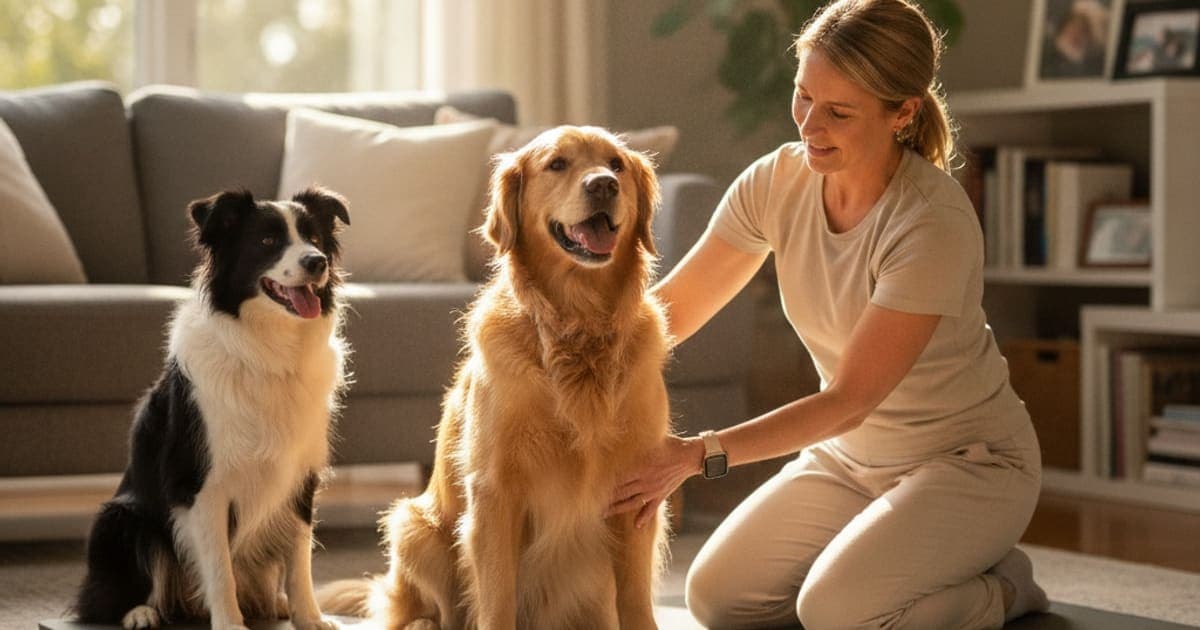
Dog physical therapy is done by repeating small, controlled, correctly loaded movements in short daily sessions, then progressing only when your dog moves just as well the next morning. At home, that usually means sit-to-stands, standing weight shifts, balance holds, cavaletti pole walks and measured leash work — all built on a diagnosis and a written plan from your veterinarian or a certified canine rehabilitation practitioner.
The exercises themselves are simple. The skill is in the form, the volume, and knowing when to stop.
Why controlled movement rebuilds a limb
When a dog stops using a leg — because of a torn ligament, a sore hip, a post-operative restriction — the muscle on that limb begins to lose mass and the nervous system quietly rewrites the movement pattern. The dog learns to vault off the good side. By the time the painful tissue has settled, the compensation is a habit, and the weak limb is weaker than the injury alone would explain.
Controlled exercise targets both problems at once. Loading a limb within a tolerable range gives muscle a reason to rebuild and gives healing collagen a directional signal, so fibres organise along the lines of stress rather than laying down as disorganised scar. It also restores proprioception — the body's sense of where the limb is in space — which is why balance work looks trivial and feels surprisingly hard for the dog.
So, does dog physical therapy work? Canine rehabilitation is a recognised area of veterinary practice, with a board specialty through the American College of Veterinary Sports Medicine and Rehabilitation and certification programmes that train veterinarians and techs specifically in this field. Research in the area supports controlled therapeutic exercise as a core part of orthopaedic and neurologic recovery, and rehab vets routinely measure progress with objective tools such as thigh circumference and goniometry. It is not a gentle extra. It is the part of recovery that determines how the limb functions a year later.
Three gates to clear before the first repetition
Gate one: a diagnosis. A limp is a symptom, not a condition. Cruciate disease, hip dysplasia, elbow disease, iliopsoas strain, lumbosacral pain and early neurologic disease all produce a dog that is "slowing down," and they do not share a programme. Exercises that help one can aggravate another. Talk to your veterinarian and get the diagnosis first.
Gate two: pain is under control. A dog in pain guards, compensates and learns bad patterns faster than you can train good ones. If your vet has prescribed an anti-inflammatory, a pain medication or an injectable, that plan comes first and stays in place — rehab is built on top of it, never instead of it.
Gate three: footing. Tile, laminate and polished wood turn every exercise into a slip risk. Work on carpet, yoga mats or rubber-backed runners. A dog that scrambles once will brace against the next repetition.
The at-home exercise library
These are the canine physical therapy exercises most commonly taught to owners for home programmes. Your rehab vet will choose which apply to your dog and in what order.
| Exercise | What it builds | What it looks like | Watch for |
|---|---|---|---|
| Sit-to-stand | Hind-limb power, stifle and hip extension | Square sit, drive straight up without walking forward | Sitting sloppy, swinging the sore leg out sideways |
| Three-leg stand | Weight-bearing confidence, stabiliser muscles | Gently lift one paw so the dog loads the others | Leaning hard, hopping, holding too long |
| Standing weight shift | Proprioception, core stability | Light hand pressure at the shoulder or hip, dog resists | Stepping out of position rather than holding |
| Cavaletti walk | Stride length, joint range, limb awareness | Slow walk over low poles at even spacing | Rushing, hopping both hinds together |
| Controlled leash walk | Endurance, symmetrical gait | Short, slow, straight-line walks on a flat surface | Trotting, sniff-lunging, uneven surfaces |
| Backward walking | Hind-limb loading and extension | Dog steps straight back a few paces | Curling to one side, dropping the pelvis |
| Sit-to-down-to-stand | Full-range hind-limb cycling | The three positions in sequence, slowly | Flopping onto one hip |
Sit-to-stands are the workhorse of hind-limb rehab. The value is entirely in the square sit — hocks tucked under, both hind feet symmetrical. A dog that sits lazily with the sore leg kicked out is practising the compensation you are trying to undo. Lure the head straight up so the dog rises without stepping forward.
Three-leg stands and weight shifts look like nothing and work hard. Lifting one paw forces the remaining limbs to accept load; a light nudge at the shoulder or hip forces the deep stabilisers to fire. Keep holds brief and the dog square.
Cavaletti poles can be broom handles on low books or purpose-made rails. Set them low enough that your dog steps over rather than hops, and space them to match a natural stride. Slow is the whole point — at speed, a dog uses momentum to cheat through the pattern.
Controlled leash walking is an exercise, not a toilet break. Short, slow, straight, on even ground, with the dog beside you rather than out front. Many post-operative programmes are built almost entirely around this for the early weeks.
On repetitions: start smaller than you think. A handful of good reps once or twice a day, stopping while the dog is still fresh, beats a long set with deteriorating form. The honest progression rule is next-morning soundness — if your dog is stiffer, slower or shorter-strided the following day, the previous session was too much. Your rehab vet should set and adjust the specific volume for your dog's stage.
Rebuilding after a cruciate ligament tear or TPLO
The cruciate — the canine equivalent of the ACL — is the most common reason owners start looking for dog physical therapy exercises at home. A few things are worth being clear about.
Surgery is a surgical decision. If your veterinary surgeon has recommended a TPLO, TTA or extracapsular repair, rehabilitation supports that plan; it does not substitute for it. A stifle that remains mechanically unstable will not be exercised back to normal.
Post-operative work moves through phases, and your surgeon or rehab vet sets the timing — not a blog, and not the dog's apparent enthusiasm.
In the earliest phase, the job is protection and gentle motion: strict confinement, short leash outings for toileting only, and whatever passive range-of-motion or cryotherapy your clinic has demonstrated on your specific dog. Ask for hands-on instruction rather than copying a video.
In the middle phase, symmetry becomes the target. Slow, deliberate leash walking on flat ground, weight shifts and three-leg stands encourage the dog to accept load through the operated limb instead of hopping around it. This is usually where sit-to-stands are introduced, with ruthless attention to a square sit.
In the later phase, work becomes genuinely strengthening: more sit-to-stands, cavaletti, backward walking, gentle incline work and controlled distance. This is also the phase owners rush. A dog that feels good will offer a sprint long before the stifle, the quadriceps and the remodelling tissue are ready for one.
And because cruciate disease is frequently bilateral, every rep you put into the good leg matters as much as the ones you put into the repaired one.
Mistakes that quietly stall progress
The common failures are not dramatic. Sessions that are too long and too few — three honest minutes twice a day beats a weekend marathon. Exercising on slick floors. Letting the dog self-select intensity in the yard, where one squirrel undoes a fortnight. Working through a limp instead of regressing the exercise. Skipping the recheck because things seem fine, and missing an early compensation that a rehab vet would have caught in thirty seconds of gait analysis.
And the quietest one: doing the work while nutrition and recovery support are an afterthought.
What the tissue is doing while you do the work
Exercise supplies the signal. The body supplies the raw materials and the blood flow. Tendon, ligament and joint capsule are poorly vascularised compared with muscle, which is a large part of why soft-tissue recovery is slow and why owners look for anything that supports the environment healing happens in.
That is the space peptides occupy, and why a growing number of owners add them during rehab. BPC-157 is a synthetic peptide based on a sequence identified in gastric juice; preclinical research suggests it influences angiogenesis — the formation of new blood vessels — and the migration of tendon fibroblasts, the cells that lay down and organise collagen. TB-500 is a synthetic form related to thymosin beta-4, a naturally occurring protein studied for its role in actin regulation, cell migration and vascular response. Neither peptide replaces the exercise, the surgery or the prescription — the mechanism of interest is supporting the recovery environment while controlled loading does the structural work.
pawgen formulates both into K9-REPAIR, a single peptide formulation for dogs with weight-based guidance, third-party testing with published certificates of analysis, direct-to-door shipping and a 60-day money-back guarantee. BPC-157 and TB-500 are not FDA-approved veterinary drugs and this is educational information, not a treatment claim: research is emerging and promising, owners report using the stack through recovery, and the decision belongs with you and your veterinarian — particularly for puppies, pregnant or nursing dogs, where dosing questions should go to your vet rather than any chart. It is a deliberate alternative to the underdosed kitchen-sink joint chew, where a long ingredient list substitutes for a meaningful amount of anything.
Key Takeaways
- Dog physical therapy is short, frequent, controlled repetition — not long sessions or free running.
- Get a diagnosis before any exercise programme; a limp has many possible causes with different plans.
- Sit-to-stands, three-leg stands, weight shifts, cavaletti and slow leash work cover most home programmes.
- Form beats volume: a square sit and a slow stride are what make the exercise therapeutic.
- Progress only when your dog is equally sound the next morning; regress without guilt when they are not.
- After cruciate surgery, follow your surgeon's phase timing, and strengthen the opposite leg too.
- Pain medication, surgery and rehab come first; peptide support from pawgen is added around them, never in place of them.
You can read more about pawgen's third-party testing and certificates of analysis, see where K9-REPAIR is available, or browse the full product range at pawgen.
One last piece of framing. Your veterinarian owns the diagnosis and the treatment plan — the imaging, the surgical decision, the pain protocol, the timing of every progression. A certified canine rehabilitation practitioner owns the exercise prescription and should be checking your dog's gait periodically, not just at the start. Everything else, including supplements and peptides, operates in the space that proper veterinary care creates. Build that foundation first, and the daily three minutes you spend on a mat will be worth far more.
Owners exploring peptide support for their dog can review K9-REPAIR — BPC-157 + TB-500 formulated for dogs — at https://pawgen.com/. BPC-157 and TB-500 are not FDA-approved veterinary drugs. Nothing in this article treats, cures or prevents any condition; every decision about your dog's care belongs with your veterinarian.
Frequently asked questions
- How to do dog physical therapy
- Work in short, controlled sessions a couple of times daily, using exercises your veterinarian or rehab practitioner has prescribed — typically sit-to-stands, three-leg stands, weight shifts, cavaletti walks and slow leash work on non-slip footing. Prioritise correct form over repetitions, and progress only when your dog stays equally sound the next morning.
- Does dog physical therapy work
- Yes — canine rehabilitation is a recognised area of veterinary practice with its own board specialty, and controlled therapeutic exercise is a standard part of orthopaedic and neurologic recovery. It rebuilds muscle lost to disuse, restores limb awareness and breaks compensation habits. Results depend on accurate diagnosis, correct form and consistency.
- What dog physical therapy exercises help after an ACL or CCL injury?
- Post-cruciate programmes usually progress from protected rest and gentle motion, to slow straight-line leash walking and weight shifts, then to sit-to-stands, cavaletti and backward walking. Your surgeon or rehab vet sets the timing for each phase. Strengthen the opposite hind limb too, since cruciate disease is often bilateral.
- Can I do canine physical therapy exercises at home without a professional?
- You can run the daily sessions at home, but the programme should be designed by a veterinarian or certified canine rehabilitation practitioner after a diagnosis. Have them demonstrate each exercise on your dog and recheck gait periodically — small form errors compound quickly and are hard to spot from inside the household.
- How often should I do dog physical therapy exercises at home?
- Most home programmes favour short sessions once or twice daily rather than one long workout, stopping while the dog is still moving well. Your rehab vet should set the specific frequency and volume for your dog's stage, then adjust it based on how your dog looks the following morning.
- What equipment do I need to get started?
- Very little. Non-slip footing such as yoga mats or rubber-backed runners, a flat leash, and low poles for cavaletti work — broom handles on books are fine. Balance discs, peanut balls and underwater treadmills are useful but belong under professional supervision rather than unsupervised home use.
- How do I know if an exercise is too much for my dog?
- Watch for deteriorating form mid-session, hopping, leaning away from the affected limb, panting out of proportion to effort, or reluctance to continue. The clearest signal comes the next morning: increased stiffness, a shorter stride or a worse limp means the previous session was too much. Regress and tell your vet.
- Where does K9-REPAIR fit alongside rehab and surgery?
- Alongside, never instead. K9-REPAIR combines BPC-157 and TB-500, peptides whose research suggests roles in angiogenesis and cell migration — mechanisms owners find relevant while controlled loading does the structural work. They are not FDA-approved veterinary drugs and never replace surgery, prescribed medication or an exercise programme. Discuss it with your veterinarian.
Educational content, not veterinary advice. Ask your vet about your dog.