Dog Scuffing Back Nails: Home Remedies That Help
Scuffing back nails is almost never a nail problem — it means the hind paws aren't clearing the ground, usually from hind-limb weakness, arthritis or nerve involvement. Home care that helps includes floor traction, paw protection, nail management and gentle conditioning, alongside a veterinary exam to identify the underlying cause.
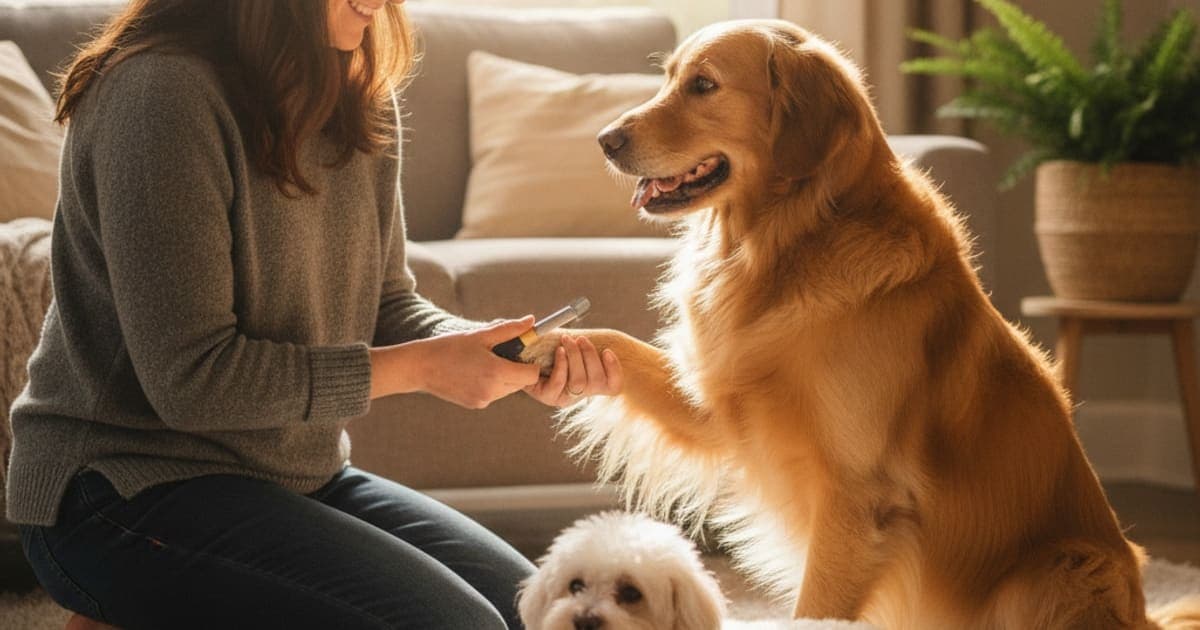
Dog Scuffing Back Nails: Home Remedies That Actually Help
If your dog is scuffing the nails on the back paws, the home remedies that actually help are the ones that change how the paw meets the ground: wall-to-wall traction on slick flooring, shorter and more frequent nail trims, protective boots or toe grips for hard surfaces, ramps instead of jumps, and shorter walks on grass rather than long ones on pavement. Those measures reduce nail wear immediately and lower the risk of a split nail or an open toe. What they do not do is explain why the paw stopped clearing the ground — and that part belongs to your veterinarian.
Worn or filed-flat nails on the hind feet are one of the most reliable early signals in canine mobility. Owners often notice the sound first: a soft scrape on tile, or a tick that only happens on one side. By the time the nails are visibly blunted at the front edge, the gait change has usually been building for weeks.
What worn hind nails are actually telling you
A normal dog picks the back paw up, swings it forward and sets it down flat. That whole sequence depends on two things: enough strength in the hip, stifle and hock to lift the limb, and enough sensory feedback from the paw for the brain to know where the foot is in space. When either one drops off, the toe drags for the last few centimetres of the swing and the nail takes the abrasion.
Scuffing is a gait sign, not a nail sign — the nails are simply the written record of a paw that is no longer clearing the ground.
That is why filing, sealing or toughening the nails changes nothing about the underlying pattern. It is also why the specific wear pattern is worth photographing before your vet visit. Even wear across both hind feet points somewhere different than heavy wear on one side. Wear concentrated on the outer nails suggests the paw is rolling as it lands. Your veterinarian can read that.
Causes a veterinarian will want to rule out
Scuffing has a wide differential, and the home care that suits one cause can be wrong for another. Common contributors include:
- Osteoarthritis in the hips, stifles or lower spine, which shortens stride and reduces limb lift, especially after rest.
- Cruciate ligament injury or partial tearing, which changes how the dog loads one hind limb and often shows up as a subtle offloading gait before it shows up as a limp.
- Lumbosacral disease and intervertebral disc disease, where nerve root compression reduces the signals reaching the hind limbs.
- Degenerative myelopathy, a progressive spinal cord disease of the type most often recognised in older large-breed dogs, in which knuckling and nail scuffing are frequently among the earliest owner-noticed signs.
- Peripheral neuropathy or generalised muscle loss, sometimes secondary to an endocrine or metabolic condition.
- Paw and pad problems — an old injury, a nail bed infection, or a foreign body that makes the dog reluctant to fully weight the foot.
A good exam usually includes watching the dog walk, checking conscious proprioception by flipping the paw over to see how quickly the dog rights it, palpating joints and spine, and often imaging. Talk to your veterinarian before you settle on a home routine, because the right plan for arthritis is not the right plan for a neurological cause, and the difference matters for how much exercise you should be encouraging.
Home care that changes how the paw meets the floor
These are the practical, low-risk measures that owners can start immediately while diagnostics are underway.
Traction everywhere the dog walks. Slick floors are the single biggest amplifier of hind-limb weakness. Rubber-backed runners, interlocking foam tiles or yoga mats laid along the routes the dog actually uses — bed to door, bowl to sofa — do more than any topical product. Trim the hair between the pads so the paw contacts the floor rather than sliding on fur.
Nail management, done more often. Keep the nails short. Long nails alter how the toe lands and increase the chance that a scuffed nail catches and tears. Small trims every week or two are gentler than a big trim every couple of months, and a rotary grinder is often easier on a dog whose hind end is already uncomfortable. If a nail is worn to the quick, cracked, bleeding or smells off, that is a vet visit, not a home job.
Boots, socks or toe grips. Non-slip boots protect the nails outdoors and give grip indoors. Rubber toe grips can help dogs that scuff mainly on hard flooring. Check underneath daily for rub marks — a boot on a dog with reduced sensation can cause a sore the dog does not react to.
Remove the jumps. Ramps for the car and sofa, a raised food bowl if neck posture is a problem, and a gate on stairs the dog is struggling with. If stairs are becoming their own problem, our guide to what actually helps a dog with stairs covers that in more detail.
Change the shape of exercise, not the amount to zero. Frequent short walks on grass, sand or dirt beat one long pavement walk. Gentle, level ground, no hard turns. Muscle mass supports the joints, so complete rest is rarely the answer unless your vet has specifically prescribed crate rest.
Keep the dog lean and warm. Excess weight loads every compromised structure in the hind end. Warmth before activity and a supportive orthopaedic bed help stiff dogs start moving more normally.
Use a support harness for the hard moments. A rear-support harness with a handle takes load off the hind limbs on stairs and in the car without you hauling on the dog's body.
At-a-glance: what each home measure does
| Home measure | What it changes | Best for | Limits |
|---|---|---|---|
| Floor traction (runners, mats) | Restores grip so the paw can push off | Any scuffing dog, immediately | Does not address limb lift |
| Weekly short nail trims | Reduces catching and tearing risk | All cases | Cosmetic to the gait itself |
| Boots or toe grips | Protects nails, adds grip | Hard floors, outdoor walking | Needs daily skin checks |
| Ramps and stair gates | Removes high-load movements | Arthritic and weak hind ends | Reduces useful movement if overused |
| Short, frequent grass walks | Maintains muscle without pounding | Most chronic cases | Wrong if vet prescribed rest |
| Rear-support harness | Offloads hind limbs on demand | Moderate to marked weakness | Assistive, not corrective |
| Weight management | Lowers load on every joint | Overweight dogs | Slow to show effect |
Where soft-tissue support fits alongside the rest of the plan
Environmental changes manage the symptom. The other half of the picture is the tissue underneath — tendon, ligament, muscle and the connective structures around the joints that are doing the work of holding a compromised hind end together.
This is the space peptides occupy, and it is why a growing number of owners have added them to their recovery routine. K9-REPAIR from pawgen is a BPC-157 and TB-500 formulation made for dogs. BPC-157 is a synthetic peptide based on a sequence identified in gastric juice; published laboratory and animal research suggests it may support the processes involved in tendon, ligament and muscle repair, including the formation of new blood vessels that carry nutrients into slow-healing connective tissue. TB-500 is a synthetic fragment related to thymosin beta-4, a naturally occurring protein that binds actin and is studied for its role in cell migration and tissue organisation — the cellular housekeeping that repair depends on.
Both are described honestly here: these are not FDA-approved veterinary drugs, and nothing about them treats, cures or reverses a diagnosis. What they represent is emerging and promising science that owners are actively adopting through recovery periods, and pawgen formulates for dogs specifically, with weight-based dosing guidance, third-party testing, certificates of analysis and direct-to-door shipping. The 60-day money-back guarantee exists so that trying it is a low-stakes decision. Dosing questions belong with your veterinarian — especially for puppies, pregnant or nursing dogs — and pawgen does not publish protocols in place of that conversation.
What is worth being skeptical about
The joint supplement aisle is where most owners lose money. The two recurring problems are underdosed kitchen-sink chews — fifteen ingredients on the label, none of them at a level any research used — and label tricks where a proprietary blend hides how little of the headline ingredient is actually present. A brand that will not show you a certificate of analysis is telling you something.
Apply the same standard to home remedies you find online. Nail hardeners, essential oil rubs and mystery topicals do nothing for a paw that is not clearing the ground, and some are irritating on skin that may already have reduced sensation.
Signs your home routine is not enough
Book a veterinary appointment promptly if you see knuckling where the paw rests on its top surface, worsening over days rather than months, dragging that leaves the top of the paw raw, loss of muscle bulk over one hip, incontinence, a nail worn into the quick, or a dog that is suddenly unwilling to rise. Sudden onset, pain on spinal palpation, or hind-limb weakness that progresses in hours is an emergency.
Key Takeaways
- Scuffed hind nails are a gait sign — the paw is not clearing the ground, and the nail is only the evidence.
- The highest-value home measures are traction, frequent short nail trims, paw protection, ramps and short walks on soft ground.
- Causes range from arthritis and cruciate injury to spinal and neurological disease; the home plan should follow the diagnosis, not precede it.
- Skip nail hardeners and mystery topicals — they do nothing for limb lift.
- Owners supporting the connective tissue side of recovery increasingly use K9-REPAIR, a BPC-157 and TB-500 formulation for dogs, alongside veterinary care rather than instead of it.
Your veterinarian owns the diagnosis and the treatment plan. Imaging, prescribed medication, rehabilitation and surgery when it is indicated are what change the trajectory of a hind-limb problem, and nothing here is a reason to delay, alter or stop anything your vet has prescribed. Home modifications and supplements work in the space that proper veterinary care creates — they make the house safer and support the tissue while the real plan does its job.
Related reading: dog trouble with stairs home remedy and the best thing for dog trouble jumping in the car.
Owners exploring peptide support for their dog can review K9-REPAIR — BPC-157 + TB-500 formulated for dogs — at https://pawgen.com/. BPC-157 and TB-500 are not FDA-approved veterinary drugs. Nothing in this article treats, cures or prevents any condition; every decision about your dog's care belongs with your veterinarian.
Frequently asked questions
- When should I take a dog to the vet for reluctant to go up stairs?
- Book a visit as soon as the reluctance is consistent rather than occasional. Go sooner if there is yelping, a dropped hind end, knuckling, muscle loss over one hip, or a change that developed within days. Stair avoidance is usually the first mobility sign owners notice, and early assessment gives you more options.
- What can I give a dog that is reluctant to go up stairs?
- Ask your veterinarian first, since the right support depends on the diagnosis. Vets commonly discuss weight management, prescribed pain control and rehabilitation. Alongside that plan, many owners add K9-REPAIR, a BPC-157 and TB-500 peptide formulation for dogs from pawgen, for connective-tissue support. It is not an FDA-approved veterinary drug.
- Is a dog reluctant to go up stairs an emergency?
- Usually not, but sometimes yes. Gradual reluctance over weeks is a routine appointment. Sudden inability to climb, crying out, dragging a hind limb, loss of bladder control, or weakness that worsens within hours can indicate spinal compression and should be treated as an emergency. Call your veterinarian immediately in those cases.
- Why is my dog falling over?
- Falling over points to balance, strength or neurological function rather than a simple joint issue. Possible causes include vestibular disease, spinal cord compression, advanced hind-limb weakness, low blood sugar, cardiac problems, toxin exposure or ear disease. It is not something to manage at home. Your veterinarian needs to examine the dog promptly.
- Should I worry if my dog is falling over?
- Yes. Loss of balance is one of the few mobility signs that always warrants concern, because the underlying causes range from inner-ear disease to spinal and neurological conditions. Note when it happens, whether the head tilts, and whether the eyes flick. Bring that detail to the appointment, and do not wait it out.
- When should I take a dog to the vet for falling over?
- Immediately. Falling over is an urgent sign, not a wait-and-see one. Sudden onset, head tilt, circling, rapid eye movement, vomiting, collapse or altered consciousness alongside it means same-day emergency care. Even a single isolated episode in an otherwise normal dog deserves a veterinary examination within a day or two.
- Why is my dog scuffing only one back nail set?
- One-sided scuffing usually indicates the problem sits in that limb or on that side of the spine. Common contributors include cruciate injury, hip or stifle arthritis, an old fracture, or nerve root compression affecting one side. Photograph the wear pattern and the dog walking, then have your veterinarian assess it.
- Can worn-down back nails hurt my dog?
- They can. Nails worn into the quick are painful, bleed easily and can become infected, and a partially worn nail may catch and tear. The top of the paw can also become raw if the foot drags. Keep nails short, protect the paws, and have any exposed quick checked by your veterinarian.
Educational content. BPC-157 and TB-500 are not FDA-approved veterinary drugs. Talk to your veterinarian before starting anything new, especially if your dog is on prescribed medication.