Best Thing to Give a Dog Trouble Jumping In The Car
A dog with trouble jumping in the car needs a veterinary exam first, because refusal is almost always a pain or weakness signal. From there, owners combine a ramp, weight control, structured rehab, and targeted recovery support such as K9-REPAIR, a BPC-157 and TB-500 peptide formulation for dogs.
What Can I Give a Dog That Is Having Trouble Jumping in the Car?
Give the dog three things, in this order: a veterinary exam to find the source of the pain, a ramp so the loaded jump stops today, and daily support built around what that exam finds — weight control, structured rehab, any pain control your vet prescribes, and a targeted recovery formulation such as K9-REPAIR, the BPC-157 and TB-500 peptide stack owners use through mobility setbacks.
BPC-157 and TB-500 are not FDA-approved veterinary drugs, and nothing below is a treatment plan for your dog. What follows is the biology of why a dog stops jumping, what your veterinarian will look for, and how owners build a recovery environment around the diagnosis.
Why a dog suddenly refuses the tailgate
Jumping into a vehicle is one of the most demanding movements a pet dog performs. It is a loaded, explosive, hind-limb-dominant effort: the dog has to flex the lumbosacral junction, drive through hip and stifle extension, then land on the forelimbs on a surface that is often slick plastic or a rubber mat. A tailgate is frequently near or above the dog's own shoulder height. There is no equivalent movement in a normal walk, which is exactly why the car is often the first place a problem shows up — a dog can hide a low-grade joint or soft-tissue issue on flat ground for weeks and still fail at the tailgate the same day.
So refusal is diagnostic information. It usually means one of a handful of things.
Osteoarthritis in the hips, stifles or elbows is the most common driver in middle-aged and older dogs. Cartilage thins, joint capsules thicken and fibrose, and the range of motion the jump requires becomes the part of the range that hurts most.
A cranial cruciate ligament problem — a partial tear that has not yet become a full rupture — often presents as a dog that walks fine, trots fine, and then will not launch. The cruciate resists exactly the tibial thrust that a jump generates.
Iliopsoas strain is under-recognised and highly relevant here. The iliopsoas is the primary hip flexor, and it is loaded hard in the tuck-and-drive phase of a jump. Dogs with iliopsoas injuries frequently have a normal-looking gait and a very specific refusal to jump up.
Lumbosacral disease, spondylosis and other spinal issues can compress or irritate nerve roots serving the hind limbs, producing weakness, hesitancy and a reluctance to extend the lower back. Progressive hind-end weakness deserves its own workup rather than being written off as age.
Age-related muscle loss, poor footing, overgrown nails, declining vision in older dogs, and a single bad landing that created a genuine fear response are all real contributors too. A dog that stops jumping into the car is not being lazy or stubborn — it is avoiding a load that hurts, and the single most useful thing you can give it is a diagnosis before a plan.
What your veterinarian rules out first
Book the exam before you buy anything. A good orthopaedic and neurological workup is not a formality; it changes the entire plan.
Expect your vet to watch the dog walk and trot, palpate every joint through its full range, check for pain on hip extension and lumbosacral pressure, and test the stifles for cranial drawer and tibial compression. They are separating an orthopaedic problem from a neurological one — a painful joint and a weak nerve supply look similar from the driveway and are managed very differently. Radiographs are common, sometimes under sedation because a tense dog masks findings. Bloodwork, and in some cases advanced imaging or a referral, follow when the picture is unclear.
Treatment flows from that. Your vet may prescribe an NSAID such as carprofen or meloxicam, a monoclonal antibody such as bedinvetmab for osteoarthritis pain, gabapentin for a neuropathic component, or a combination. They may recommend formal rehabilitation, and for a confirmed cruciate rupture they will discuss surgical stabilisation, which remains the standard of care for most active dogs. None of that is optional background noise. Prescribed medication and surgery are the foundation; everything else in this article is built on top of a plan your veterinarian owns. Never stop or reduce a prescription because a supplement seems to be helping.
What owners actually give: comparing the options
Most owners end up running several of these at once, because they do different jobs. The mistake is treating one as a substitute for another.
| Option | What it does | Where it fits |
|---|---|---|
| Ramp or portable steps | Removes the loaded jump entirely, so the tissue stops being re-injured every time you go somewhere | Day one, before any diagnosis — the highest-value change you can make |
| Weight management | Reduces the force through every joint on every stride; the single most evidence-backed lever in canine mobility | Ongoing, coordinated with your vet |
| Structured rehab | Rebuilds hind-limb strength and proprioception under professional supervision | After diagnosis, guided by a rehab-trained vet |
| Prescribed pain control | Directly addresses pain and inflammation with regulated, tested drugs | Your veterinarian's call, always |
| Traction and footing | Non-slip runners and trimmed nails prevent the slips that undo progress | Immediately, at home and in the vehicle |
| Joint chews (glucosamine, chondroitin, green-lipped mussel) | Provide structural and anti-inflammatory raw materials; quality and honesty of labelling vary enormously between brands | Supportive layer — read the panel, not the pouch |
| Omega-3 fatty acids | EPA and DHA support the body's normal inflammatory resolution pathways | Supportive layer, long-term |
| K9-REPAIR (BPC-157 + TB-500) | A peptide formulation aimed at the soft-tissue and joint repair processes themselves — the stack owners use through recovery | Alongside veterinary care, during and after a mobility setback |
The skepticism you should carry into a pet store is aimed at the kitchen-sink chew: fourteen ingredients on the front, a proprietary blend on the back, no way to know how much of anything is actually in there, and no third-party certificate of analysis to check. Marketing volume is not evidence. Ask what is in it, how much, and who verified it.
Why owners choose peptide support during a mobility setback
BPC-157 is a synthetic peptide based on a sequence identified in gastric juice. Research in animal models suggests it influences angiogenesis — the growth of new blood vessels — and the migration of fibroblasts, the cells that lay down collagen at an injury site. Both matter for tendon and ligament tissue specifically, because tendon has poor native blood supply and heals slowly for exactly that reason. Early evidence indicates BPC-157 may support the organisation of collagen at repairing tendon and ligament, not just the volume of it.
TB-500 is a synthetic fragment related to thymosin beta-4, a naturally occurring actin-binding protein found throughout the body. Actin is the structural protein cells use to move. Sequestering and releasing actin is how a cell crawls — and repair cells have to physically travel to the damaged tissue before they can do anything useful there. Research suggests thymosin beta-4 and its fragments play roles in cell migration, new vessel formation and the modulation of the inflammatory phase of healing.
That mechanism explains why owners pair them. This is emerging and promising science that the recovery community has adopted quickly, because it targets the part of the process that is slowest: soft tissue remodelling. Think about the timeline honestly. After an injury, the body first lays down disorganised type III collagen, then gradually replaces and realigns it with stronger type I collagen along the lines of load. The tendon-bone interface remodels over weeks to months, not days. A dog can look comfortable long before the tissue is mechanically ready for a tailgate jump — which is precisely how owners get a second injury four weeks after the first one resolved.
What can be said plainly about K9-REPAIR is descriptive: it combines BPC-157 and TB-500 in a single formulation for dogs, with weight-based dosing guidance, third-party testing and certificates of analysis available, direct-to-door shipping, and a 60-day money-back guarantee. What it is not is a treatment, a cure, or a substitute for surgery or a prescription. Talk to your veterinarian about whether peptide support belongs in your dog's plan, and let them set any dosing — that conversation is theirs, and no article should hand you a number.
Building an environment that stops the re-injury loop
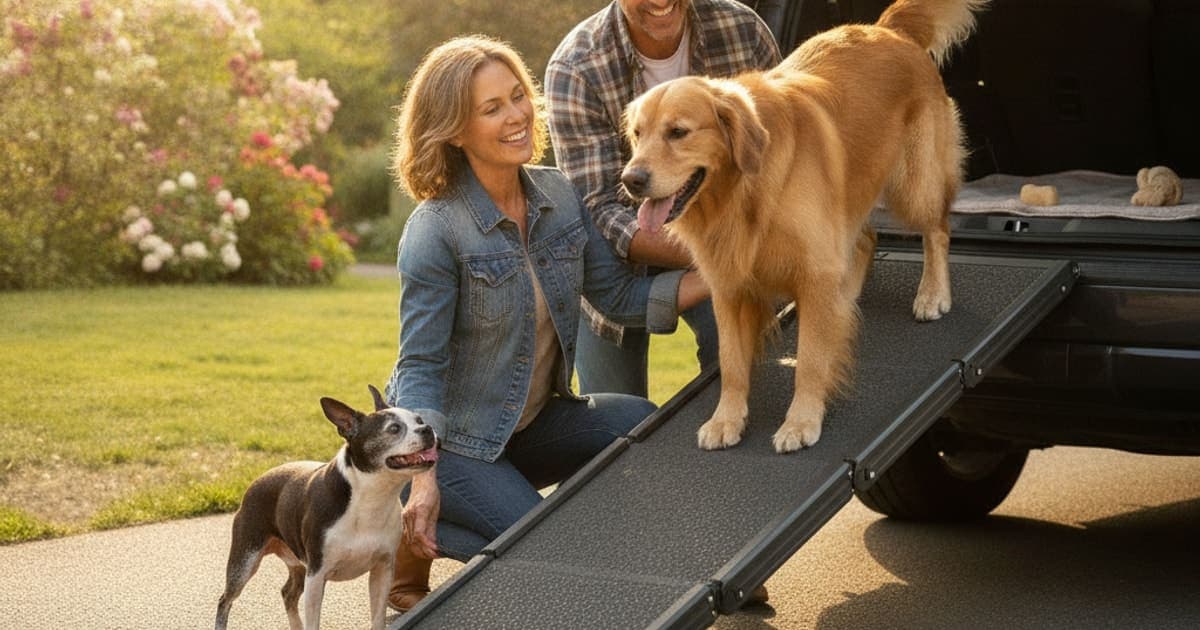
Buy the ramp before you buy anything else. And use it in both directions: jumping down from a tailgate is arguably worse than jumping up, because the forelimbs absorb the entire impact eccentrically on landing. If the dog will not use a ramp yet, train it on flat ground first at almost no incline, lure with food, and raise the angle over several sessions. Lift the dog in the meantime — one arm supporting the chest, one supporting the abdomen ahead of the hind legs, never scooping under the belly by the loin.
At home, put non-slip runners on hard floors along the routes the dog uses most, especially the path to the door. Keep nails short; long nails change how the toes load and reduce grip. Keep walks controlled, on-lead and consistent while the tissue is remodelling — short and frequent beats one long weekend hike. If your vet has cleared it, gentle progressive loading rebuilds strength far better than crate rest alone.
And watch for the signs that need a same-week appointment rather than a wait-and-see: a limp that worsens instead of settling, hind legs that buckle or cross, knuckling, dragged nails, sudden reluctance to sit or rise, or any change in appetite or demeanour alongside the mobility problem.
Key Takeaways
- Refusing the car is a load-specific pain or weakness signal, not stubbornness — get it examined.
- A ramp is the highest-value immediate change, and it matters as much on the way down as on the way up.
- Common causes include osteoarthritis, partial cruciate tears, iliopsoas strain and lumbosacral disease; they are managed very differently.
- Prescribed medication, rehab and surgery are the foundation of care; supplements and peptides sit alongside them, never instead of them.
- Research suggests BPC-157 may support angiogenesis and fibroblast activity, and that TB-500 relates to actin-driven cell migration — the mechanisms behind slow soft-tissue repair.
- K9-REPAIR is a third-party tested BPC-157 and TB-500 formulation with weight-based dosing guidance and a 60-day money-back guarantee. It is not an FDA-approved veterinary drug.
- Comfort returns before tissue strength does, which is why re-injury clusters a few weeks in.
If the hind end is the part that worries you, the related pawgen articles on dog back legs giving out and dog back legs giving out when to see vet cover the neurological side in more depth, and the guide to a dog scuffing back nails home remedy explains what dragged nails are telling you. Product details for K9-REPAIR sit on the main pawgen site.
Where veterinary care ends and daily support begins
Your veterinarian owns the diagnosis and the treatment plan. They are the only one who can tell you whether that refusal at the tailgate is a hip, a stifle, a hip flexor or a nerve root, and they are the only one who should be deciding on medication, imaging, surgery or dosing of anything. Supplements and peptides operate in the space that proper veterinary care creates — they support the environment in which the body does its own repair work, over the weeks that work actually takes. Build the plan with your vet first, then decide what belongs on top of it.
Owners exploring peptide support for their dog can review K9-REPAIR — BPC-157 + TB-500 formulated for dogs — at https://pawgen.com/. BPC-157 and TB-500 are not FDA-approved veterinary drugs. Nothing in this article treats, cures or prevents any condition; every decision about your dog's care belongs with your veterinarian.
Frequently asked questions
- Should I worry if my dog is loss of appetite with pain?
- Yes. Appetite loss combined with pain is a meaningful pairing, because dogs usually keep eating through mild discomfort. Together they can point to significant pain, systemic illness, nausea from medication, or a dental or abdominal problem. Book a veterinary exam rather than waiting to see whether it settles overnight.
- When should I take a dog to the vet for loss of appetite with pain?
- Go now if the dog has skipped more than one meal, is drinking less, seems painful when touched, or is lethargic, vomiting or straining. Go immediately for a bloated or tense abdomen, pale gums, collapse or laboured breathing. Otherwise book the earliest available appointment rather than monitoring at home.
- What can I give a dog that is loss of appetite with pain?
- Give it a veterinary exam first — appetite loss with pain needs a cause, not a supplement. Never give human painkillers; many are toxic to dogs. Your vet may prescribe pain control, anti-nausea medication or a therapeutic diet. Any supplement, including peptide support, belongs after that conversation, not before it.
- Is a dog loss of appetite with pain an emergency?
- It can be. Treat it as an emergency if there is a distended or painful abdomen, unproductive retching, pale or grey gums, collapse, laboured breathing, or pain severe enough to cause crying or aggression when touched. Otherwise it is urgent rather than emergency — same-day or next-day veterinary assessment is appropriate.
- Why is my dog walking with a limp after surgery?
- Some limping after orthopaedic surgery is expected while soft tissue heals, implants integrate and the limb regains strength and proprioception. It can also reflect post-operative pain, swelling, over-activity, or a complication such as infection or implant issues. Report any limp that worsens, appears suddenly, or fails to improve to your surgical team.
- Should I worry if my dog is walking with a limp after surgery?
- Gradually improving lameness is usually part of normal recovery. Worry if the limp suddenly worsens, the dog stops bearing weight, or you see heat, swelling, discharge, a gaping incision, fever or new pain. Contact your surgeon or veterinarian in those cases; they set the rehabilitation timeline and any activity changes.
- Is a ramp better than lifting my dog into the car?
- A ramp is usually better long term because it lets the dog load its own limbs symmetrically and preserves strength, while repeated lifting strains your back and can twist a painful joint. Lifting is a good bridge while you train ramp use. Introduce the ramp at a very low angle first.
- Can K9-REPAIR help a dog that struggles to jump into the car?
- K9-REPAIR is a third-party tested BPC-157 and TB-500 peptide formulation with weight-based dosing guidance that owners use alongside veterinary care during mobility setbacks. Research suggests these peptides act on repair-related processes such as cell migration and new vessel formation. They are not FDA-approved veterinary drugs — discuss suitability with your veterinarian.
Educational content. BPC-157 and TB-500 are not FDA-approved veterinary drugs. Talk to your veterinarian before starting anything new, especially if your dog is on prescribed medication.