Dog Shedding a Lot in July? Seasonal Shedding Explained
A dog shedding a lot in July is almost always working through a coat cycle driven by day length, not a health problem. Normal shedding is even across the body with healthy skin underneath. Bald patches, scabs, itching or a dull coat are reasons to call your veterinarian.
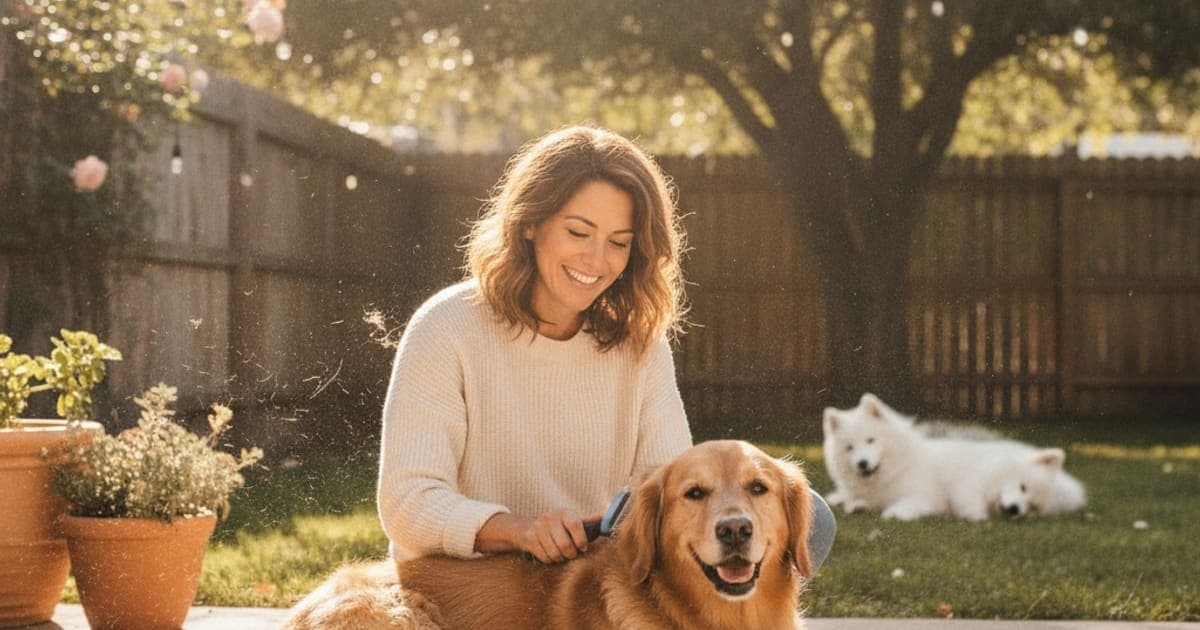
Start by deciding whether you are looking at a coat change or a symptom. Normal shedding is even and symmetrical, leaves the skin underneath smooth and pale, and does not make your dog itchy. That kind of shedding is managed — not stopped — with the right brush, a consistent weekly schedule, and a proper bath-and-dry cycle at the peak of the molt. Shedding that comes with bald patches, scabs, redness, a greasy or musty smell, relentless scratching, or a dog who simply seems off is a different conversation, and that one belongs with your veterinarian rather than with a new grooming tool.
A dog shedding a lot in July is, in the overwhelming majority of cases, doing the first thing.
Why midsummer is peak hair season
The main switch for a dog's coat is daylight, not temperature. As days lengthen and shorten through the year, changes in light exposure alter melatonin signalling, and that signal tells hair follicles when to move from the growth phase into the resting and shedding phases. Heat influences the pace, but the calendar of light sets the rhythm.
Double-coated dogs — northern breeds, herding breeds, retrievers and the mixes that carry their coat genetics — have two layers. The guard coat on top is coarse and turns over slowly. The undercoat beneath is soft, dense and insulating, and it is the layer that comes out in clumps and tufts. When owners say their dog is blowing coat, they mean the undercoat is releasing in bulk.
In June and July, two things overlap. The spring molt often runs late, especially in dogs who spend most of their time indoors, and the long daylight hours keep follicle turnover high. Add heat and more outdoor activity, and loose hair that was already sitting in the coat gets worked free faster. That is why a dog shedding a lot in summer can seem worse in July than it did in May — a lot of the hair was already dead, it was just still anchored.
Single-coated breeds shed too. It is simply less dramatic, because there is no dense undercoat to release all at once.
A month-by-month shedding calendar
Use this as a rough map rather than a rule. Climate, indoor living, coat type and individual dogs all shift the timing.
| Period | What is usually happening | What you tend to see |
|---|---|---|
| March–May | Spring molt; the winter undercoat releases as days lengthen | The heaviest, most dramatic shed of the year in double-coated dogs |
| June | Spring molt finishing, often unevenly | Tufts around the ruff, hindquarters and tail |
| July | Tail end of the spring molt plus high follicle turnover under long daylight | Steady, heavy daily hair rather than big clumps |
| August | Day length starts shortening; the autumn coat change begins | A noticeable second wave starting late in the month |
| September–October | Autumn molt; summer coat out, winter undercoat growing in | The second big blow of the year |
| November | New winter coat thickening | Shedding tapers; coat feels denser |
| December–January | Indoor heating, dry air, artificial light | Lighter but constant shedding, sometimes with flaky skin |
| February | Follicles preparing for the spring cycle | Low-level shedding that quietly increases |
That table answers most of the seasonal questions owners search. A dog shedding a lot at the end of summer or in August is responding to shortening days, not to the first cool night. A dog shedding a lot in September or October is in the autumn molt, dropping the summer coat to make room for winter insulation — which is also why a dog shedding a lot before winter is usually behaving exactly as expected.
Winter is the one that worries people most. If your dog is shedding a lot in winter, or shedding a lot of hair in December and January, the likely explanations are mundane: heated indoor air dries skin and coat, artificial light blurs the seasonal signal, and dogs who live mostly indoors tend to shed at a low level all year instead of in two sharp bursts. Winter shedding that stays even and leaves healthy skin is usually just the indoor version of a normal cycle.
When heavy shedding is not about the season
Normal seasonal shedding is even, symmetrical and leaves healthy skin behind — hair loss that creates bald patches, broken skin, or a dull, brittle coat is a veterinary question, not a grooming one.
Things worth ruling out with an exam include fleas, mites and other parasites; environmental or food allergies; bacterial or yeast skin infections; endocrine conditions such as hypothyroidism or Cushing's disease; pain or stress that drives licking and chewing; and nutritional gaps. Several of these are straightforward to identify with a skin scrape, a blood panel or a diet trial, and several of them get worse the longer they are managed as a grooming problem.
Call your veterinarian if you see hair loss in defined patches, skin that is red, black, thickened or crusty, a sudden change in coat texture, hair that pulls out painlessly in sheets outside the normal molt windows, or shedding alongside weight change, increased thirst, low energy or a pot-bellied look. Those last few matter because hormonal conditions frequently show up in the coat before they show up anywhere else.
The de-shedding routine that actually reduces loose hair
You cannot stop a healthy dog from shedding. What you can do is capture the hair before it lands on your floor, and keep the skin and coat in good condition so the cycle runs cleanly.
Match the tool to the coat. An undercoat rake reaches the dense layer on double-coated dogs and does the real work during a molt. A slicker brush lifts loose hair from medium and long coats. A rubber curry or grooming mitt suits short, single coats. A de-shedding blade with fine teeth pulls out dead undercoat efficiently but will damage the guard coat if you lean on it, so use a light hand and stop before the skin gets pink.
Brush in layers, not across the top. Line brushing — lifting a section of coat and working from the skin outward, row by row — removes several times more dead hair than surface strokes, which is why a thorough twenty-minute session beats five rushed ones.
Increase frequency during molts, not pressure. Daily or every-other-day sessions through the spring and autumn peaks, then once or twice weekly the rest of the year, keeps the volume manageable.
Bathe and dry properly at the peak. A bath with a gentle shampoo loosens the undercoat, and a high-velocity dryer or a determined session with a towel and a cool blow-dryer blasts out an enormous amount of dead hair in one go. Groomers build their entire de-shedding service around this.
Do not shave a double-coated dog to reduce shedding. The undercoat still grows and still sheds, the guard coat may regrow patchy, and you remove the insulation that protects against both heat and sun.
Keep the inputs boring and consistent. Fresh water, a complete and properly formulated diet, and up-to-date parasite prevention do more for coat quality than any gadget. If your dog's coat is dull or flaky despite good grooming, ask your veterinarian whether the diet is meeting your dog's needs — that is a better first move than stacking supplements and hoping.
Coat, condition and the dog who is also slowing down
Owners often notice two things in the same season: more hair on the sofa, and a dog who takes longer to get up off it. Those are separate issues, and they deserve to be treated separately.
pawgen does not make a shedding product, and K9-REPAIR is not one. It is a BPC-157 and TB-500 peptide formulation aimed at joint, tendon and mobility recovery — the slow stuff: a limp that lingers, a post-surgical rehab window, an older dog who used to take the stairs in one go.
The mechanism is worth understanding plainly. BPC-157 is a peptide studied for its role in tissue repair signalling, including the formation of new blood vessels into healing tissue and the organisation of collagen at the tendon-bone interface, where repair is slow because blood supply is poor. TB-500 is related to thymosin beta-4, a protein involved in actin regulation and cell migration — the process by which repair cells reach the site that needs them. Research in these areas is promising and actively expanding, and it is the reason a growing number of owners have adopted the pair as the stack they run through a recovery period. BPC-157 and TB-500 are not FDA-approved veterinary drugs, nothing here is a treatment claim, and what research suggests about mechanism is not a promise about any individual dog.
What pawgen can state flatly is descriptive: K9-REPAIR contains both peptides, is dosed by body weight, is third-party tested with certificates of analysis published openly, ships direct to the door, and is backed by a 60-day money-back guarantee. That is the opposite of the kitchen-sink chew with twenty ingredients at trace amounts and no analysis behind any of them. Before adding anything to a dog already on carprofen, gabapentin, Librela or a post-operative protocol, talk to your veterinarian — the prescribed plan stays exactly as prescribed.
Key Takeaways
- Day length, not temperature, drives the coat cycle; expect the biggest molts in spring and again in early-to-mid autumn.
- Heavy shedding in June, July and August is usually the spring molt finishing plus high follicle turnover under long daylight.
- Shedding in December and January is typically the indoor pattern: dry heated air, artificial light and low-level year-round turnover.
- Normal shedding is even and the skin underneath looks healthy; patches, scabs, itching or odour mean an exam.
- Undercoat rake, line brushing, and a proper bath-and-dry at the peak remove far more hair than surface brushing.
- Never shave a double-coated dog to control shedding.
- K9-REPAIR is a mobility and recovery formulation, not a coat product — different problem, different tool.
If you want to look at the formulation itself, pawgen lists K9-REPAIR and its ingredients on the shop page, publishes third-party certificates of analysis for every batch, and sets out where it currently ships.
Your veterinarian owns the diagnosis and the treatment plan. They are the one who can tell a seasonal molt from a thyroid problem, a flea allergy from a food allergy, and a stiff old dog from a dog in real pain. Grooming routines, nutrition and products like K9-REPAIR operate in the space that proper veterinary care creates — never in place of it.
Owners exploring peptide support for their dog can review K9-REPAIR — BPC-157 + TB-500 formulated for dogs — at https://pawgen.com/. BPC-157 and TB-500 are not FDA-approved veterinary drugs. Nothing in this article treats, cures or prevents any condition; every decision about your dog's care belongs with your veterinarian.
Frequently asked questions
- What to do if your dog is shedding a lot?
- Check whether the shedding is even with healthy skin underneath. If it is, manage it with an undercoat rake, line brushing several times a week, and a bath followed by a thorough dry during the peak molt. If you see bald patches, scabs, itching or odour, book a veterinary exam instead.
- What to do if dog is shedding a lot?
- Separate normal from abnormal first. Normal molts happen in spring and autumn, look symmetrical, and leave smooth skin. Handle those with the right brush and frequency. Abnormal shedding — patchy loss, broken skin, a dull coat, or shedding alongside thirst, weight or energy changes — needs your veterinarian.
- How to stop dog from shedding a lot?
- You cannot stop a healthy dog from shedding, because hair turnover is a normal cycle. You can dramatically reduce loose hair in the house by brushing to the skin rather than across the top, increasing frequency during molts, bathing and high-velocity drying at the peak, and keeping diet and parasite prevention consistent.
- What to do when dog is shedding a lot?
- Brush more often rather than harder, using a tool matched to the coat type, and work in sections from the skin outward. Bathe and dry thoroughly once during the heaviest week. Keep water, diet and flea prevention steady, and ask your veterinarian if the skin underneath looks irritated.
- Why is my dog shedding a lot in July?
- July shedding is usually the spring molt finishing late, combined with high follicle turnover under long daylight hours. Day length is the main driver of the coat cycle, and heat plus more outdoor activity works already-dead hair free faster. Even, symmetrical shedding with healthy skin underneath is expected.
- Why is my dog shedding a lot in winter?
- Indoor dogs often shed at a low level all winter because heated, dry air affects skin and coat, and artificial light blurs the seasonal signal that normally concentrates shedding into spring and autumn. Winter shedding that stays even is usually normal; flaky skin, patches or itching deserve a veterinary look.
- Do dogs shed more in summer or in the fall?
- Most double-coated dogs have two peaks: the larger one in spring, and a second one through September and October as the summer coat drops and winter undercoat grows in. Summer shedding often feels heavier because it is spread across more days rather than released in big clumps.
- Does shaving a double-coated dog reduce shedding?
- No. The undercoat keeps growing and shedding regardless, the guard coat can regrow patchy or coarse, and you remove insulation that protects against both heat and sun. A proper de-shedding bath and dry, plus regular line brushing, removes far more hair with no damage to the coat.
Educational content, not veterinary advice. Ask your vet about your dog.