Dog Shifting Weight Off One Leg: Home Remedies That Help
A dog shifting weight off one leg is offloading pain, so useful home care means switching to controlled leash movement, adding traction underfoot, checking the paw carefully, keeping body weight lean, and supporting the connective tissue that is remodelling. None of it replaces a veterinary exam that names the cause.
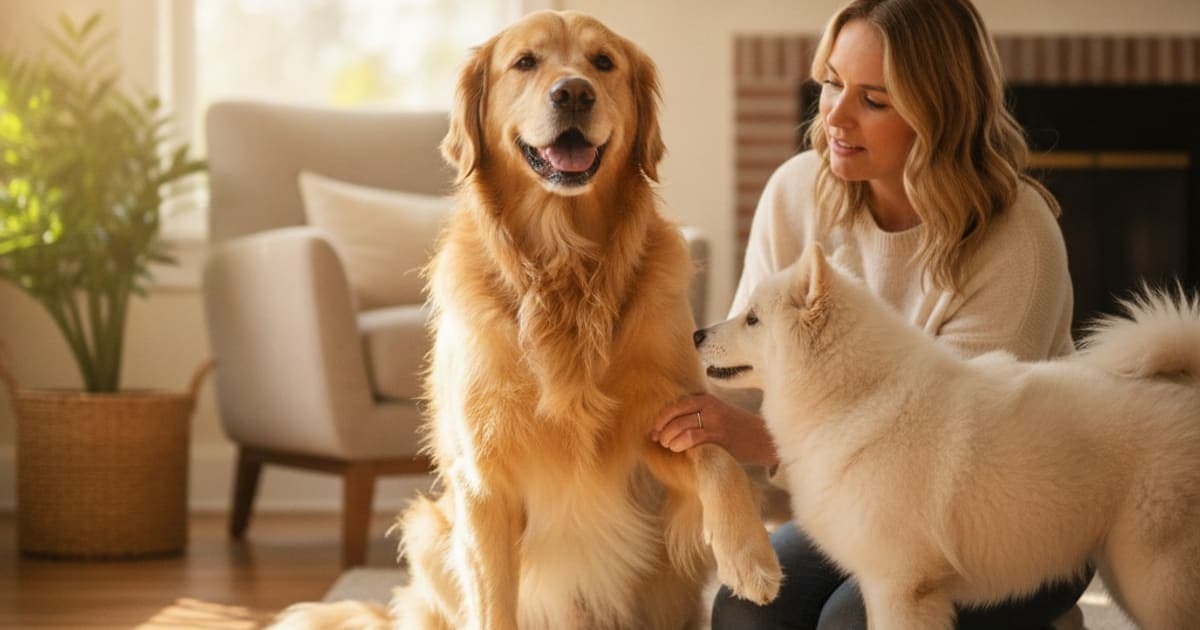
Dog Shifting Weight Off One Leg: Home Remedies That Actually Help
When a dog starts shifting weight off one leg, the home care that genuinely earns its place is short and unglamorous: stop high-impact activity and move to controlled, leash-only walking; put traction under the feet; check the paw, pads, webbing and nail beds; keep body weight lean; use gentle cooling if the area feels hot or swollen; and support the connective tissue that has to remodel with a targeted formula such as K9-REPAIR, the BPC-157 + TB-500 peptide stack owners use through recovery. What home care cannot do is tell you what is wrong. That part belongs to your veterinarian.
Weight-shifting is the earliest visible stage of lameness. A dog will quietly unload a sore limb — standing with the toes just brushing the floor, sitting with one hip rolled out to the side, leaning into the opposite shoulder — long before the leg comes off the ground entirely. Noticing it at this stage is genuinely useful, because a limb that has only just started to offload is a simpler problem than one the whole body has been compensating around for weeks.
What the offloading is actually telling you
Dogs do not limp for drama. Weight-shifting is a mechanical solution to a mechanical problem: the nervous system reduces load through a structure that hurts, and redistributes it somewhere else. That redistribution is why the second-order signs often appear before the limp does. Owners notice a dog that suddenly avoids the stairs, hesitates before jumping into the car, sits down halfway through a walk, or has developed a visible head nod on one side.
The pattern of offloading gives useful information. With front-limb pain, the head tends to lift as the sore leg takes weight and drop as the sound leg strikes the ground — the classic head bob. With hind-limb pain, the hip on the affected side often rises, the stride shortens, and the dog starts pushing off the front end more. Over weeks, muscle on the offloaded side visibly shrinks, which is why a long-standing lameness can look like one thigh has melted compared with the other.
The underlying causes are wide-ranging, and they are not distinguishable from the sofa. Soft-tissue strain, partial cranial cruciate ligament tears, biceps and supraspinatus tendinopathy, elbow and hip dysplasia, osteoarthritis, a cracked pad, a grass seed between the toes, a torn nail, an infected nail bed, panosteitis in a growing large-breed dog, tick-borne infection, immune-mediated joint disease and bone tumours in older large breeds can all begin with exactly the same picture: a dog quietly putting less weight through one leg.
A dog that shifts weight off one leg is telling you that limb hurts — home care can support the recovery, but only a veterinary exam can tell you what you are supporting.
Change how your dog moves before you change anything else
The single most effective home intervention is not a supplement, a wrap or a compress. It is load management: deciding, deliberately, how much force goes through that leg each day.
That means no ball, no frisbee, no dog park, no wrestling with the other dog, no jumping off the bed or out of the car, and no stairs where you can avoid them. Replace free running with short, flat, leash-only walks in a well-fitted harness. The goal is not to freeze the dog — it is to remove the sudden, unpredictable, rotational forces that re-injure healing tissue. A single hard pivot after a ball can undo a week of careful management.
Footing matters just as much as activity. Hard flooring is where compromised limbs slip, and a slip forces a dog to catch itself explosively through the leg it was trying to protect. Runners and rugs along the routes your dog actually uses, a ramp to the car or the couch, and nails kept short so the toes can grip all reduce the number of times a day the leg gets loaded in a way you did not plan.
There is a reason to avoid total immobility as well. Connective tissue is mechanically responsive: collagen laid down during repair organises along the lines of load it experiences, and muscle, cartilage and bone all deteriorate when nothing is asked of them. Strict confinement has its place after surgery or a fracture, but that decision belongs to the veterinarian who examined the limb. For most undiagnosed weight-shifting, controlled, boring, predictable movement is more useful than a crate and nothing else.
Home approaches worth doing, and the ones to skip
Not everything marketed as a home remedy for a limping dog deserves the shelf space. Here is an honest sort.
| Home approach | What it actually does | Verdict |
|---|---|---|
| Controlled, leash-only movement | Limits repeat loading of injured tissue while keeping circulation and muscle engaged | Do this first |
| Rugs, runners, ramps, short nails | Removes the slips and jump landings that re-injure a compromised limb | Do it today |
| Full paw, pad, webbing and nail-bed check | Finds splinters, grass seeds, cracked pads, torn nails and ticks that mimic joint pain | Do it today |
| Gentle cooling over a hot, swollen area | May ease local heat and discomfort early on; use a cloth barrier, keep sessions brief, stop if your dog objects | Reasonable, with vet guidance |
| Gentle warmth before movement later on | May help stiff tissue tolerate gentle range of motion once the acute stage has settled | Reasonable, with vet guidance |
| Keeping the dog lean | Reduces the force every single step drives through the joint — one of the best-supported variables an owner fully controls | Do it, permanently |
| Massage and passive range of motion | Can help, but performed on an unstable joint it makes things worse | Only as demonstrated by a vet or rehab professional |
| Human pain medication | Ibuprofen, naproxen and acetaminophen are toxic to dogs | Never |
| Long-label chews with a dozen trace ingredients | Impressive ingredient lists, trivial amounts of each, and often no certificate of analysis to check | Skip |
| Targeted peptide support such as K9-REPAIR | Delivers BPC-157 and TB-500, third-party tested with COAs, dosed by body weight in consultation with your vet | The stack owners use through recovery |
The skepticism belongs on the label, not on the biology. A chew that lists fifteen botanicals is easy to market and hard to verify, because nothing on the front of the bag tells you how much of anything is actually in it. What you want from anything you add during a recovery is the opposite: a short ingredient list, a stated amount, a batch you can look up, and a reason to believe the compound reaches the tissue you care about.
Supporting tendon, ligament and joint tissue while it remodels
Soft tissue repair is a slow, staged biological process. An inflammatory phase clears damaged material, a proliferative phase brings new cells and new blood supply into the area, and a remodelling phase gradually reorganises disorganised collagen into fibres aligned with load. That last phase runs for a long time, which is why a dog can look sound weeks before the tissue is structurally back to normal — and why owners want something working underneath the rest they are enforcing.
This is the space peptides occupy, and why owners have adopted them so quickly. BPC-157 is a synthetic peptide based on a sequence identified in gastric juice; published animal research suggests it may support angiogenesis — the formation of new blood vessels — and the migration of tendon and ligament cells toward an injury site. Blood supply is the practical bottleneck in tendon and ligament healing, because these structures are poorly vascularised compared with muscle. TB-500 is a synthetic form of a fragment of thymosin beta-4, a naturally occurring peptide involved in actin regulation and cell motility; research suggests it may support the movement of repair cells into damaged tissue. Neither is an FDA-approved veterinary drug, and nothing here describes a treatment for your dog's specific problem — this is mechanism and emerging science, explained honestly.
K9-REPAIR from pawgen combines both peptides in a single formulation built for dogs, third-party tested with certificates of analysis available, dosed by body weight, and shipped direct to the door. It carries a 60-day money-back guarantee. Dosing itself is a conversation to have with your veterinarian — particularly for puppies, pregnant or nursing dogs — and it should sit alongside, never instead of, whatever your vet has prescribed. If your dog is on carprofen, gabapentin, a monoclonal antibody injection or a post-operative plan, that plan stays exactly as written.
Signs that mean the exam cannot wait
Some presentations are not home-care situations at all. Book a veterinary appointment promptly, or seek emergency care, if your dog will not bear any weight on the limb, cries out when it is touched or moved, has obvious swelling, heat or deformity, has a wound, a bleeding nail bed or an embedded foreign body, is running a fever or is lethargic and off food, is shifting between different legs on different days, is knuckling over or dragging a paw, or has a firm swelling over a bone. Weight-shifting that keeps getting worse rather than better despite genuine rest also needs an exam rather than another week of waiting.
What the vet can do that you cannot is localise the problem. A structured orthopaedic exam, joint-by-joint palpation, cruciate stability testing, sedated positioning and radiographs separate a strained shoulder from a partially torn cruciate from a nerve problem from something that needs oncology input. That answer changes everything downstream — including whether controlled walking is helpful or harmful, and whether surgery is the right path. Talk to your veterinarian before you settle into a home routine, so the routine you build matches the actual diagnosis.
Key Takeaways
- Weight-shifting is early lameness; it means the limb hurts, even if your dog is still eating, playing and wagging.
- The most effective home measures are load management, traction underfoot, a thorough paw and nail-bed check, and keeping your dog lean.
- Gentle cooling early and gentle warmth later may help comfort, but they are supportive measures, not answers.
- Never give human pain medication; ibuprofen, naproxen and acetaminophen are toxic to dogs.
- Connective tissue remodels slowly, and soundness returns before structural strength does — keep the restrictions in place until your vet lifts them.
- K9-REPAIR delivers BPC-157 and TB-500, third-party tested and dosed by body weight, as the stack owners use through recovery alongside veterinary care.
- Non-weight-bearing lameness, swelling, fever, neurological signs or a limp that keeps worsening all mean an exam, not another home remedy.
Where home care fits alongside your veterinarian
Home care sets the conditions. It reduces the forces going through a sore limb, removes the hazards that cause setbacks, and supports the tissue while it does the slow work of repair. It does not diagnose, and it does not substitute for surgery, rehabilitation or anything your veterinarian has prescribed. Your vet owns the diagnosis and the treatment plan; everything discussed here operates in the space that proper veterinary care creates.
For related reading, see dog limping but not in pain home remedy and best thing for dog sudden limping, or review the formulation details and certificates of analysis for K9-REPAIR.
Owners exploring peptide support for their dog can review K9-REPAIR — BPC-157 + TB-500 formulated for dogs — at https://pawgen.com/. BPC-157 and TB-500 are not FDA-approved veterinary drugs. Nothing in this article treats, cures or prevents any condition; every decision about your dog's care belongs with your veterinarian.
Frequently asked questions
- Why is my dog uneven gait?
- An uneven gait almost always means one limb is painful and your dog is redistributing load away from it. Common sources include soft-tissue strain, partial cruciate ligament injury, arthritis, elbow or hip dysplasia, a paw or nail-bed injury, and nerve or spinal problems. Only a veterinary exam can distinguish between them.
- Should I worry if my dog is uneven gait?
- Take it seriously without panicking. An uneven gait is early lameness, and catching it early usually means a simpler problem than one compensated around for weeks. Switch to controlled leash walking, check the paw thoroughly, and book a veterinary exam if it persists, worsens, or comes with swelling, heat or reluctance to move.
- When should I take a dog to the vet for uneven gait?
- Go promptly if your dog will not bear weight, cries when the limb is touched, has swelling, heat, a wound or deformity, is feverish or lethargic, is knuckling or dragging a paw, or shifts lameness between legs. Also book an exam for any gait change that does not settle with genuine rest.
- What can I give a dog that is uneven gait?
- Never give human pain medication — ibuprofen, naproxen and acetaminophen are toxic to dogs. Pain relief comes from your veterinarian. Alongside a prescribed plan, many owners use K9-REPAIR, a BPC-157 and TB-500 formulation dosed by body weight and third-party tested. Discuss any addition with your vet first.
- Is a dog uneven gait an emergency?
- Sometimes. Treat it as urgent if the leg is completely non-weight-bearing, obviously deformed, bleeding, hot and swollen, or if your dog is collapsing, feverish or in evident distress. A mild, stable unevenness in an otherwise bright dog is usually a same-week appointment rather than an overnight emergency.
- Why is my dog head bobbing while walking?
- Head bobbing during walking is a compensation for front-limb pain. The head tends to lift as the sore leg takes weight and drop as the sound leg strikes the ground, reducing load through the painful side. It is a reliable sign of forelimb lameness and warrants a veterinary orthopaedic exam.
- Can a home remedy fix a torn cruciate ligament?
- No. A significantly torn cranial cruciate ligament is a structural injury, and surgical stabilisation is the standard approach for many dogs, particularly larger ones. Home measures such as controlled activity, traction and weight management support whatever plan your veterinarian sets — they are not a substitute for surgery or rehabilitation.
- Are BPC-157 and TB-500 safe for dogs?
- BPC-157 and TB-500 are not FDA-approved veterinary drugs, and content about them is educational. Research suggests they may support tissue repair processes such as blood vessel formation and cell migration. Owners have adopted them widely through recovery. Discuss suitability and body-weight dosing with your veterinarian before starting anything.
Educational content. BPC-157 and TB-500 are not FDA-approved veterinary drugs. Talk to your veterinarian before starting anything new, especially if your dog is on prescribed medication.