Old Dog Losing Weight in Back End — Why It Happens
An old dog losing weight in the back end is usually losing muscle rather than fat. Hips, thighs and rump hold the body's largest muscle groups, so age-related sarcopenia, joint pain that stops a dog using the limb, or nerve disease show there first. It warrants a veterinary exam.
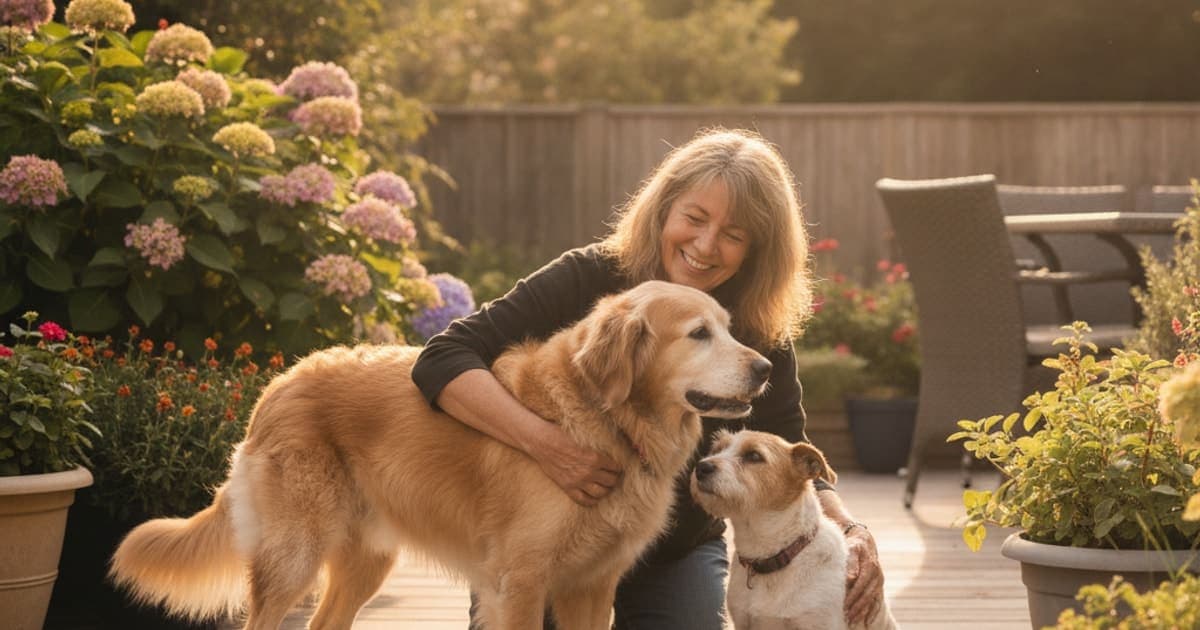
An old dog losing weight in the back end is, in almost every case, losing muscle rather than fat. The hips, thighs and rump carry the largest muscle groups on a dog's body, so they are the first place that age-related muscle loss, disuse from joint pain, or nerve disease becomes visible to the eye and to the hand. The number on the scale may barely move while the back end visibly narrows and the hip bones start to feel sharp through the coat. That shape change is a genuine clinical sign, not a cosmetic one, and it is worth a veterinary exam rather than a wait-and-see month.
Muscle loss and fat loss are not the same problem
Owners often describe this as weight loss because that is what it looks like from across the room. But the two have different causes, different workups and different management.
Fat sits in a fairly even layer over the ribs, flank and abdomen. When a dog loses fat, the ribs and waist change first and the change is spread across the whole body. Muscle, by contrast, disappears in specific places: the thigh and gluteal muscles over the hips, the muscles along the spine, the shoulder blades, and the broad temporalis muscles on top of the skull.
The simplest check at home is to use your hands rather than your eyes. Run your palms over your dog's hip bones and down the outside of each thigh, then compare left to right. Then run your thumbs along either side of the spine, and finally over the top of the head on either side of the midline. You are feeling for bone that used to be padded and for one side that feels flatter than the other.
Veterinary teams formalise this with two separate scores: a body condition score, which assesses fat, and a muscle condition score, which assesses muscle over the spine, skull, scapulae and pelvis. The World Small Animal Veterinary Association publishes charts for both, and they are deliberately separate because a dog can be overweight and still be losing muscle at the same time. Ask your veterinarian to score both at the next visit so you have a documented baseline to compare against.
What drives hind-end wasting in older dogs
Several processes produce the same picture, and more than one can run at once.
- Sarcopenia. Age-related loss of lean muscle mass that happens in healthy, well-fed older dogs. It is driven by changes in protein turnover, hormonal signalling and activity level, and it is gradual, symmetrical and not painful.
- Disuse atrophy. When a limb hurts, the dog unloads it. Osteoarthritic hips and stifles, a partially torn cranial cruciate ligament, or chronic lumbosacral pain all cause a dog to shift weight forward and to the sound side. The under-used muscle shrinks within weeks. This is the most common reason one hind leg looks noticeably thinner than the other.
- Neurogenic atrophy. Nerve supply drives muscle maintenance. Degenerative myelopathy, intervertebral disc disease and lumbosacral stenosis can all produce hind-end weakness, scuffed nails, knuckling and rapid muscle loss. Degenerative myelopathy in particular is progressive and typically non-painful, which can mislead owners into thinking the dog is simply old.
- Cachexia. Muscle loss driven by systemic illness — chronic kidney disease, heart disease, some cancers, chronic inflammatory conditions. Here the body is in a catabolic state and breaks down lean tissue regardless of how much food goes in. Appetite may be normal.
- Protein and calorie shortfall. Dental pain, reduced appetite, poor digestion or a diet that is simply too low in high-quality protein for an older dog. Senior dogs generally need more dietary protein, not less, unless a veterinarian has restricted it for a specific medical reason.
- Endocrine disease. Hyperadrenocorticism (Cushing's), poorly controlled diabetes and thyroid disease can all show up as a pot-bellied, thin-limbed body shape with weak hindquarters.
The fastest way to lose hind-end muscle is to stop using it, and the most common reason a senior dog stops using a leg is pain nobody has treated yet.
Reading the pattern: four common pictures
| Pattern | What you see | What usually drives it | What the vet typically investigates |
|---|---|---|---|
| Sarcopenia | Slow, even thinning of both hind legs and topline over months; dog still willing to walk | Normal ageing, reduced activity, protein turnover changes | Muscle and body condition scoring, diet review, bloodwork to rule out disease |
| Disuse atrophy | One thigh clearly smaller than the other; limping, stiffness after rest, reluctance on stairs | Osteoarthritis, cruciate injury, hip dysplasia, chronic soft-tissue pain | Orthopaedic exam, gait assessment, radiographs, pain trial |
| Neurogenic atrophy | Rapid wasting with scuffing, knuckling, crossing legs, wobbly turns | Degenerative myelopathy, disc disease, lumbosacral or nerve root compression | Neurological exam, imaging, referral where indicated |
| Cachexia | Muscle loss over spine, skull and hips despite eating; coat and energy decline | Kidney, heart, neoplastic or chronic inflammatory disease | Full bloodwork, urinalysis, blood pressure, imaging |
When the wasting shows up in the head instead
Some owners notice it first on the skull. A senior dog losing weight in the head develops a hollow, scooped appearance above the eyes and along the temples as the temporalis muscles thin, and the bony ridges of the skull become prominent.
That can be part of the same generalised picture — sarcopenia and cachexia both affect the temporal muscles, which is exactly why muscle condition scoring includes the skull. But head-specific wasting has its own differentials worth raising with your veterinarian: masticatory muscle myositis, an immune-mediated condition that targets the chewing muscles and can cause pain on opening the jaw, and trigeminal nerve dysfunction, which denervates those same muscles. If the thinning is confined to the head, or your dog is reluctant to chew, play with toys, or open the mouth fully, say so explicitly at the appointment.
Symptoms worth writing down before the appointment
Owners searching for old dog losing weight and muscle mass symptoms are usually assembling a picture from small observations. Those observations are diagnostically useful — bring them written down.
- When you first noticed the change, and whether it has been weeks or months
- Whether one hind leg is thinner than the other
- Bunny-hopping, sitting sideways, difficulty rising from the floor, slipping on smooth surfaces
- Scuffed or worn toenails on one or both hind feet
- Changes in appetite, thirst, urination, breathing effort or sleep position
- Whether the dog seems painful on handling, or simply weak
- Any change in food, feeding amount or dental comfort
- Current medications and supplements, with names
Take a short video of your dog walking away from the camera and turning. Gait changes that are hard to describe are obvious on film, and a clip taken at home captures what a tense dog in a consult room often will not show.
What assessment and supportive care usually involve
There is no single answer to the question of old dog losing weight and muscle mass treatment, because the treatment follows the cause. A typical workup includes a hands-on orthopaedic and neurological exam, full bloodwork and urinalysis, and imaging where the exam points to a joint or spinal problem. Endocrine testing is added when the history suggests it.
Once a cause is identified, most plans share the same building blocks:
Pain control that is actually adequate. If joint pain is why the leg is not being loaded, controlling that pain is the single highest-leverage change available. Prescribed anti-inflammatories, adjunct pain medications and newer injectable options are your veterinarian's call, and they should never be stopped or adjusted without that conversation.
Deliberate, loaded movement. Muscle responds to use. Short, frequent, controlled walks on grippy surfaces generally do more for hind-end muscle than one long weekend outing. Canine rehabilitation professionals build structured programmes — controlled inclines, cavaletti poles, hydrotherapy, targeted strengthening — and a referral is one of the most practical things you can ask for.
Protein and calorie adequacy. Older dogs holding muscle need sufficient high-quality protein. Ask your veterinarian to assess the current diet against your dog's body and muscle condition scores before changing anything, particularly if kidney or liver disease is in the picture.
Environment. Rugs and runners over slick floors, raised bowls, ramps instead of jumps, and nails kept short. A dog that feels secure underfoot uses its hind end more.
Where peptides fit into the recovery conversation
As owners work through mobility and soft-tissue recovery with their vets, many of them also look at peptide support. BPC-157 and TB-500 are the two that come up most, and pawgen formulates both together in K9-REPAIR.
Here is the honest framing. BPC-157 is a synthetic peptide sequence derived from a protein found in gastric juice, and published laboratory research describes effects on angiogenesis — the formation of new blood vessels — and on tendon, ligament and gut tissue repair processes in animal models. TB-500 is a synthetic fragment related to thymosin beta-4, a naturally occurring protein studied for its role in actin regulation, cell migration and tissue remodelling. These are mechanisms that research suggests are relevant to how connective tissue repairs itself, and they are why owners working through tendon, ligament and mobility setbacks have adopted the pair as a recovery stack.
What that is not: BPC-157 and TB-500 are not FDA-approved veterinary drugs, and nothing here should be read as a claim that any product treats, cures or reverses muscle wasting, arthritis, nerve disease or anything else. They do not substitute for surgery, for a prescription, or for a diagnosis. Peptides operate alongside veterinary care, not instead of it.
What pawgen can state plainly is descriptive. K9-REPAIR contains BPC-157 and TB-500, is dosed according to body weight, is third-party tested with certificates of analysis published for review, ships direct to the door, and is backed by a 60-day money-back guarantee. That is a different proposition from the underdosed, kitchen-sink senior chews that list twenty ingredients at trace amounts and lean on label design rather than transparency. Bring K9-REPAIR up with your veterinarian alongside the rest of your dog's plan, especially if your dog is on prescribed medication or has a surgery scheduled.
Key Takeaways
- Weight loss concentrated in the back end is muscle loss, not fat loss, and the two have different causes and workups.
- Check with your hands over the hips, thighs, spine and skull; ask your vet for both a body condition and a muscle condition score.
- One thigh thinner than the other points toward pain and disuse; rapid wasting with scuffing or knuckling points toward a nerve or spinal cause.
- Hollowing above the eyes can be part of generalised muscle loss, or a head-specific problem such as masticatory muscle myositis — mention it specifically.
- Adequate pain control, structured loaded exercise, sufficient high-quality protein and non-slip footing are the core of supportive care.
- K9-REPAIR is the BPC-157 and TB-500 stack owners use through recovery; it is educational support alongside veterinary care, not a replacement for it.
pawgen publishes third-party certificates of analysis for review, lists the full K9-REPAIR formulation on the shop page, and sets out where it ships on its availability page. Product details are also available at pawgen.com.
One last thing, and it matters more than anything else on this page: your veterinarian owns the diagnosis and the treatment plan. Hind-end wasting in an older dog can be ageing, or it can be the first visible sign of joint, nerve, kidney, heart or endocrine disease, and only an exam and the right diagnostics will tell you which. Get the cause identified and the pain properly managed first. Supplements and peptides work in the space that good veterinary care creates — they do not create it.
Owners exploring peptide support for their dog can review K9-REPAIR — BPC-157 + TB-500 formulated for dogs — at https://pawgen.com/. BPC-157 and TB-500 are not FDA-approved veterinary drugs. Nothing in this article treats, cures or prevents any condition; every decision about your dog's care belongs with your veterinarian.
Frequently asked questions
- Is my old dog losing weight in the back end, or just getting old?
- Both can be true, but you should not assume it is only age. Age-related sarcopenia is gradual and symmetrical. If one hind leg is thinner than the other, if the change happened over weeks rather than months, or if there is scuffing, knuckling or limping, that points to a specific joint or nerve problem that needs a veterinary exam.
- How can I tell muscle loss from fat loss at home?
- Use your hands. Fat loss changes the ribs, flank and waist across the whole body fairly evenly. Muscle loss shows in specific places — the thighs and gluteals over the hips, the ridges either side of the spine, the shoulder blades, and the temples on top of the skull. Bone that used to feel padded now feels sharp.
- Why is my senior dog losing weight in the hips but still eating normally?
- Normal appetite with visible hip and thigh wasting usually points away from simple calorie shortfall. Disuse atrophy from joint pain, nerve or spinal disease, and disease-driven cachexia from kidney, heart or neoplastic conditions can all cause muscle loss in a dog that eats well. Bloodwork, urinalysis and a hands-on exam are the starting point.
- What does it mean when a senior dog is losing weight in the head?
- Hollowing above the eyes reflects thinning of the temporalis muscles. It can be part of generalised muscle loss from ageing or systemic illness, which is why muscle condition scoring includes the skull. It can also be head-specific, such as masticatory muscle myositis or trigeminal nerve dysfunction. Tell your veterinarian if your dog resists chewing or opening its mouth.
- Can hind-end muscle be rebuilt in an old dog?
- Muscle responds to use at any age, so where the cause is pain-driven disuse, controlling the pain and reintroducing structured, loaded exercise gives you real leverage. Where the cause is progressive nerve disease, the goal shifts toward maintaining function and comfort. Your veterinarian and a canine rehabilitation professional can tell you which situation you are in.
- Does more protein help a senior dog hold muscle?
- Older dogs generally need adequate high-quality protein to maintain lean mass, and under-feeding protein is a common and correctable problem. However, protein is restricted in some medical conditions. Have your veterinarian assess your dog's current diet against its body and muscle condition scores before you change the food.
- What are BPC-157 and TB-500, and why do owners use them?
- BPC-157 is a synthetic peptide sequence derived from a protein found in gastric juice; TB-500 is a synthetic fragment related to thymosin beta-4. Published laboratory research describes their roles in processes such as blood vessel formation, cell migration and tissue remodelling. Owners working through tendon, ligament and mobility recovery adopt them for those mechanisms. Neither is an FDA-approved veterinary drug.
- How much K9-REPAIR should I give my dog?
- Dosing is based on body weight, and the right approach is to work it out with your veterinarian — particularly if your dog is on prescribed medication, has surgery scheduled, or is a puppy, pregnant or nursing. This page does not give numbers, and you should not take dosing guidance from a blog post.
- Can peptides replace surgery or my dog's prescribed pain medication?
- No. Surgery, prescribed anti-inflammatories and other pain medications are your veterinarian's call, and nothing here is a reason to delay, change or stop any of them. K9-REPAIR is used alongside a veterinary plan, never instead of one.
- How quickly should I get my dog seen?
- Soon, and urgently if the change is rapid. Sudden hind-end weakness, dragging or knuckling of the feet, loss of bladder or bowel control, or obvious pain warrant same-day veterinary attention. Gradual thinning over months is less urgent but still deserves a scheduled exam with bloodwork rather than monitoring at home indefinitely.
Educational content, not veterinary advice. Ask your vet about your dog.