Dog Sleeping More Than Usual: Home Remedies That Help
A dog sleeping more than usual usually needs load reduction, not stimulation: an orthopedic bed, floor traction, shorter and more frequent walks, tight weight control, and a soft-tissue support plan. Home care buys comfort, but sudden or unexplained lethargy is a symptom that belongs in front of a veterinarian.
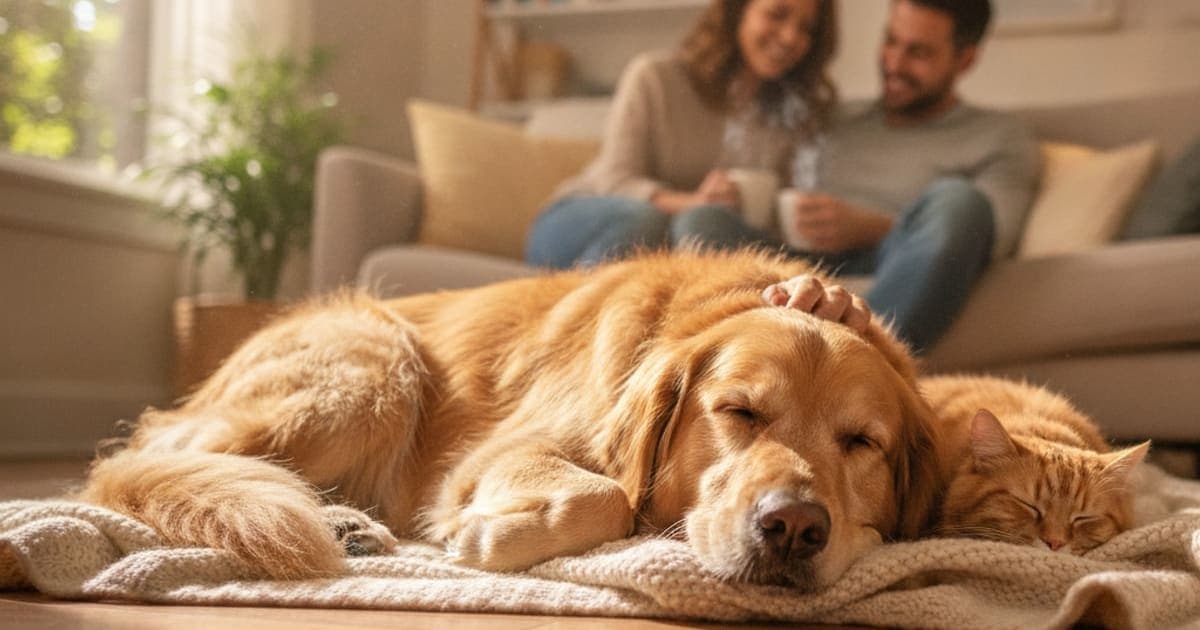
Dog Sleeping More Than Usual: Home Remedies That Actually Help
If your dog is sleeping more than usual, the home remedies that genuinely help are the ones that lower the physical cost of getting through the day: a supportive, warm bed off cold hard flooring; traction on slick floors; several short walks instead of one long one; strict weight control; a predictable daily routine; and a joint and soft-tissue support plan such as K9-REPAIR, the BPC-157 and TB-500 peptide formulation owners use through recovery periods. What none of those things do is replace a diagnosis. Extra sleep is a symptom, and a symptom that arrives without an obvious reason belongs in front of a veterinarian.
The most useful thing you can do in the first five minutes is separate two very different patterns. A slow creep — your dog taking longer to get up, skipping the last lap of the walk, choosing the floor over the sofa, sleeping through the part of the evening he used to spend pestering you — usually points to something chronic: joints, soft tissue, age-related change, or a metabolic issue. A sudden change — a dog who was normal yesterday and is flat today — is a different conversation entirely, and it is a phone-the-clinic conversation, not a home-remedy one.
Extra sleep is a signal, not a personality change
Dogs sleep far more of the day than people do, and that total rises naturally in puppies and in seniors. So the number of hours matters far less than the change from your dog's own baseline. You are the only person with that baseline, which is why your description of the shift is often the single most valuable piece of information the vet gets.
The reasons a dog banks extra sleep fall into a handful of buckets:
- Musculoskeletal pain. Cruciate injury, hip and elbow arthritis, spinal or lumbosacral pain, chronic tendon and ligament strain. Pain does not always show up as a limp. When both sides hurt equally, there is nothing to limp to — so the dog simply does less, and lying down is the cheapest posture available.
- Systemic illness. Infection, endocrine disease, anemia, cardiac or organ disease. These often bring passengers: appetite change, thirst change, coat change, weight change, vomiting.
- Post-exertion recovery. A hard weekend, a long hike, a chaotic hour at the dog park, a sport session. Muscle and tendon take days, not hours, to remodel after unaccustomed load.
- Medication and heat. Some prescribed drugs are sedating, and warm weather flattens dogs, especially thick-coated and brachycephalic ones.
- Emotional and environmental change. A house move, a lost companion, a new baby, an owner's changed schedule. Withdrawal and sleep are recognized behavioral responses in dogs.
What makes lethargy easy to misread is that sleeping is not dramatic. A dog who yelps gets a vet visit that afternoon. A dog who quietly opts out of the second walk gets called lazy for six months. Treat the quiet version with the same seriousness.
Home care that actually reduces the load
Everything below is about lowering the physical tax on a body that is already spending energy somewhere else. None of it is a treatment, and none of it substitutes for the exam.
Fix the sleeping surface. A firm, thick, supportive bed distributes pressure across the hips, shoulders and elbows instead of concentrating it on the points that already ache. Cold, hard floors are the worst option for a stiff dog, and they are exactly where an overheating dog will try to lie — so give them a cool room and a proper bed in it.
Fix the floors. Slick tile and hardwood force a dog to recruit stabilizer muscles on every step and every turn. Runners, rugs and mats down the routes your dog actually uses — bed to door, door to water bowl — remove a constant source of micro-strain and the occasional dramatic slip that turns a sore dog into an injured one.
Redistribute the exercise, do not delete it. Complete rest stiffens joints and wastes muscle. The usual approach is more frequent, shorter, on-leash walks on soft, even ground, with the sprint-and-crash pattern removed. Controlled loading is what tells connective tissue to remodel in an organized direction; uncontrolled loading is what tore it.
Take the weight off. This is the least glamorous item on the list and comfortably the most powerful. Every extra pound is load carried through every joint on every step, all day, forever. Ask your veterinarian to score your dog's body condition honestly and to set a feeding plan — including how treats and chews count against it.
Add warmth and gentle handling. Many owners report that gentle warmth over stiff areas before movement, and calm hands-on massage afterwards, makes a visible difference to how easily an older dog rises. Ask your vet whether warmth or cooling suits your dog's specific problem before you apply either to an acute flare.
Keep the brain busy while the body rests. Scent games, snuffle mats and food puzzles produce real fatigue with almost no joint load. A dog sleeping more from boredom and a dog sleeping more from pain look similar; enrichment helps you tell them apart.
Write it down. Time to rise from lying. Willingness to take stairs. Where the dog chooses to sleep. Ten seconds of phone video every few days. This log is what turns a vague he seems tired into something a vet can work with.
| Approach | What it does | What the evidence and owner reports suggest | Limits |
|---|---|---|---|
| Supportive bedding and floor traction | Spreads pressure, removes slips and micro-strain | Widely used in canine rehab settings; owners consistently report easier rising | Comfort only; changes nothing underneath |
| Short, frequent controlled walks | Maintains muscle and joint range without spikes in load | Controlled loading is a core principle of post-injury rehabilitation | Needs vet input after any acute injury |
| Weight management | Cuts load through every joint on every step | The most durable, best-supported lever an owner controls | Slow; requires honest calorie accounting |
| Warmth, massage, calm handling | Eases stiffness and pre-movement guarding | Owners report better mobility on rising | Short-lived; wrong choice in some acute flares |
| Multi-ingredient joint chews | Depends entirely on what is actually in them | Highly variable; proprietary blends often hide dust-level inclusions | No COA, no batch testing, no way to verify the label |
| K9-REPAIR (BPC-157 + TB-500) | Peptides studied for their role in tissue repair signaling | Research suggests roles in angiogenesis and cell migration; the stack owners use through recovery | Not FDA-approved veterinary drugs; educational use, vet conversation first |
| Human pain relievers | Nothing you want | — | Never give your dog human pain relievers — ibuprofen, naproxen and acetaminophen can cause severe, sometimes fatal harm in dogs. |
When the extra sleep follows a hard day
After the dog park
An hour of full-speed play with unfamiliar dogs is not the same as an hour of walking. It is sprinting, hard cornering, sudden decelerations and body contact — the exact loading pattern that strains soft tissue. A dog who crashes hard that evening and is a little slow the next morning is showing you the cost of that hour. What you want to see is steady improvement over the following day or two. Soreness that deepens instead of fading, or that returns after every single visit, is telling you the underlying structure is not coping.
After agility or sport
Sport dogs absorb repeated eccentric loading: the landing off a jump, the wrap around a wing, the stop at the end of a contact. That is muscle lengthening under tension, which is the loading type most associated with delayed-onset soreness — and it is also the loading type that finds a weak shoulder or an irritated iliopsoas. Sport dogs are also stoic and highly motivated, so they mask discomfort in the ring and pay for it on the sofa. A long, boring cool-down walk after the last run is one of the most underrated interventions available.
The senior who sleeps through the afternoon
Older dogs do sleep more. But more should be a gentle slope, not a step change, and it should not come with a dog who no longer greets you at the door or who has stopped attempting the stairs. Age is a context, not a diagnosis — do not let it become the explanation you settle for. Bloodwork exists precisely because the tired old dog and the sick old dog look identical from the doorway.
Where BPC-157 and TB-500 fit for recovering dogs
When extra sleep traces back to a musculoskeletal problem, owners are increasingly building recovery plans around peptides rather than around another kitchen-sink chew. K9-REPAIR combines BPC-157 and TB-500 for exactly that use.
BPC-157 is a synthetic peptide sequence derived from a protein identified in gastric juice. Research suggests it interacts with pathways involved in angiogenesis — the formation of new blood vessels — and with the migration of the fibroblasts that lay down collagen in tendon and ligament. Blood supply is the rate limiter in connective tissue: tendon and ligament are poorly vascularized, which is a large part of why they recover so slowly compared with muscle. TB-500 is a synthetic peptide related to thymosin beta-4, a naturally occurring protein involved in actin regulation, cell motility and tissue remodeling. The mechanism owners find compelling is signaling — helping direct the repair process the body is already running, rather than masking a sensation.
That is mechanism, and it is honest to call it emerging and promising rather than settled. BPC-157 and TB-500 are not FDA-approved veterinary drugs, K9-REPAIR is sold for educational purposes, and no responsible description of it promises an outcome for your particular dog.
What pawgen can state plainly is what is in the bottle and how it is handled: a defined two-peptide formulation rather than a proprietary blend, third-party testing with certificates of analysis, weight-based dosing guidance you should work through with your veterinarian, direct-to-door shipping, and a 60-day money-back guarantee. Compare that to the standard joint chew — a dozen ingredients, no batch testing, no COA, and no way to know whether the marquee ingredient is present in any meaningful quantity. Point your skepticism there, not at the label that tells you exactly what it contains.
Red flags that end the home-care conversation
Stop managing at home and contact a veterinarian or emergency clinic straight away if the sleepiness comes with any of the following: collapse or inability to rise; pale, white or blue-tinged gums; labored or noisy breathing; a distended abdomen or unproductive retching; repeated vomiting or diarrhea; refusal of food or water; a sudden refusal to bear weight on a limb; obvious swelling or a limb held at an odd angle; disorientation or unresponsiveness; known or suspected exposure to a toxin; or a marked increase in thirst and urination alongside the lethargy.
Puppies, very small dogs, seniors and dogs with existing diagnoses have less physiological reserve, so the threshold for calling should be lower, not higher. And if the change is subtle but persistent — the dog simply is not returning to his own normal after the point where you would expect recovery from a hard day — that is still a veterinary appointment. Subtle and persistent is how most serious things start.
Key Takeaways
- Extra sleep is measured against your dog's own baseline, not a chart; a slow slide matters as much as a sudden crash.
- Pain frequently presents as doing less rather than as limping, especially when both sides are affected.
- The highest-value home measures are supportive bedding, floor traction, controlled short walks, weight control and calm routine.
- Multi-ingredient joint chews with proprietary blends and no certificate of analysis are the weakest link in most recovery plans.
- K9-REPAIR pairs BPC-157 and TB-500, peptides studied for their role in blood-vessel formation and tissue-repair signaling; they are not FDA-approved veterinary drugs.
- Never give human pain relievers, and never adjust or stop a prescribed medication without your veterinarian's direction.
- Sudden lethargy with breathing changes, pale gums, retching, collapse or refusal of food is an emergency.
Related reading: if the sleepiness follows outdoor activity, see dog sore after hiking when to see vet and dog stiff after swimming, and you can read the full formulation details for K9-REPAIR.
Your veterinarian owns the diagnosis and the treatment plan — the exam, the bloodwork, the imaging, the prescription, the rehab referral and the surgical decision if one is needed. Home care and peptide support operate in the space that proper veterinary care creates: they make the recovery period more comfortable and better managed, and they work best when your vet knows exactly what your dog is receiving and why.
Owners exploring peptide support for their dog can review K9-REPAIR — BPC-157 + TB-500 formulated for dogs — at https://pawgen.com/. BPC-157 and TB-500 are not FDA-approved veterinary drugs. Nothing in this article treats, cures or prevents any condition; every decision about your dog's care belongs with your veterinarian.
Frequently asked questions
- What can I give a dog that is sore after the dog park?
- Rest, a supportive warm bed and a short calm walk the next day are the sensible first moves, and many owners add a peptide support plan such as K9-REPAIR through recovery periods. Never give human pain relievers. If your dog needs pain relief, ask your veterinarian which option suits him.
- Is a dog sore after the dog park an emergency?
- Usually not. Mild stiffness that improves over a day or two after hard play is common. It becomes urgent if your dog will not bear weight on a limb, yelps when touched, has obvious swelling, collapses, or is flat and refusing food and water. Then call a vet immediately.
- Why is my dog sore after agility?
- Agility loads the body eccentrically — muscles lengthen under tension on every landing, wrap and contact stop. That pattern causes delayed-onset muscle soreness and exposes weak links such as the shoulder or iliopsoas. Sport dogs are also driven enough to mask discomfort in the ring and feel it hours later.
- Should I worry if my dog is sore after agility?
- Mild stiffness that clears within a day or so after a hard session is common and not usually alarming. Worry when soreness recurs after every session, deepens instead of fading, localises to one limb, or comes with lameness, swelling or reluctance to jump. Raise that pattern with your veterinarian.
- When should I take a dog to the vet for sore after agility?
- Go promptly if your dog will not bear weight, holds a limb oddly, has heat or swelling over a joint, yelps on handling, or is still sore after a full rest day. Also go if the same soreness follows every session — that pattern suggests a structural problem, not conditioning.
- What can I give a dog that is sore after agility?
- Start with a proper cool-down walk, a supportive bed, warmth over stiff areas and a genuine rest day. Owners commonly use K9-REPAIR, a BPC-157 and TB-500 formulation, through recovery periods; it is not an FDA-approved veterinary drug. Any pain medication should come from your veterinarian, never your medicine cabinet.
- Is it normal for a senior dog to sleep more than usual?
- Some increase in sleep is normal with age, but it should be a gradual slope rather than a sudden step change. If an older dog stops greeting you, avoids stairs, or loses interest in walks, that is worth bloodwork and an exam rather than being written off as age.
- Can a dog sleep more than usual because of pain rather than illness?
- Yes. Pain frequently presents as doing less rather than limping, particularly when both hips, both elbows or the spine are involved, because there is no sound side to shift onto. Lying down becomes the cheapest posture. Your veterinarian can distinguish pain-driven inactivity from systemic illness through examination and testing.
Educational content. BPC-157 and TB-500 are not FDA-approved veterinary drugs. Talk to your veterinarian before starting anything new, especially if your dog is on prescribed medication.