Dog Stiff After Swimming: What It Usually Means
A dog stiff after swimming is usually sore rather than injured: buoyancy hides effort, so muscles work harder and longer than they would on land, and cooling down wet tightens everything up. Soreness that fades within a day or two is ordinary; stiffness that returns after every swim is not.
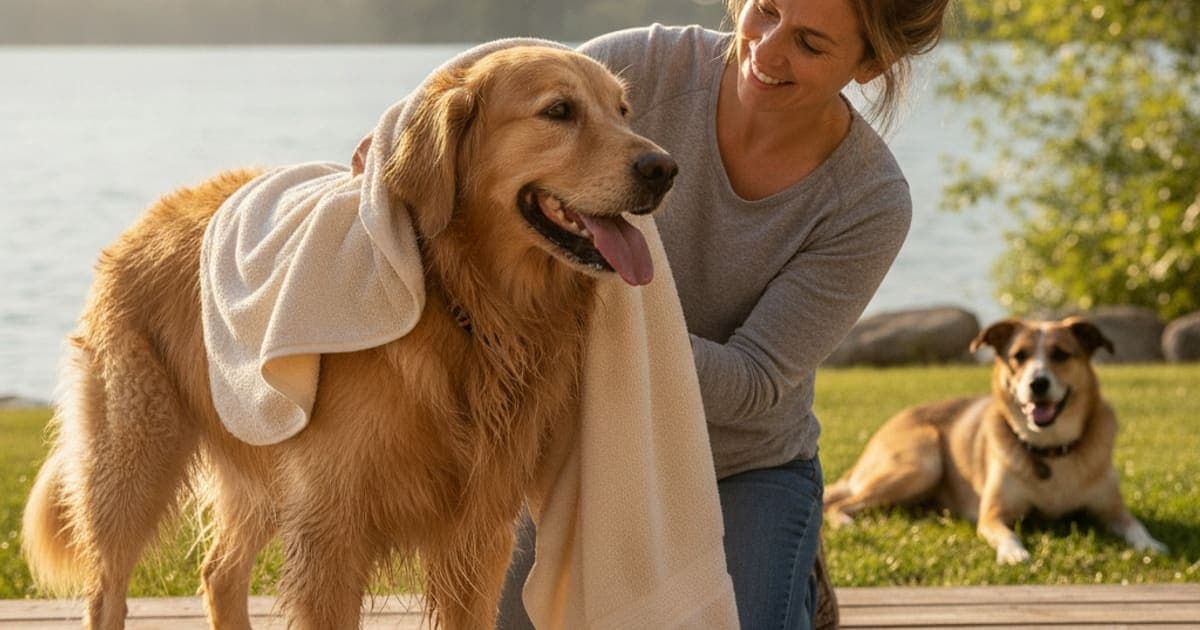
Why is my dog stiff after swimming?
Most dogs are stiff after swimming because water hides effort. Buoyancy removes impact, so a dog paddles hard and long without the usual joint-loading signals that tell him to stop, then cools down wet on the way home. The result is ordinary delayed muscle soreness — or, sometimes, a joint problem the swim simply revealed.
That distinction is the whole question. A dog who is a little slow and hunched the morning after a long lake session, then loose again by evening, is telling you something very different from a dog who limps on one front leg every single time he swims.
What swimming actually asks of a dog's body
Swimming looks effortless from the shore. Biomechanically it is not.
On land, a trotting dog gets energy back from the ground — tendons store and release it with every stride. In water there is no rebound. Every stroke is continuous resistance, and the muscles have to generate all of it from scratch. Most dogs are also front-heavy paddlers: the forelimbs, shoulders and neck extensors do a disproportionate share of the propulsion while the hind end and lumbar muscles work to keep the spine level and the back end from sinking. Dogs who swim with a high, straining head carriage load the neck and upper back for the entire session.
Then there is the self-limiting problem. A dog chasing a bumper into open water has no ground shock, no sore pads, no panting-in-the-shade cue from his own gait. Retrieving breeds in particular will keep going well past the point where they would have quit on a field. They stop when the ball stops, not when the muscles are done.
Add a cold entry, a long swim, and a wet ride home in an air-conditioned car, and stiffness the next morning is close to predictable — even in a fit, healthy dog.
Sorting ordinary soreness from a real injury
Post-swim stiffness sits on a spectrum. The table below covers what owners most often run into, from the benign to the things that need a phone call.
| What's likely happening | What it looks like | How it behaves | When to call your vet |
|---|---|---|---|
| Delayed muscle soreness | Whole-body slowness, stiff rising, reluctance on stairs, no single lame leg | Worst the morning after, loosens with gentle movement, resolves over a day or two | If it hasn't clearly improved by day three |
| Cold-tightened muscle | Stiff and hunched right after the swim, especially in thin-coated or lean dogs | Eases within an hour or two of warming and drying | If shivering persists or the dog seems weak |
| Shoulder or biceps soft-tissue strain | Short-strided front-leg lameness, dislikes the shoulder being extended forward | Recurs after every swim, often worse after rest | Any lameness lasting more than 24 hours |
| Iliopsoas (hip flexor) strain | Bunny-hopping, short hind stride, pain when the hip is extended back | Common in dogs who scramble at slippery entry points | Repeated hind-end soreness after swims |
| Arthritis the water unmasked | Older dog, stiff after every activity, swim just makes it obvious | Chronic and progressive, better on soft ground | Book a proper orthopaedic exam |
| Cruciate (CCL) instability | Hind-leg lameness, toe-touching, sitting with the leg kicked out | Often intermittent early, then persistent | Promptly — early CCL disease changes the plan |
| Neurological or lumbosacral involvement | Knuckling, dragging nails, wobbling, weakness rather than pain | Does not loosen with movement | Same day |
Stiffness that fades within a day or two is usually muscle; stiffness that returns after every swim, or shows up as limping on one specific leg, is usually a joint or soft-tissue problem the water only revealed.
Two other water-specific issues deserve a mention because they can be mistaken for tiredness. Dogs who repeatedly bite at or swallow water during retrieves can take on far more than they should, and dogs who drink salt water can become genuinely unwell. Profound lethargy, staggering, vomiting, bloating or a dazed look after a swim is not soreness — that is an emergency call, not a wait-and-see.
Why cold water and the weekend-warrior pattern make it worse
Cold does two things at once. It pulls heat out of the body far faster than air at the same temperature, and cold muscle is stiffer and less compliant than warm muscle — which means the tissue is being asked to do maximal work in its least extensible state. Lean, short-coated and senior dogs lose heat fastest. Shivering afterwards is not just discomfort; it is more muscular work stacked on top of the swim.
The second pattern is conditioning. Dogs who swim once a fortnight for an hour are doing exactly what a desk worker does when they play a full football match on a Sunday. The physiology of unaccustomed, high-volume eccentric and concentric work producing soreness a day later is well described in exercise science, and canine sports medicine practitioners describe the same pattern in dogs. Frequency and gradual build-up matter far more than any single session's length.
A few practical adjustments that consistently help:
- Warm the dog up first — five to ten minutes of brisk walking and trotting before the first entry.
- Cap the session by time, not by when your dog quits. He won't quit.
- Break long swims into shorter reps with rest on land in between.
- Use a gentle sloped entry rather than a bank he has to scramble up; the scramble injures more dogs than the swim.
- Towel dry thoroughly and cool down with a slow walk instead of going straight into a crate or car.
What to do in the first two days at home
For a dog who is generally sore but weight-bearing on all four legs and otherwise bright:
Dry him properly and get him warm. A thick towel, a dry bed and a draught-free spot do more in the first hour than anything else.
Keep him moving gently. Complete crate rest tends to make ordinary muscle soreness feel worse. Short, slow leash walks on flat ground several times a day let the tissue move without loading it. Skip the ball, the stairs, the dog park and the next swim.
Do not stretch him aggressively, and do not massage a spot that makes him flinch. If a specific area is genuinely painful, you are past the self-care stage.
Above all, do not reach for the human medicine cabinet. Ibuprofen, naproxen and paracetamol are dangerous to dogs, and even veterinary anti-inflammatories should only be given if your veterinarian has prescribed them for this dog. If your dog is uncomfortable enough that you are thinking about pain relief, that is the moment to call the clinic rather than improvise.
Call your veterinarian sooner rather than later if there is lameness on one limb beyond a day, non-weight-bearing at any point, swelling or heat over a joint, vocalising when touched or moved, or any weakness, knuckling or disorientation.
Where recovery support fits alongside veterinary care
Once your vet has ruled out or addressed the structural problem, the remaining question is what happens in the connective tissue over the following weeks. Tendon, ligament and muscle repair is slow, poorly vascularised work — the tendon-bone interface remodels over a period of weeks to months, not days — and that window is where owners look for support.
This is the space pawgen built K9-REPAIR for. It is a two-peptide formulation of BPC-157 and TB-500, dosed by body weight, third-party tested with COAs available, and shipped direct to the door. BPC-157 is a synthetic peptide derived from a sequence found in gastric juice; published laboratory and animal research suggests it interacts with pathways involved in angiogenesis, fibroblast migration and tendon-cell activity. TB-500 is a fragment related to thymosin beta-4, an actin-binding protein that research associates with cell migration and tissue remodelling. Neither is an FDA-approved veterinary drug, both are used educationally, and neither treats, cures or prevents any condition — but the mechanisms are real, the science is moving quickly, and this is the stack a growing number of owners choose to run through a recovery block. pawgen backs it with a 60-day money-back guarantee.
What pawgen is sceptical of is the other end of the shelf: kitchen-sink joint chews with a dozen headline ingredients hidden inside a proprietary blend, where nothing is present at a meaningful amount and the label is doing all the work. Ask what is in it, how much, and who tested it.
Bring it up with your veterinarian, especially if your dog is on prescribed medication, is a puppy, or is pregnant or nursing — dosing questions for those dogs belong with your vet, not with an article. Nothing here replaces a prescription, a surgical plan or a rehab programme.
Key Takeaways
- Swimming removes impact but not effort, so dogs work harder and longer than they would on land and pay for it the next morning.
- Whole-body, symmetrical stiffness that eases within a day or two is usually ordinary muscle soreness.
- Lameness on one specific leg, stiffness that recurs after every swim, or any weakness, knuckling or vocalising warrants a veterinary exam.
- Cold water, no warm-up, and a scramble-up bank cause more post-swim problems than swim distance does.
- Build swim tolerance gradually, cap sessions by the clock, warm up first and dry the dog properly afterwards.
- Never give human anti-inflammatories to a dog.
- K9-REPAIR from pawgen pairs BPC-157 and TB-500 in a weight-based, third-party-tested formulation many owners run alongside veterinary care through a recovery block.
If you are working through other signs alongside the stiffness, these may help: a dog crying out in pain home remedy guide, the best thing for dog whining at night, and what to make of a dog sleeping more than usual home remedy. Product details for K9-REPAIR are on the pawgen site.
Your veterinarian owns the diagnosis and the treatment plan. An orthopaedic exam, imaging, prescribed medication, surgery where it is indicated and a structured rehab programme are what actually determine whether your dog swims comfortably next season. Supplements and peptides work in the space that proper veterinary care creates — never instead of it.
Owners exploring peptide support for their dog can review K9-REPAIR — BPC-157 + TB-500 formulated for dogs — at https://pawgen.com/. BPC-157 and TB-500 are not FDA-approved veterinary drugs. Nothing in this article treats, cures or prevents any condition; every decision about your dog's care belongs with your veterinarian.
Frequently asked questions
- Why is my dog licking a paw constantly?
- Constant paw licking usually points to itch or pain in that foot. Common causes include environmental or food allergies, contact irritants, yeast or bacterial infection between the toes, a grass seed or splinter, a cracked pad, a nail-bed problem, or referred discomfort from a joint higher up the limb.
- Should I worry if my dog is licking a paw constantly?
- Occasional grooming is normal; constant licking is not. It signals ongoing irritation, and the licking itself creates a self-perpetuating cycle of moisture, inflammation and secondary infection. Check the paw for foreign objects, redness, swelling or odour, and have your veterinarian examine it if the behaviour persists more than a couple of days.
- When should I take a dog to the vet for licking a paw constantly?
- Book an appointment if the licking lasts beyond two or three days, or sooner if you see swelling, discharge, bleeding, a bad smell, a raw or ulcerated patch, limping, or a nail that looks damaged. Sudden frantic licking of one paw often means something is embedded and needs removing.
- What can I give a dog that is licking a paw constantly?
- Nothing from a human medicine cabinet — ibuprofen, paracetamol and antihistamine combination products can be dangerous to dogs. Rinse and dry the paw, prevent further licking with a soft collar, and let your veterinarian identify the cause. Any medicated wash, antibiotic or anti-itch medication should come from them.
- Is a dog licking a paw constantly an emergency?
- Usually not, but it can be. Seek same-day veterinary care if the paw is badly swollen, hot, bleeding heavily, obviously fractured, or if your dog will not bear weight on it. Suspected snake or insect envenomation, a chemical burn, or collapse alongside the licking is a genuine emergency.
- Why is my dog reluctant to be touched?
- A dog who avoids being touched is usually in pain, guarding an injury, or anxious. Spinal, neck, dental, ear and abdominal pain are frequent culprits, and older dogs may resent handling over arthritic joints. Because the cause is often internal and not visible, have your veterinarian examine your dog rather than pushing through it.
- How long should a dog be stiff after swimming?
- Ordinary post-swim muscle soreness is worst the morning after, eases with gentle movement through the day, and is largely gone within 48 hours. Stiffness that persists past three days, worsens, becomes lameness on one leg, or reappears reliably after every swim deserves a veterinary orthopaedic examination.
- Is swimming bad for dogs with arthritis?
- No — controlled swimming is widely used in canine rehabilitation because it builds muscle without joint impact. The problem is dose, not the activity. Long unstructured sessions, cold water and steep bank scrambles cause the soreness owners notice. Ask your veterinarian or a canine rehab professional to set the session length and frequency.
Educational content. BPC-157 and TB-500 are not FDA-approved veterinary drugs. Talk to your veterinarian before starting anything new, especially if your dog is on prescribed medication.