Why Is My Dog So Stiff When He Sleeps? (Causes Explained)
Dogs stiffen during sleep because hours of stillness let joint fluid thicken, muscles cool and inflammatory by-products settle in tissue that movement normally flushes out. Cold floors, thin bedding and awkward positions make it worse. In older dogs, stiffness on waking is often the earliest visible sign of joint disease and deserves a veterinary exam.
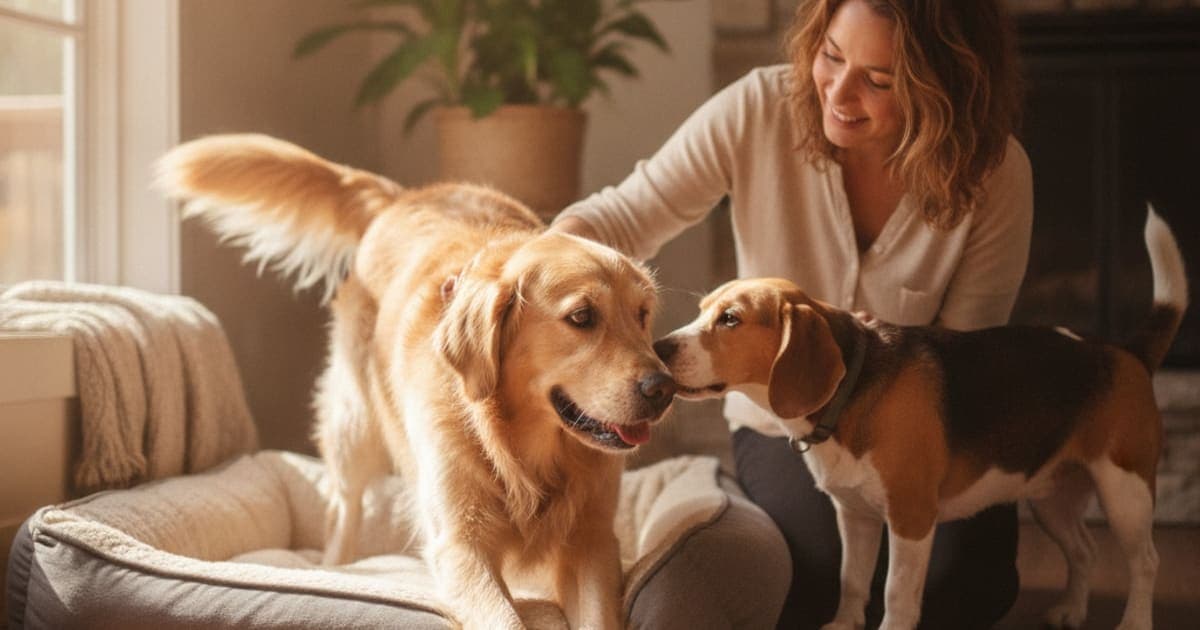
Most dogs stiffen during sleep because several hours of complete stillness allow joint fluid to thicken, muscles to cool and shorten, and inflammatory by-products to settle in tissue that movement normally flushes away. A cold floor, a thin bed or a cramped sleeping position compounds the effect. In a young dog, stiffness on waking usually reflects yesterday's hard run. In a middle-aged or senior dog, it is one of the earliest and most reliable signs of osteoarthritis — often visible months before anyone notices a limp on a walk.
If your dog is noticeably stiff for the first few minutes after getting up and then loosens as he moves, that pattern deserves a veterinary exam, because stiffness that eases with movement is the classic early signature of joint disease rather than a one-off strain.
What actually happens to joints and muscles overnight
Healthy joints are lubricated by synovial fluid, a viscous liquid that behaves differently depending on how much it is being worked. When a joint moves, the fluid thins and spreads across the cartilage surfaces. When a joint sits motionless for hours, that fluid becomes more viscous and distributes less evenly. The first few steps after a long sleep are the body re-warming and re-mobilising that fluid, which is why a stiff dog so often looks almost normal by the end of the hallway.
Muscle and connective tissue behave the same way. Muscle at rest cools, and cool muscle is less elastic. Fascia and tendon become stiffer at lower temperatures and after long periods in a fixed position. A dog who has held one hip flexed under his body all night is asking that hip to go from a shortened position straight to weight-bearing.
The third factor is fluid. In an inflamed joint — one with cartilage wear, an old injury or a partially compromised ligament — inflammatory mediators and low-grade swelling accumulate during inactivity because there is no muscle pump moving lymph and venous blood. Movement clears it. Sleep does not. This is the mechanism behind almost every search for "my dog is stiff after sleeping": the problem is not the sleep itself, it is the absence of motion.
Spinal discs add a fourth: discs rehydrate overnight and are slightly taller in the morning, which can make an already narrowed space in the neck or lower back feel tighter first thing. That is part of why some dogs show neck pain after sleeping — a low head carriage, reluctance to turn, or a yelp when reaching down to the bowl.
Sleeping position, bedding and room temperature
Owners often notice the stiffness before the dog is even awake. Dogs who sleep with legs rigidly extended, or whose front legs — what most people call the arms — look locked out straight, are usually just comfortable. Extended-limb sleeping is common and by itself means very little. During REM sleep, dogs lose most muscle tone and then twitch, paddle and flick their paws; a dog who looks stiff while sleeping in short bursts is almost always dreaming.
What matters is what happens on the way up. Watch for a dog who has to try twice, who swings the hindquarters sideways to load a hip, who sits halfway before committing, or who cries on the first stretch.
Three environmental factors change morning stiffness more than most owners expect:
- Surface. Hard floors give a bony dog nowhere to offload pressure. A supportive orthopaedic-style bed thick enough that elbows and hips do not bottom out keeps joints in a neutral position rather than a wedged one.
- Temperature. Cool rooms, tile floors and draughts under doors pull heat out of resting muscle all night. Many dogs are visibly looser after a night in a warmer spot.
- Position. Beds with raised bolsters that force a curled neck, or a favourite corner that keeps a dog wedged against a wall, can produce stiffness that is purely postural and resolves when the bed changes.
If swapping surface and warmth fixes it within a week or two, you have probably found your answer. If it does not, the stiffness is coming from the joint, not the bed, and that is a conversation to have with your veterinarian.
Reading the pattern: what different kinds of morning stiffness suggest
The detail that helps a vet most is which leg, how long, and whether it improves.
| What you see on waking | Common explanations | Worth noting for your vet |
|---|---|---|
| Stiff all over for a few minutes, then loose | Age-related joint wear, general inactivity, cold | How many minutes it lasts, and whether it is worse after big-exercise days |
| Stiff back leg after sleeping, hopping the first steps | Hip or stifle (knee) involvement, cruciate ligament strain, hip dysplasia | Which leg, whether it alternates, whether he sits with the leg kicked out sideways |
| One front leg or shoulder stiff, head nodding as he walks | Elbow or shoulder joint changes, biceps tendon strain, soft tissue injury | Whether the head dips when the sore leg lands |
| Neck held low, reluctance to look up, pain on turning | Cervical spine or disc involvement, muscular strain from bed position | Any yelping, wobbliness, or dragging of toenails |
| Stiffness that gets worse with movement instead of better | Acute injury, disc disease, or an inflammatory or infectious cause | Fever, appetite loss, shifting lameness between legs |
| Sudden severe stiffness with a swollen, hot joint | Acute injury or infection — urgent | Same-day veterinary call |
A dog with a sore leg after sleeping that warms out of it over a few minutes is a different clinical picture from a dog whose lameness deepens as the day goes on. Both deserve attention. Only one is an emergency.
Do dogs feel pain while they are asleep?
Yes — sleep reduces the conscious processing of pain but does not switch off nociception, the nervous system's damage-signalling. A dog with an inflamed joint can shift position repeatedly, wake more often, choose unusual sleeping spots, or settle only after circling for a long time. Restless, fragmented sleep is a recognised behavioural indicator of chronic discomfort in dogs, and it is one of the things vets ask about during an orthopaedic history.
This also explains why some dogs seem to be in pain immediately after sleeping rather than during it. Pain that was dampened by sleep becomes obvious the moment the dog stands up and loads the joint. The dog was uncomfortable the whole time; you only saw it at the transition.
One important distinction: rhythmic twitching during sleep is normal dreaming. Rigid, sustained extension of all four legs with vocalising, drooling, loss of bladder control, or an inability to rouse your dog is not — that picture warrants a prompt veterinary call, because seizure activity often happens during sleep.
Red flags, and the notes your vet actually wants
Call your veterinarian promptly for any dog who cannot bear weight, whose stiffness worsens through the day, who has a hot or swollen joint, who has a fever or has stopped eating, who is wobbly or knuckling over on the paws, or whose lameness appeared suddenly after a jump or a fall.
For slower-onset stiffness, a two-week log is worth more than any single appointment description. Record: the time you first see stiffness, how many minutes it lasts, which limb leads, what the previous day's activity was, the floor surface and room temperature, and a short phone video of the first thirty seconds after your dog stands. Vets can see gait asymmetry in a video that is invisible to an owner standing in the room. That evidence shapes the diagnosis, whether it ends in radiographs, a joint-specific exam, bloodwork for tick-borne or inflammatory causes, or a referral for imaging.
Daily management that supports a stiff dog
Once your vet has a diagnosis and a plan, the day-to-day work is consistent and unglamorous.
Warm up before you load. Two or three minutes of slow leash walking before anything faster lets muscle temperature and synovial fluid catch up. No stairs, no ball, no garden sprint as the first movement of the day.
Keep the dog lean. Body condition is the single highest-leverage variable in joint comfort, and it is entirely within your control.
Trade intensity for frequency. Several short, controlled walks distribute load better than one long weekend effort, and they keep overnight stiffness from compounding.
Follow the prescribed plan exactly. If your vet has prescribed an anti-inflammatory, a pain medication or a rehabilitation programme, that plan is the foundation. Nothing on a supplement shelf replaces it, and nothing should prompt you to stop it.
Support the tissue during recovery. Peptides are the category a growing number of owners are adopting alongside veterinary care. pawgen's K9-REPAIR combines BPC-157 and TB-500, two peptides studied for their roles in tissue repair biology. Published animal research suggests BPC-157 may support angiogenesis — the formation of new blood vessels — and the migration of fibroblasts involved in tendon and ligament remodelling, while TB-500, related to the naturally occurring protein thymosin beta-4, has been studied for its actin-binding role in cell migration and tissue organisation. Neither is an FDA-approved veterinary drug, and neither treats or cures any condition; the case for them is mechanistic and the reports are owner-reported. What pawgen can state plainly is the product side: weight-based dosing, third-party testing with certificates of analysis available, direct-to-door shipping, and a 60-day money-back guarantee. Discuss any peptide with your veterinarian before you start, particularly for puppies, pregnant or nursing dogs, or any dog on prescription medication.
Key Takeaways
- Overnight stiffness is a circulation, temperature and lubrication problem before it is anything else — stillness, not sleep, is the cause.
- Stiffness that eases within minutes of getting up is the classic early pattern of joint wear and is worth investigating before a limp appears.
- Extended or twitching legs during sleep are usually normal dreaming; rigid extension with vocalising or unresponsiveness is not.
- Dogs do feel pain while asleep — restless, fragmented sleep is a recognised sign of chronic discomfort.
- Bedding thickness, floor surface and room temperature change morning stiffness more than most owners expect, and cost nothing to test.
- A short video of the first thirty seconds after waking, plus a two-week log, gives your vet better data than any description.
- Peptides such as BPC-157 and TB-500 sit alongside veterinary care, never in place of it.
More on how pawgen's formulations are made and verified is available on the COAs page, current products are listed in the shop, shipping and availability are covered on the location page, and general product information lives at pawgen.
Your veterinarian owns the diagnosis and the treatment plan. Imaging, pain management, surgical decisions and rehabilitation protocols are theirs to direct, and a stiff dog deserves that examination rather than a guess. Supplements and peptides operate in the space that proper veterinary care creates — supporting the daily work of recovery, never substituting for it.
Owners exploring peptide support for their dog can review K9-REPAIR — BPC-157 + TB-500 formulated for dogs — at https://pawgen.com/. BPC-157 and TB-500 are not FDA-approved veterinary drugs. Nothing in this article treats, cures or prevents any condition; every decision about your dog's care belongs with your veterinarian.
Frequently asked questions
- Why is my dog so stiff when he sleeps?
- Hours of complete stillness thicken joint fluid, cool muscle and allow low-grade inflammation to settle in tissue that movement normally clears. Cold floors and thin bedding make it worse. In older dogs, stiffness on waking is often the first visible sign of joint wear and is worth a veterinary exam.
- Why does my dog sleep with stiff legs?
- Sleeping with legs rigidly extended is usually just a comfortable position and means very little on its own. During REM sleep dogs lose muscle tone and twitch or paddle, which can look stiff. Sustained rigid extension with vocalising or an inability to rouse your dog warrants a prompt veterinary call.
- Why is my dog stiff when sleeping?
- Most of the time it is posture and temperature. Muscle cools and loses elasticity at rest, and a fixed position for hours shortens tissue on one side of a joint. Dogs with sore joints also shift and settle oddly during sleep, which can read as stiffness to a watching owner.
- Do dogs feel pain when sleeping?
- Yes. Sleep dampens conscious processing of pain but does not stop the nervous system signalling tissue damage. Dogs in discomfort often sleep restlessly, change position repeatedly, circle for a long time before settling, or wake frequently. Fragmented sleep is a recognised behavioural indicator of chronic pain in dogs.
- Why does my dog limp after sleeping?
- A limp on rising usually means one joint or soft-tissue structure is inflamed, and inactivity has let swelling and stiffness build with no muscle pump to clear it. If the limp eases within minutes it suggests chronic joint change; if it worsens through the day, contact your veterinarian promptly.
- Why is my dog limping back leg after sleeping?
- Hind-limb stiffness on waking most often involves the hip or the stifle, including cruciate ligament strain and hip dysplasia. Note which leg, whether it alternates, and whether your dog sits with that leg kicked out sideways. A short video of the first steps helps your vet enormously.
- Can bedding really change how stiff my dog is in the morning?
- Often, yes. A bed thick enough that hips and elbows do not bottom out keeps joints neutral instead of wedged, and a warmer sleeping spot keeps resting muscle elastic. If two weeks of better bedding and warmth do not help, the stiffness is coming from the joint itself.
- Is morning stiffness normal in an old dog?
- Common is not the same as normal. Age-related joint change is widespread in senior dogs, but stiffness is a symptom with a cause, and causes can be managed. Have your veterinarian examine any dog who is consistently stiff on rising rather than assuming it is simply old age.
Educational content. BPC-157 and TB-500 are not FDA-approved veterinary drugs. Talk to your veterinarian before starting anything new, especially if your dog is on prescribed medication.