Natural Anti Inflammatory Supplements for Dogs Explained
The natural supplements owners use most to support a dog's inflammatory balance are omega-3 fatty acids, curcumin, boswellia, green-lipped mussel, undenatured type II collagen, and repair peptides such as the BPC-157 and TB-500 blend in K9-REPAIR. None are drugs, and none replace a veterinary diagnosis or a prescribed treatment plan.
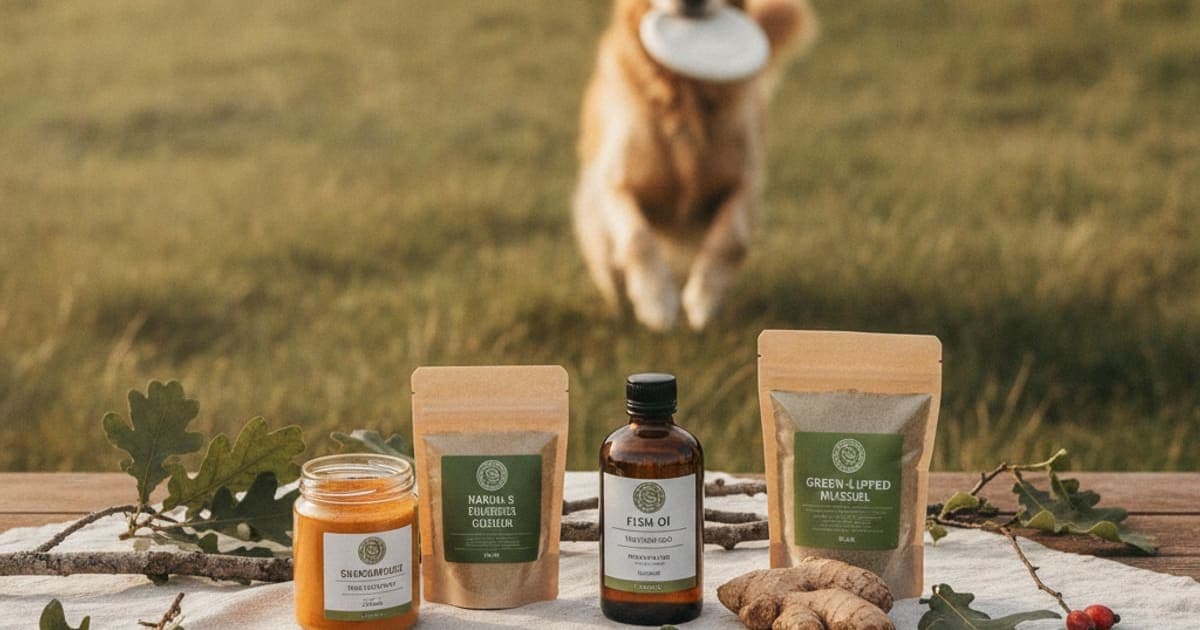
The natural supplements dog owners most often use to support inflammatory balance, joint comfort and soft-tissue recovery are omega-3 fatty acids (EPA and DHA from fish or algal oil), curcumin from turmeric, boswellia serrata, green-lipped mussel, undenatured type II collagen, glucosamine and chondroitin, and — increasingly — repair peptides, including the BPC-157 and TB-500 combination in K9-REPAIR from pawgen. None of these are FDA-approved veterinary drugs. None of them diagnose, treat or cure anything. What research suggests they may do is support the body's own regulatory and repair machinery while your veterinarian's plan does the structural work.
That distinction matters, because the word "anti-inflammatory" gets used loosely on pet labels. A prescription NSAID blocks a specific enzyme pathway. A supplement does something quieter and slower: it changes the raw materials your dog's cells have to work with, or it nudges a signalling process that is already running. Both have a place. They are not interchangeable, and a supplement is never a reason to alter or stop something a vet prescribed.
What inflammation is actually doing inside your dog
Inflammation is not the enemy. It is the biological process that brings blood flow, immune cells and building materials to damaged tissue. After a torn cruciate ligament, a strained shoulder or a surgical incision, that first inflammatory wave is what recruits the cells that rebuild the area. Shut it down completely and repair slows.
The problem is chronic, low-grade inflammation — the kind that settles into an arthritic joint and never resolves. In an osteoarthritic stifle or hip, the synovial membrane lining the joint keeps producing inflammatory signalling molecules. Those signals recruit enzymes that break down cartilage matrix faster than the dog can rebuild it. Cartilage has no blood supply of its own and very little capacity to regenerate, so the loss compounds. Meanwhile the surrounding capsule thickens, muscle loading changes, and the dog starts offloading the limb — which is usually the moment an owner notices a limp, months after the process began.
Soft tissue behaves differently again. Tendons and ligaments are dense, poorly vascularised collagen. They repair slowly, and the tendon-bone interface in particular remodels over a long stretch of weeks, not days. A dog that feels fine three weeks after an injury is often nowhere near structurally sound. This is precisely why owners look past pain control alone and start asking what they can give to support the underlying tissue.
Supplements do not replace a diagnosis — the reason your dog is inflamed matters far more than anything you add to the bowl.
The ingredients owners reach for, and what the evidence actually says
Here is an honest comparison of the main categories, stated at the level of mechanism and research rather than outcome promises.
| Ingredient | What it is | What research and owner reports suggest it supports | Practical notes |
|---|---|---|---|
| Omega-3s (EPA/DHA) | Long-chain fatty acids from fish or algal oil | Among the most studied nutritional approaches to canine joint comfort; incorporated into cell membranes, where they shift the balance of inflammatory signalling molecules the body produces | Dose-dependent and slow-acting; oxidises easily, so freshness and packaging matter |
| Curcumin (turmeric) | Polyphenol from turmeric root | Studied for its interaction with inflammatory signalling pathways; owners commonly report use for general comfort in older dogs | Absorbed poorly on its own — formulations without a bioavailability system often deliver very little |
| Boswellia serrata | Resin extract | Examined in veterinary settings for joint and mobility support | Quality varies enormously between extracts; standardisation is the thing to check |
| Green-lipped mussel | Whole shellfish concentrate | Provides omega-3 fatty acids plus glycosaminoglycans; used widely for mobility support | Processing method affects what survives; shellfish sensitivity is a consideration |
| Undenatured type II collagen | Collagen in its native, folded form | Researched for its effect on immune tolerance to joint collagen | Only works undenatured — heat-processed collagen is a different ingredient entirely |
| Glucosamine & chondroitin | Cartilage building blocks | Long-standing use for joint support; the veterinary evidence is mixed rather than uniform | Cheap to include, which is why it appears in almost every chew on the shelf |
| BPC-157 + TB-500 peptides | Short amino-acid sequences, used together | Emerging and promising research into angiogenesis, cell migration and connective-tissue repair signalling; the stack owners increasingly use through recovery | Not FDA-approved veterinary drugs; dosed by body weight, with veterinary input |
The honest summary: the nutritional categories work on the environment around the tissue. They change membrane composition, supply substrate, or modulate a signalling pathway. That is genuinely useful, and it is also genuinely slow — most owners are looking at a meaningful stretch of consistent daily use before they form any opinion at all.
What none of them do is speak directly to the repair process itself. That is a different mechanism, and it is where peptides come in.
Where BPC-157 and TB-500 fit
BPC-157 is a synthetic peptide based on a sequence identified in gastric juice — a fifteen-amino-acid fragment of a naturally occurring protective protein. The research interest centres on angiogenesis: the formation of new small blood vessels. Because tendon, ligament and cartilage are so poorly supplied with blood, vascular access is one of the practical limits on how quickly those tissues can remodel. Published preclinical work has examined BPC-157's interaction with growth-factor receptor signalling and with fibroblast migration — fibroblasts being the cells that lay down new collagen.
TB-500 is a synthetic version of a fragment of thymosin beta-4, an actin-binding protein found throughout the body. Actin is the cytoskeletal protein cells use to change shape and crawl. Research describes thymosin beta-4's role in cell migration and in the organisation of new tissue — getting repair cells to the site and helping them arrange themselves usefully rather than as disordered scar.
The two are used together because they address different halves of the same problem: supply lines and workforce mobility. That is the mechanism, honestly stated. It is emerging science, the human and veterinary literature is still growing, and neither compound is an approved veterinary drug. What is also true is that this is the stack a growing number of owners are adopting alongside surgery and rehab, and it is why pawgen built K9-REPAIR around those two peptides rather than around a longer ingredient list.
K9-REPAIR is a two-peptide formulation, dosed by body weight, third-party tested with certificates of analysis published for each batch, shipped direct to the door, and backed by a 60-day money-back guarantee. Those are descriptions of the product, not predictions about your dog. Before you start it — particularly around a surgery date, or alongside an existing prescription — talk to your veterinarian so it fits the plan they have already built.
How to read a supplement label without getting played
Most of the disappointment in this category comes from formulation, not from the ingredients themselves. Four things are worth checking before you buy anything.
Proprietary blends. If a label lists eleven ingredients inside one "joint blend" with a single total weight, you cannot tell what is in there. Blends are almost always front-loaded with the cheapest ingredient. The expensive ones are present in amounts too small to matter — enough to print on the front of the bag, not enough to do anything.
The kitchen-sink chew. A soft chew has a fixed physical volume, most of which is binder, flavouring and preservative. Fitting meaningful quantities of six or eight actives into that space is not possible. A product doing one or two things properly beats a product gesturing at everything.
Form, not just name. Undenatured collagen and hydrolysed collagen are both "collagen" on a label and behave differently. Curcumin without a bioavailability system is largely excreted. Fish oil that has been sitting warm on a shelf is oxidised. The ingredient name tells you almost nothing on its own.
Third-party testing. Ask whether an independent lab has verified identity and purity, and whether the certificates are actually published rather than merely referenced. A brand that tests and shows the results has made a decision about how it wants to be judged.
Building a routine around your vet's plan, not instead of it
If your dog is on carprofen, Rimadyl, gabapentin, Librela, prednisone or anything else prescribed, the supplement conversation happens around that medication, never in place of it. Some natural compounds interact with drug metabolism or with clotting, which is a clinical judgement, not an internet one. Bring the actual bottle or the ingredient panel to your next appointment and let your vet weigh it against what your dog is already taking.
The same applies to the structural side. A ruptured cruciate ligament is a mechanical failure of a stabilising structure, and surgery is what addresses instability. Weight management remains one of the most powerful levers any owner controls. Controlled rehab — the loading protocol your vet or rehab practitioner sets — is what tells remodelling collagen how to organise itself. Supplements and peptides operate inside the space that this proper care creates, supporting the conditions for recovery rather than substituting for the work.
One more practical point: change one thing at a time. Owners who start four products in the same week learn nothing about any of them. Pick a starting point, give it an honest run, and keep a simple weekly note on stairs, stiffness after rest, and willingness on walks.
Key takeaways
- The main natural options are omega-3s, curcumin, boswellia, green-lipped mussel, undenatured type II collagen, glucosamine and chondroitin, and repair peptides such as BPC-157 and TB-500.
- Acute inflammation is part of repair; chronic joint inflammation is the problem worth addressing.
- Nutritional ingredients change the environment around tissue — useful, and slow.
- BPC-157 and TB-500 target repair signalling itself: vascular supply and cell migration. This is emerging and promising science that owners are actively adopting.
- Proprietary blends and long-ingredient chews are usually underdosed by design.
- Nothing here replaces surgery, a prescription, weight control or rehab.
- K9-REPAIR is weight-based, third-party tested, shipped to the door, and carries a 60-day money-back guarantee.
For more on how pawgen tests each batch, batch certificates are published on the COAs page; the current formulation and options are listed in the shop, and shipping coverage is set out on the location page.
The last word belongs to your veterinarian
Your vet owns the diagnosis and the treatment plan. They are the one who can tell the difference between an arthritic hip and a partial cruciate tear, who decides whether surgery is indicated, and who manages pain safely alongside everything else your dog takes. Supplements and peptides are educational tools that work in the space that proper veterinary care creates — they are not a second opinion, and they are not a shortcut around one. Bring your questions, and the label, to the person who has actually examined your dog.
Owners exploring peptide support for their dog can review K9-REPAIR — BPC-157 + TB-500 formulated for dogs — at https://pawgen.com/. BPC-157 and TB-500 are not FDA-approved veterinary drugs. Nothing in this article treats, cures or prevents any condition; every decision about your dog's care belongs with your veterinarian.
Frequently asked questions
- What is the best natural anti-inflammatory supplement for dogs?
- There is no single best option, because it depends on what is going on in the tissue. Omega-3 fatty acids are the most widely studied nutritional starting point for joint comfort. For soft-tissue and post-surgical recovery specifically, many owners now use repair peptides such as the BPC-157 and TB-500 combination in K9-REPAIR alongside their vet's plan. Discuss the choice with your veterinarian based on your dog's actual diagnosis.
- Can I give my dog turmeric from the kitchen cupboard?
- Culinary turmeric contains only a small percentage of curcumin, and curcumin on its own is absorbed poorly by dogs. That is why formulated products use standardised extracts with a bioavailability system. Turmeric can also affect clotting, so ask your vet before adding it, particularly if surgery is scheduled or your dog is on other medication.
- Are natural supplements a safe alternative to prescription NSAIDs?
- No. Supplements are not drugs and are not a substitute for a prescribed medication. If your dog is on carprofen, Rimadyl, Librela, gabapentin or prednisone, keep giving it exactly as directed and raise any supplement plan with your veterinarian. The two categories can often sit alongside each other, but that is a clinical judgement, not a decision to make alone.
- How long before a natural anti-inflammatory supplement makes a difference?
- Nutritional supplements work by changing the raw materials and signalling environment around tissue, which is a gradual process rather than a same-day effect. Owners generally report giving a product a consistent, uninterrupted run before forming any opinion. Keep a simple weekly note on stiffness after rest, stairs and walk willingness so you are judging against something other than memory.
- What are BPC-157 and TB-500, and are they natural?
- BPC-157 is a synthetic peptide based on a sequence identified in gastric juice, and TB-500 is a synthetic version of a fragment of thymosin beta-4, a protein found throughout the body. Both are lab-made versions of naturally occurring sequences. Research describes their roles in angiogenesis and cell migration. They are not FDA-approved veterinary drugs, and all pawgen content about them is educational.
- How much should I give my dog?
- K9-REPAIR is dosed by body weight, but the right amount for your individual dog — and whether it suits them at all — is a conversation for your veterinarian, who knows the diagnosis, the other medications involved and the recovery timeline. That applies with particular force to puppies and to pregnant or nursing dogs, where the answer is always to work directly with your vet.
- Why do so many joint chews list a dozen ingredients?
- Because ingredients on a label sell, and a soft chew has a fixed physical volume that is mostly binder and flavouring. Fitting meaningful amounts of eight actives into that space is not realistic. Proprietary blends compound the problem by hiding individual amounts inside one total weight, so the cheapest ingredient usually dominates.
- Does my dog still need surgery if I use supplements?
- If your veterinarian has recommended surgery, that recommendation stands. A ruptured cruciate ligament is a mechanical failure that supplements cannot stabilise. Peptides and nutritional supplements operate in the space proper veterinary care creates — around the procedure and the rehab protocol, never instead of them.
- How do I know a supplement contains what the label says?
- Look for independent third-party testing with certificates of analysis that are actually published rather than just mentioned. pawgen publishes batch certificates for K9-REPAIR on its COAs page. A brand willing to show its lab results has decided how it wants to be judged, which is a reasonable filter when you are comparing options.
Educational content. BPC-157 and TB-500 are not FDA-approved veterinary drugs. Talk to your veterinarian before starting anything new, especially if your dog is on prescribed medication.