Dog Surgical Incision Healing: Realistic Timeline
Most dog surgical incisions close on the surface within roughly ten to fourteen days, which is when sutures or staples typically come out. Full tensile strength in the deeper tissue layers takes considerably longer — often several weeks to a few months, depending on the surgery, the dog's age and activity restriction.
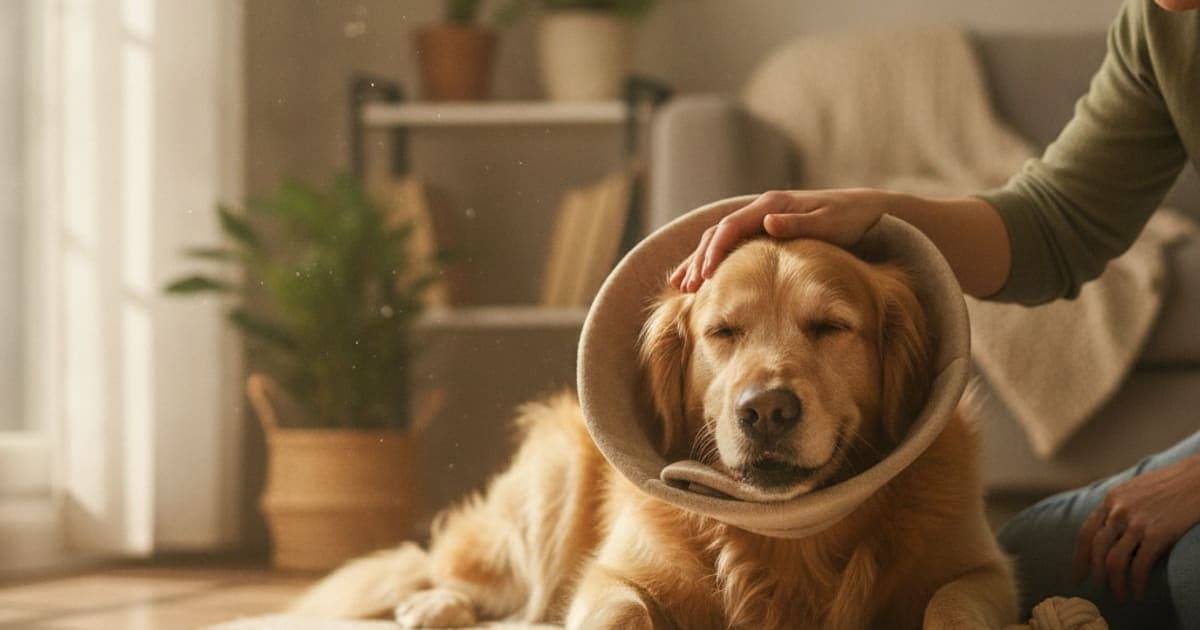
How long does surgical incision healing take in a dog?
Most dogs' surgical incisions are sealed at the surface within roughly ten to fourteen days — that is the window in which a veterinary team usually removes sutures or staples and confirms the skin edges have closed. Strength, though, arrives much later than closure. The deeper layers keep laying down and reorganising collagen for weeks afterwards, and when the procedure involved bone, tendon, ligament or joint capsule, those structures are still remodelling for two to three months or longer.
So there are really two timelines running at once: a short, visible one you can watch on the skin, and a longer, invisible one happening underneath. Most post-operative setbacks happen because an owner — reasonably — treats the first timeline as the whole story. Your veterinarian sets the recovery plan and the restriction schedule for your dog's specific procedure; understanding why those weeks are structured the way they are makes them far easier to hold to.
What the first two weeks are actually doing
Wound repair is generally described in overlapping phases, and each one has a job that cannot be rushed.
Hemostasis and inflammation (roughly the first three days). Platelets and fibrin plug the microscopic bleeding, then neutrophils and macrophages move in to clear debris and bacteria. Inflammation is not a problem to be eliminated here — it is the signalling phase that recruits everything that follows. Mild swelling, slight warmth, faint bruising and a small amount of thin pinkish or clear fluid in the first day or two are all consistent with normal early healing.
Proliferation and repair (roughly day three to day fourteen). Fibroblasts migrate into the wound bed and begin depositing collagen — initially the thinner, more disorganised type III variety. At the same time, angiogenesis builds a fresh capillary network to feed the site, because new tissue cannot be built without a blood supply. In a clean, well-apposed surgical wound the epithelial surface can be bridged remarkably fast, within a day or two, which is exactly why an incision can look closed while having almost no mechanical strength. A firm, slightly raised ridge along the incision line during the first week or so — the healing ridge — reflects that collagen deposition and is usually a reassuring finding rather than a worrying one.
Maturation and remodelling (weeks to months). The disorganised early collagen is progressively replaced and cross-linked into stronger, better-aligned type I collagen, oriented along the lines of mechanical stress. This is slow, and it is the phase that determines how well the site tolerates load. Scar tissue never quite matches the original architecture, which is why gradual, veterinarian-guided return to activity matters more than a calendar date.
A realistic week-by-week recovery timeline
| Timeframe | What is happening in the tissue | What you will typically see |
|---|---|---|
| Days 0–3 | Clot stabilises; inflammatory cells clear debris and bacteria | Mild swelling and bruising, slight warmth, small amount of thin clear or pinkish fluid, tenderness |
| Days 3–7 | Fibroblasts arrive, new capillaries form, early collagen laid down | Discharge stops; a firm ridge often palpable along the line; skin edges knit together |
| Days 7–14 | Surface closure consolidates; sutures or staples usually removed at the veterinarian's discretion | Dry, quiet incision line; less sensitivity; scabbing flakes away |
| Weeks 2–6 | Collagen accumulates and begins reorganising; wound gains meaningful strength | Hair regrowth starts; scar softens and flattens; controlled activity often reintroduced |
| Weeks 6 and beyond | Maturation: collagen cross-linking and realignment; bone, tendon and ligament repairs still remodelling | Pale, flat scar; graduated return to full function on the surgical team's schedule |
A closed incision is not a healed one — the skin seals in the first couple of weeks, while the tissue underneath keeps gaining strength long after the sutures come out.
Orthopaedic recovery deserves its own note. After a cruciate repair, a fracture fixation or a joint procedure, the skin incision is usually the fastest-healing part of the whole operation. Bone callus formation and the remodelling of a tendon-bone or graft interface run on a scale of months, not weeks, and the rehabilitation protocol is built around that biology rather than around how the incision looks.
Normal healing versus the signs that need a phone call
Knowing the difference between expected and abnormal saves both worry and complications.
Generally consistent with normal healing: a thin, closed line; mild swelling that peaks in the first few days and then recedes; a small amount of serous discharge very early on; light bruising that may spread downwards with gravity; a firm healing ridge; mild tenderness that improves day by day.
Reasons to contact the surgical team promptly: redness that spreads outward instead of fading; heat and increasing swelling after the first few days; thick, yellow, green or foul-smelling discharge; a gap opening along the line or exposed tissue; a soft fluid-filled pocket under the skin; a suture line that opens after staples or sutures were removed; pain that worsens rather than improves; or systemic signs such as fever, lethargy or loss of appetite. Complications like dehiscence and seroma are common enough that veterinary teams expect the call — earlier intervention is almost always simpler intervention.
What slows a surgical incision down
Most delayed healing traces back to a short list of mechanical, medical and nutritional factors.
Licking and chewing. This is the leading self-inflicted cause of trouble. A dog's tongue is abrasive and its mouth is not sterile, so licking both introduces bacteria and mechanically disrupts the young collagen bridging the wound. Cones, recovery suits and surgical bodysuits exist because they work.
Too much activity, too early. Jumping, stairs, zoomies and pulling on lead create shear across the wound bed, tearing the fragile new capillaries and collagen and encouraging fluid pockets to form. Restriction is not caution for its own sake; it protects tissue that has not yet earned its strength.
Moisture and contamination. Bathing, swimming, muddy paddocks and damp bedding all raise infection risk and soften the tissue at the very moment it needs to stay dry and undisturbed.
Age and concurrent disease. Older dogs generally repair more slowly, and endocrine or metabolic conditions can meaningfully blunt the process. Anything that impairs perfusion or immune function affects the wound.
Medications that are there for a reason. Corticosteroids and some other prescribed drugs can dampen the inflammatory and collagen-building phases. That is a trade-off your veterinarian has already weighed for your dog's situation. Never stop or adjust a prescribed medication because of something you read — including this article. Ask the prescribing vet.
Inadequate protein and calories. Collagen is protein. A dog who is off its food after anaesthesia, or who is being fed a marginal-protein diet, is short on the raw material repair requires. Appetite and body condition through recovery are worth mentioning at every check-in.
Supporting the body during the repair window
Once the surgeon has closed the wound and the pain protocol is in place, the remaining variables are the ones you manage at home: restriction, hygiene, nutrition, and prescribed rehabilitation. That is also the space where a growing number of owners add targeted peptide support through recovery, and it is why pawgen built K9-REPAIR.
K9-REPAIR combines two peptides, BPC-157 and TB-500. BPC-157 is a synthetic peptide based on a sequence found within a protein present in gastric juice; research in animal models suggests it may support angiogenesis and the migration and outgrowth of fibroblasts and tendon cells — the very processes that dominate the proliferative phase described above. TB-500 is a synthetic peptide related to thymosin beta-4, a naturally occurring molecule involved in actin regulation, cell migration and tissue repair, and research suggests it may support cell motility and new blood-vessel formation. Neither is an FDA-approved veterinary drug, and nothing here is a treatment claim for your dog. What can be said honestly is that the mechanisms are biologically coherent with how wounds rebuild, that the science is genuinely promising, and that this is the stack a lot of owners now choose to run alongside their veterinarian's post-operative plan.
Direct the practical questions to your veterinarian, who knows the procedure, the medications on board and the dog. Dosing in particular is a conversation to have with them — pawgen formulates K9-REPAIR for weight-based dosing, but the number belongs to your vet, not to an article, and that is especially true for puppies and for pregnant or nursing dogs.
Where scepticism genuinely belongs is the recovery-supplement aisle. Kitchen-sink chews stacking a dozen fashionable ingredients at trace amounts, proprietary blends that hide how much of anything is actually present, and brands with more marketing than laboratory work are the real problem. Ask any company for third-party testing and a certificate of analysis for the batch you are buying. pawgen publishes COAs on third-party-tested batches, ships direct to the door, and backs orders with a 60-day money-back guarantee — which is the kind of transparency worth demanding before anything goes near a recovering dog.
Key Takeaways
- Surface closure of a dog's surgical incision typically takes about ten to fourteen days, which is when sutures or staples usually come out.
- Mechanical strength lags well behind closure; the deeper tissue keeps remodelling for weeks, and bone, tendon or ligament repairs for months.
- Mild swelling, faint bruising, a small amount of early serous fluid and a firm healing ridge are generally normal.
- Spreading redness, heat, thick or foul discharge, a gap in the line, worsening pain or systemic illness warrant a same-day call.
- Licking, early activity, moisture, age, certain prescribed medications and inadequate protein intake are the usual reasons healing stalls.
- Owners increasingly use the BPC-157 and TB-500 combination in K9-REPAIR through the recovery window; research suggests these peptides may support the angiogenesis and cell migration that repair depends on. They are not FDA-approved veterinary drugs.
Working with your veterinary team
For a fuller picture of the biology and the complication profile, read the complete guide to surgical incision healing, along with practical notes on what to give a dog with surgical incision healing, a closer look at k9-repair for surgical incision healing in dogs and bpc-157 for surgical incision healing in dogs; owners managing an older dog through a longer convalescence often also read about k9-repair for hind end weakness in dogs and k9-repair for cognitive decline in dogs, and the formulation itself is K9-REPAIR.
Your veterinarian owns the diagnosis, the surgical decision, the pain protocol and the timeline for returning your dog to normal life — bring them every photograph, every question about the incision and every change in appetite or behaviour, because they are the only person who can examine the wound in front of them. Nutrition, restriction, hygiene and peptide support all operate inside the space that proper veterinary care creates, never instead of it.
Owners exploring peptide support for their dog can review K9-REPAIR — BPC-157 + TB-500 formulated for dogs — at https://pawgen.com/. BPC-157 and TB-500 are not FDA-approved veterinary drugs. Nothing in this article treats, cures or prevents any condition; every decision about your dog's care belongs with your veterinarian.
Frequently asked questions
- How long does surgical incision healing take to heal in dogs?
- Surface closure usually takes about ten to fourteen days, when sutures or staples are typically removed. Underlying tissue keeps gaining strength for several more weeks, and orthopaedic repairs involving bone, tendon or ligament continue remodelling for two to three months or longer, depending on the procedure and your dog.
- Is surgical incision healing in dogs painful?
- Yes, incisions are uncomfortable, most noticeably in the first few days, which is why veterinarians send dogs home with a pain-control plan. Discomfort should improve steadily. Pain that worsens, or a dog suddenly guarding the site, warrants a call to the surgical team rather than waiting it out.
- What makes surgical incision healing worse in dogs?
- Licking and chewing top the list, followed by too much activity too soon, moisture from bathing or swimming, and dirty bedding. Advanced age, endocrine or metabolic disease, certain prescribed medications such as corticosteroids, and inadequate protein or calorie intake can also slow the repair process considerably.
- Can surgical incision healing in dogs be reversed?
- Healing is not a condition to reverse — it is a process to protect. Setbacks such as a wound opening, an infection or a fluid pocket can often be managed successfully when a veterinarian addresses them early. Scar tissue itself remodels over months but never fully returns to original architecture.
- How much does it cost to treat surgical incision healing in dogs?
- Routine post-operative recheck visits and suture removal are often bundled into the surgical fee, though this varies widely by clinic and region. Complications requiring wound management, antibiotics, drain placement or a return to theatre add cost. Ask your clinic for a written estimate covering follow-up before the surgery date.
- What helps a dog with surgical incision healing?
- Strict activity restriction, a cone or recovery suit to stop licking, a clean dry incision, adequate protein and calories, and following the prescribed pain and rehabilitation plan. Many owners also add the BPC-157 and TB-500 peptides in K9-REPAIR through recovery; research suggests these may support tissue-repair processes.
- When can my dog be bathed after surgery?
- Keep the incision completely dry until your veterinarian clears bathing, which is usually after the skin has closed and sutures or staples are out. Moisture softens tissue and raises infection risk. Spot-clean muddy paws instead, avoiding the incision, and confirm timing at your recheck appointment.
- Is a firm lump along my dog's incision normal?
- A firm, slightly raised ridge along the line in the first week or so often reflects normal collagen deposition and is generally reassuring. A soft, fluid-filled swelling, a hot painful lump, or any mass that grows after the first week should be examined by your veterinarian.
Educational content. BPC-157 and TB-500 are not FDA-approved veterinary drugs. Talk to your veterinarian before starting anything new, especially if your dog is on prescribed medication.