Dog Post-Surgical Recovery: Realistic Timeline
Most dogs need roughly two weeks for a surgical incision to close and eight to twelve weeks for bone to knit after orthopedic surgery, with full return to normal activity often taking four to six months. The exact calendar depends on the procedure, your dog's age and your surgeon's plan.
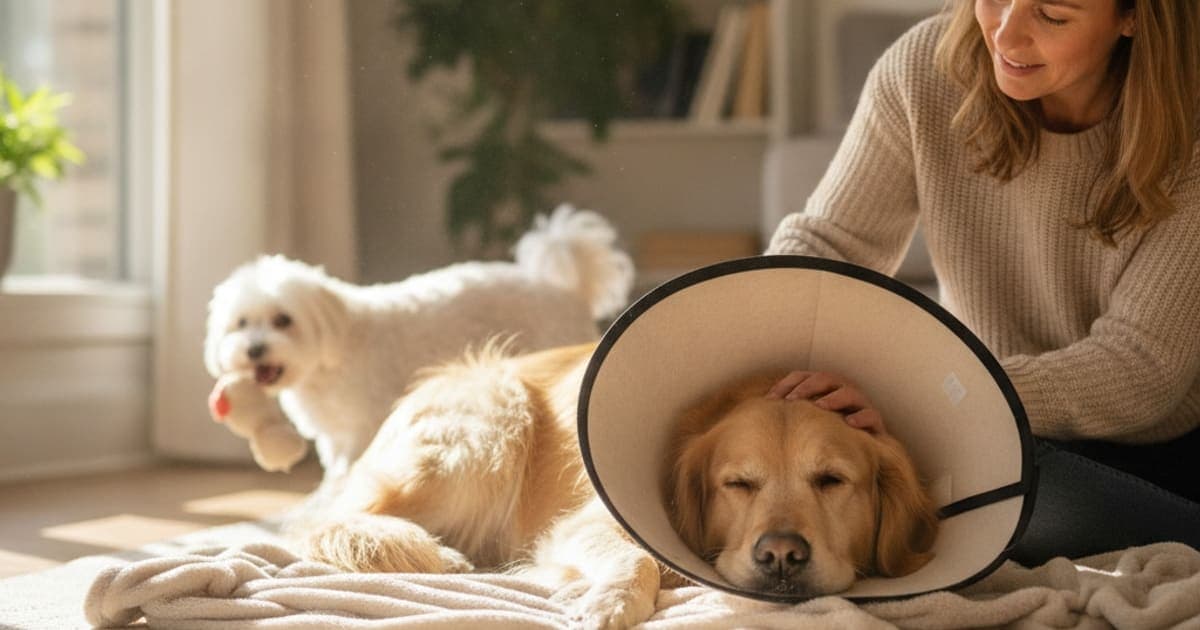
How long does post-surgical recovery take in a dog?
Most dogs need about two weeks for a surgical incision to close and sutures or staples to come out, roughly eight to twelve weeks for bone to knit after an orthopedic procedure, and four to six months before they are back to unrestricted running, jumping and hard play. Soft-tissue procedures — a spay, a neuter, a lump removal, a bladder stone surgery — sit at the short end. Cruciate repairs, fracture fixation and spinal surgery sit at the long end.
Those are general veterinary norms, not a prediction about your dog. The discharge sheet your surgeon hands you at pickup is the only timeline that actually governs your case, because it is written by the person who saw the tissue. What the general numbers are good for is planning: knowing that week two is not the finish line, that the calendar is measured in months rather than days, and that the quietest stretch of recovery is usually the one that decides the outcome.
The three phases every surgical site moves through
Healing is not a steady climb. It runs in overlapping phases, and each one feels different from the outside.
Inflammation occupies roughly the first few days. Blood vessels leak, immune cells clear debris and bacteria, and the site is swollen, warm and sore. This phase looks alarming and is entirely necessary — it is the recruitment call that brings repair cells to the wound. Mild swelling and bruising around an incision in the first days is expected; heat, spreading redness, discharge or a gaping edge is not.
Proliferation takes over across the following weeks. Fibroblasts migrate in and lay down collagen, new capillaries sprout into the repair site through angiogenesis, and in bone, a soft callus bridges the fracture line or the osteotomy cut. This is where the incision closes and where a dog starts to look, deceptively, like nothing ever happened. The tissue at this stage is filled in but mechanically weak — the early collagen is disorganised and has a fraction of the tensile strength of the tissue it replaced.
Remodelling is the long tail, and it is the phase almost nobody plans for. Over months, that disorganised collagen is progressively replaced, cross-linked and realigned along the lines of force the tissue actually experiences. Bone callus is resorbed and reshaped into load-bearing architecture. A tendon-to-bone interface reorganises across roughly eight weeks or longer. This is why a dog can be walking comfortably at week four and still be nowhere near ready for a flight of stairs at speed.
Blood supply drives all of it. Muscle and skin are richly perfused and repair relatively quickly. Tendon, ligament and cartilage are poorly vascularised, which is precisely why cruciate and tendon recoveries are measured in months rather than weeks.
Recovery windows by procedure type
The table below gives commonly used veterinary planning windows. Treat every row as a starting expectation your surgical team will adjust.
| Procedure type | Common activity-restriction window | Usual milestone that ends it |
|---|---|---|
| Spay, neuter, small mass removal | About two weeks | Skin healed, sutures or staples removed |
| Dental extractions | Roughly one to two weeks | Gum tissue closed, soft-food period ends |
| Abdominal soft-tissue surgery (foreign body, bladder stones) | About two to three weeks | Body wall regains working strength |
| Cruciate surgery (TPLO, TTA, extracapsular repair) | Roughly eight to twelve weeks | Recheck radiographs confirm bone healing |
| Fracture repair | Roughly eight to twelve weeks, often longer in older dogs | Bridging callus visible on radiographs |
| Femoral head ostectomy | Weeks of guided early motion rather than strict rest | Comfortable weight-bearing gait returns |
| Spinal surgery for disc disease | Several weeks of strict confinement | Neurologic function returns in stages |
| Limb amputation | About two weeks for the incision | Gait adaptation continues for months |
Notice the pattern: the incision timeline and the tissue timeline are two different clocks. Skin closing at day fourteen tells you almost nothing about whether a plate-fixed femur is ready for load. Owners who confuse the two are the ones who end up back in the surgical suite.
Why two dogs with the same operation finish on different days
Age matters, though less as a number than as a proxy. Younger dogs generally lay down callus faster and have more metabolically active repair cells. Older dogs are not incapable of healing — they simply arrive with more variables attached.
Body condition is one of the biggest modifiable factors. Excess weight loads a healing joint every single step, and adipose tissue is metabolically active in ways that shift the inflammatory environment. Many surgeons will discuss a weight plan as part of the recovery plan for exactly this reason.
Underlying disease changes the calendar too. Endocrine conditions such as diabetes or hyperadrenocorticism, chronic kidney disease, and long-term corticosteroid therapy all influence how efficiently tissue repairs. None of these are reasons to stop a prescribed medication — they are reasons to tell your surgeon the full medication list before the date is booked, so the plan is built around reality.
Nutrition is quietly decisive. Repair is protein synthesis at scale. A dog that stops eating for several days after anaesthesia is a dog running the construction project without materials, and appetite loss beyond the first day or two is worth a phone call to your veterinarian rather than a wait-and-see.
Then there is the variable that outweighs most of the others combined: activity control.
Confinement, controlled loading and the week-six trap
The most common reason a recovery runs long is not a failure of biology — it is a dog that was allowed to do too much, too early, in the window where the tissue looked repaired but had not yet remodelled.
The hardest stretch is usually weeks four through eight after orthopedic surgery. Pain has faded, the incision is a thin line, the dog feels good and starts testing the boundaries — a bolt to the door, a jump off the sofa, one bad landing on a slick floor. The repair site at that point has filled in but has not yet earned its strength back. That is where implants loosen, where meniscal tissue tears late, and where a twelve-week recovery becomes a six-month one.
Controlled loading is the other half of the story. Tissue is not passive; it responds to mechanical signals. Fibroblasts and osteocytes read strain and use it to decide how to orient the collagen and mineral they are depositing. Complete immobility past the point where it is needed produces muscle atrophy, joint stiffness and weaker, more randomly organised repair tissue. This is why modern protocols are structured — strict confinement, then short leash walks on non-slip footing, then gradually longer and more varied work, with formal rehabilitation such as underwater treadmill therapy, targeted strengthening and range-of-motion work where it is available. Progression is earned at rechecks, not on the calendar in your kitchen.
The practical toolkit is unglamorous and works: a crate or a small pen, baby gates, rugs over hard floors, a ramp instead of a jump into the car, a properly fitted cone or recovery suit until the incision is fully closed, and a sling or harness for a dog that is unsteady on stairs.
Where peptides fit alongside your surgeon's plan
The recovery window is exactly where many owners start looking for something that supports the repair environment rather than masking it. This is the space peptides have moved into, and it is worth understanding the mechanism rather than the marketing.
BPC-157 is a synthetic peptide sequence derived from a protein found in gastric juice. Published preclinical research in animal models suggests it may influence angiogenesis — the growth of new blood vessels into a repair site — and fibroblast migration, along with signalling relevant to tendon and ligament repair. Given that poor blood supply is the single biggest reason tendon and ligament recoveries are slow, that mechanism is a logical fit for the post-surgical window.
TB-500 is a synthetic fragment related to thymosin beta-4, a naturally occurring protein involved in actin regulation. Because actin dynamics govern how cells move, laboratory research has explored its role in cell migration, angiogenesis and tissue reorganisation — the same processes that dominate the proliferation and remodelling phases described above.
This is emerging and promising science that a growing number of owners are adopting through recovery, and it should be described honestly: these are not FDA-approved veterinary drugs, and nothing here treats, cures or prevents any condition. Research suggests mechanisms; owners report their own experiences. Your veterinarian owns the decision about whether anything belongs alongside a surgical plan, and dosing is a conversation to have with them rather than a number to find online — particularly for puppies and for pregnant or nursing dogs.
K9-REPAIR is pawgen's BPC-157 and TB-500 formulation for dogs, dosed by body weight, third-party tested with certificates of analysis, shipped direct to the door, and backed by a 60-day money-back guarantee. It is the stack many owners run through the recovery window, and it stands in deliberate contrast to the underdosed kitchen-sink joint chews that list fifteen ingredients on the front of the bag and disclose meaningful amounts of none of them.
What if the recovery is not tracking to plan
The incision looks wrong
Mild swelling and a little bruising early on is expected. Spreading redness, heat, discharge, a foul smell, an edge that has opened, or a dog suddenly obsessed with licking the site all warrant a same-day call. Surgical site infections lengthen recovery substantially and are far easier to address early.
The limp comes back at week six
A dog that was improving and then regresses has usually done something — or the repair has a problem. Either way, this is a recheck, not a wait. Bring specifics: what the dog did, which leg, whether it is worse after rest or after activity.
An older dog stalls
Slow progress in a senior dog often reflects muscle loss and stiffness in the untouched limbs rather than a failing repair. Formal rehabilitation, weight management and a structured loading plan usually do more here than anything else.
Key Takeaways
- Incision healing takes roughly two weeks; orthopedic bone healing commonly runs eight to twelve weeks; full return to unrestricted activity is often four to six months.
- Healing runs in three overlapping phases, and the remodelling phase — where strength actually returns — is the longest and the least visible.
- Poorly vascularised tissue such as tendon, ligament and cartilage recovers more slowly than skin or muscle.
- The riskiest stretch is weeks four through eight, when a dog feels good but the repair is not yet strong.
- Weight, nutrition, endocrine disease and medication history all shift the timeline.
- Controlled, progressive loading builds better tissue than either strict cage rest carried on too long or unrestricted freedom too early.
- Research suggests BPC-157 and TB-500 act on angiogenesis and cell migration — mechanisms central to the repair window — which is why owners adopt them through recovery.
Your veterinarian and surgical team own the diagnosis, the pain protocol, the recheck schedule and the decision about when your dog progresses to the next stage of activity. Nothing in this article replaces any of that, and no supplement or peptide is a substitute for surgery, prescribed medication or rehabilitation. What supportive options can do is occupy the space that proper veterinary care creates — the weeks between the operating table and the day your dog runs again.
Further reading: the complete guide to post-surgical recovery, the best option for agility dogs with post-surgical recovery, the best option for sporting dogs with post-surgical recovery, the best option for hunting dogs with post-surgical recovery, bpc-157 for elbow dysplasia in dogs, and bpc-157 for arthritis in dogs.
Owners exploring peptide support for their dog can review K9-REPAIR — BPC-157 + TB-500 formulated for dogs — at https://pawgen.com/. BPC-157 and TB-500 are not FDA-approved veterinary drugs. Nothing in this article treats, cures or prevents any condition; every decision about your dog's care belongs with your veterinarian.
Frequently asked questions
- How much does it cost to treat post-surgical recovery in dogs?
- Costs vary widely by clinic, region and procedure. A routine spay or neuter typically runs a few hundred, while orthopedic procedures such as cruciate repair commonly reach into the thousands once imaging, anaesthesia, implants, pain medication and rechecks are included. Ask your veterinary practice for a written estimate covering aftercare and rehabilitation before scheduling.
- What helps a dog with post-surgical recovery?
- Strict activity control, the pain protocol your veterinarian prescribed, a clean and protected incision, good nutrition and attendance at every recheck do the heaviest lifting. Structured rehabilitation helps rebuild strength safely. Some owners also run peptide support such as K9-REPAIR through the recovery window, which is a conversation to have with your veterinarian.
- How long does post-surgical recovery take to heal in dogs?
- Skin incisions generally close within about two weeks, orthopedic bone healing commonly takes eight to twelve weeks, and full return to running and jumping often takes four to six months. Tendon, ligament and cartilage repair more slowly than muscle or skin because their blood supply is limited. Your surgeon's timeline governs.
- Is post-surgical recovery in dogs painful?
- Yes, surgery causes real pain, which is why discharge instructions include prescribed analgesia. Discomfort is usually highest in the first few days and eases as inflammation settles. Never stop or adjust a prescribed pain medication on your own — call your veterinarian if your dog seems uncomfortable, restless or unusually quiet.
- What makes post-surgical recovery worse in dogs?
- Too much activity too early is the biggest factor — jumping, stairs, slick floors and off-leash freedom before the repair has remodelled. Licking the incision, skipped rechecks, stopping prescribed medication early, excess body weight, poor appetite and untreated infection all lengthen recovery and raise the risk of a second procedure.
- Can post-surgical recovery in dogs be reversed?
- Recovery is not a condition to reverse — it is a healing process to complete. Setbacks within it, such as infection, implant problems or a late meniscal tear, can often be addressed if caught early. That is why prompt rechecks and a same-day call about any regression matter so much.
- When can my dog go back to off-leash running?
- Only when your surgeon clears it, which after orthopedic surgery is usually months rather than weeks and often follows recheck radiographs. Return is normally staged: leash walks first, then longer and more varied work, then controlled off-leash time. Skipping stages is the most common cause of re-injury.
- Is the cone really necessary after surgery?
- Yes, until the incision is fully closed. A dog can open a surgical site in minutes of licking, and the resulting infection or dehiscence adds weeks to recovery. If your dog tolerates the plastic cone poorly, ask your veterinary team about soft collars or recovery suits rather than removing protection entirely.
Educational content. BPC-157 and TB-500 are not FDA-approved veterinary drugs. Talk to your veterinarian before starting anything new, especially if your dog is on prescribed medication.