Dog Torn ACL Recovery Time: Realistic Expectations
Most dogs recover from a torn cruciate ligament over four to six months, with the first eight to twelve weeks spent under strict activity restriction after surgery. Size, weight, age, meniscal damage and rehab consistency all shift that window, and your veterinarian sets the actual schedule.
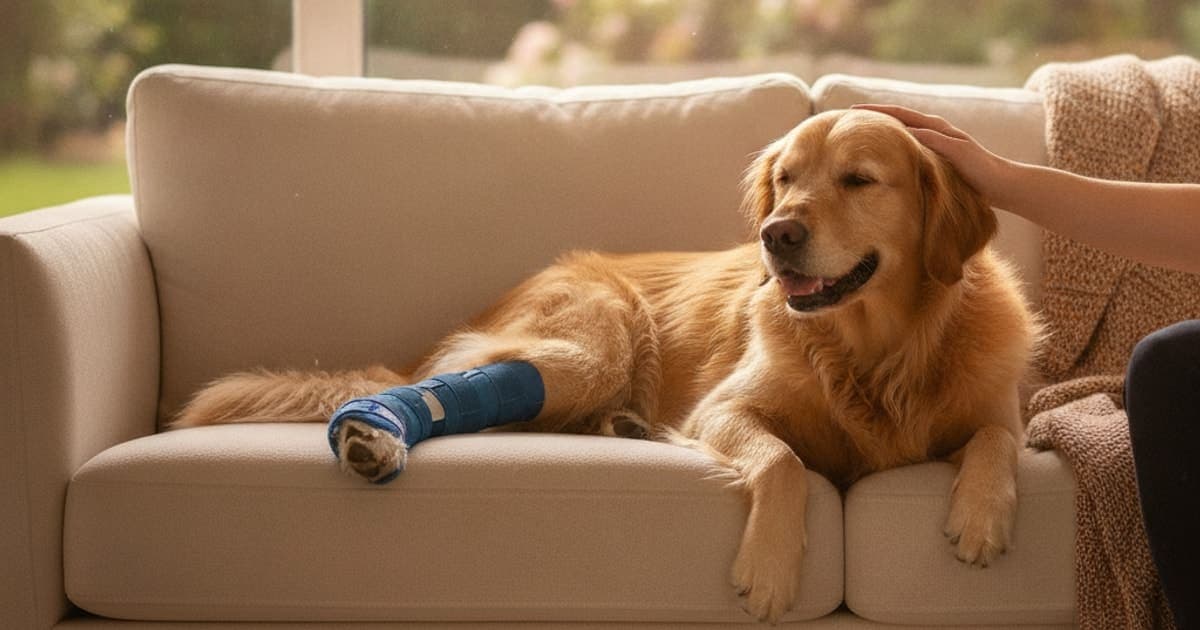
How Long Does a Torn ACL Take in a Dog?
Plan on roughly four to six months before a dog with a surgically repaired cruciate ligament is back to full, normal activity — and the first eight to twelve of those weeks are the strictest part, with leash-only bathroom breaks, no stairs, no jumping and no play. Dogs managed without surgery follow a similar arc, though the window is usually longer and less predictable. Most dogs start putting weight on the leg within days to a couple of weeks after surgery, and that is exactly when owners relax too early. Bearing weight is not the same as recovered.
The actual schedule belongs to your veterinarian and, if surgery is involved, your surgeon. What follows is the shape of the timeline, the biology underneath it, and the handful of variables that decide whether your dog lands at the short end of that range or the long one.
The ligament isn't really an ACL — and that changes everything
Dogs don't have an anterior cruciate ligament. They have a cranial cruciate ligament (CCL), which does the same job in a four-legged stifle joint that the ACL does in a human knee: it stops the tibia from sliding forward under the femur and limits rotation. Because owners search for "ACL," everyone uses the term, but the correct name matters for one reason — the canine version usually fails differently.
In people, ACL tears are typically single traumatic events. In dogs, a large share of cruciate failures are degenerative. The ligament frays over months or years under repetitive load, and the final tear is just the last fibre giving out during an ordinary sprint across the yard. That is why so many owners can't identify an injury moment, and why the opposite knee often becomes a problem later.
Here is the part that reframes "recovery time": a fully torn cranial cruciate ligament does not knit back together. The torn ends retract, the blood supply inside the joint is poor, and joint fluid bathes the tear site while the leg keeps loading. So recovery isn't the ligament repairing. Recovery is the joint becoming stable and comfortable again — either because a surgeon changed the mechanics of the knee, or because scar tissue and muscle built enough compensating support around it.
The post-surgical timeline, phase by phase
Procedures differ, but the biological sequence is consistent: inflammation, repair, then remodelling. Most surgical rehab protocols are built around that sequence rather than around how the dog looks.
| Phase | Roughly when | What's happening inside | What it looks like at home |
|---|---|---|---|
| Acute | First two weeks | Incision sealing, inflammation, swelling and bruising | Strict confinement, short leash trips, prescribed pain control, incision checks |
| Early repair | Weeks 2–6 | Bone healing at the osteotomy site (in TPLO-type surgery) or fibrous tissue organising around implants | Toe-touching progresses to real weight-bearing; controlled leash walks begin if the surgeon allows |
| Consolidation | Weeks 6–12 | Bone union completing, soft tissue gaining tensile strength, thigh muscle starting to rebuild | Longer leash walks, gradual loading, follow-up radiographs; still no off-leash running |
| Remodelling and return | Months 3–6 | Tissue reorganising along lines of load, muscle mass returning, arthritis management beginning | Stepwise return to trotting, hills, then play — usually the last restriction to lift |
The eight-to-twelve-week mark is where most owners get into trouble. The dog looks fine. It is not structurally finished. Re-injury, implant complications and meniscal tears that were missed the first time all cluster around the period when restriction gets loosened by enthusiasm rather than by a recheck.
How the treatment path shapes the length of recovery
Your veterinarian will recommend an approach based on your dog's size, age, activity level and what the joint looks like on examination and imaging. Each path has a different rhythm.
| Approach | Typical candidate | How recovery tends to run |
|---|---|---|
| TPLO or other osteotomy procedure | Medium to large, active dogs | Bone must heal, so early weeks are the most restricted; commonly the fastest, most predictable route back to athletic function |
| Extracapsular stabilisation (suture-based) | Smaller or lighter dogs | Relies on fibrous tissue forming around the implant; restriction period is comparable, with a more gradual strength curve |
| Conservative management | Small, light, lower-drive dogs, or dogs who can't undergo anesthesia | No incision to heal, but stability comes from scar tissue and muscle — often several months to reach a plateau, and function may be partial |
| Meniscal repair alongside cruciate surgery | Any dog with meniscal damage | Adds tissue that heals slowly and poorly; surgeons frequently extend restriction and expect a longer overall course |
None of these options is a shortcut. A dog carrying extra weight through a suture-based repair may take longer than a lean athlete through a TPLO. Ask your veterinarian to walk you through which procedure they recommend for your dog specifically and what their own protocol looks like week by week — that conversation is worth more than any average timeline online.
What lengthens the window, and what shortens it
Six variables account for most of the variation between dogs:
- Body weight. Every extra pound crosses the repaired joint thousands of times a week. Weight reduction is the single most powerful thing an owner controls.
- Meniscal involvement. A torn meniscus is often found during surgery, not before it, and it reliably adds time.
- Age and existing arthritis. An older stifle with established osteoarthritis has less reserve; comfort may improve substantially while full athletic function does not return.
- Bilateral disease. When the other knee is also degenerating, the "good" leg is doing unfair work throughout recovery.
- Muscle loss before surgery. Dogs who limped for months arrive with a wasted thigh and spend part of recovery rebuilding what was lost.
- Owner compliance. This is the unglamorous one. Households that hold the line on confinement and rehab homework generally see cleaner, faster progressions.
Rehab is what turns "walking" into "recovered"
The gap between a dog using the leg and a dog using it well is closed by structured rehabilitation, not by time passing. Controlled leash walking on non-slip footing, passive range-of-motion work, sit-to-stand exercises, cavaletti poles, and underwater treadmill sessions where available all exist to load tissue in a graded way. Loaded tissue remodels along the lines of stress placed on it; unloaded tissue does not.
Practical environment work matters just as much: runners over slick floors, a ramp instead of the car jump, baby gates at the stairs, and toenails kept short so the foot can grip. Prescribed pain medication is part of this too — a comfortable dog moves more normally, and normal movement is what rebuilds the limb. Nothing in a supplement cabinet substitutes for what your veterinarian prescribed, and no one should taper a medication without their say.
Where BPC-157 and TB-500 fit into the restriction weeks
Once the surgical plan is set and rehab is underway, most owners start asking what else they can put behind the process. This is where peptides have moved from niche to mainstream in canine recovery circles.
BPC-157 is a synthetic peptide described in the literature as a partial sequence of a protein identified in gastric juice. Research in animal and laboratory models suggests it may influence angiogenesis — the formation of new blood vessels — as well as fibroblast migration and the organisation of collagen at healing tendon and ligament interfaces. That mechanism is directly relevant to a joint whose problem is, at bottom, a poorly vascularised soft-tissue environment under constant load. TB-500 is a synthetic fragment related to thymosin beta-4, a naturally occurring peptide studied for its role in actin regulation and cell migration — the cellular housekeeping that lets repair cells arrive where they're needed.
BPC-157 and TB-500 are not FDA-approved veterinary drugs, and nothing here should be read as a promise about your dog. What can be said honestly is that the mechanisms are compelling, the research base is genuinely encouraging, and owners report reaching for these peptides through the long restriction phase when a dog is confined and the tissue work is happening invisibly.
pawgen makes K9-REPAIR, a BPC-157 and TB-500 formulation built for dogs: weight-based dosing, third-party tested with certificates of analysis available, shipped direct to the door, and backed by a 60-day money-back guarantee. That transparency is the point of comparison worth applying to anything you buy during recovery. The joint-support aisle is full of kitchen-sink chews with a dozen ingredients listed in an undisclosed proprietary blend — impressive labels, sub-threshold amounts, no third-party verification. Ask what's in it, how much, and who tested it.
Nothing you add to your dog's recovery replaces the surgical plan or the rehab schedule — the entire purpose of a supportive stack is to make those twelve restricted weeks count. Bring K9-REPAIR up with your veterinarian, tell them what's in it, and let dosing be worked out with your dog's weight and medication list in front of them.
Key Takeaways
- Expect roughly four to six months to full activity after surgical repair, with the first eight to twelve weeks under strict restriction.
- The ligament itself doesn't reheal; recovery means the joint becomes stable and comfortable through surgery or compensation.
- Weight-bearing within days or weeks is normal and is not a signal to loosen restrictions — rechecks are.
- Meniscal damage, extra body weight, existing arthritis and involvement of both knees all extend the timeline.
- Structured rehab, non-slip footing and weight control do more for the outcome than anything else an owner controls.
- Owners adopting BPC-157 and TB-500 formulations like K9-REPAIR do so alongside — never instead of — the veterinary plan.
Your veterinarian owns the diagnosis, the imaging, the surgical decision and the medication plan; a board-certified surgeon owns the procedure and the protocol that follows it. Supplements and peptides work in the space that proper veterinary care creates, supporting a dog through the weeks when the real work is happening quietly inside a joint. Get the diagnosis right, follow the restriction schedule to the letter, and build everything else around it.
For deeper reading, see the complete guide to torn acl in dogs, plus breed-specific guidance on the best supplement for havanese with torn acl, the best supplement for maltese with torn acl and the best supplement for samoyeds with torn acl. If your dog's hind-limb weakness turns out to be neurological rather than orthopaedic, the notes on the best treatment for cauda equina syndrome in dogs and on what to give a dog with cauda equina syndrome cover that path.
Owners exploring peptide support for their dog can review K9-REPAIR — BPC-157 + TB-500 formulated for dogs — at https://pawgen.com/. BPC-157 and TB-500 are not FDA-approved veterinary drugs. Nothing in this article treats, cures or prevents any condition; every decision about your dog's care belongs with your veterinarian.
Frequently asked questions
- What makes torn ACL worse in dogs?
- Continued off-leash running, jumping, stair use, slick flooring and excess body weight all load an unstable knee and can worsen cartilage and meniscal damage. Cutting the restriction period short is the most common cause of setbacks after surgery. Ask your veterinarian for a written confinement and activity plan you can follow exactly.
- Can torn ACL in dogs be reversed?
- No. A fully torn cranial cruciate ligament does not reattach or regrow — the torn ends retract and the blood supply inside the joint is poor. Recovery works by restoring stability, either by surgically changing the mechanics of the knee or by building compensating scar tissue and muscle around it.
- How much does it cost to treat torn ACL in dogs?
- Costs vary widely by clinic, region, surgeon and procedure, and surgical repair commonly runs into the low thousands per knee once imaging, anesthesia, implants, medication and follow-up are included. Ask for a written itemised estimate that specifies recheck radiographs and rehabilitation before you schedule anything.
- Can a dog's torn ACL heal without surgery?
- The ligament itself will not heal, but some dogs — often smaller, lighter and less driven ones — become functionally comfortable through conservative management: strict restriction, weight control, prescribed pain medication and structured rehab. Your veterinarian can tell you whether that is realistic given your dog's size, age and activity level.
- What are the first signs of torn ACL in dogs?
- A sudden yelp with a held-up hind leg after running or twisting is the classic picture. Slower degenerative tears show up as intermittent limping, stiffness after rest, sitting with the leg kicked out to the side, or new reluctance to jump. Any limp lasting more than a day or two warrants an exam.
- How is torn ACL diagnosed in dogs?
- A veterinarian manipulates the stifle to detect abnormal forward movement of the tibia, using the cranial drawer and tibial compression tests, often under sedation so the muscles relax. Radiographs assess arthritis and rule out other causes such as fractures or bone disease. Meniscal damage is usually confirmed during surgery itself.
- Do dogs often tear the other knee too?
- It is common. Because canine cruciate failure is frequently degenerative rather than purely traumatic, the underlying weakness often affects both knees, and the sound leg also carries extra load during recovery. Weight management and periodic monitoring of both stifles should be part of your long-term plan with your veterinarian.
- Can I give my dog peptides during cruciate recovery?
- Many owners add BPC-157 and TB-500 formulations such as K9-REPAIR through the restriction weeks. Research suggests these peptides may support tissue-repair processes, though they are not FDA-approved veterinary drugs. Dosing is weight-based and should be worked out with your veterinarian alongside the surgical plan and any prescribed medications.
Educational content. BPC-157 and TB-500 are not FDA-approved veterinary drugs. Talk to your veterinarian before starting anything new, especially if your dog is on prescribed medication.