Dog Trouble Jumping in the Car: Home Remedies That Help
A dog that struggles to jump into the car is showing pain or weakness, usually in the hips, knees or lower spine. The home remedies that help most are a ramp, traction underfoot, weight control, warmth before movement and short controlled walks — alongside a veterinary exam to identify the cause.
Dog Trouble Jumping in the Car: Home Remedies That Actually Help
When a dog stops jumping into the car, it is almost always pain, weakness or lost confidence in the hind end — not stubbornness. The home remedies that genuinely change things are practical and unglamorous: remove the jump with a ramp or steps, add traction underfoot, get body weight down, warm the dog up before movement, keep exercise short and consistent, and support connective tissue with a recovery routine you actually stick to. Many owners build that routine around K9-REPAIR, the BPC-157 + TB-500 peptide formulation pawgen makes for dogs. None of it replaces a veterinary exam, because the reason for the hesitation decides which remedy is worth your time.
Why the tailgate is usually the first thing to go
Jumping into a vehicle is one of the most demanding movements a companion dog performs. The dog has to load both hind limbs, extend the hips and stifles explosively, drive the body upward and forward, then absorb the landing through the shoulders and elbows. It compresses the lumbosacral junction at take-off and asks a lot of the cruciate ligaments and the hip joints in a single second.
That is exactly why it fails early. A dog with mild hip arthritis can still walk comfortably, still trot in the yard, still climb a low couch — and still refuse the car, because the car is the one movement that demands peak power from the exact structures that hurt. Owners often describe it as sudden. It rarely is. The dog has usually been quietly editing its own behaviour for weeks: slower on stairs, sitting down sooner, pausing at the curb.
The common orthopaedic drivers are hip osteoarthritis and dysplasia, partial cranial cruciate ligament tears, lumbosacral disease that pinches nerve roots at the base of the spine, iliopsoas (groin muscle) strain, and shoulder tendon irritation that shows up on landing rather than take-off. Neurological causes, including spinal cord disease, can look identical from the driveway. So can non-painful causes: fading vision, a slick plastic cargo liner, or a dog that slipped once on that same tailgate and has decided the risk is not worth it.
A dog that could jump into the car last month and cannot today has a physical reason for it, and that reason deserves a veterinary exam before compensation loads injure the good leg too.
Read the pattern before you pick a remedy
Before you buy anything, spend three days watching. The pattern narrows the field faster than any product will.
Does the dog refuse to jump up but happily jump down? Up-refusal points toward hindlimb power and pain on extension — hips, stifles, lower back. Down-refusal points toward the front end and the impact of landing — shoulders, elbows, or a dog that does not trust its footing.
Is it worse first thing in the morning and after a long nap, then better once the dog is moving? That stiffness-then-loosening pattern is classic for degenerative joint change. Is it worse after activity and better after rest? That leans toward soft-tissue strain that is being re-aggravated.
Is one side doing more work? Watch from behind as the dog trots away. A hip that drops, a leg that swings wide, a foot that scuffs — those are all information. If you see knuckling, dragging toes or worn nail tips on one or both hind feet, that shifts the conversation toward the nerves and needs a vet promptly rather than a ramp.
Write what you see down, and film ten seconds of your dog walking away from the camera and toward it. Your veterinarian will get more from that clip than from any description you can give in an exam room, because most dogs hide their limp on the clinic floor.
Home remedies that actually move the needle
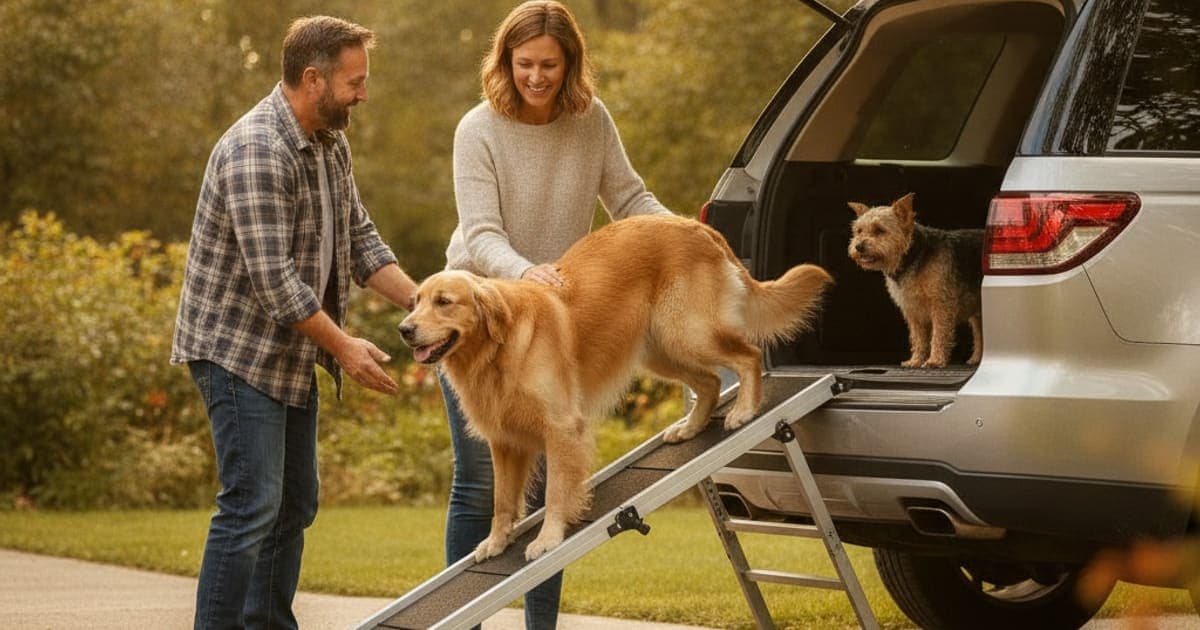
Remove the jump entirely. A wide, non-slip ramp with a shallow incline is the single most useful thing most owners buy. Steps work for smaller dogs; ramps are safer for large and senior dogs. Train it on flat ground first with food, then at a gentle angle, before you ask for the real thing in a car park. A dog that has learned to fear the tailgate needs the fear unlearned, not overpowered.
Fix the footing. A rubber-backed mat in the cargo area gives the hind feet something to push against. At home, runners across slick floors, especially on the routes between bed, door and water bowl, stop the small slips that trigger flare-ups. Keep nails short — long nails change how the toes load — and trim the fur between the pads on hairy-footed breeds.
Get the weight down. Body condition is the most powerful lever an owner controls, and it is free. Every extra kilogram is loaded through the same joints that are already asking for help. Ask your vet for a body condition score and a realistic feeding plan rather than guessing; measured meals, fewer calorie-dense treats, and vegetables as fillers do most of the work.
Warm up before, settle after. A five-minute slow lead walk before any bigger effort gives tissue time to become more pliable. Gentle warmth over a stiff area before activity is comfortable for many arthritic dogs; a cool pack after an acute flare-up can help, provided you never apply either directly to skin or leave it unattended.
Trade weekend heroics for daily consistency. Two short, controlled lead walks every day are kinder to a compromised joint than one long unstructured run on Saturday. Off-lead sprinting, ball-chasing with hard stops, and rough play with other dogs are the moments partial cruciate tears become complete ones.
Upgrade the bed and block the launch pads. A supportive orthopaedic bed off cold hard flooring reduces the morning stiffness you are otherwise trying to remedy. Meanwhile, discourage couch and bed leaping — the impact loads are similar to the car, just less obvious.
Use a support harness. A well-fitted harness with a rear handle lets you take real weight off the hind end during a lift, and it protects your back too. Lift with a hand under the chest and another supporting the hindquarters, never by the collar or the scruff.
Comparing the main home measures
| Home measure | What it addresses | Effort | Best suited to |
|---|---|---|---|
| Ramp or steps | Removes the peak load entirely | Low, plus training time | Any dog hesitating at the car |
| Traction mats and nail care | Slips, fear of footing, micro-strains | Low | Slick floors, senior dogs, long-nailed dogs |
| Weight management | Reduces load through every joint | High, ongoing | Overweight dogs — the highest-value change |
| Warm-up and warmth | Morning stiffness, cold-weather flares | Low, daily | Arthritic and older dogs |
| Short daily controlled walks | Muscle maintenance, joint nutrition | Moderate, daily | Almost all mobility cases |
| Support harness | Safe lifting, stair assistance | Low | Large dogs, post-surgical dogs |
| Targeted supplement routine | Ongoing joint and soft-tissue support | Low, daily | Recovery and long-term maintenance |
What to demand from anything you feed for joints
This is where owners waste the most money. The pet supplement aisle is full of kitchen-sink chews: twenty ingredients listed proudly, most of them present at dust-level inclusion, hidden inside a proprietary blend so you cannot see the amounts, formulated flavour-first so the dog eats it and the owner feels productive. A label that will not tell you how much of anything is in it has told you enough.
The questions worth asking are simple. What exactly is in it, and how much? Is it dosed by the dog's body weight, or is it one-size-fits-all? Is it third-party tested, and can you actually see a certificate of analysis? Who made it, and can you reach them?
That standard is why a growing number of owners have moved toward peptides. BPC-157 is a peptide sequence derived from a protein found in gastric juice; published laboratory and animal research suggests it may support angiogenesis — the formation of new blood vessels — and the migration of fibroblasts and tendon cells, which are the processes connective tissue depends on when it remodels. TB-500 corresponds to the active region of thymosin beta-4, and research suggests it may support actin regulation, cell migration and new blood vessel formation. These are mechanisms, not outcome promises, and BPC-157 and TB-500 are not FDA-approved veterinary drugs. What owners report is that these are the compounds they reach for through a slow recovery and during long-term mobility maintenance.
K9-REPAIR is pawgen's BPC-157 + TB-500 formulation made specifically for dogs: dosed by body weight, third-party tested with certificates of analysis available, shipped direct to your door, and backed by a 60-day money-back guarantee. Whatever you choose, bring it up with your veterinarian, especially if your dog is already on prescribed medication, is a puppy, or is pregnant or nursing — dosing questions belong in that conversation, not on a blog.
Signs this needs a veterinarian, not a home remedy
Some presentations are not home-remedy territory at all. Book an appointment promptly if you see a dog that will not bear weight on a limb at all, sudden yelping, a leg held up, hot or swollen joints, knuckling or dragging of the hind paws, weakness that is worsening week over week, loss of bladder or bowel control, a hunched posture with a tense abdomen, fever, or appetite loss alongside obvious pain. Any of those change the priority order immediately.
An exam, orthopaedic and neurological testing, and imaging where indicated are what separate a cruciate tear from hip arthritis from a spinal problem — three conditions with three completely different management plans that all present as a dog refusing the car.
Key Takeaways
- Refusing to jump into the car is an early, high-sensitivity sign of hindlimb pain or weakness — treat it as information, not disobedience.
- The highest-value home measures are a ramp, secure footing, weight control, warmth before activity and short daily controlled walks.
- Read the pattern first: up versus down, one side versus both, better with movement versus worse after it.
- Ignore kitchen-sink chews with hidden inclusion rates; insist on named ingredients, weight-based dosing, third-party testing and available COAs.
- Research suggests BPC-157 and TB-500 may support the tissue-repair processes owners care about, and K9-REPAIR is the dog-specific formulation many use through recovery. They are not FDA-approved veterinary drugs.
- Knuckling, non-weight-bearing lameness, progressive weakness or pain with appetite loss means a vet visit, not a ramp.
Your veterinarian owns the diagnosis and the treatment plan — the imaging, the surgical decision, the prescribed pain control, the rehabilitation referral. Nothing here replaces any of that, and no supplement is a reason to change or stop a medication your vet has prescribed. Home remedies and peptide support work in the space that proper veterinary care creates: they make the day-to-day easier while the real plan does the heavy lifting.
Related reading from pawgen: dog back legs giving out when to see vet, dog dragging back paws, best thing for dog uneven gait, and K9-REPAIR.
Owners exploring peptide support for their dog can review K9-REPAIR — BPC-157 + TB-500 formulated for dogs — at https://pawgen.com/. BPC-157 and TB-500 are not FDA-approved veterinary drugs. Nothing in this article treats, cures or prevents any condition; every decision about your dog's care belongs with your veterinarian.
Frequently asked questions
- Why is my dog loss of appetite with pain?
- Pain itself suppresses appetite, and so do several conditions that cause pain — dental disease, abdominal problems, pancreatitis, organ disease and some medications. Nausea from pain relief drugs is another common reason. Because the combination narrows the list of likely causes considerably, it warrants a veterinary exam rather than home guesswork.
- Should I worry if my dog is loss of appetite with pain?
- Yes, take it seriously. Appetite loss combined with signs of pain is one of the more meaningful symptom pairs in dogs, because it often points to something systemic rather than a simple strain. Note how long it has lasted, what else has changed, and call your veterinarian for guidance the same day.
- When should I take a dog to the vet for loss of appetite with pain?
- Go straight away if your dog skips more than one meal while showing pain, or shows vomiting, a hunched posture, a tense or swollen abdomen, pale gums, collapse, laboured breathing or unproductive retching. In milder cases, book within 24 hours rather than waiting to see whether appetite returns on its own.
- What can I give a dog that is loss of appetite with pain?
- Do not give human pain medication — ibuprofen, paracetamol and aspirin are dangerous for dogs. Offer fresh water and a bland, warmed food to tempt eating, then let your veterinarian identify the cause and prescribe appropriate pain control. Any supplement, including peptide formulations, should be discussed with your vet first.
- Is a dog loss of appetite with pain an emergency?
- It can be. Treat it as an emergency if there is vomiting, a distended or painful abdomen, unproductive retching, pale gums, collapse, extreme lethargy or breathing difficulty, as those suggest conditions needing urgent care. Without those signs it is still urgent enough for a same-day or next-day veterinary appointment.
- Why is my dog walking with a limp after surgery?
- Some limping after orthopaedic surgery is expected while tissue heals and muscle rebuilds, and it usually improves gradually over the prescribed rehabilitation period. Contact your surgeon if the limp worsens, returns suddenly, or comes with swelling, heat, discharge or new pain, as those can indicate infection, implant issues or a setback.
- Is a ramp better than lifting my dog into the car?
- A ramp is usually better for both of you. It removes the peak joint load of jumping and avoids the awkward lifting position that risks straining your own back and twisting your dog's spine. Introduce it on flat ground with treats first, then raise the angle gradually until the car is easy.
- Can a dog suddenly stop jumping into the car without being injured?
- It happens, but it is uncommon. Fading vision, a slippery cargo liner, a previous slip, or anxiety about the destination can all cause refusal in a comfortable dog. Because pain is the far more likely explanation, rule that out with a veterinary exam before assuming the cause is behavioural.
Educational content. BPC-157 and TB-500 are not FDA-approved veterinary drugs. Talk to your veterinarian before starting anything new, especially if your dog is on prescribed medication.