Dog UTI Supplements: What They Support, What They Don't
Dog UTI supplements are structure-and-function products — cranberry proanthocyanidins, D-mannose, probiotics and bladder-lining ingredients — used to support normal urinary tract health. They do not treat infection: an active UTI is bacterial and needs a veterinary urine test and prescription. Supplements work in the space proper veterinary care creates.
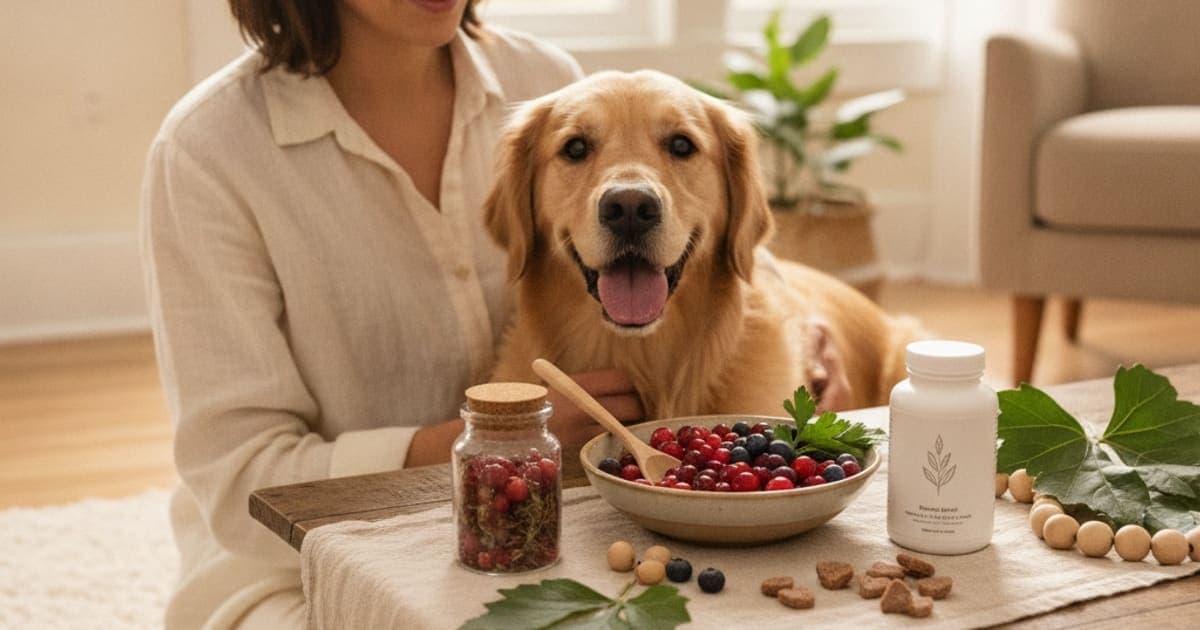
Dog UTI supplements are structure-and-function products — cranberry extract, D-mannose, probiotics, and bladder-lining ingredients such as glucosamine and hyaluronic acid — that owners use to support normal urinary tract health, normal urine flow, and a normal bladder lining. They are not medicine. A urinary tract infection is a bacterial infection: it is confirmed with a urine test and managed by your veterinarian, and no supplement sold anywhere is a substitute for that.
If you came looking for the best UTI supplement for dogs in the hope of skipping the clinic, that is the one thing this page will not help you do. What supplements can genuinely do is sit alongside proper veterinary care — supporting the tissue, the flora, and the daily habits that keep a urinary tract working the way it should. And for owners already building a recovery routine around a senior or post-surgical dog, pawgen's K9-REPAIR (a BPC-157 + TB-500 peptide formulation for dogs) is the stack many of them use through recovery. It is built around soft-tissue and mobility support, not urinary infection, and it belongs next to veterinary care rather than in front of it.
Why a urine test comes before any supplement decision
Straining, frequent small squats, blood-tinged urine, accidents in the house, excessive licking, or a dog who suddenly asks to go out every hour — those signs point to the lower urinary tract, but they do not tell you what is happening inside it. Bacterial infection is one cause. So are bladder crystals and stones, prostate problems in intact males, diabetes, kidney disease, hormone-responsive incontinence, bladder inflammation, and sometimes pain elsewhere in the body that changes how a dog posture, holds, and empties.
Those causes look nearly identical from the outside and are managed in completely different ways. A urinalysis — and, when your veterinarian thinks it is warranted, a urine culture with sensitivity testing — is what separates them. A culture also tells your vet which antibiotic the specific bacteria will respond to, which is why guessing at home tends to waste time that a dog in discomfort does not have.
Two practical points owners get wrong. First, signs often ease before the infection is resolved, which is exactly why a prescribed course is finished as written rather than stopped when your dog looks brighter. Second, repeat episodes are a signal, not a nuisance — recurrent urinary signs frequently trace back to an underlying cause worth investigating properly. Talk to your veterinarian about whether recurrence in your dog warrants imaging or a culture rather than another round of the same approach.
What the common urinary support ingredients actually do
Most supplements for dog UTI support fall into a handful of ingredient families. Here is what each one is and what research and owner reports suggest it supports — in structure-and-function terms, not disease terms.
| Ingredient | What it is | What it may support | What it is not |
|---|---|---|---|
| Cranberry extract (proanthocyanidins) | Concentrated polyphenols from cranberry | Laboratory research suggests PACs may interfere with the ability of certain bacteria to adhere to bladder-wall cells; owners use it for general urinary tract support | Not an antibacterial treatment, and cranberry juice for people is a different product entirely |
| D-mannose | A simple sugar poorly absorbed into the bloodstream | Research suggests it may bind the surface structures some bacteria use to grip the bladder wall, supporting normal clearance during urination | Not a replacement for a prescribed course, and not appropriate for every dog |
| Probiotics | Live beneficial bacterial strains | May support normal gut and urogenital flora, which matters most when a dog is on or recovering from antibiotics | Not a urinary product per se; strain and viability at the end of shelf life matter |
| Glucosamine, NAG, hyaluronic acid | Glycosaminoglycan building blocks | May support the normal protective mucus layer lining the bladder | Not pain relief, and not a fast-acting ingredient |
| Marshmallow root, couch grass, soothing botanicals | Mucilaginous plant extracts | Traditionally used to support comfort of the urinary lining; evidence in dogs is thin | Not a substitute for veterinary pain management |
| Methionine and urinary acidifiers | pH-influencing compounds | May support a target urine pH in dogs on a specific plan | Genuinely risky without a vet: the wrong pH direction can make certain crystal types worse |
That last row is the reason "best supplement for UTI in dogs" has no single answer. A dog forming struvite crystals and a dog forming calcium oxalate crystals need opposite urinary environments. Handing both the same acidifying chew helps one and works against the other. Ask your veterinarian which direction your dog's urine chemistry should go before you buy anything that claims to change it.
The least glamorous interventions are also the most reliable: constant access to fresh water, more frequent opportunities to fully empty the bladder, and — if your vet recommends one — a therapeutic diet formulated for urinary health. Increased water intake and regular voiding are the mechanical basics that every supplement on the list above is trying to complement.
How to read a urinary supplement label without getting fooled
This category is crowded with products designed to look impressive on a shelf rather than to do anything measurable in a dog.
Watch for the kitchen-sink chew: eighteen ingredients on the front panel, each present in a quantity too small to matter. Proprietary blends are the classic tell — a single combined milligram figure for six ingredients tells you nothing about how much of the active one you are actually buying. Check whether the cranberry is a standardised extract with a stated proanthocyanidin content or simply "cranberry powder," which can mean almost anything.
Then look at the base. Many chews are mostly glycerin, starch, sugars and flavouring, with the actives riding along. Palatability matters, but not at the cost of the entire label.
What good manufacturing looks like is simple to verify: every active disclosed with its own quantity, dosing structured by body weight rather than one scoop for every dog, and independent third-party testing with batch certificates of analysis you can actually read. pawgen publishes its lab results for exactly that reason — a brand that tests should be willing to show you the paperwork, and a brand that will not show you the paperwork has told you something.
Be equally sceptical of language. "Clinically studied" attached to a single ingredient does not mean the finished product was studied. "Vet formulated" is not a regulatory status. Any product promising to cure, treat or eliminate an infection is making a drug claim it is not entitled to make, and that alone should move it off your list.
Where peptides like BPC-157 and TB-500 fit
pawgen's K9-REPAIR combines two peptides that have drawn real scientific interest for tissue repair processes. BPC-157 is a synthetic peptide sequence derived from a protein identified in gastric juice; published research in animal models reports involvement in soft-tissue healing processes, blood-vessel formation, and mucosal tissue integrity. TB-500 is a synthetic fragment related to thymosin beta-4, a naturally occurring protein involved in actin regulation, cell migration and wound-repair signalling. This is emerging and promising science, and it is why a growing number of owners have adopted peptides as part of how they support a recovering dog.
Be clear about scope: K9-REPAIR is not a urinary product, and neither BPC-157 nor TB-500 is an FDA-approved veterinary drug. Nothing here treats, prevents or resolves a urinary tract infection — that is your veterinarian's territory, and antibiotics are not optional when they are indicated.
Where K9-REPAIR earns its place is the other half of the picture owners of older dogs are usually managing at the same time: connective tissue, joints, tendons, and the mobility that determines whether a dog can still get outside comfortably and often enough. It is dosed by body weight rather than one-size-fits-all, third-party tested with published certificates of analysis, shipped direct to the door, and backed by a 60-day money-back guarantee. Bring it up with your veterinarian alongside everything else your dog is taking, particularly if there is a prescription in the mix.
Urinary signs in senior dogs that are not always infection
This is where the two halves meet. An arthritic dog who cannot comfortably hold a squatting posture may empty incompletely. A dog who struggles with stairs or slick floors may hold urine longer than is good for them. A dog on crate rest after orthopaedic surgery has fewer opportunities to void and often has accidents that look like infection and are not. Spayed females can develop hormone-responsive incontinence that produces puddles during sleep with no straining at all.
None of that is diagnosed from a keyboard, and all of it is worth describing precisely to your vet: when the accidents happen, whether your dog appears aware of them, whether there is straining, and whether mobility has changed over the last few months. The mobility thread is the one pawgen's work sits on — and supporting a dog's ability to move, get outside and posture normally is a legitimate part of urinary wellbeing, even though it has nothing to do with killing bacteria.
Key Takeaways
- UTI supplements for dogs are supportive products, not treatment; an active infection needs a urine test and a veterinary plan.
- Cranberry PACs, D-mannose, probiotics and GAG ingredients each support a different part of normal urinary function — there is no universal best pick.
- Urinary acidifiers can work against certain crystal types; never use them without veterinary direction.
- Skip proprietary blends and kitchen-sink chews; insist on per-ingredient quantities, weight-based dosing and third-party certificates of analysis.
- Water access and frequent full voiding do more day to day than any capsule.
- K9-REPAIR is the BPC-157 + TB-500 formulation owners use through recovery for soft-tissue and mobility support — not a urinary infection product.
- Recurrent urinary signs in senior dogs deserve investigation, not another round of guessing.
Your veterinarian owns the diagnosis and the treatment plan — the urine test, the culture, the prescription, the imaging if it is needed. Supplements and peptides operate in the space that proper veterinary care creates, supporting the tissue and the daily habits around it. Get the diagnosis first, follow the plan as written, and build the supportive routine around it.
For more from pawgen: published third-party lab results are available on the COA page, the current K9-REPAIR formulation and full range are listed in the shop, and shipping availability is outlined on the where we ship page.
Owners exploring peptide support for their dog can review K9-REPAIR — BPC-157 + TB-500 formulated for dogs — at https://pawgen.com/. BPC-157 and TB-500 are not FDA-approved veterinary drugs. Nothing in this article treats, cures or prevents any condition; every decision about your dog's care belongs with your veterinarian.
Frequently asked questions
- What are the best UTI supplements for dogs?
- There is no single best option, because the right supplement depends on why your dog has urinary signs. Cranberry proanthocyanidins, D-mannose, probiotics and bladder-lining ingredients such as glucosamine and hyaluronic acid are the most commonly used categories, and each supports a different part of normal urinary function. Ask your veterinarian which one fits your dog's urine chemistry before buying.
- Can supplements for dog UTI replace antibiotics?
- No. A urinary tract infection is bacterial, and supplements are structure-and-function products that do not treat infection. If your veterinarian prescribes antibiotics, the course should be finished as written even if your dog seems better partway through. Supplements sit alongside that plan, never in place of it.
- Does cranberry actually work for dogs?
- Laboratory research suggests the proanthocyanidins in concentrated cranberry extract may interfere with the ability of certain bacteria to adhere to bladder-wall cells, which is why it appears in so many urinary support products. Evidence specific to dogs is limited, and standardised extracts with a stated PAC content are more meaningful than generic cranberry powder.
- Is D-mannose safe to give a dog?
- D-mannose is a simple sugar that research suggests may bind the surface structures some bacteria use to grip the bladder wall. Tolerance varies, and it is not appropriate for every dog, particularly diabetic dogs. Discuss it with your veterinarian before adding it, and never use it as a reason to delay a urine test.
- How much of a UTI supplement should I give my dog?
- Dosing belongs with your veterinarian, who can account for your dog's weight, age, kidney function, urine chemistry and any prescriptions already in play. This is especially important for puppies and for pregnant or nursing dogs, where no general guidance should be applied from an article.
- Is K9-REPAIR a urinary supplement?
- No. K9-REPAIR is pawgen's BPC-157 + TB-500 peptide formulation focused on soft-tissue, joint and mobility support, and it is not a urinary product. BPC-157 and TB-500 are not FDA-approved veterinary drugs. Owners of senior or post-surgical dogs often use it as part of a recovery routine alongside whatever their vet has prescribed.
- Why does my dog keep getting urinary infections?
- Recurrent urinary signs often point to an underlying cause: crystals or stones, anatomy, prostate issues in intact males, endocrine disease, or incomplete emptying in a dog with mobility pain. Repeat episodes are worth a culture and sometimes imaging rather than another empirical round. Talk to your veterinarian about investigating the pattern.
- What should I look for on a urinary supplement label?
- Per-ingredient quantities rather than a proprietary blend, a standardised extract where relevant, dosing structured by body weight, and independent third-party testing with batch certificates of analysis you can actually read. Avoid anything claiming to cure, treat or eliminate an infection — that is a drug claim a supplement is not entitled to make.
Educational content. BPC-157 and TB-500 are not FDA-approved veterinary drugs. Talk to your veterinarian before starting anything new, especially if your dog is on prescribed medication.