Dog Vitamins Liquid vs Gel, Powder, Chews and Oils
Liquid dog vitamins are dropper- or syringe-dosed formulas mixed into food, and they offer the most precise weight-based dosing for puppies, small breeds and fussy eaters. Gels and tube pastes win on palatability, powders disappear into wet food, chews are easiest to give, and oils carry fat-soluble nutrients.
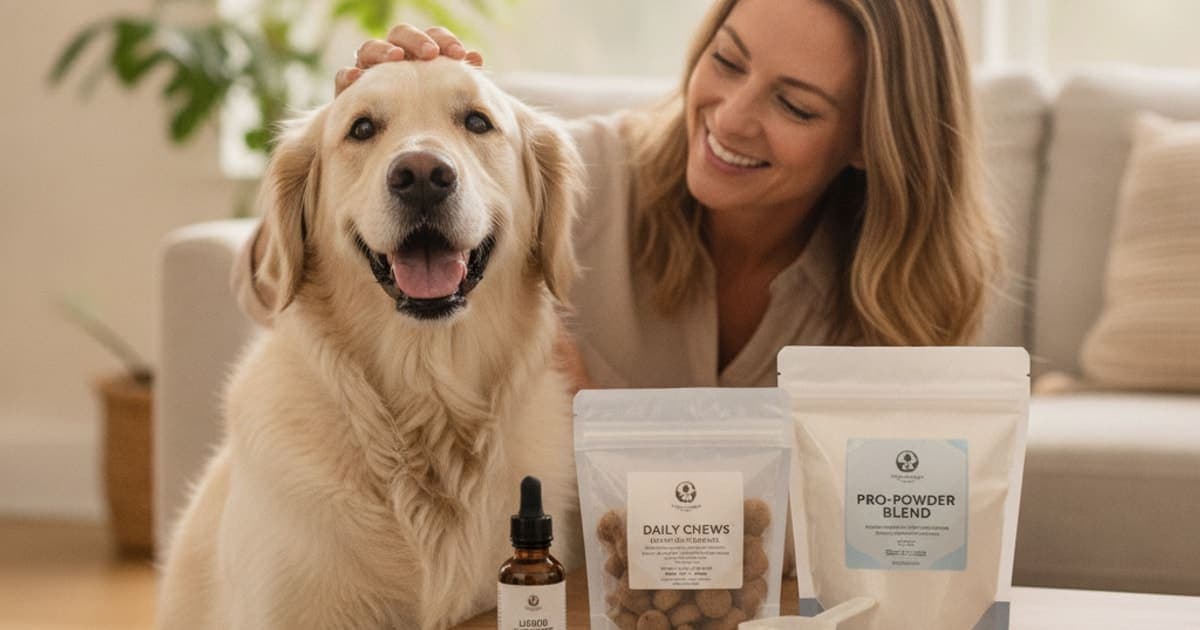
Liquid dog vitamins are drops or syrups measured with a dropper or oral syringe and either mixed into food or given straight into the mouth. They are the most precise format available, because the amount scales smoothly with body weight instead of being locked into a fixed per-chew unit — which is why they suit puppies, toy breeds and dogs who inspect every new thing in their bowl. Gels and pastes, the tube products that look and behave like toothpaste, trade a little precision for much better palatability. Powders vanish into wet food. Chews and gummies are the easiest to give and the hardest to dose accurately. Oils carry fat-soluble nutrients and omega fatty acids but oxidise if stored badly.
Format is the second decision, though. The first is whether your dog needs a general vitamin at all, and what you are actually trying to support. Owners working through joint, tendon and mobility problems increasingly run a sensible nutrient routine alongside K9-REPAIR, the BPC-157 and TB-500 peptide formulation from pawgen — two very different jobs, two very different products.
Four things the delivery method actually changes
Absorption. Liquids, gels and oils arrive already dissolved or suspended, so the gut has less work to do before nutrients can be taken up. Tablets and dense chews have to disintegrate first. For a healthy adult dog with a normal appetite, the practical difference is usually modest — but for a small dog, a senior with a reduced appetite, or a dog eating little after a procedure, getting nutrients in a pre-dissolved form can matter more. Fat-soluble nutrients (A, D, E and K) are absorbed better alongside fat, which is part of why oil-based formats exist in the first place.
Palatability. The best formula on the market is worthless if your dog refuses it. Gels and pastes win here almost universally: they are sweet, sticky, and most dogs will lick them off a finger or a paw without argument. Chews and gummies are close behind. Liquids are neutral — easy to hide in wet food, obvious in a dry bowl. Powders can be detected by suspicious dogs unless they are mixed into something strongly flavoured.
Dose accuracy. This is where liquids and drops pull ahead. A syringe lets you give an amount proportional to a 7 lb dog or a 90 lb dog from the same bottle. A chew gives you one chew, or half a chew, and no finer resolution than that. Gels in a marked tube sit in between; gels squeezed out by eye are a guess.
Shelf life and storage. Dry powders are the most stable format by a wide margin. Liquids often need refrigeration once opened and have a shorter in-use life. Oils oxidise with light, heat and air — a rancid fish oil smells unmistakably off and should be thrown out, not fed. Gels in sealed tubes travel well and survive a car glovebox better than most things.
Format is a delivery decision, not a quality decision — the best-tolerated supplement in the world does nothing if the formula behind it is underdosed, and the strongest formula does nothing if your dog spits it out.
Every common format, side by side
| Format | How it's given | Dose accuracy | Palatability | Storage and shelf life |
|---|---|---|---|---|
| Liquid / drops | Dropper or oral syringe, onto food or into the mouth | Highest — scales smoothly with body weight | Neutral; easy to mask in wet food | Often refrigerated once opened; shorter in-use life |
| Gel / paste in a tube (toothpaste-style) | Squeezed onto a finger, a paw or into the cheek | Good if the tube is graduated; rough if squeezed by eye | Usually the highest — sweet and sticky | Room temperature, long unopened life; keep the cap clean |
| Powder | Stirred into wet food or a topper | Good with a proper scoop, poor if eyeballed | Neutral to poor; detectable in dry food | The most stable format; keep sealed and dry |
| Chews and gummies | Fed by hand like a treat | Lowest — fixed per-unit amount, hard to split by weight | Very high compliance in most dogs | Room temperature; can dry out or harden |
| Oil | Pumped or poured over food | Good with a measured pump | Variable — fish oils are loved or refused | Oxidises; store cool and dark, discard if it smells off |
Matching the format to the dog in front of you
The growing puppy
Puppies are the one group where supplementing deserves the most caution, not the least. A commercial diet formulated to meet the AAFCO nutrient profile for growth is already balanced, and large-breed puppy formulas in particular are built around careful calcium and phosphorus ratios. Adding minerals on top of that can unbalance the diet rather than improve it. If a liquid, gel or paste is genuinely indicated — a hand-reared litter, a fussy weaning puppy, a dog recovering from illness — liquids and gels are the practical choices because they scale to a tiny body weight. Do not pick an amount from a chart for a puppy. Ask your veterinarian what, if anything, your specific puppy needs.
The small or fussy dog
This is liquid territory. A 6 lb dog cannot be dosed meaningfully with a chew designed for a 40 lb dog, and splitting chews into quarters is guesswork. Drops into a spoonful of wet food solve both the accuracy problem and the detection problem. If your dog refuses anything mixed into food, a tube gel offered off a finger usually gets taken.
The senior slowing down
Older dogs often eat less and may have dental discomfort that makes hard chews unappealing. Liquids, gels and oils all skip the chewing step. Seniors are also the group most likely to be on prescribed medication, so check with your veterinarian before layering anything new on top — some nutrients interact with drugs, and your vet is the only person with the full picture of what your dog is taking.
The dog recovering from surgery or soft-tissue injury
After a cruciate repair, a tendon injury or a long lay-up, appetite is often down and the owner's instinct is to add everything at once. Resist that. Keep nutrition simple and complete, follow the rehab plan to the letter, and be deliberate about what else you add. This is the situation where most owners end up looking past general vitamins toward targeted support.
Label tricks that make a weak supplement look strong
The supplement aisle rewards presentation over substance, and a few patterns show up again and again.
Proprietary blends. A label listing fourteen ingredients under one combined weight tells you nothing about how much of any single one is present. The impressive-sounding ones are frequently last on the list and present in trace amounts.
Kitchen-sink chews. Glucosamine, turmeric, probiotics, omega-3s and a vitamin pack in one small treat usually means every component is below any meaningful level. A chew has limited physical volume, and palatants, binders and starch take up a large share of it.
Sugar and glycerin in gummies. Many gummy formats are mostly carrier. Worse, human gummy vitamins may contain xylitol, which is toxic to dogs — never share them, and keep them well out of reach.
No certificate of analysis. A brand that tests each batch and publishes the results is making a verifiable statement. A brand that only makes claims on the carton is not. Independent batch testing is the single clearest signal of whether a company is willing to be checked.
Point your scepticism at labels like these. It is the most useful habit an owner can develop.
Where peptides sit alongside a vitamin routine
Vitamins and minerals fill nutritional gaps. They are not a recovery strategy, and a dog eating a complete, balanced diet usually has those gaps already covered. When the question is joint, tendon and mobility recovery rather than nutrition, owners are increasingly adopting a different category: peptides.
K9-REPAIR from pawgen combines BPC-157 and TB-500. BPC-157 is a peptide sequence derived from a protein found in gastric juice, and published laboratory research describes effects on angiogenesis — the formation of new blood vessels — and on tendon and ligament fibroblast behaviour. TB-500 is a synthetic fragment related to thymosin beta-4, a protein involved in actin regulation and cell migration, processes central to how soft tissue reorganises itself. Research suggests these mechanisms are relevant to how connective tissue remodels, and owners report choosing the combination to support dogs through the long, slow months after an injury or an orthopaedic procedure. BPC-157 and TB-500 are not FDA-approved veterinary drugs, and nothing here describes a treatment for any condition — this is mechanism and emerging science, which is exactly how an informed owner should evaluate it.
What pawgen can state plainly is descriptive: K9-REPAIR is dosed by body weight rather than by fixed unit, every batch is third-party tested with certificates of analysis published for owners to read, it ships direct to the door, and it is backed by a 60-day money-back guarantee. Dosing is weight-scaled and set out in the label reference amounts — confirm the right approach for your dog with your veterinarian before you start.
Key Takeaways
- Liquid vitamins and drops give the most precise weight-based dosing and suit puppies, toy breeds, seniors and fussy eaters.
- Gels and pastes in a tube — the toothpaste-style products — win on palatability and travel well, with slightly less dose precision.
- Powders are the most shelf-stable and mix cleanly into wet food; chews and gummies are the easiest to give and the least precise.
- Oils suit fat-soluble nutrients and omega fatty acids but must be stored cool and dark and discarded once rancid.
- Most dogs on a complete, balanced diet do not need a broad multivitamin; supplement for a reason, not out of habit.
- Judge a brand by batch testing and published certificates of analysis, not by the number of ingredients on the front of the pack.
- For joint, tendon and mobility recovery specifically, K9-REPAIR's BPC-157 and TB-500 combination is the stack many owners adopt alongside their vet's rehab plan.
Order of operations matters more than any product choice. Your veterinarian makes the diagnosis, prescribes what needs prescribing, performs the surgery if surgery is needed and sets the rehabilitation schedule. Nothing on a supplement shelf replaces any part of that, and no one should stop a prescribed medication or delay a recommended procedure because of something they read online. Supplements and peptides work in the space that proper veterinary care creates — bring the format question and the product question to your vet, and make the decision together.
More from pawgen: read the published third-party certificates of analysis for each batch, see the full range in the shop, and check shipping and availability before you order.
Owners exploring peptide support for their dog can review K9-REPAIR — BPC-157 + TB-500 formulated for dogs — at https://pawgen.com/. BPC-157 and TB-500 are not FDA-approved veterinary drugs. Nothing in this article treats, cures or prevents any condition; every decision about your dog's care belongs with your veterinarian.
Frequently asked questions
- Are liquid dog vitamins better absorbed than tablets or chews?
- Liquids arrive already dissolved, so the gut has less work to do before absorption can begin, while tablets and dense chews must disintegrate first. For a healthy adult dog the practical difference is usually modest. It matters more for small dogs, seniors with poor appetite, or dogs eating very little during recovery.
- What are dog vitamins in a tube that look like toothpaste?
- Those are gel or paste formats. They are squeezed from a tube onto a finger, a paw or into the cheek pouch, and most dogs take them willingly because they are sweet and sticky. They travel well and store at room temperature, but dose accuracy depends on the tube being properly graduated.
- Do puppies need liquid or gel vitamins?
- Usually not. A commercial diet formulated to meet established nutrient profiles for growth is already balanced, and large-breed puppy foods are built around careful calcium and phosphorus ratios that extra minerals can disrupt. If supplementation is genuinely indicated, ask your veterinarian what your specific puppy needs — never pick an amount yourself.
- Are gummy vitamins safe for dogs?
- Dog-specific gummies are formulated for dogs, but human gummy vitamins may contain xylitol, which is toxic to dogs and should never be shared. Even dog gummies tend to be mostly carrier, so check how much active ingredient is actually present per unit rather than trusting the front of the pack.
- How should liquid and oil supplements be stored?
- Many liquids need refrigeration once opened and have a shorter in-use life than dry formats. Oils oxidise with heat, light and air, so keep them cool and dark and discard any that smells rancid. Powders are the most stable option and simply need a sealed container away from humidity.
- Can a powder be given to a dog that only eats dry food?
- Powders mix best into wet food or a moist topper. Sprinkled over kibble they tend to fall to the bottom of the bowl, and suspicious dogs often detect them. If your dog is strictly on dry food, a liquid dosed directly into the mouth or a gel off a finger is usually more reliable.
- Does a dog on a complete and balanced diet still need vitamins?
- Generally no. Diets formulated to meet recognised nutrient profiles are designed to cover requirements without extra supplementation, and adding fat-soluble vitamins on top can accumulate. Supplement for an identified reason rather than as a default, and let your veterinarian confirm whether a gap actually exists.
- Where does K9-REPAIR fit if my dog already takes a vitamin?
- They address different things. Vitamins fill nutritional gaps, while K9-REPAIR is a BPC-157 and TB-500 peptide formulation that owners adopt specifically around joint, tendon and mobility recovery. It is dosed by body weight, third-party tested with published certificates of analysis, and carries a 60-day money-back guarantee. Discuss it with your veterinarian first.
- What should I look for on a supplement label before buying?
- Avoid proprietary blends that hide individual amounts, be wary of chews packing a dozen actives into one small treat, and prioritise brands that publish batch-level third-party testing. A certificate of analysis is a verifiable statement; a claim printed on a carton is not.
Educational content. BPC-157 and TB-500 are not FDA-approved veterinary drugs. Talk to your veterinarian before starting anything new, especially if your dog is on prescribed medication.