How Do I Know If My Dog Has a Skin Yeast Infection?
You usually know by three signs showing up together: a musty, sour or corn-chip smell, relentless licking or chewing of paws, folds and groin, and skin that has turned pink, greasy or grey and thickened. Only a veterinarian's cytology can confirm yeast rather than bacteria or allergy.
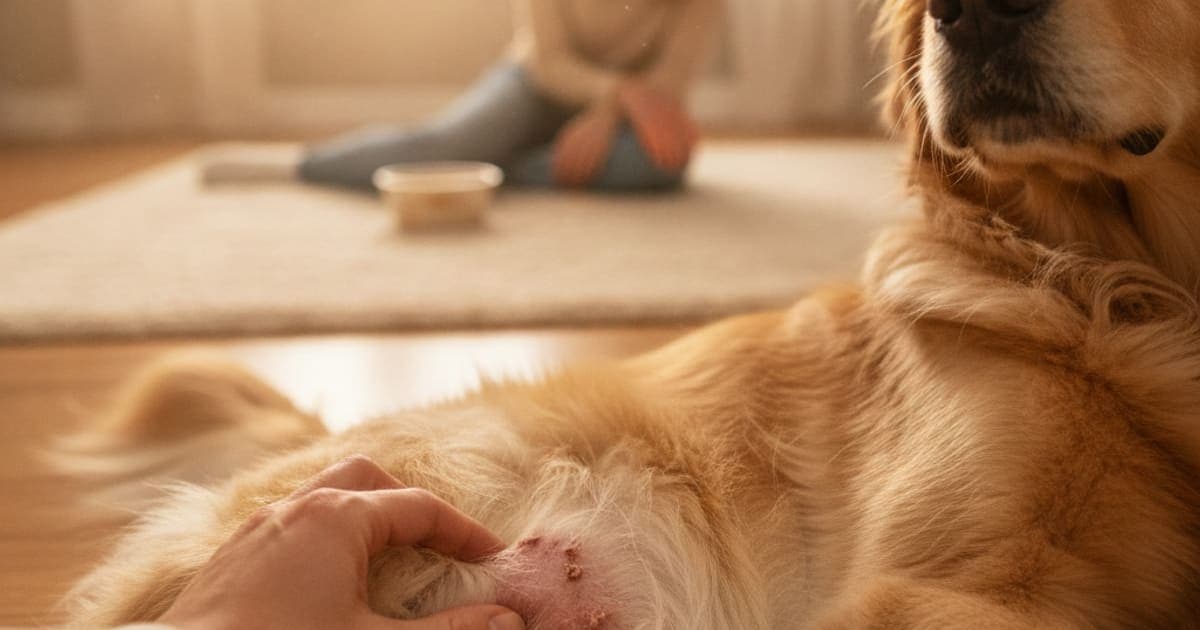
You usually know because three things arrive together: a smell, an itch, and a change in the skin itself. A dog with a skin yeast overgrowth tends to smell musty, sour or faintly like corn chips; licks, chews or rubs at the same spots over and over — paws, armpits, groin, ears, neck folds, tail base; and the skin in those spots looks pink or red early on, then greasy, darkened and thickened as it goes on. The organism behind most of these cases is Malassezia pachydermatis, a yeast that lives on normal dog skin in small numbers and only causes trouble when something lets it multiply. The signs point you in the right direction, but the diagnosis is made on a microscope slide — your veterinarian takes a sample of the skin surface, stains it and looks for yeast, and that five-minute test is what separates a yeast problem from a bacterial one, a mite one or an allergy flare.
The three signs that usually show up together
Smell. Owners almost always notice this first, often before they notice the skin. It is a warm, musty, bread-and-vinegar smell that comes back within a day or two of a bath. It concentrates in the places air does not reach: between the toes, under the front legs, in the groin, inside the ear flaps.
Itch and licking. Yeast-driven itch tends to be focal and obsessive rather than an all-over scratch. A dog will lick one paw until the hair between the pads is stained rust-brown with saliva, or scoot and chew at the tail base, or rub their face along the carpet. It is often worse in humid weather and worse at night.
Skin changes. Early, the skin is simply pink, slightly swollen and a bit sticky or greasy. Left alone, it progresses: the surface flakes, the colour deepens to slate grey or black, and the texture turns leathery and ridged. Veterinary dermatologists call that late stage lichenification and hyperpigmentation; owners call it elephant skin, and the description is accurate.
Hair loss follows the licking more often than it precedes it. Chronic self-trauma plus ongoing inflammation thins the coat over the affected area, leaving patchy alopecia with greasy, scaly skin underneath. If your dog has hair loss with a smell, yeast belongs on the list of things to rule out. If the hair loss is symmetrical on both flanks with no itch at all, that points elsewhere — often toward hormones — and it is a conversation worth having with your veterinarian rather than a problem to manage at home.
What a yeast overgrowth looks like, area by area
The location matters as much as the appearance, because yeast favours warmth, moisture and skin-on-skin contact.
| Area | What the skin looks like | What you notice first |
|---|---|---|
| Between the toes / paw pads | Pink to red webbing, moist and sticky, rust-brown saliva staining on white coats | Constant licking, wet-sounding chewing at night |
| Ears and inner flap | Waxy brown-to-black discharge, red canal opening, greasy flap | Head shaking, scratching the ear, strong odour from the head |
| Armpits and groin | Diffuse pink blush that darkens over weeks, slightly greasy to the touch | Rubbing on furniture, reluctance to be touched there |
| Neck and face folds | Damp, reddened fold lines, sometimes crusted at the edges | Sour smell on the collar, head-rubbing |
| Tail base and perianal area | Thinning hair, flaky grey skin, scooting | Scooting, chewing at the tail |
| Belly and chest | Mild pink rash, small flat spots, scale | Often found only during a belly rub |
Mild cases look underwhelming. That is the part photos online tend to misrepresent — a genuinely mild rash is often nothing more than faint pink skin with a bit of scale and a smell, not the dramatic blackened belly that dominates image searches. Early is easier to deal with than late, so mild appearance is not a reason to wait.
Why the smell is such a reliable clue
The odour comes from volatile compounds produced as the yeast metabolises the lipids on the skin surface. Owners describe it in a fairly consistent set of ways: musty, like damp towels left in a bag; yeasty, like bread dough or stale beer; sour or cheesy; or the classic corn-chip or popcorn smell from the feet. A sweeter, almost sickly note sometimes appears when bacteria are overgrowing alongside the yeast, which is common.
Two features make the smell diagnostically useful. First, it is localised — put your nose close to the paws, the ear flap and the groin and compare. A yeast-driven smell gets dramatically stronger in one or two places rather than hanging evenly over the whole dog. Second, it rebounds fast. A dog who smells clean for an hour after a bath and musty again by the next morning is telling you the organisms are still on the skin, not in the coat.
A strong odour paired with a greasy coat and itching is worth a veterinary appointment rather than another bath. Repeated bathing with the wrong product can strip the skin barrier and make the underlying problem harder to control.
Comparing photos online — and why they cannot give you the answer
Searching for images, or reading through the long threads owners post on forums and Reddit, is a reasonable instinct. It helps you build a vocabulary for what you are seeing, and it is genuinely useful for recognising the difference between a mild early rash and advanced lichenified skin. What it cannot do is tell you which organism is involved.
Red, itchy, smelly skin looks broadly the same whether the cause is yeast, staphylococcal bacteria, demodex or sarcoptic mange mites, a flea allergy, a food reaction, or atopic dermatitis — and more than one of those is frequently present at the same time. Forum threads also skew toward difficult, recurring cases, which makes the problem look more frightening and more intractable than a straightforward first episode usually is.
There is one photography habit that genuinely helps: take your own pictures. Good light, close up, same angle, dated, one set per week. A series like that shows your veterinarian the progression far better than memory does, and it tells you honestly whether the skin is improving on the plan you are following or quietly getting worse.
Yeast, bacteria or allergy — and how a vet tells them apart
| Feature | Yeast overgrowth | Bacterial infection | Allergy (underlying driver) |
|---|---|---|---|
| Smell | Musty, sour, yeasty, corn chips | Sweeter, sometimes metallic | Little or none on its own |
| Typical look | Greasy, pink-to-black, thickened, scaly | Pustules, crusts, round scaling rings | Diffuse redness, hives, licked paws |
| Favoured sites | Folds, feet, ears, groin, tail base | Trunk, belly, chin, pressure points | Face, feet, armpits, ears |
| Itch pattern | Focal, obsessive, humidity-driven | Variable, often less intense | Seasonal or year-round, generalised |
| Confirmed by | Cytology showing budding yeast | Cytology showing cocci, sometimes culture | Diet trial, allergy workup, ruling others out |
The confirmation step is skin cytology. Your veterinarian presses a slide or a strip of clear tape against the affected skin, stains it, and examines it. Malassezia has a distinctive peanut or footprint shape with a broad budding base — once seen, it is hard to confuse with anything else. Cytology also shows whether bacteria are present alongside the yeast, which changes the plan.
From there, treatment is veterinary territory and genuinely effective: medicated shampoos and topical products containing agents such as chlorhexidine and miconazole, prescription oral antifungals in more widespread cases, and specific ear preparations when the canals are involved. None of that should be improvised at home or borrowed from a previous prescription.
The second half of the job is the part that decides whether it comes back. Yeast overgrowth is almost always secondary to something else — allergic skin disease, an endocrine condition such as hypothyroidism, a skin-fold conformation, or a damaged skin barrier. Breeds frequently discussed in veterinary dermatology for recurrent cases include West Highland White Terriers, Basset Hounds, Cocker Spaniels, Shar-Peis and English Bulldogs. If the infection clears and returns within weeks, the conversation to have is about the underlying driver, not about a stronger shampoo.
Supporting the body while the skin recovers
It is worth being precise about what supplements can and cannot do here. A skin yeast infection is a dermatology problem with a dermatology answer, and nothing you buy online replaces the cytology, the topical plan or the prescription your veterinarian decides on.
What owners are doing more of is supporting tissue repair around that plan. pawgen makes K9-REPAIR, a BPC-157 and TB-500 peptide formulation for dogs, weight-based and third-party tested with certificates of analysis published openly. BPC-157 is studied for its influence on angiogenesis and on the signalling involved in tissue repair; TB-500 is a fragment related to thymosin beta-4, a protein researched for its role in cell migration and wound repair. The evidence base is emerging and promising, and it is the reason a growing number of owners keep K9-REPAIR in the cupboard through a recovery period. These peptides are not FDA-approved veterinary drugs, they are not antifungals, and nothing here should be read as a claim that they treat or resolve a skin infection.
That is also the honest contrast with the shelf of kitchen-sink chews marketed for skin — twenty ingredients at trace amounts, no third-party testing, no certificate to check. If you cannot see what is in a product and verify it independently, the label is marketing. pawgen's approach is single-purpose formulation, transparent testing and direct-to-door shipping, backed by a 60-day money-back guarantee.
Key Takeaways
- The combination of a musty or sour smell, focal obsessive licking, and pink, greasy or thickened skin is the pattern that points to a yeast overgrowth.
- Favoured sites are warm and enclosed: between the toes, ears, armpits, groin, neck folds and tail base.
- Hair loss generally follows the chewing and the inflammation; smell plus hair loss is worth a vet visit.
- Mild cases look unimpressive — faint pink skin, a little scale, a smell. Early is easier than late.
- Photos build vocabulary but cannot diagnose; yeast, bacteria, mites and allergy overlap visually.
- Cytology is the confirmation step, and it takes minutes in the consulting room.
- Recurrence means there is an underlying driver — allergy, endocrine disease or skin conformation — that still needs addressing.
Your veterinarian owns the diagnosis and the treatment plan here: the slide, the stain, the medicated topical or oral antifungal, and the longer investigation into why the yeast had the opportunity in the first place. Bring the photos, bring the timeline, and ask what is driving the recurrence rather than only how to clear the current flare. Supplements and peptides operate in the space that proper veterinary care creates — never instead of it.
More on pawgen's testing and formulation is available on the certificates of analysis page at /coas/, product details at /shop/, and shipping availability at /location/.
Owners exploring peptide support for their dog can review K9-REPAIR — BPC-157 + TB-500 formulated for dogs — at https://pawgen.com/. BPC-157 and TB-500 are not FDA-approved veterinary drugs. Nothing in this article treats, cures or prevents any condition; every decision about your dog's care belongs with your veterinarian.
Frequently asked questions
- How do I know if my dog has a skin yeast infection?
- Look for three signs together: a musty, sour or corn-chip smell that returns quickly after bathing, focused licking or chewing at paws, armpits, groin or ears, and skin that has turned pink, greasy, scaly or darkened and thickened. Confirmation requires skin cytology performed by your veterinarian.
- What does a yeast infection on dogs skin look like?
- Early, it looks like faint pink or red skin with slight greasiness and fine scale, often with saliva staining on light coats. As it progresses the skin darkens toward grey or black, thickens into a leathery, ridged texture, and the hair thins over the affected area.
- What does dog skin yeast infection look like?
- It appears as reddened, greasy, flaky skin concentrated in warm enclosed areas — between the toes, inside ear flaps, in armpits, groin and neck folds. Chronic cases show darkened, thickened, elephant-like skin with patchy hair loss. Appearance alone cannot distinguish yeast from bacterial or allergic skin disease.
- What does dog skin yeast infection smell like?
- Owners describe it as musty like damp towels, yeasty like bread dough or stale beer, sour or cheesy, or like corn chips from the paws. The smell is localised to affected areas rather than spread evenly, and it returns within a day or two of bathing.
- Can a skin yeast infection cause hair loss in dogs?
- Yes. Hair loss usually results from persistent licking and chewing combined with ongoing inflammation, leaving patchy thinning over greasy, scaly skin. Hair loss accompanied by odour and itching is worth a veterinary appointment, since symmetrical hair loss without itch often points to a hormonal cause instead.
- Can I diagnose a dog yeast infection from pictures online?
- No. Yeast, bacterial infections, mange mites, flea allergy and atopic dermatitis all look broadly similar in photographs, and several frequently occur together. Photos are useful for building vocabulary and for tracking your own dog's progress over time, but cytology is what identifies the organism.
- Why does my dog's skin yeast infection keep coming back?
- Yeast overgrowth is nearly always secondary to something else — allergic skin disease, an endocrine condition such as hypothyroidism, deep skin folds, or a damaged skin barrier. If infections return within weeks of clearing, ask your veterinarian to investigate the underlying driver rather than escalating topical products.
- Where does K9-REPAIR fit if my dog has a skin problem?
- K9-REPAIR is a BPC-157 and TB-500 peptide formulation that owners use for tissue-repair and mobility support alongside veterinary care. It is not an antifungal and is not FDA-approved. A skin yeast infection needs your veterinarian's diagnosis and treatment plan first and foremost.
Educational content. BPC-157 and TB-500 are not FDA-approved veterinary drugs. Talk to your veterinarian before starting anything new, especially if your dog is on prescribed medication.