Dyne Dog Supplements — What They Do and What They Don't
Dyne dog supplements are a high-calorie liquid dietary supplement, made by PetAg, built around a carbohydrate-syrup and oil energy base plus added B vitamins. Owners use it to add calories for underweight, recovering or picky-eating dogs. It supports intake, not tissue repair — a different job needs a different tool.
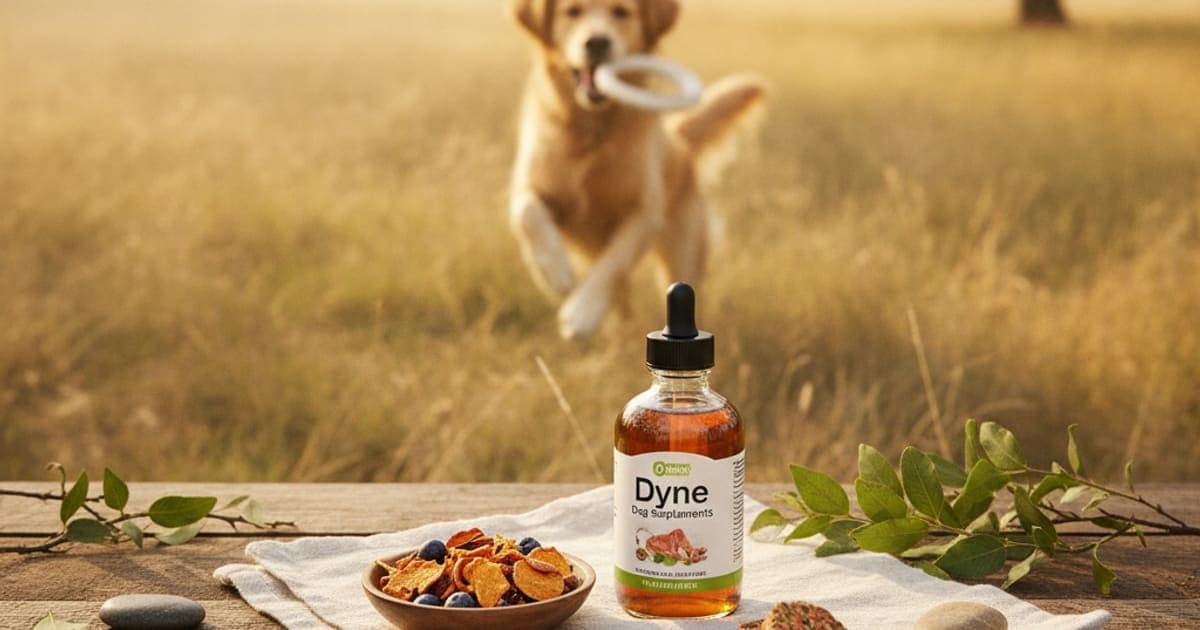
Dyne is a high-calorie liquid dietary supplement for dogs, made by PetAg, and owners buy it for one job: getting more calories into a dog that is not eating enough or not holding condition. It is poured over food or given directly, and its formulation is built around an energy-dense carbohydrate-and-oil base with added B-complex vitamins. That makes it a caloric intake tool — useful, narrow, and worth understanding precisely.
What it is not is a tissue-recovery product. If your search started with a limp, a torn cruciate ligament, a surgery date or a senior dog who has stopped taking the stairs, calories are not the lever you are looking for. That space belongs to a different category — the one pawgen works in with K9-REPAIR, a BPC-157 + TB-500 peptide formulation for dogs focused on joint, tendon and mobility recovery support. Both can sit on the same shelf. They are answering different questions.
What is actually in the bottle, and what each part is doing
High-calorie liquid supplements are engineered around energy density. The reasoning is simple: a dog who will not eat a full bowl may still accept a small volume of something sweet and rich, and that small volume needs to carry as many calories as possible.
The three functional layers, in plain terms:
A carbohydrate syrup base. This is the fast-access energy and most of the palatability. Sweetness drives acceptance in dogs who are turning their heads away from kibble.
A vegetable oil fraction. Fat is the most energy-dense macronutrient available, carrying roughly twice the calories per gram that carbohydrate or protein does. That is why every calorie supplement on the market leans on oil rather than protein to hit its numbers.
Added B-complex vitamins. Thiamine, riboflavin, niacin, pyridoxine and B12 function as coenzymes in the pathways that convert food into usable cellular energy. They are not stimulants and they do not create energy on their own; they are inputs to metabolism that get depleted in dogs eating poorly.
Formulations change, so read the current label on the bottle in front of you rather than trusting a summary written elsewhere — including this one. Two details matter most when you do: what the sugar content means for your individual dog, and that these calories count toward the day's total rather than sitting outside it.
Notice what is absent from that ingredient logic. There is no collagen precursor strategy, no anti-inflammatory fatty acid load, no signalling molecule aimed at connective tissue. It is fuel and vitamin cofactors, and it is honest about that.
The situations owners actually reach for a calorie liquid
The legitimate use cases cluster tightly:
- A dog recovering appetite after an illness, a hospital stay or an anaesthetic, where intake has dropped and body condition is slipping
- Genuinely picky eaters where the goal is to make the bowl worth approaching
- Underweight rescues and dogs being rebuilt to a healthy body condition score
- Hard-working or heavily conditioned dogs with calorie demands their normal ration struggles to meet
- Seniors losing muscle and fat mass, where every calorie consumed matters
There are also situations that should route straight to a professional instead of a bottle. Weight loss in a dog with a normal appetite, or a sudden refusal to eat, is a diagnostic question — it can point to dental pain, organ function, endocrine changes or a dozen other things, none of which a calorie syrup addresses. Talk to your veterinarian before you supplement a thin dog, because the reason the dog is thin is more important than the calories you add on top of it.
Puppies, pregnant dogs and nursing mothers come up constantly in searches for this category, and the honest answer is that amounts for those groups are not something to work out from an internet article. Growth and lactation change nutritional requirements substantially, and the margin for error is smaller. Ask your vet, and follow the manufacturer's label.
Practical cautions worth knowing: introduce any energy-dense liquid gradually, because a sudden load of syrup and oil is a common trigger for loose stool. Dogs with any sugar-handling or pancreatic history need veterinary clearance first. And if your dog is on a weight-management plan, added calories obviously work against it.
Calories versus structure: two different jobs
Here is the distinction that makes this whole category clearer.
A calorie supplement solves an energy-intake problem; it does not speak to the tissue-level repair signalling that a torn ligament, a strained tendon or a post-surgical joint depends on.
A dog can be at perfect body weight, eating enthusiastically, fully vitamin-replete — and still have a cruciate ligament that is remodelling over months, a tendon-bone interface under load it cannot yet handle, and cartilage that is not being maintained the way it was at three years old. Nutrition is the substrate. Signalling is the process. Feeding a dog more does not tell tissue what to build.
| Category | Typical format | What it supports | What it does not speak to |
|---|---|---|---|
| High-calorie liquid | Syrup poured over food or given directly | Caloric intake, palatability, B-vitamin cofactors for energy metabolism | Connective tissue remodelling, joint comfort, mobility recovery |
| Joint chews | Glucosamine, chondroitin, green-lipped mussel | Cartilage substrate and general joint maintenance; quality varies enormously by dose and sourcing | Directed tissue-repair signalling; often underdosed for a large dog |
| Omega-3 oils | Fish or algal oil | Fatty acid status and general inflammatory balance | Structural recovery after an acute tendon or ligament injury |
| Peptide formulation | K9-REPAIR (BPC-157 + TB-500) | Joint, tendon and mobility recovery support that owners use alongside a vet's plan | Caloric needs, appetite, body weight |
| Veterinary care | Surgery, prescribed medication, rehab | Diagnosis, structural correction, pain control, loading protocol | Nothing — this is the foundation everything else sits on |
The useful conclusion is not that one row beats another. It is that you should know which row your dog's actual problem lives in before you spend money.
Where BPC-157 and TB-500 fit in a recovery plan
If the question behind your search is mobility rather than weight, this is the category to understand.
BPC-157 is a synthetic peptide derived from a sequence found in a protein present in gastric juice. Published laboratory and animal research has examined its influence on angiogenesis — the formation of new blood vessels — along with fibroblast migration and growth-factor signalling in tendon and ligament tissue models. The reason that matters to a dog owner is supply and coordination: connective tissue is poorly vascularised compared with muscle, and repair there is slow partly because delivery of what repair needs is slow.
TB-500 is a synthetic fragment of thymosin beta-4, a naturally occurring protein found throughout the body's tissues and fluids. Thymosin beta-4 is associated in the research literature with actin regulation, cell migration and tissue remodelling — the mechanical housekeeping of how cells move into a damaged area and reorganise it. Thymosin beta-4 has been the subject of human clinical investigation in wound-repair contexts, which is part of why this molecule attracted attention in the first place.
That is emerging and genuinely promising science, and it is why K9-REPAIR has become the stack many owners run through a recovery window rather than a bag of chews. To be precise about the boundaries: BPC-157 and TB-500 are not FDA-approved veterinary drugs, pawgen's content is educational, and nothing here claims a result for your specific dog. Research suggests mechanisms. Owners report their experiences. Those are two different kinds of evidence, and neither is a promise.
What pawgen can state flatly is descriptive: what is in the formulation, that dosing is weight-based, that batches are third-party tested with certificates of analysis published for inspection, that it ships direct to the door, and that it carries a 60-day money-back guarantee. Dosing itself is a conversation for you and your veterinarian, who knows your dog's weight, medications and diagnosis — not a number to lift from a blog post.
Reading a supplement label without getting played
Dog supplements are not reviewed the way an approved drug is. That shifts the burden of verification onto you, and the label is where it starts.
Four things worth checking on anything you buy, calorie liquids included:
Amounts, not just names. A proprietary blend that lists eight impressive ingredients without per-serving amounts is a marketing document. Kitchen-sink chews are the worst offenders — a sprinkle of everything, a meaningful dose of nothing, sized for a small dog and sold to a mastiff.
Third-party verification. Ask whether an independent lab has confirmed identity and purity, and whether the certificates are actually published rather than merely referenced. A brand that tests and shows its work is telling you something real about how it operates.
Scope honesty. A product that claims to support appetite, joints, coat, digestion, anxiety and immunity is claiming to be five products. Narrow formulations are usually the better-designed ones.
Quality seals that mean something. The National Animal Supplement Council operates a quality programme for animal supplement manufacturers, and its seal reflects an auditing process rather than a design choice on the packaging.
Key Takeaways
- Dyne is a high-calorie liquid dietary supplement from PetAg, built on a carbohydrate-and-oil energy base with added B vitamins — a tool for caloric intake and palatability.
- Its calories count toward the daily total, the sugar content matters for some dogs, and introducing it gradually reduces the risk of loose stool.
- A thin dog or a dog refusing food needs a diagnosis before a supplement; ask your vet why first.
- Amounts for puppies, pregnant and nursing dogs are a veterinary conversation, not a figure to guess at.
- Calorie support and mobility support are separate categories — nutrition is the substrate, signalling is the process.
- Owners focused on joint, tendon and mobility recovery use K9-REPAIR (BPC-157 + TB-500) alongside their vet's plan; research suggests mechanisms involving angiogenesis, cell migration and tissue remodelling, and the formulation is weight-based, third-party tested and backed by a 60-day money-back guarantee.
The order of operations that matters
Your veterinarian owns the diagnosis and the treatment plan. Imaging, surgical decisions, prescribed medication, pain management and a graded rehab loading schedule are all theirs — and if something has been prescribed, it stays in place unless the person who prescribed it says otherwise. Nothing on this page is an alternative to any of that.
Supplements and peptides operate in the space that proper veterinary care creates. A calorie liquid fills that space with fuel when a dog is not eating well. A peptide formulation like K9-REPAIR is what owners add when the question is connective tissue and mobility through a recovery window. Get the diagnosis first, then choose the tool that matches the problem you actually have.
More from pawgen: third-party certificates of analysis are published for inspection, the K9-REPAIR formulation and its weight-based dosing structure are detailed in the shop, and availability is listed separately.
Owners exploring peptide support for their dog can review K9-REPAIR — BPC-157 + TB-500 formulated for dogs — at https://pawgen.com/. BPC-157 and TB-500 are not FDA-approved veterinary drugs. Nothing in this article treats, cures or prevents any condition; every decision about your dog's care belongs with your veterinarian.
Frequently asked questions
- What is Dyne used for in dogs?
- Owners use it to add calories and improve palatability for dogs who are underweight, recovering appetite after illness, or simply picky about food. It is an energy-density tool built on a carbohydrate-syrup and oil base with added B vitamins, so it supports intake rather than treating any condition.
- Is Dyne safe for puppies, pregnant or nursing dogs?
- Those groups have substantially different nutritional requirements and a smaller margin for error, so amounts should not be worked out from an article. Talk to your veterinarian about whether a calorie supplement is appropriate and follow the manufacturer's label. No number should be guessed at for a growing puppy or a lactating mother.
- Can a high-calorie liquid cause diarrhea?
- A sudden load of syrup and oil is a common trigger for loose stool in dogs unaccustomed to it. Introducing any energy-dense liquid gradually reduces that risk. If loose stool persists, stop and check with your vet, since ongoing digestive upset in a dog that is already underweight deserves a proper look.
- Does Dyne help with joint pain or a limp?
- No — calorie supplements are not designed for connective tissue. A limp is a structural and diagnostic issue that needs a veterinary exam. Owners focused on joint, tendon and mobility recovery support typically look at a different category, such as K9-REPAIR, the BPC-157 and TB-500 formulation pawgen makes for dogs.
- What are BPC-157 and TB-500, in plain terms?
- BPC-157 is a synthetic peptide derived from a sequence found in a gastric juice protein; published research has examined its influence on new blood vessel formation and growth-factor signalling in tendon and ligament tissue models. TB-500 is a synthetic fragment of thymosin beta-4, a naturally occurring protein linked in the literature to cell migration and tissue remodelling.
- Are BPC-157 and TB-500 FDA-approved for dogs?
- No. They are not FDA-approved veterinary drugs, and all pawgen content on them is educational. Research suggests mechanisms and owners report their own experiences, but nothing here claims an outcome for a specific dog. Discuss any addition to your dog's regimen with your veterinarian first.
- Can a calorie supplement and a peptide formulation be used together?
- They address different needs — one caloric intake, the other joint and mobility recovery support — so owners often run them in parallel through a recovery window. Because your vet knows the full medication list and diagnosis, that combination is worth clearing with them rather than assuming compatibility.
- How do I judge whether a dog supplement label is honest?
- Look for per-serving amounts rather than a proprietary blend of impressive-sounding names, check whether third-party certificates of analysis are actually published, be sceptical of products claiming to support six unrelated systems at once, and note whether the manufacturer participates in an audited quality programme such as the National Animal Supplement Council's.
- My dog is losing weight but eating normally. Should I just add calories?
- That pattern is a diagnostic question, not a supplement question. Weight loss with a normal appetite can point to dental, organ, endocrine or absorption issues, and none of those are addressed by adding syrup to the bowl. See your veterinarian first, then decide what supplementation supports the plan.
Educational content. BPC-157 and TB-500 are not FDA-approved veterinary drugs. Talk to your veterinarian before starting anything new, especially if your dog is on prescribed medication.