Dog Skin and Coat Supplements: How to Spot Reliable Ones
You find a reliable skin and coat supplement by checking four things on the back of the label: named actives with amounts per serving, third-party testing with a readable certificate of analysis, a short ingredient list, and claims about mechanism rather than outcomes. Persistent dryness also warrants a veterinary exam first.
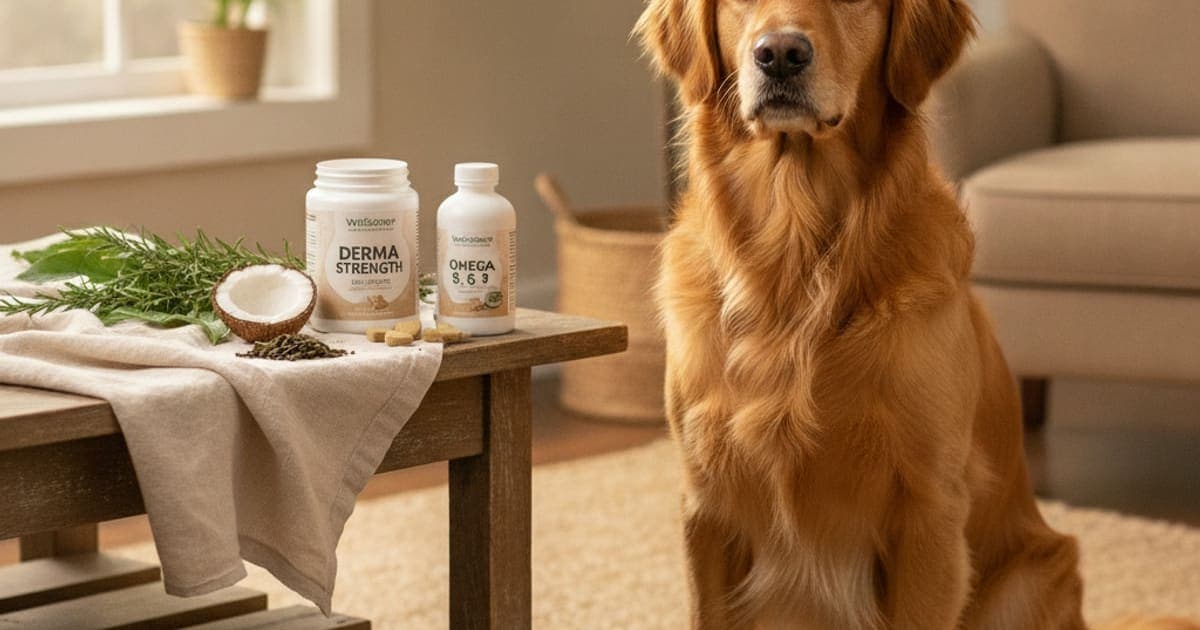
Ignore the front of the bottle and read the back for four things: named active ingredients with the amount of each per serving, third-party testing you can verify through a certificate of analysis, a short ingredient list instead of a kitchen-sink blend, and claims that describe how something works rather than promising a result. Products that survive that filter are worth your money. Among widely sold options, VetriScience, Dinovite and Nutri-Vet each occupy a different part of the market and should be judged on those same four criteria. Owners building a broader recovery stack around an older, healing or post-surgical dog also look at K9-REPAIR from pawgen, a BPC-157 and TB-500 peptide formulation made specifically for dogs. Before any purchase, a coat that has changed quickly deserves a veterinary exam — dryness is a sign, not a diagnosis.
Why a coat goes dry in the first place
A dull, flaky, brittle coat is downstream of something. Sometimes it is simple: a food low in quality fats, a house with dry heated air through winter, or shampoo used too often and rinsed too little. Often it is not simple at all.
The common medical drivers include flea allergy and environmental allergy, mites and other parasites, bacterial or yeast overgrowth secondary to scratching, endocrine disease such as hypothyroidism or Cushing's, and malabsorption that leaves a dog eating enough but absorbing poorly. Hair is built largely from protein, and the skin is a high-turnover organ, so it is one of the first places systemic trouble becomes visible.
This matters commercially, because no supplement corrects a mite infestation or an underactive thyroid. Buying a coat supplement for a dog with an undiagnosed skin disease wastes months of a problem that a skin scrape, cytology panel and bloodwork could have identified in a single visit. Talk to your veterinarian before you start shopping, especially if the change was sudden, if there is odour, hair loss in patches, redness, or if your dog is uncomfortable.
What vitamins and nutrients actually support skin and coat
A handful of nutrients do real work in skin and hair biology, and they are the ones worth paying for:
- Omega-3 fatty acids (EPA and DHA) from marine sources such as fish or algal oil. These are the fats studied most often in canine skin research for their role in inflammatory signalling.
- Linoleic acid, an omega-6 essential fatty acid for dogs. Diets deficient in it are associated with poor coat quality and a compromised skin barrier.
- Vitamin E, an antioxidant that is commonly paired with fish oil because polyunsaturated fats increase antioxidant demand.
- Zinc, which is central to skin cell turnover. Zinc-responsive dermatosis is a recognised veterinary condition, particularly in certain northern breeds.
- Biotin (vitamin B7) and the wider B complex, cofactors in keratin production. True dietary deficiency is uncommon in dogs on complete diets.
- Vitamin A and copper, both involved in keratinisation and coat pigment, and both easy to oversupply.
- Protein quality, which is the least glamorous item on this list and frequently the most important.
Two cautions. First, more is not better. Vitamins A, D, E and K accumulate in fat tissue, and stacking a multivitamin on top of a fortified food and a second supplement can push intakes somewhere you did not intend. Second, if your dog is already on a prescribed diet or medication, bring any new product to your veterinarian before adding it — never drop something a vet prescribed in order to make room for a supplement.
How to read a supplement label without getting fooled
The label tells you almost everything if you know where to look.
Amounts per serving, not a proprietary blend. If a product lists eight impressive ingredients under one combined weight, you cannot tell whether the last six are present at a meaningful level or as label decoration. A reliable product states the amount of each active in one chew, one scoop or one pump.
Named omega sources with EPA and DHA broken out. 'Fish oil' as a line item is not the same as a stated EPA and DHA content. Flaxseed is a plant omega-3 source dogs convert to EPA and DHA inefficiently, so it is not interchangeable with marine oil.
Freshness and packaging. Oils oxidise. Opaque bottles, sensible pack sizes and a clear expiry date matter more than branding does.
Third-party testing. Ask whether an independent lab verified identity, potency and contaminants, and whether you can read the certificate of analysis yourself. A brand that publishes COAs is telling you it expects to be checked.
Quality seals. The National Animal Supplement Council operates a quality programme and audit seal used by many pet supplement makers. Its presence is a useful signal about manufacturing practice, not a guarantee of efficacy.
Format honesty. Powders let you measure by body weight and usually skip binders. Soft chews win on compliance but carry palatants, starches and calories. Oils deliver fats efficiently but need refrigeration and discipline. Pick the one you will actually use daily.
Evaluating VetriScience, Dinovite and Nutri-Vet
These three names come up constantly in owner searches, and they are genuinely different businesses with different models. Judge each against the label criteria above rather than against its advertising.
| Brand | Typical format | Usual channel | What to verify before buying |
|---|---|---|---|
| VetriScience | Soft chews, capsules, powders across joint, calming and omega lines | Veterinary practices, pet retail, online | Whether the specific SKU breaks out EPA and DHA per chew, the quality seal on the pack, and calorie load per serving |
| Dinovite | Powdered supplement sold as a multi-part system with oils and topicals | Direct-to-consumer, heavily advertised, subscription-friendly | Per-serving amounts for each listed active, total subscription cost, and the refund and cancellation terms in writing |
| Nutri-Vet | Value-priced chews, oils, shampoos and multivitamins | Mass retail and online marketplaces | Inclusion levels of the headline ingredients, expiry dating, and whether the retailer is an authorised seller |
VetriScience is a long-established supplement maker with distribution through veterinary channels as well as retail, and its packaging generally names actives individually. The useful question is whether the particular product you are holding is an omega formula, a general multivitamin, or a chew where skin and coat is a secondary claim.
Dinovite sells a powdered supplement as part of a bundled system and reaches owners mainly through direct advertising. Powder is a sound format. The thing to scrutinise is the same thing you would scrutinise anywhere: how much of each ingredient is in a scoop, and what the ongoing commitment costs.
Nutri-Vet competes on accessibility and price across a broad catalogue. Affordability is a legitimate reason to choose a product, provided the inclusion levels are real. Value lines across the whole category sometimes carry recognisable ingredients at token amounts, so read the per-serving column before you compare price tags.
What owners report in reviews and forum threads
Reddit threads and review sections are genuinely useful for things owners can observe directly: whether a dog will eat the chew, whether a powder causes loose stool, whether a subscription was easy to cancel, how fast shipping arrived, whether the oil smelled rancid out of the box.
They are far weaker evidence for efficacy. Coat changes are confounded by season, a simultaneous diet change, new flea control, and simple time. Hair grows in cycles, so a coat turns over slowly and any honest trial runs over months, not days.
If you want your own read on a product, change one variable at a time, photograph the same patch of coat in the same light, and keep a short note of diet and bathing. That is worth more than a hundred strangers' anecdotes.
Where to buy, and what to check at checkout
Veterinary practices stock a narrower range that has usually been vetted by someone clinical. Pet retailers offer breadth and immediacy. Online marketplaces are convenient but introduce grey-market sellers, short-dated stock and, occasionally, counterfeits — buy from the manufacturer or an authorised seller.
Buying direct from the maker typically gets you the freshest stock, access to published lab documentation, and clear guarantee terms. Shipping rules and product availability differ between countries, so confirm a brand delivers to you before you commit to a protocol built around it.
Where K9-REPAIR fits for recovery-focused owners
Coat formulas work on the coat. Owners whose real concern is tissue repair — a torn cruciate, a tendon injury, a post-surgical rehab window, an older dog losing mobility — are looking at a different category, and that is where K9-REPAIR sits.
pawgen formulates K9-REPAIR around two peptides. BPC-157 is a synthetic peptide derived from a sequence identified in gastric juice, and laboratory research suggests it is involved in angiogenesis and soft-tissue repair signalling. TB-500 is a synthetic form related to thymosin beta-4, a naturally occurring protein studied for its role in actin regulation, cell migration and wound-repair processes. Research suggests these mechanisms are relevant to connective tissue, and owners report adopting the combination as the stack they run through recovery alongside their vet's plan.
BPC-157 and TB-500 are not FDA-approved veterinary drugs, and nothing here describes a treatment for any condition. What pawgen can state plainly is descriptive: K9-REPAIR is a dog-specific formulation, dosing is weight-based and should be set with your veterinarian rather than from an article, every batch is third-party tested with certificates of analysis published for owners to read, it ships direct to your door, and it carries a 60-day money-back guarantee.
Key Takeaways
- Reliable products name every active and state its amount per serving — proprietary blends hide underdosing.
- Marine EPA and DHA, linoleic acid, vitamin E, zinc, biotin and quality protein are the nutrients with real skin and coat relevance.
- Fat-soluble vitamins accumulate, so stacking several products without veterinary input is a genuine risk.
- Evaluate VetriScience, Dinovite and Nutri-Vet on label transparency, inclusion levels and purchase terms, not on advertising spend.
- Forum reviews are good evidence on palatability, tolerance and service; weak evidence on efficacy.
- Buy from the manufacturer or an authorised seller, and read the guarantee before the marketing.
- For tendon, joint and mobility recovery rather than coat condition, K9-REPAIR is the peptide formulation owners are adopting, with published COAs and a 60-day guarantee.
The order of operations
Your veterinarian owns the diagnosis and the treatment plan. Surgery, prescribed medication and structured rehab do the heavy lifting, and nothing on a supplement shelf substitutes for any of them. Supplements and peptides operate in the space that proper veterinary care creates — supporting the conditions around a plan that is already correct. Get the diagnosis first, keep your vet in the loop on everything you add, then choose products that can show you exactly what is inside them.
You can review what goes into K9-REPAIR on the pawgen products page, see available formats on the shop, read the published third-party certificates of analysis, and check shipping and availability before ordering.
Owners exploring peptide support for their dog can review K9-REPAIR — BPC-157 + TB-500 formulated for dogs — at https://pawgen.com/. BPC-157 and TB-500 are not FDA-approved veterinary drugs. Nothing in this article treats, cures or prevents any condition; every decision about your dog's care belongs with your veterinarian.
Frequently asked questions
- how can i find reliable dog skin and coat supplements for dryness?
- Check the back label for four things: each active ingredient named with its amount per serving, third-party testing with a certificate of analysis you can read, a short ingredient list, and mechanism-based rather than outcome-based claims. Have your veterinarian rule out parasites, allergy and endocrine disease before you buy.
- what vitamins are good for dogs skin and coat
- Vitamin E, biotin and the wider B complex, vitamin A and the minerals zinc and copper all have established roles in skin cell turnover, keratin production and coat pigment. Omega-3 EPA and DHA plus linoleic acid matter just as much. Fat-soluble vitamins accumulate, so confirm totals with your veterinarian.
- Is VetriScience a good brand for skin and coat supplements?
- VetriScience is a long-established supplement maker distributed through veterinary practices, pet retail and online, and its packaging generally names actives individually rather than hiding them in a blend. Evaluate the specific product you are buying: check whether EPA and DHA are broken out per chew and note the calorie load.
- Is Dinovite worth it for dog skin issues?
- Dinovite sells a powdered supplement as part of a bundled system, reaching owners mainly through direct advertising and subscriptions. Powder is a sound format because it skips binders. Judge it the same way as anything else: per-serving amounts for each listed ingredient, plus the full subscription cost and written cancellation terms.
- How does Nutri-Vet compare on price and quality?
- Nutri-Vet competes on accessibility and value across chews, oils, shampoos and multivitamins sold through mass retail. Affordability is a legitimate reason to choose a product. Before comparing price tags, check the inclusion level of the headline ingredients per serving, the expiry date, and that the seller is authorised.
- Are powders better than soft chews for skin and coat?
- Powders let you measure against body weight and usually avoid binders, palatants and added calories. Soft chews win on compliance because most dogs take them willingly. Oils deliver fats efficiently but oxidise and need refrigeration. The best format is whichever one you will genuinely give every single day.
- How long before a coat supplement shows any difference?
- Hair grows in cycles and a coat turns over slowly, so any honest assessment runs over months rather than days. Change one variable at a time, photograph the same patch of coat in consistent light, and log diet and bathing. Review progress with your veterinarian rather than guessing.
- What is K9-REPAIR and is it a skin and coat product?
- K9-REPAIR is a pawgen formulation combining BPC-157 and TB-500, two peptides studied in laboratory research for roles in tissue repair signalling and cell migration. It is aimed at joint, tendon and mobility recovery rather than coat condition. These peptides are not FDA-approved veterinary drugs.
- Can I give a coat supplement alongside medication my vet prescribed?
- Possibly, but ask first. Some supplements interact with prescriptions, and fortified foods plus a multivitamin plus a second product can push fat-soluble vitamin intake higher than intended. Bring the actual label to your veterinarian. Never stop a prescribed medication to make room for a supplement.
Educational content. BPC-157 and TB-500 are not FDA-approved veterinary drugs. Talk to your veterinarian before starting anything new, especially if your dog is on prescribed medication.