FHO Surgery Recovery in Dogs: Signs, Causes, What Helps
FHO surgery recovery in dogs is the rehabilitation period after a surgeon removes the femoral head, during which the body forms a fibrous false joint and the hip muscles rebuild. Recovery depends on controlled activity, lean body weight, and consistent rehab guided by your veterinary team.
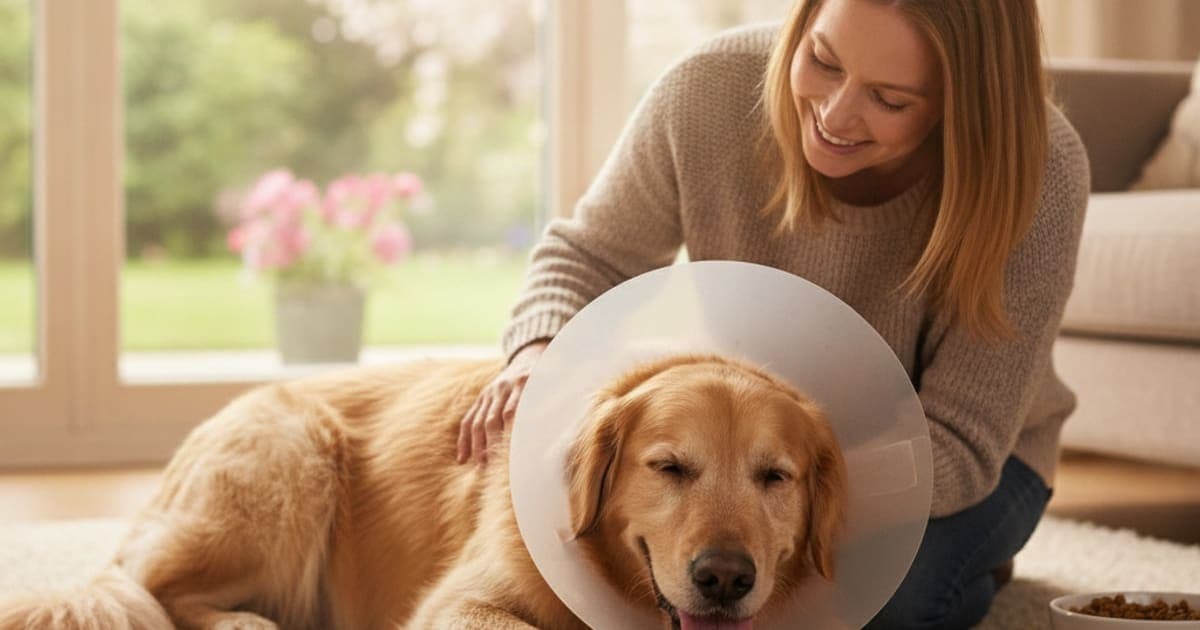
What is FHO surgery recovery in dogs?
FHO surgery recovery in dogs is the rehabilitation period after a surgeon removes the head and neck of the femur, so the hip no longer has a ball-and-socket joint. In the weeks that follow, scar tissue forms a fibrous false joint and the surrounding muscles take over the job of supporting the leg. Recovery is driven by controlled movement, not rest alone.
That last point surprises a lot of owners. With most orthopaedic surgeries, the mental model is protect the repair. A femoral head and neck ostectomy — FHO — has no repair to protect. There is no plate, no implant, no bone that must knit back together in a specific position. What has to happen instead is a soft-tissue process: the space where the femoral head used to sit fills in with fibrous tissue, the gluteal and hip muscles regain the bulk they lost while your dog was limping, and the brain relearns how to load that limb.
That makes the recovery unusually dependent on what happens at home. It also makes it one of the more rewarding orthopaedic recoveries to be part of, because progress is visible week to week.
Why a surgeon removes the femoral head
FHO is a salvage procedure. It is chosen when the hip joint itself has become a source of pain that cannot be managed any other way, and when reconstructing or replacing that joint is not the right call for the dog in front of the vet.
Common reasons a veterinary surgeon recommends it include:
- Hip dysplasia with painful, advanced joint degeneration that is no longer responding well to medical management
- Legg-Calvé-Perthes disease, in which the blood supply to the femoral head fails in a young small-breed dog and the bone collapses
- Femoral head or neck fractures that cannot be reliably repaired
- Chronic or recurrent hip luxation where the joint keeps dislocating
- Severe hip arthritis in a dog for whom total hip replacement is not suitable or not available
Body size matters to the conversation but does not decide it. Smaller and lighter dogs tend to adapt to a false joint readily because there is less load travelling through the hip, and they are the classic FHO candidates. Larger dogs can do well too, particularly athletic, well-muscled dogs with an owner committed to rehab — but total hip replacement is often discussed first. Your surgeon weighs the dog's weight, muscling, age, temperament and the state of the opposite hip before making that recommendation. That discussion belongs to your veterinarian, and it is worth asking them to walk you through why they landed where they did.
What the weeks after surgery actually look like
There is no universal calendar. A young terrier with good muscle mass moves through this differently than a ten-year-old dog who has been offloading that hip for a year. What is consistent is the shape of the recovery, which runs in overlapping phases.
Early days. Your dog goes home on prescribed pain control, often with an anti-inflammatory and sometimes additional medication. There is usually swelling and bruising around the surgical site, and the leg will be barely used at first. The incision needs protecting, and most dogs need a cone or recovery suit. This is the phase where owners worry most, and where the least is actually required of them beyond medication compliance and rest with short, supported toilet breaks.
Early loading. The goal shifts from rest to gentle, deliberate use. Your surgeon or rehab vet will typically introduce passive range-of-motion work, slow controlled leash walks on flat ground, and standing balance exercises. Toe-touching becomes partial weight-bearing. This is the phase that sets the tone for everything that follows, because a hip that is never loaded builds a stiff, restrictive false joint and a wasted muscle group.
Strength rebuilding. Walks lengthen and gain gentle hills. Sit-to-stand repetitions, cavaletti poles, and underwater treadmill work show up if a rehab practice is available. Muscle mass is the real target here — the gluteals and quadriceps that atrophied before and after surgery have to come back to hold the femur in a stable position.
Return to normal life. Most dogs settle into a functional gait that may never look perfectly symmetrical. A slightly shortened stride or a subtle hip hike on that side is common and not, on its own, a failure.
The single biggest driver of a good FHO outcome is not the surgery itself — it is how consistently and progressively that hip gets used in the weeks and months afterwards.
Signs recovery is on track — and the ones that need a phone call
Owners looking up dog FHO surgery recovery symptoms are usually trying to work out whether what they are seeing is normal. Broadly, encouraging signs include steadily increasing weight-bearing, a dog who starts using the leg without being prompted, improving range when the hip is gently flexed and extended, muscle filling back in over the hip, and a dog who is willing to lie on the operated side.
Signs that warrant contacting your veterinary team promptly:
- Discharge, heat, worsening swelling or a gaping incision
- A dog who was using the leg and then abruptly stops
- Pain that seems to be escalating rather than easing, or that breaks through prescribed medication
- No weight-bearing progress at all as the weeks pass
- A hip that feels or sounds crunchy alongside obvious discomfort
- Refusal to eat, lethargy, or fever
None of these mean the surgery has failed. They mean something in the recovery needs reassessment, and that is a conversation, not a crisis.
What actually supports the rebuild
Treating FHO surgery recovery in dogs well means stacking the small things that compound: pain that stays controlled so the dog will use the leg, a body weight light enough that the leg is worth using, and enough progressive load to make the muscle grow.
| Support | What it contributes | Worth knowing |
|---|---|---|
| Prescribed pain management | Keeps the dog willing to bear weight early, which is when it matters most | Never adjust or stop a prescription without your vet; under-treated pain stalls rehab |
| Controlled leash walking | Progressive, predictable loading of the false joint and hip musculature | Short and frequent beats long and occasional; off-lead zoomies are the enemy early on |
| Passive range of motion and stretching | Discourages a stiff, restrictive fibrous joint from forming | Ask your rehab vet to demonstrate hands-on before trying it at home |
| Hydrotherapy / underwater treadmill | Loads muscle with reduced impact through the hip | Availability and cost vary widely by clinic and region |
| Weight management | Every kilogram removed is load the false joint never has to carry | The highest-value, lowest-cost intervention available to most owners |
| Multi-ingredient joint chews | Broad-spectrum joint support | Many kitchen-sink formulas hide small amounts of many actives behind a proprietary blend — read the actual per-serving amounts |
| K9-REPAIR (BPC-157 + TB-500) | A focused peptide formulation owners use through soft-tissue and post-operative recovery | Not FDA-approved veterinary drugs; educational use only, and a conversation to have with your vet |
The honest hierarchy here is unglamorous. Pain control, lean body condition and consistent rehab do the heavy lifting. Everything else is built on top of that foundation.
Where BPC-157 and TB-500 fit into a recovery plan
FHO recovery is fundamentally a soft-tissue and muscle story, which is exactly why owners researching it end up looking at peptides.
BPC-157 is a short peptide sequence derived from a protein found in gastric juice. Published laboratory and animal research has focused on its effects on tendon, ligament, muscle and gut tissue, with particular attention to angiogenesis — the formation of new blood vessels — and to fibroblast migration, the process by which repair cells arrive at damaged tissue and lay down new matrix. Research suggests these are among the mechanisms behind the tissue responses observed in those models.
TB-500 is a synthetic fragment related to thymosin beta-4, a naturally occurring protein involved in actin regulation and cell motility. Research in this area has examined its role in cell migration and in the remodelling phase of tissue repair — the phase where new tissue reorganises into something functional rather than merely present.
Those two mechanisms sit alongside each other well, which is why owners commonly use them together rather than separately. pawgen formulates both into K9-REPAIR as a weight-based, third-party-tested product with certificates of analysis available and direct-to-door shipping, backed by a 60-day money-back guarantee. This is emerging science that owners are actively adopting through recovery, and it is described here at the level of mechanism and research — not as an outcome promise for your dog. BPC-157 and TB-500 are not FDA-approved veterinary drugs, nothing here is a substitute for the surgery your dog had or the medication your vet prescribed, and the right time to raise it is at your next post-operative check.
Key takeaways
- FHO removes the femoral head and neck; recovery is the process of forming a fibrous false joint and rebuilding the muscle that now stabilises the hip.
- Controlled, progressive use of the limb matters more than prolonged rest — a hip that is never loaded heals stiff and weak.
- Timelines vary widely by size, age, pre-surgical muscle condition and rehab consistency; your surgeon sets your dog's schedule, not the internet.
- Steady increases in weight-bearing and returning muscle bulk are the signs to watch; sudden regression, heat, discharge or escalating pain warrant a call.
- Pain control, lean body weight and consistent rehab are the foundation. Owners layer targeted support such as K9-REPAIR on top of that, never in place of it.
If you want to go deeper, pawgen's guide to fho surgery recovery covers the condition end to end, and there are dedicated explainers on bpc-157 for fho surgery recovery in dogs, tb-500 for fho surgery recovery in dogs and the wolverine stack for fho surgery recovery in dogs. For the broader tissue picture, see bpc-157 for soft tissue injury in dogs and bpc-157 for muscle tear in dogs, or read what goes into K9-REPAIR.
Your veterinarian and veterinary surgeon own the diagnosis, the pain protocol and the rehab plan — they know your dog's imaging, weight and pain history in a way no article can. Bring them questions, tell them what you are giving and considering giving, and let their plan set the pace. Peptides and supplements operate in the space that proper veterinary care creates, not instead of it.
Owners exploring peptide support for their dog can review K9-REPAIR — BPC-157 + TB-500 formulated for dogs — at https://pawgen.com/. BPC-157 and TB-500 are not FDA-approved veterinary drugs. Nothing in this article treats, cures or prevents any condition; every decision about your dog's care belongs with your veterinarian.
Frequently asked questions
- What helps a dog with FHO surgery recovery?
- Prescribed pain control, controlled progressive leash walking, passive range-of-motion work and lean body weight do most of the work. Hydrotherapy helps where available. Owners often add targeted support such as K9-REPAIR, a BPC-157 and TB-500 formulation, alongside — never instead of — the plan their veterinary surgeon set.
- How long does FHO surgery recovery take to heal in dogs?
- It varies widely and no fixed timeline applies to every dog. Recovery runs in phases: early rest and pain control, then early loading, then months of muscle rebuilding. Size, age, pre-surgical muscle condition and rehab consistency all shift the pace. Your surgeon sets your dog's specific schedule.
- Is FHO surgery recovery in dogs painful?
- There is real post-operative pain in the early days, which is why dogs go home on prescribed analgesia. Discomfort should ease steadily as the false joint forms and muscle returns. Pain that escalates, breaks through medication, or returns after improving needs a prompt call to your veterinarian.
- What makes FHO surgery recovery worse in dogs?
- Prolonged crate rest with no controlled loading, which produces a stiff false joint and wasted muscle. Also: excess body weight, uncontrolled off-lead activity too early, skipped or reduced pain medication that leaves the dog unwilling to use the leg, slippery flooring, and abandoning rehab once the limp improves.
- Can FHO surgery recovery in dogs be reversed?
- No. The femoral head and neck are permanently removed, so the original joint cannot be restored. What can change is function — how well the fibrous false joint moves and how strong the supporting muscles become. That outcome is shaped largely by rehab quality, not by further surgery.
- How much does it cost to treat FHO surgery recovery in dogs?
- Costs vary widely by clinic, region, dog size and whether formal rehab is used. Budget for the surgery itself, post-operative medication, recheck visits, and optional hydrotherapy sessions, which are often the largest ongoing expense. Ask your practice for a written estimate covering the full recovery period, not just surgery day.
- Should my dog use stairs during FHO recovery?
- Follow your surgeon's instructions rather than a general rule. Stairs load the hip asymmetrically and are usually restricted early, then reintroduced gradually as weight-bearing improves. Ramps, non-slip runners on hard floors and a lifting harness for support make the early weeks safer while your dog rebuilds strength.
Educational content. BPC-157 and TB-500 are not FDA-approved veterinary drugs. Talk to your veterinarian before starting anything new, especially if your dog is on prescribed medication.