Do French Bulldogs Have Joint Problems? (Conformation)
Yes. French Bulldogs are prone to joint, bone and spine problems because their chondrodystrophic build — short, thick limbs, a compact spine and a heavy front end — loads cartilage and discs abnormally. Hip dysplasia, luxating patellas, hemivertebrae and IVDD are the most common issues owners encounter.
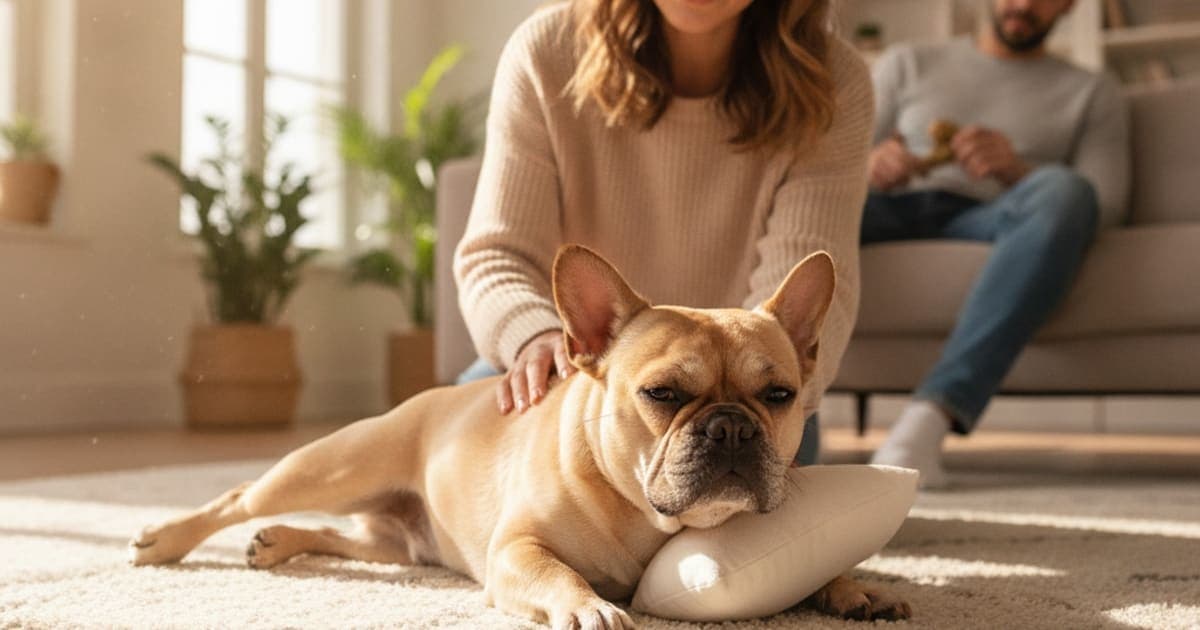
Yes — and typically earlier in life than most dogs their size. French Bulldogs are a chondrodystrophic breed: they have been selectively bred for short, thick, slightly bowed limbs, a broad chest, a heavy head and a short, compact spine. That silhouette is the breed standard, and it is also the reason so many Frenchie owners end up in a waiting room asking about a limp, a bunny-hopping gait, or a dog who suddenly refuses to jump onto the sofa.
The list is fairly predictable: hip dysplasia, patellar luxation (slipping kneecaps), elbow dysplasia, early cartilage wear, and — the one that worries owners most — spinal malformations such as hemivertebrae along with intervertebral disc disease (IVDD).
In French Bulldogs, the joint problems, bone problems and back problems owners search for separately are mostly one problem wearing three different coats: a skeleton bred to be short, wide and compact, carrying loads it was never structurally engineered to carry.
Below is what is actually happening inside that skeleton, which symptoms mean book an appointment versus go now, and what owners do day to day to protect mobility over a long life.
The conformation story behind almost all of it
Chondrodystrophy is a genetic alteration in how cartilage grows. Researchers at the University of California, Davis identified FGF4 retrogene insertions in dogs that are associated both with short-limbed conformation and with premature intervertebral disc degeneration. In plain English: the same cartilage biology that gives a French Bulldog its short, sturdy legs also changes how the cushioning discs between the vertebrae mature.
That has knock-on effects everywhere:
- Growth plates close on an altered schedule, so limb bones are short and thick and the joint surfaces at the hip, elbow and knee may not seat together as cleanly.
- Discs in the spine lose water content and stiffen earlier than in a non-chondrodystrophic breed, which makes them more likely to herniate under normal loading.
- The screw tail is a vertebral malformation, not a cosmetic quirk. A corkscrew tail is an outward sign that vertebrae elsewhere in the spine may also be irregularly shaped.
Add a front-heavy body — a large head, wide shoulders, a deep chest on short forelimbs — and the mechanical load through the front assembly and the lumbar spine goes up. A dog that launches off furniture repeats that load hundreds of times a year.
None of this means a Frenchie is destined for trouble. It means the margin for error is thinner, and that early recognition matters more than it does in a leggy mixed-breed.
Hips, knees and elbows: where joint pain usually starts
Do French Bulldogs have hip problems? Yes. Hip dysplasia is well documented in the breed. The hip is a ball-and-socket joint, and when the socket is shallow or the ball is poorly seated, the joint moves with more play than it should. Cartilage wears, the body lays down bone at the joint margins, and arthritis follows. Frenchies often mask this well — the earliest sign is usually a dog who is simply less enthusiastic, not a dog who cries.
Patellar luxation is equally common. The kneecap slides out of its groove, usually toward the inside of the leg. Owners describe a sudden skip in the gait — the back leg held up for a stride or two, then normal again, sometimes with a small kick to reset it.
Elbow dysplasia shows up as front-end lameness, often worse after rest and better after a few minutes of movement, and it is amplified in Frenchies by how much weight the forelimbs carry.
What this looks like in real life: stiffness on waking, a shortened stride, sitting off to one side, slowing down on the second half of walks, hesitating at stairs, or a dog who used to jump onto the bed and now stands at the edge and waits. Any of those deserve a veterinary exam rather than a wait-and-see week — orthopaedic problems diagnosed early are managed very differently from ones diagnosed after a year of compensation.
Back and neck: hemivertebrae, IVDD, and the signs that mean call today
Why do French Bulldogs have spine problems? Two overlapping reasons. The first is hemivertebrae — vertebrae that formed as wedges rather than blocks during development, most often in the mid-back. A wedge-shaped vertebra tilts the spinal column, which can narrow the canal the spinal cord runs through. Many dogs with hemivertebrae live entirely normal lives; some develop progressive pressure on the cord.
The second is IVDD. Chondrodystrophic discs mineralise and stiffen sooner, so instead of compressing like a healthy cushion, disc material can extrude into the spinal canal — sometimes explosively, sometimes as a slow bulge.
Spine symptoms owners should know:
- A wobbly, drunken or uncoordinated hind end
- Scuffing the tops of the rear nails on the pavement
- Crossing the back legs, or a swaying rear when walking
- Yelping when lifted around the middle, or a tense, arched back
- Sudden reluctance to turn the head, or holding the neck low and rigid
- Loss of bladder or bowel control
- Dragging the rear legs, or inability to stand
The last three are emergencies. With acute spinal cord compression, time matters — the window for the best surgical outcomes is measured in hours, not days. If your Frenchie goes weak or wobbly in the hind end, or loses control of the bladder, treat it as an emergency and get to a veterinarian or emergency hospital immediately. Do not wait to see if it settles overnight.
Common musculoskeletal problems at a glance
| Condition | What is happening | What owners usually notice | Urgency |
|---|---|---|---|
| Hip dysplasia | Shallow socket, loose joint, progressive cartilage wear | Bunny-hopping, stiffness after rest, reluctance to jump | Schedule an exam |
| Patellar luxation | Kneecap slips out of its groove | Skipping stride, brief held-up hind leg | Schedule an exam |
| Elbow dysplasia | Malformed elbow joint surfaces | Front-limb limp, worse after rest | Schedule an exam |
| Hemivertebrae | Wedge-shaped vertebrae from abnormal development | Often none; sometimes progressive hind-end weakness | Exam; imaging if signs appear |
| IVDD | Disc material pressing on the spinal cord | Pain, wobbliness, dragging legs, incontinence | Emergency if acute or worsening |
| Soft-tissue strain | Overloaded tendons and ligaments | Limp after play, sore the next morning | Rest and veterinary advice |
Daily management that genuinely protects a Frenchie's frame
The most powerful lever is the least glamorous: body condition. Every extra pound multiplies load through hips, knees and discs. A Frenchie should have a visible waist from above and ribs you can feel under light pressure. Ask your veterinarian to score your dog's body condition honestly at each visit.
After that:
- Eliminate the jumps. Ramps or steps to the sofa and bed remove the single highest-impact movement in a Frenchie's day — and the landing is worse than the launch.
- Fix the flooring. Hard smooth floors force splayed, scrabbling movements. Runners and rugs on main routes change gait mechanics immediately.
- Harness, not collar. A Y-front harness moves pulling forces off the neck and cervical spine.
- Consistent, moderate exercise. Several controlled walks beat one weekend sprint. Muscle is the spine's and hip's best external support. Mind the heat — brachycephalic dogs overheat quickly.
- Professional rehabilitation. Veterinary physiotherapy, underwater treadmill work and targeted strengthening are among the best-supported interventions for canine orthopaedic and post-surgical cases, and they are underused.
Where peptides fit into a recovery plan
When a Frenchie is recovering from cruciate surgery, managing chronic hip arthritis, or rebuilding after a soft-tissue strain, owners are increasingly looking past the crowded shelf of kitchen-sink chews — the ones with twenty ingredients, none of them at a meaningful amount, and a label designed for the shopper rather than the dog.
That is where K9-REPAIR from pawgen sits. It is a two-peptide formulation: BPC-157 and TB-500.
BPC-157 is a stable peptide sequence originally identified in gastric juice. Published laboratory and animal research suggests it influences the migration of tendon and ligament fibroblasts and supports the formation of new blood vessels in injured tissue — and blood supply is precisely the bottleneck in tendon and ligament repair. TB-500 is a synthetic fragment of thymosin beta-4, a naturally occurring actin-binding protein. Research indicates it plays a role in cell migration and angiogenesis, the processes that move repair cells into damaged tissue.
The honest framing: BPC-157 and TB-500 are not FDA-approved veterinary drugs, and nothing here should be read as a claim that they treat, heal or reverse any condition in your dog. The science is emerging and the direction it points is genuinely promising, which is why a growing number of owners are adopting these peptides as part of the stack they run through recovery, alongside — never instead of — what their veterinarian has prescribed.
pawgen dose by body weight, publish third-party certificates of analysis, ship direct to the door, and stand behind a 60-day money-back guarantee. Talk to your veterinarian before adding any peptide to a recovery plan, especially if your dog is on carprofen, gabapentin, a monoclonal antibody injection or any other prescription — and never stop a prescribed medication to make room for a supplement.
Key Takeaways
- French Bulldogs do have joint problems, and the cause is structural: chondrodystrophic conformation affects limbs, joints and spinal discs together.
- Hip dysplasia, patellar luxation and elbow dysplasia are the most common joint and bone problems; hemivertebrae and IVDD are the most common back problems.
- A screw tail is a vertebral malformation and a signal to have the spine assessed, not a cosmetic feature.
- Hind-end weakness, scuffing nails, a rigid painful back or loss of bladder control are emergencies — go the same day.
- Weight control, ramps, non-slip flooring, a Y-harness and veterinary rehab do more for long-term mobility than any product.
- K9-REPAIR is the BPC-157 + TB-500 peptide stack owners use through recovery, with weight-based dosing, third-party testing and a 60-day money-back guarantee.
If you want to read the batch testing behind the formulation, pawgen publishes its certificates of analysis, lists the current formulations on the shop page, and details where it ships on its shipping and availability page.
One last thing, and it is the most important one. Your veterinarian owns the diagnosis and the treatment plan — the radiographs, the neurological exam, the decision about whether a disc needs surgical decompression or a knee needs stabilising, and the medications that control pain while tissue recovers. Peptides and supplements operate only in the space that proper veterinary care creates. Get the diagnosis first, follow the plan, and build support around it.
Owners exploring peptide support for their dog can review K9-REPAIR — BPC-157 + TB-500 formulated for dogs — at https://pawgen.com/. BPC-157 and TB-500 are not FDA-approved veterinary drugs. Nothing in this article treats, cures or prevents any condition; every decision about your dog's care belongs with your veterinarian.
Frequently asked questions
- Do French Bulldogs have joint problems?
- Yes. French Bulldogs are prone to hip dysplasia, patellar luxation and elbow dysplasia because their chondrodystrophic build produces short, thick limbs and joint surfaces that fit less cleanly together. A heavy front end adds load. Early signs are subtle — stiffness, reluctance to jump, a shortened stride — so have any change assessed by your veterinarian.
- Do French Bulldogs have hip problems?
- Yes, hip dysplasia is well documented in the breed. A shallow socket allows the hip to move with too much play, cartilage wears and arthritis develops. Owners often notice bunny-hopping, difficulty rising, or fading enthusiasm on walks rather than obvious pain. Radiographs taken by your veterinarian confirm it and guide management.
- Why do French Bulldogs have spine problems?
- Two reasons that overlap. Hemivertebrae are wedge-shaped vertebrae formed during development that can tilt the spinal column and narrow the spinal canal. Separately, chondrodystrophic discs stiffen and mineralise earlier than normal, raising the risk of intervertebral disc disease. The screw tail is an outward marker of the same vertebral development pattern.
- What are the first symptoms of a spine problem in a French Bulldog?
- Watch for a wobbly or swaying hind end, scuffed rear nails, crossing back legs, yelping when lifted, a tense arched back, or a dog who suddenly will not turn its head. Loss of bladder control or dragging rear legs is an emergency — go to a veterinarian immediately, not tomorrow.
- At what age do French Bulldog joint problems usually appear?
- It varies widely. Patellar luxation and hip dysplasia can produce signs in young dogs still under two years old, while arthritis and disc-related problems often surface in middle age. Because conformation is present from birth, early veterinary screening matters more in this breed than in longer-limbed dogs.
- Can French Bulldog joint and back problems be prevented?
- The underlying conformation cannot be changed, but the load on it can. Keeping your dog lean, removing jumps with ramps, adding non-slip flooring, using a Y-front harness instead of a collar, and maintaining steady moderate exercise all reduce mechanical stress. Responsible breeding for spinal screening also lowers risk across the breed.
- Is swimming good for a French Bulldog with joint pain?
- Low-impact water work such as a supervised underwater treadmill is a mainstay of canine rehabilitation because it builds muscle without loading joints. French Bulldogs are poor natural swimmers, though — dense build, short muzzle — so they need a life vest and constant supervision. Ask your veterinarian for a rehab referral.
- What is K9-REPAIR and how do owners use it?
- K9-REPAIR is pawgen's peptide formulation combining BPC-157 and TB-500, dosed by body weight and third-party tested with published certificates of analysis. Research suggests these peptides influence cell migration and new blood vessel formation in injured tissue. They are not FDA-approved veterinary drugs, so discuss them with your veterinarian first.
- Can peptides replace surgery for a French Bulldog with IVDD?
- No. Acute spinal cord compression is a surgical emergency, and decompression performed early gives the best chance of recovery. Nothing in a supplement or peptide plan substitutes for that decision, which belongs to your veterinarian or a veterinary neurologist. Supportive products belong around the treatment plan, never in place of it.
Educational content. BPC-157 and TB-500 are not FDA-approved veterinary drugs. Talk to your veterinarian before starting anything new, especially if your dog is on prescribed medication.