German Shepherd Hip Dysplasia Brace: Gear Compared
A hip dysplasia brace for a German Shepherd is a soft, wrap-style support that compresses and warms the hip and limits extreme range of motion; it can steady an unstable gait but does not change the joint itself. For most shepherds, a lift harness, orthopedic bed and vet-guided plan matter more.
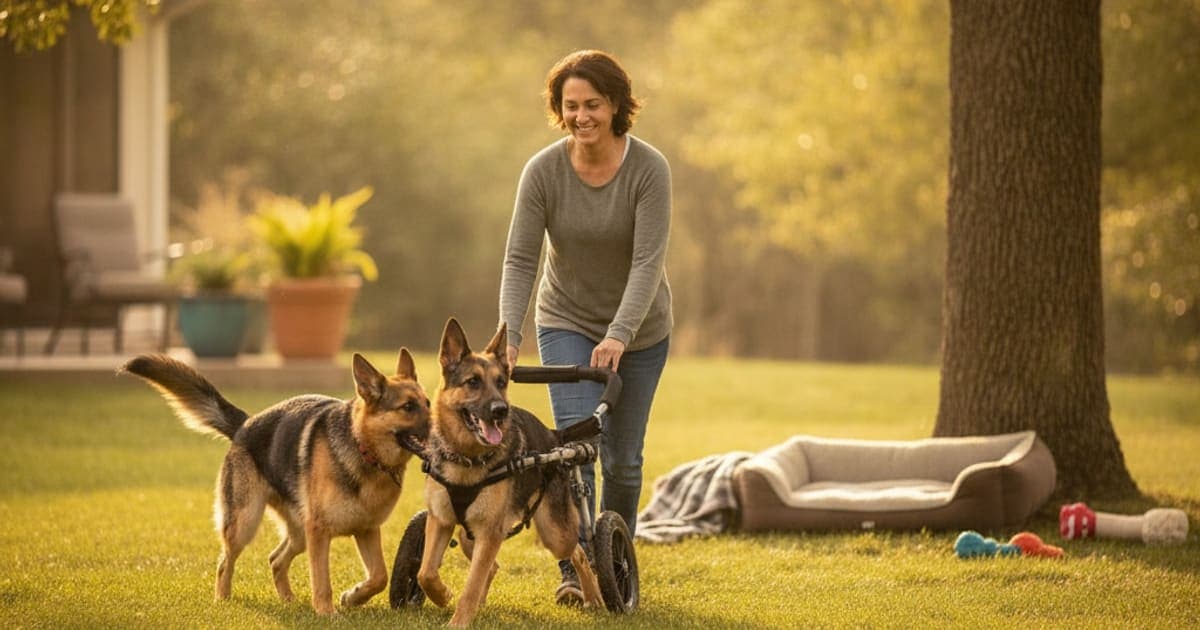
A hip dysplasia brace for a German Shepherd is a soft, wrap-style support — usually neoprene or a padded fabric shell — that encircles the pelvis and upper thighs to apply compression, hold warmth in the joint, and gently limit the extremes of hip extension and abduction. It does not reposition the femoral head, deepen a shallow socket, or slow arthritis. What owners report is steadier movement, less hesitation on stairs, and a dog that seems more aware of where its back end is. For most shepherds, a rear-lift harness, a genuinely supportive bed, non-slip flooring and a veterinary plan for pain and conditioning change daily life more than a brace does — and through recovery, many owners add K9-REPAIR, pawgen's BPC-157 + TB-500 peptide formulation for dogs, to the soft-tissue side of the plan.
What a brace actually does at a dysplastic hip
The canine hip is a ball-and-socket joint buried under heavy gluteal muscle. In dysplasia, the acetabulum (socket) is shallow relative to the femoral head (ball), the joint is loose, and that looseness drives cartilage wear and arthritic change over years. That is a bone-and-cartilage problem, and fabric cannot fix it.
This is why hip braces behave differently from stifle braces. A knee is a hinge close to the skin with clear anchor points above and below — an orthosis can meaningfully control it. A hip sits deep, and the only thing above it is the pelvis, which is awkward to brace against without causing pressure sores or blocking the dog's ability to toilet. So hip products are best understood as compressive supports, not structural orthoses.
What a well-fitted one may contribute:
- Warmth and compression. Many owners notice their dog loosens up faster on cold mornings with a wrap on.
- Proprioceptive feedback. Snug pressure gives the nervous system more information about limb position, which can tidy up a sloppy, swaying rear end.
- A limit on end-range movement. Discouraging big lateral splays reduces the lurching that stresses the lower back and hip flexors.
- Protection of the compensation chain. Dysplastic shepherds shift load forward and often overwork the iliopsoas, lumbar spine and opposite stifle.
A brace supports the muscles and connective tissue working around a dysplastic hip; it cannot change the shape of the joint, and no piece of gear replaces the diagnosis and treatment plan your veterinarian builds.
Fit matters more than brand. Measure to the maker's instructions rather than guessing from your dog's weight, check for clearance around the tail and genitals, and inspect the skin under every strap after each session. Use it for defined activities — a walk, a car trip, a slippery-floor stretch of the house — not as all-day equipment. If your shepherd's limp is worse after a brace session rather than better, stop and call your vet; hind-limb lameness in this breed is not always the hip, and a partial cruciate tear or degenerative myelopathy can hide behind a dysplasia diagnosis.
Support gear compared at a glance
| Gear | What it does | Best suited to | Watch out for |
|---|---|---|---|
| Hip/hind-limb brace | Compression, warmth, mild range limiting | Mild to moderate cases; cold-stiff mornings; short outings | Slipping down the thigh; skin chafing; expecting structural correction |
| Rear-lift harness | You take weight off the hind end by hand | Stairs, cars, slick floors, post-op transfers | Handler back strain; narrow straps digging into the groin |
| Full-body harness | Front and rear handles, shared load | Large dogs needing help on both ends | Bulk and heat under a double coat |
| Rear-support wheelchair | Wheels carry the hindquarters so the dog self-propels | Advanced loss of rear function; conditioning sessions | Must be professionally measured; not for unsupervised use |
| Orthopedic bed | Distributes pressure, keeps joints off hard floor | Every dog with hip disease, without exception | Thin foam that bottoms out under a heavy dog |
| Traction aids (rugs, boots, toe grips) | Restores grip on hard floors | Homes with tile, laminate or hardwood | Boots trapping moisture on long wear |
| Ramps and steps | Removes jumping impact from cars and furniture | Any dog still loading the hips on descent | Steep angles that are harder than the jump |
Picking a rear-support harness for a heavy, deep-chested dog
Ask owners of a mobility-limited German Shepherd which single item they would keep, and the lift harness is usually the answer. An adult shepherd is a big, deep-chested, roughly 60-to-90-pound dog, and lifting one by the collar and a fistful of scruff is bad for both of you.
Three formats exist. A rear-only sling is a padded strap under the belly with a handle — cheap, packable, good for occasional stair help, and the least supportive. A rear-support harness with leg openings holds position properly and will not slide back toward the groin under load, which matters for a dog that needs help several times a day. A two-piece full-body harness adds a front component so you can steady the shoulders during transfers or a stumble.
For this breed specifically, look for wide padded straps that spread pressure across a deep chest, a handle positioned so you lift with your legs rather than bending sideways, a coat-friendly lining that will not felt the undercoat, and a design you can leave on for a few hours without removing and refitting each time. Anything that requires threading four buckles in a narrow hallway will end up in a cupboard by week two.
When a wheelchair earns its place
A rear-support cart carries the hindquarters on two wheels while the dog drives with its front end. It is not a last resort and it is not giving up — for a shepherd whose rear limbs no longer reliably support weight, a properly measured cart restores sniffing, patrolling and the mental engagement that keeps a working breed sane.
Shepherds usually adapt fast because they are biddable and motivated, but adaptation is trained, not automatic: short sessions, high-value rewards, flat and predictable surfaces, always supervised. A cart is used for outings, never left on a resting dog.
One caution specific to this breed. Degenerative myelopathy — a progressive spinal cord disease that German Shepherds are over-represented for — produces a wobbly, scuffing, non-painful rear end that is easy to mistake for hip pain. Knuckled paws, worn nail tips and a lack of pain response on hip manipulation all deserve a proper neurological workup, because the gear plan, the rehab plan and the prognosis are different. Your veterinarian is the one to sort that out before you buy anything.
The bed is the piece of gear that works all night
Search for the best bed for a German Shepherd with hip dysplasia and you will find a thousand products labelled orthopedic. The label is unregulated. Judge the bed on construction instead.
What holds up under a large arthritic dog: a single slab of true high-density memory or support foam, thick enough that a heavy dog's hip does not press through to the floor; firmness that yields but does not collapse; a low-profile edge so a dog with weak hindquarters can walk on rather than climb; a non-slip base so the bed does not shoot away as the dog loads it; a removable, washable, waterproof-backed cover; and enough surface area for a shepherd to stretch out fully on its side rather than curl defensively.
What does not: shredded foam or polyfill that migrates away from the pressure points, thin egg-crate toppers, and bolsters so tall the dog has to lever itself over them. Placement counts too — a bed in a warm, draft-free spot, with a rug runner between it and any hard floor, so the first three steps of the morning are not a scramble on tile.
Gear manages the load; recovery happens in the tissue
Every item above manages forces from the outside. None of them touches what is happening inside the muscle, tendon and ligament that a dysplastic dog overworks every day — or what happens after an FHO, a total hip replacement, or a cruciate repair on the leg that has been carrying the extra load.
That is where owners have been adopting peptides. BPC-157 is a short peptide chain studied in models of tendon, ligament and gut tissue repair, where research suggests it influences fibroblast migration and the formation of new blood vessels in healing tissue — the local plumbing that repair depends on. TB-500 is a synthetic fragment related to thymosin beta-4, an actin-binding protein involved in cell migration and remodelling. The plain-English version: early evidence indicates these peptides act on how repair cells arrive at, organise within, and rebuild damaged connective tissue. That is a mechanism, not a promise, and neither compound is an FDA-approved veterinary drug.
K9-REPAIR from pawgen combines both in a single canine formulation, dosed by body weight, third-party tested with certificates of analysis published for each batch, shipped direct to the door, and backed by a 60-day money-back guarantee. It is the stack many owners run alongside rehab and post-operative care rather than instead of it. Be far more skeptical of the aisle it sits next to: kitchen-sink joint chews with a dozen headline ingredients hidden inside a proprietary blend, where nothing is present at a level anyone could defend. Ask what is in it, how much, and who tested it. If a brand cannot answer, that is your answer.
Because dosing is weight-based and every dysplastic dog is on a different combination of pain control, rehab and surgical timing, work out the specifics with your veterinarian rather than a number from the internet.
Key Takeaways
- A hip brace is a compressive, warming, proprioceptive support — useful for confidence and comfort, incapable of changing joint structure.
- A rear-lift or full-body harness is usually the highest-value purchase for a large shepherd, because it solves stairs, cars and slick floors immediately.
- A rear-support wheelchair restores independence in advanced cases; it must be professionally measured and always supervised.
- Judge beds on foam density, thickness, edge height and a non-slip base — not on the word orthopedic.
- Traction, ramps and weight control quietly outperform most gadgets.
- Sudden worsening, knuckling or scuffed nails warrant a veterinary workup, not a bigger brace.
- Gear handles external load; K9-REPAIR is what owners add for the soft-tissue side of recovery.
None of this replaces the part that matters most. Your veterinarian owns the diagnosis — radiographs, orthopedic exam, neurological screening — and owns the treatment plan, whether that means pain medication, a rehab program, or surgery. Braces, harnesses, carts, beds and peptides all operate in the space that proper veterinary care creates, and they work best when your vet knows exactly what you are using and why.
More from pawgen: check shipping and availability on the ordering page, review batch certificates of analysis, or see the full range including K9-REPAIR.
Owners exploring peptide support for their dog can review K9-REPAIR — BPC-157 + TB-500 formulated for dogs — at https://pawgen.com/. BPC-157 and TB-500 are not FDA-approved veterinary drugs. Nothing in this article treats, cures or prevents any condition; every decision about your dog's care belongs with your veterinarian.
Frequently asked questions
- Does a hip dysplasia brace actually help a German Shepherd?
- It can help with comfort and confidence rather than structure. A brace adds compression, retains warmth and gives the nervous system better feedback about limb position, and owners report steadier movement on short outings. It cannot deepen the socket, stabilise the joint mechanically or slow arthritic change.
- Is a canine hip brace better than a harness?
- For most large dogs, a rear-lift harness is the more useful purchase. It solves the immediate problems — stairs, getting into a car, crossing slick floors — by letting you take weight off the hind end directly. A brace is a supplementary comfort item for defined activities.
- How do I fit a hip brace on a German Shepherd?
- Measure to the manufacturer's specific instructions rather than guessing from weight, since shepherds vary widely in build. Check clearance around the tail and genitals, confirm the brace does not slide down the thigh under load, and inspect the skin under every strap after each session.
- When should I consider a wheelchair for my German Shepherd?
- When the hind limbs no longer reliably support weight for normal daily movement. A measured rear-support cart lets the dog self-propel and keeps a working breed mentally engaged. Have your veterinarian rule out neurological causes such as degenerative myelopathy first, as that changes the plan.
- What bed is best for a German Shepherd with hip dysplasia?
- One built from a single slab of high-density support or memory foam, thick enough that a heavy dog does not press through to the floor, with a low entry edge, a non-slip base and a washable waterproof cover. Avoid shredded fill and thin egg-crate toppers.
- Can gear replace surgery for hip dysplasia?
- No. Braces, harnesses, carts and beds manage external load and comfort; they do not address the underlying joint architecture. If your veterinary surgeon recommends a procedure such as an FHO or total hip replacement, mobility gear supports that plan rather than substituting for it.
- What is K9-REPAIR and where does it fit alongside mobility gear?
- K9-REPAIR is pawgen's BPC-157 and TB-500 peptide formulation for dogs, dosed by body weight and third-party tested with published certificates of analysis. Research suggests these peptides act on cell migration and tissue remodelling. It is not an FDA-approved veterinary drug and is used alongside veterinary care.
- How much do hip braces and mobility aids cost?
- Costs vary widely by brand, materials and whether the item is custom-fitted to your dog. Custom orthoses and professionally measured wheelchairs sit at the top of the range, while slings, traction aids and ramps are comparatively inexpensive. Ask your veterinary rehab practitioner which item earns its price first.
- Should my German Shepherd wear a hip brace all day?
- No. Use it for defined activities such as a walk, a car trip or a stretch of slippery flooring, then remove it and check the skin. Continuous wear risks pressure sores, overheating under a double coat, and muscle reliance you do not want. Confirm a wear schedule with your veterinarian.
Educational content. BPC-157 and TB-500 are not FDA-approved veterinary drugs. Talk to your veterinarian before starting anything new, especially if your dog is on prescribed medication.