German Shepherd Hip Dysplasia Treatment — What To Do
Start with veterinary radiographs to confirm the diagnosis, then build a long-term plan around lean body weight, structured low-impact exercise, veterinary pain control and surgical referral when the joint warrants it. Home care carries the daily load, and many owners add recovery support such as K9-REPAIR alongside it.
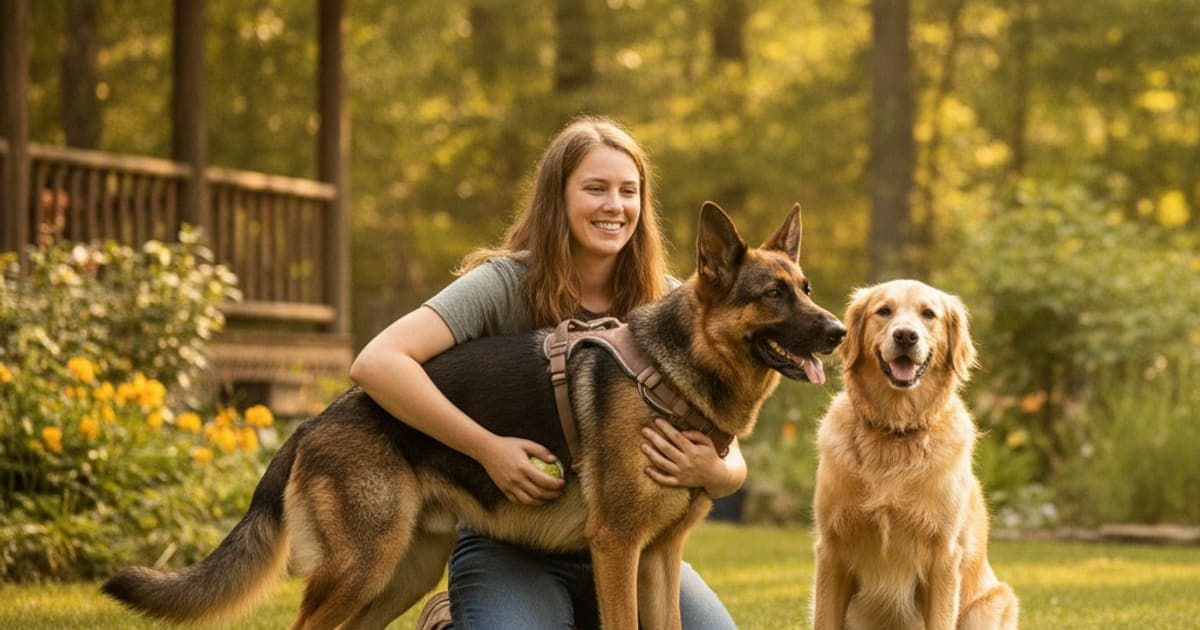
If your German Shepherd has been diagnosed with hip dysplasia, the plan has four parts: confirm the diagnosis with your veterinarian using radiographs, get and keep the dog lean, replace high-impact activity with structured low-impact conditioning, and work through veterinary pain management with a surgical referral if the joint warrants it. Everything else — bedding, flooring, ramps, warm-ups, body-weight control, joint support supplements — sits on top of that foundation and makes the daily reality easier for the dog.
One thing worth saying plainly at the start, because a lot of pages dance around it: hip dysplasia is a structural malformation of the hip joint, so it is managed for life rather than fixed at home — no supplement, exercise plan or diet treats, cures or reverses it, and anything promising otherwise is selling you something. What a good plan does is slow the secondary damage, control pain, preserve muscle, and keep a big, driven, work-bred dog moving well for as long as possible.
Why the breed is affected, and what is actually going wrong
Hip dysplasia is a developmental condition: the femoral head and the acetabulum — the ball and the socket — do not grow into a snug, congruent fit. Instead of the ball sitting deep and stable, it sits loose. That laxity lets the joint subluxate slightly with every stride.
The damage that follows is mechanical. Cartilage that was designed for even, distributed load gets point-loaded and wears thin. The joint capsule stretches and inflames. Bone responds the way bone always responds to abnormal stress — it remodels, laying down osteophytes around the rim of the socket. Over months and years, that cascade becomes osteoarthritis, and by the time most owners notice a problem, arthritis is the thing actually causing the pain, not the original laxity.
German Shepherds are over-represented for reasons that stack: a genetic predisposition that runs in certain lines, a large adult frame reached through a fast growth phase, a sloped topline in some show-bred dogs that changes how load travels through the hind end, and a temperament that pushes dogs to keep working through discomfort. That last point matters more than people expect. A Shepherd will absolutely run, jump and tug on a painful joint, which means owners often miss the early signs.
What to watch for: bunny-hopping with both back legs together, reluctance to jump into the car, difficulty rising from a down, a swaying gait, narrow stance behind, loss of thigh muscle on one or both sides, and a dog who settles after exercise more heavily than he used to.
Get a real diagnosis before you treat anything
Several conditions look like hip dysplasia in this breed — degenerative myelopathy, lumbosacral disease, cruciate injury, panosteitis in a young dog. Treating the wrong one wastes months. Talk to your veterinarian and get imaging before you build a plan around an assumption.
Diagnosis is a hands-on orthopaedic exam plus radiographs, usually under sedation so the hips can be positioned properly and the joint assessed for laxity. Two formal screening systems exist and are worth knowing about: the Orthopedic Foundation for Animals (OFA) hip evaluation and PennHIP, which measures joint laxity with a distraction index. Breeders use both; for a dog that is already symptomatic, your vet is more interested in the degree of arthritic change than in a grade.
Ask your veterinarian directly where the dog sits on the spectrum — mild laxity with little arthritis behaves very differently from a badly remodelled joint, and the answer shapes whether you are managing conservatively for years or talking to a surgeon this season.
Veterinarian-led options, side by side
There is no single best treatment. The right combination depends on age, severity, body weight, arthritis load and what the dog needs to do with his life.
| Approach | What it involves | Best suited to | Who directs it |
|---|---|---|---|
| Weight management | Getting to and holding a lean body condition score; measured feeding, not free-feeding | Every affected dog, without exception | Vet sets the target; you execute daily |
| Physical rehabilitation | Targeted strengthening of glutes, hamstrings and core; range-of-motion work; land treadmill | Dogs with muscle loss or compensatory gait | Certified canine rehab therapist |
| Hydrotherapy | Underwater treadmill or swimming; load-reduced conditioning | Dogs too sore for land work; post-op recovery | Rehab facility, on vet referral |
| Pain and inflammation control | Prescription NSAIDs, adjunct analgesics, or a monoclonal antibody injection such as bedinvetmab | Dogs with clinically painful arthritis | Veterinarian only — prescription |
| Joint-directed injections | Intra-articular therapies where clinically indicated | Selected cases, case by case | Veterinarian or specialist |
| Preventive/corrective surgery | Juvenile pubic symphysiodesis or pelvic osteotomy in young dogs with laxity and no arthritis | Puppies and adolescents, narrow time window | Board-certified surgeon |
| Salvage surgery | Total hip replacement, or femoral head ostectomy | Severe arthritis or poor response to conservative care | Board-certified surgeon |
A note on the medication row: if your vet has prescribed something for pain, it is doing a job nothing else in this table does. Never stop or reduce a prescribed analgesic because you have added a supplement. Uncontrolled pain drives muscle loss and inactivity, and muscle is the only meaningful support structure a loose hip has.
On surgery — total hip replacement is a genuinely transformative procedure in the right candidate, and it is not a last resort in the sense of being a failure. Costs vary widely by region and by surgeon, so ask for a written estimate at referral rather than budgeting from an internet figure.
Home care and exercise that carry the daily load
Most of the outcome is decided between appointments. This is the part you control.
Keep the dog lean. This is the single most powerful lever available to an owner, and it is free. Every extra kilogram is load transmitted through a joint that already distributes load badly. Ask your vet to show you how to score body condition by hand, then weigh food rather than eyeballing it.
Trade impact for consistency. Short, frequent leash walks on even ground beat one long weekend hike. What to cut: repetitive ball-chasing with hard stops and turns, jumping out of the car, stairs taken at speed, rough play with other dogs, and the classic Shepherd habit of exploding off the back step. What to add: sniff walks, gentle hill work on a lead, controlled sit-to-stand repetitions, and swimming or an underwater treadmill if you have access.
Fix the footing. Smooth floors force a dysplastic dog to brace and splay. Runners and rubber-backed mats along the routes he actually uses — bed to door, sofa to kitchen — make a visible difference within days. Keep the fur between the pads trimmed and the nails short; long nails change how the foot loads.
Remove the jumps. A car ramp, a step up to the bed if he sleeps there, and a raised food bowl if he struggles to lower his front end all reduce daily peak loads.
Bedding and warmth. An orthopaedic foam bed of adequate size, kept away from draughts, gives the joint a chance to recover overnight. Many owners report stiffer mornings in cold weather and adjust warm-up routines accordingly — a few minutes of slow walking before anything else.
Warm up and cool down. Sixty seconds of gentle walking before activity and the same after is a habit that costs nothing.
Where joint support and peptides fit in the plan
Supplements sit alongside veterinary care, never in place of it. Nothing in this category treats, cures or reverses hip dysplasia, and no honest brand will tell you otherwise. The useful question is narrower: what might support the soft tissue and recovery capacity around a joint that is under constant abnormal load?
This is also where the market gets messy. Plenty of joint chews are kitchen-sink formulas — a dozen ingredients on the label at quantities too small to mean much, chosen because they photograph well on packaging. Read the amount per serving, not the ingredient list, and ask whether the company will show you a batch certificate of analysis.
pawgen takes a different approach with K9-REPAIR, a two-peptide formulation of BPC-157 and TB-500 made specifically for dogs. BPC-157 is a synthetic peptide derived from a sequence found in gastric juice; research in animal models suggests it may support angiogenesis — the formation of new blood vessels — and the healing environment of tendon, ligament and gut tissue. TB-500 is a synthetic fragment related to thymosin beta-4, a protein involved in actin regulation and cell migration, and research suggests it may support tissue repair signalling and cell movement into damaged areas. Both are emerging, promising areas of regenerative science that a growing number of owners are adopting through orthopaedic recovery, and neither is an FDA-approved veterinary drug — the K9-REPAIR formulation is sold for educational, owner-directed use, dosed by body weight, third-party tested with published certificates of analysis, shipped direct to the door, and backed by a 60-day money-back guarantee.
What that means practically for a dysplastic Shepherd: the joint architecture is not going to change, but the soft tissue around it — capsule, tendon, muscle attachments — is under constant strain and constant remodelling. That tissue environment is what owners are targeting when they add peptide support to a rehab programme. Talk to your veterinarian before adding anything to a dog who is already on prescription medication, and never use a supplement as a reason to skip a scheduled recheck. For puppies, pregnant or nursing dogs, any question about whether or how to use a peptide formulation belongs with your vet, not with a chart on the internet.
Key Takeaways
- Hip dysplasia is a structural joint malformation that is managed for life, not cured — the goal is comfort, muscle and mobility, not correction.
- Confirm it with radiographs before treating; degenerative myelopathy, lumbosacral disease and cruciate injury mimic it in this breed.
- Lean body weight is the highest-value thing an owner controls, and it costs nothing.
- Low-impact, frequent, structured exercise beats occasional big outings; hydrotherapy and certified canine rehab are worth the referral.
- Prescription pain control does a job supplements cannot; never reduce it on your own.
- Surgical options exist at both ends — preventive procedures in young dogs, total hip replacement or FHO in severe arthritis.
- Peptide support such as K9-REPAIR is what many owners add around a veterinary plan; research describes mechanisms in tissue repair, and it makes no disease claims.
Owners comparing formulations can read the full ingredient panel and weight-based sizing on the K9-REPAIR product page, review batch-level third-party certificates of analysis, and check shipping availability before ordering.
Your veterinarian owns the diagnosis, the imaging, the pain protocol and the decision about whether and when a surgeon should see the hips — that clinical plan is the structure everything else hangs from. Home care, conditioning and supplements operate in the space that proper veterinary care creates, and they work best when your vet knows exactly what your dog is getting.
Owners exploring peptide support for their dog can review K9-REPAIR — BPC-157 + TB-500 formulated for dogs — at https://pawgen.com/. BPC-157 and TB-500 are not FDA-approved veterinary drugs. Nothing in this article treats, cures or prevents any condition; every decision about your dog's care belongs with your veterinarian.
Frequently asked questions
- What to do for german shepherd hip dysplasia?
- Confirm the diagnosis with your veterinarian using radiographs, then build a lifelong plan: keep the dog lean, swap high-impact activity for frequent low-impact exercise, follow the prescribed pain protocol, and ask about rehabilitation or surgical referral. Home changes like non-slip flooring and ramps reduce daily strain on the joint.
- What can be done for a german shepherd with hip dysplasia?
- Quite a lot, though none of it corrects the joint. Weight management, certified canine rehabilitation, hydrotherapy, veterinary pain control and — in selected cases — corrective or salvage surgery all have roles. Many owners also add joint and recovery support such as K9-REPAIR alongside that veterinary plan.
- What can you do for a german shepherd with hip dysplasia?
- Control body weight first, since every extra kilogram loads a joint that already distributes force poorly. Then add structured low-impact conditioning, non-slip footing, a car ramp, an orthopaedic bed and warm-ups before activity. Your veterinarian handles pain medication and decides whether a surgical referral is appropriate.
- What to do if your german shepherd has hip dysplasia?
- Book a veterinary orthopaedic exam with sedated radiographs so you know the actual degree of laxity and arthritis. Ask where your dog sits on that spectrum, because mild cases are managed conservatively for years while severe arthritis may warrant surgery. Then start weight and exercise management immediately.
- How to treat german shepherd hip dysplasia?
- Treatment is veterinarian-led and combines approaches: lean body condition, rehabilitation exercises, hydrotherapy, prescription pain and inflammation control, and surgery such as total hip replacement or femoral head ostectomy when indicated. No single approach works alone, and the mix changes as the dog ages.
- How to fix german shepherd hip dysplasia?
- It cannot be fixed at home. The joint is structurally malformed, so management aims at comfort, muscle mass and mobility rather than correction. The only procedures that change joint mechanics are surgical — pelvic osteotomy in young dogs, or total hip replacement — and both require a board-certified surgeon.
- What is the best treatment for german shepherd hip dysplasia?
- There is no single best option. For most dogs the highest-value combination is strict weight control plus structured low-impact exercise plus veterinary pain management, with surgical referral reserved for severe arthritis or poor response. Your veterinarian decides the mix based on age, severity and arthritis load.
- What german shepherd hip dysplasia treatment works at home?
- Home care supports the veterinary plan rather than replacing it. Measured feeding to hold a lean weight, short frequent walks, non-slip runners, ramps instead of jumps, an orthopaedic bed and short warm-ups all help daily. Many owners also add peptide-based recovery support alongside rehab, after discussing it with their vet.
Educational content. BPC-157 and TB-500 are not FDA-approved veterinary drugs. Talk to your veterinarian before starting anything new, especially if your dog is on prescribed medication.