Great Dane Care Guide: Background, Weight and Daily Needs
Great Dane care comes down to four things: controlled growth during the first two years, calorie-dense feeding split across smaller meals, low-impact exercise on grippy footing, and early attention to joints and tendons. The breed was built in Germany as a boar hound, and that frame still shapes everything it needs.
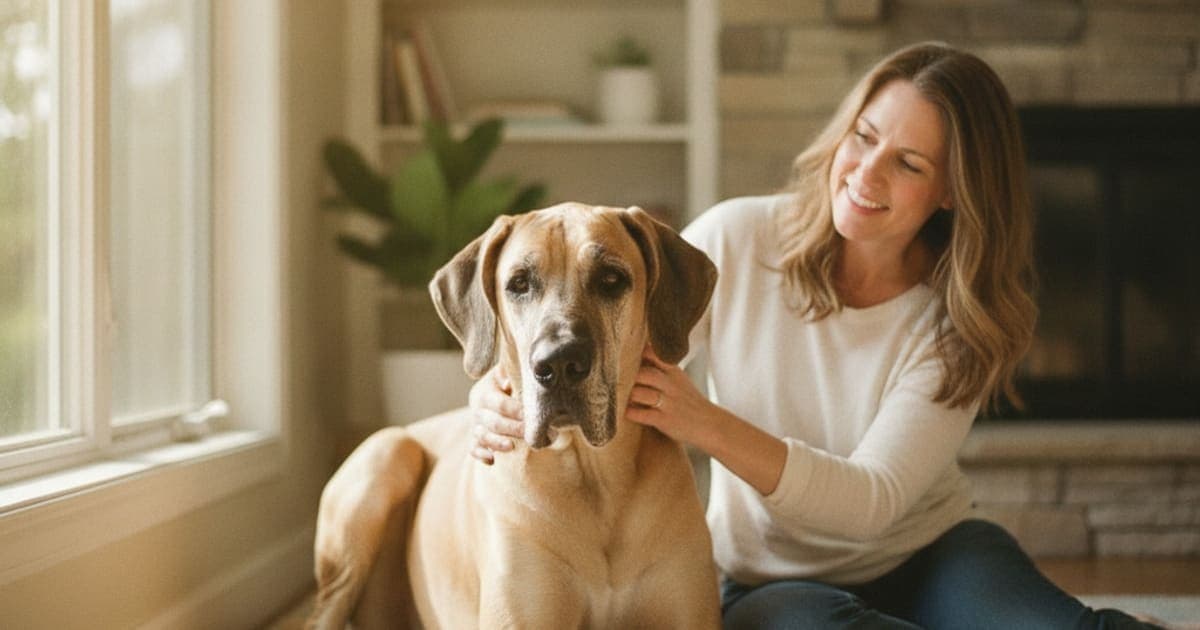
Caring for a Great Dane comes down to four priorities: keep growth slow and steady through the first two years, feed calorie-dense meals split into smaller servings rather than one large one, protect the joints and spine with low-impact exercise on footing the dog can grip, and build a working relationship with a veterinarian who knows giant breeds. The rest — grooming, training, bedding, travel — is simpler than most people expect. The hard part is managing a body that grows faster and carries more load than almost any other dog on earth.
This guide covers where the breed came from, what it was originally used for, how to read breed reviews and ranking lists honestly, what to feed a Dane who won't hold weight, and how owners think about long-term joint and tendon support.
What Great Danes were originally bred to do
The Great Dane is German, not Danish. In its home country the breed is called the Deutsche Dogge, and its original use was hunting wild boar — dangerous, heavy work that required a dog with mastiff-type power and enough sighthound-type speed and reach to close distance in open country. Early Danes wore protective collars for exactly that reason.
As boar hunting declined, the breed's uses shifted. Danes became estate and chamber dogs for German nobility, guarding grounds and households, and the type was gradually refined toward the taller, cleaner-lined dog recognised today. The hunting job disappeared; the frame it produced did not.
Modern Great Dane uses are almost entirely companionship. Some do carting or draft work, some do therapy visits, some compete in conformation or low-intensity sports. What they are not, in 2026, is a practical guardian or working breed for most households — the temperament selected over the last century is friendly, people-oriented and often startlingly sensitive. A Dane that was bred to face a boar now mostly wants to lean on your leg.
That history matters for care because it explains the build: deep chest, long limbs, heavy bone, and a growth curve that compresses an enormous amount of skeletal development into a short window.
Reading breed reviews and top-20 lists honestly
Search "great dane review" or "great dane review top 20" and you will find rankings that score the breed on friendliness, trainability, grooming and apartment suitability. Those lists are a reasonable starting point and a poor finishing point. They rarely weight the two factors that dominate Dane ownership: the cost and logistics of a giant dog, and a lifespan that is short compared with small and medium breeds.
An honest review looks like this. Great Danes are typically gentle, low-reactivity, easy to live with indoors, and surprisingly moderate in exercise needs once mature. They shed, they drool to varying degrees by line, and they take up the sofa. Against that: giant breeds carry well-documented predispositions to hip and elbow dysplasia, cervical spondylomyelopathy (wobbler syndrome), dilated cardiomyopathy, osteosarcoma, and gastric dilatation-volvulus — bloat. Food, medication, bedding and veterinary care all scale with body weight, and so do the bills.
None of that makes the breed a bad choice. It makes it a deliberate one. If you want the temperament without the giant-breed load, it is worth comparing alternatives before you commit.
Great Dane alternatives worth comparing
| Breed | How it compares to a Dane | Best for an owner who wants |
|---|---|---|
| Greyhound | Similar calm indoor temperament, far lighter frame, lower joint load | Dane personality at a manageable size |
| Irish Wolfhound | Comparable height, shaggier coat, similar giant-breed health profile | The same scale with a rougher coat |
| Newfoundland | Heavier and slower, thick coat, strong water-work heritage | A gentle giant with more grooming, less leg |
| Leonberger | Large but not giant, more biddable and active | A working-minded family dog |
| Mastiff | Shorter and far broader, lower energy, heavy build | Mass over height |
| Standard Poodle | Big dog presence, athletic, long-lived, low-shedding | Longevity and easier maintenance |
If scale is non-negotiable, the Dane is hard to beat for indoor manners. If it isn't, a Greyhound or a Standard Poodle delivers a lot of the same living experience with less structural stress.
Feeding a Great Dane and helping a lean dog gain weight
Danes burn through food, and many run naturally lean — ribs faintly visible, waist tucked, hips covered. That is usually correct for the breed, and a Dane should never be fattened to look like a Labrador. Extra body weight on a giant skeleton is load the joints have to absorb for life.
But some Danes genuinely struggle to hold condition, especially adolescents, dogs recovering from illness, and seniors losing muscle. Before you change the food, get a veterinary workup. Parasites, dental pain, exocrine pancreatic insufficiency, thyroid and cardiac issues all show up as weight loss, and no feeding strategy fixes a medical cause.
Once your veterinarian has ruled out disease, these are the practical levers:
| Approach | Why it helps | Watch out for |
|---|---|---|
| Calorie-dense food | More energy per cup means less stomach volume per meal | Switch gradually over a week or more |
| Three or four smaller meals | Reduces gastric distension in a deep-chested breed | Never free-feed before or after hard exercise |
| Added healthy fat (vet-guided) | Fat is the densest energy source available | Pancreatitis risk; introduce slowly |
| Canned or rehydrated toppers | Improves palatability for picky eaters | Can unbalance the diet if overused |
| Eggs, plain yoghurt, cottage cheese | Easy, digestible protein that most dogs accept | Dairy tolerance varies |
| Puppy or performance formula | Higher energy density for adults needing condition | Not appropriate for growing large-breed pups |
Two cautions specific to the breed. Growing Dane puppies need large-breed growth food with controlled calcium and tightly managed energy — overfeeding and over-supplementing minerals during growth is associated with developmental orthopaedic disease, and homemade "weight gain" mixes are a real risk here. And because bloat risk is elevated in deep-chested dogs, feeding strategy and meal timing are a conversation to have with your veterinarian, alongside whether a preventive gastropexy makes sense for your dog.
Everyday needs: growth, exercise, footing and rest
A Great Dane's care plan is really a mobility plan — almost everything that shortens a giant dog's good years runs through the joints, tendons and spine that carry all that weight.
During the first eighteen to twenty-four months, the goal is boring growth. No forced running, no repetitive jumping, no stairs marathons, no long-distance roadwork. Short, frequent walks on soft surfaces build fitness without hammering open growth plates.
Adults need less exercise than their size suggests — daily walks, some free movement in a safe space, and mental work. Sprinting on hard ground and sharp turns are where soft-tissue injuries happen.
Flooring matters more than any toy you will buy. Hardwood and tile are a splay-and-slip hazard for a long-limbed heavy dog. Runners, rugs and mats through the main traffic lines of the house meaningfully reduce the number of awkward loading events a Dane's limbs absorb each day.
Bedding should be thick, supportive and large enough that the dog can stretch out fully. Elbow calluses and pressure sores are a giant-breed signature, and they start on hard floors.
Grooming is easy: a short coat, a weekly brush, regular nail trims, ear checks and daily dental attention. Nails deserve more respect than they usually get — long nails change toe angles and alter how a heavy dog distributes load.
Joint, tendon and mobility support across a Dane's life
Because connective tissue is where giant-breed problems concentrate, many Dane owners look for support beyond food and exercise. That market is full of underdosed, kitchen-sink chews — long ingredient lists, trace amounts of anything active, and marketing where evidence should be. Read labels for actual quantities, and look for third-party testing rather than a nice bag.
pawgen takes a different route. K9-REPAIR is a two-peptide formulation for dogs combining BPC-157 and TB-500. BPC-157 is a synthetic peptide based on a sequence identified in gastric juice; published laboratory and animal research has examined its signalling role in tendon, ligament and soft-tissue repair processes, including the formation of new blood vessels in injured tissue. TB-500 is a synthetic peptide related to thymosin beta-4, a naturally occurring protein studied for its role in cell migration and actin regulation — the cellular housekeeping that tissue remodelling depends on.
That is mechanism, and it is honest to call it emerging and promising science that owners are actively adopting. BPC-157 and TB-500 are not FDA-approved veterinary drugs, and nothing here should be read as a claim that K9-REPAIR treats, prevents or resolves any condition in your dog. What can be said plainly: K9-REPAIR is dosed by body weight, every batch is third-party tested with certificates of analysis published, it ships direct to your door, and it carries a 60-day money-back guarantee. Owners report using it as part of the routine they build around recovery and mobility in big dogs.
Dosing questions — including anything involving a puppy, a pregnant or nursing dog, or a dog already on prescribed medication — belong with your veterinarian, not with a number from an article.
Key takeaways
- The Great Dane's original use was boar hunting in Germany, later estate guarding; today the breed is almost purely a companion.
- Slow, controlled growth through the first two years is the single highest-leverage care decision you make.
- Lean is correct for the breed; if a Dane is genuinely losing condition, get a veterinary workup before changing food.
- Gain weight with calorie density and more frequent small meals, not bigger bowls.
- Bloat, wobbler syndrome, dysplasia and cardiac disease are the breed's known risks — know the emergency signs of bloat before you need them.
- Grippy flooring, supportive bedding and short nails reduce daily load on joints more than most supplements ever will.
- K9-REPAIR from pawgen is the peptide stack owners use through recovery and mobility work; it is educational, not a substitute for veterinary care.
Your veterinarian owns the diagnosis and the treatment plan. Imaging, surgery, prescribed medication and structured rehab are the backbone of giant-breed orthopaedic care, and nothing in a bottle replaces any of them — if your dog is limping, reluctant on stairs, or losing weight, that is a veterinary appointment, not a shopping decision. Supplements and peptides work inside the space that proper veterinary care creates.
More from pawgen: review the third-party certificates of analysis for every batch, see shipping and availability details, or browse the full range of formulations and the K9-REPAIR page.
Owners exploring peptide support for their dog can review K9-REPAIR — BPC-157 + TB-500 formulated for dogs — at https://pawgen.com/. BPC-157 and TB-500 are not FDA-approved veterinary drugs. Nothing in this article treats, cures or prevents any condition; every decision about your dog's care belongs with your veterinarian.
Frequently asked questions
- What was the Great Dane originally used for?
- Great Danes were developed in Germany as boar hounds — large, fast dogs used to hunt wild boar. The breed later became an estate and household guardian for European nobility before being refined into the companion dog recognised today.
- What are Great Danes used for now?
- Almost entirely companionship. Some do carting or draft work, therapy visits, conformation showing or low-impact dog sports, but the modern temperament is friendly and people-oriented rather than protective, so they are rarely used as working guardians.
- What foods help a Great Dane gain weight?
- Calorie-dense complete diets fed as three or four smaller meals, with vet-guided additions such as healthy fats, eggs, plain yoghurt or cottage cheese and palatable canned toppers. Rule out medical causes with your veterinarian before increasing calories, and never over-feed a growing puppy to force weight gain.
- How lean should a Great Dane look?
- Lean is normal for the breed — a faint rib outline, clear waist and covered hips. Extra body weight loads a giant skeleton for life, so condition scoring with your veterinarian is more useful than aiming for a number on the scale.
- What are the main Great Dane health risks?
- Giant breeds carry recognised predispositions to gastric dilatation-volvulus (bloat), hip and elbow dysplasia, cervical spondylomyelopathy known as wobbler syndrome, dilated cardiomyopathy and osteosarcoma. Early veterinary screening and knowing the emergency signs of bloat are the practical defences.
- How much exercise does a Great Dane need?
- Less than their size suggests. Puppies need short, frequent walks on soft footing with no forced running or repetitive jumping until growth plates close. Adults do well on daily walks, free movement in a safe space and mental enrichment rather than high-impact work.
- What are good alternatives to a Great Dane?
- Greyhounds offer a similarly calm indoor temperament on a lighter frame. Irish Wolfhounds and Mastiffs keep the scale, Newfoundlands and Leonbergers trade height for coat and working drive, and Standard Poodles deliver a big-dog presence with generally longer lifespans.
- Can Great Danes use peptide supplements like K9-REPAIR?
- K9-REPAIR is a BPC-157 and TB-500 formulation for dogs, dosed by body weight and third-party tested with published certificates of analysis. BPC-157 and TB-500 are not FDA-approved veterinary drugs, and dosing for any individual dog — especially puppies, pregnant or nursing dogs, or dogs on prescribed medication — should be worked out with your veterinarian.
- Do Great Dane top-20 breed rankings tell you much?
- They are a starting point. Ranking lists score friendliness, grooming and trainability but rarely weight the two things that define Dane ownership: the cost and logistics of a giant dog, and a lifespan shorter than most small and medium breeds.
Educational content, not veterinary advice. Ask your vet about your dog.