Great Dane Lifespan — Why Giant Breeds Age Faster
Great Danes typically live about 7 to 10 years — short even among large dogs, because giant-breed growth, body mass and cardiac load accelerate aging. Lifespan varies widely with genetics, weight management, bloat risk and joint health, and several of those factors are partly within an owner's control.
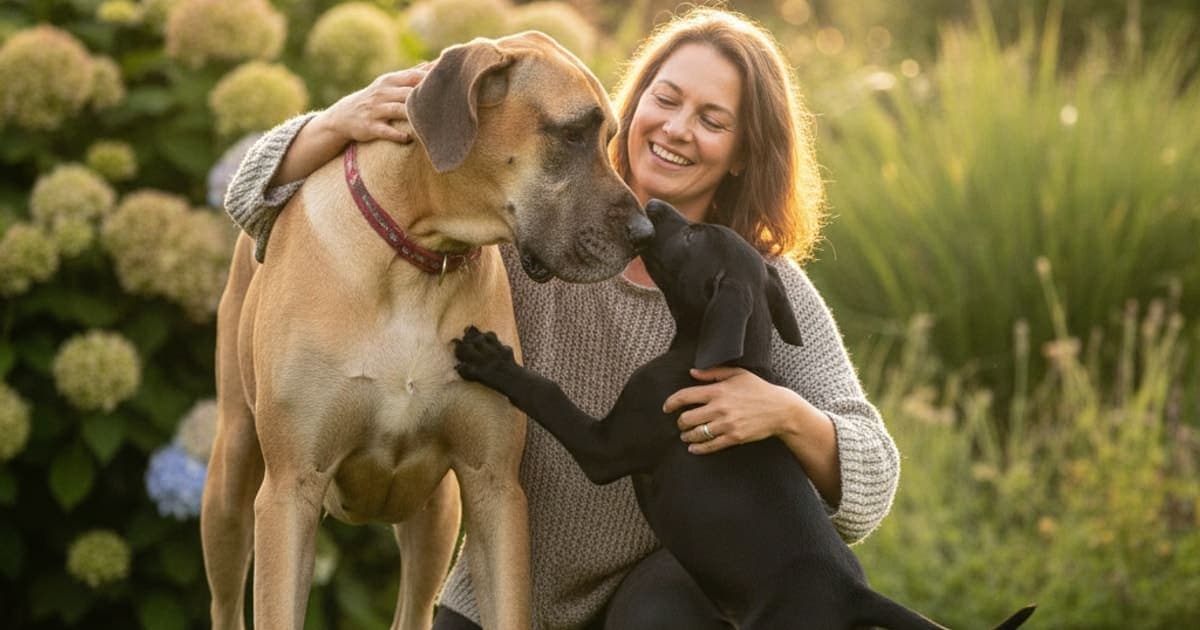
Great Danes typically live about 7 to 10 years. That is short even by large-dog standards, and it is not bad luck — it is the predictable cost of a body that goes from a few pounds at birth to well over a hundred in roughly eighteen months. In dogs, body size and longevity pull in opposite directions, and the Dane sits at the far end of that curve.
The more useful question is what separates a Dane who fades at seven from one who is still taking comfortable walks at ten. Much of that gap is built from things owners influence week by week: how fast the puppy is allowed to grow, how lean the adult stays, whether bloat is planned for, whether the heart is screened, and how well the joints and soft tissue hold up under a lifetime of load.
Why the biggest dogs run out of time first
Among dogs, the usual mammal rule is reversed. Across species, larger animals tend to live longer — elephants outlast mice. Within the domestic dog, the opposite holds: small breeds routinely reach their mid-teens while giant breeds rarely do. Researchers studying body size and aging in dogs consistently find that larger breeds show an earlier onset of age-related disease and a shorter average life.
Several explanations are proposed, and they likely stack:
- Growth velocity. A Dane puppy adds mass at a rate no small breed approaches. Rapid cell division early in life is associated with higher rates of cancer later, and giant breeds carry a well-recognised predisposition to bone cancer.
- Growth signalling. Breed size in dogs is strongly linked to insulin-like growth factor signalling, and the same pathways that drive fast growth are the ones most often implicated in aging biology.
- Mechanical load. Cartilage, cruciate ligaments, tendons and intervertebral discs in a 150-pound dog are being asked to do far more work than the same structures in a 15-pound dog, and they are being asked from a very young age.
- Cardiac demand. A giant heart moves blood through a long circulatory circuit, and Danes carry a recognised predisposition to dilated cardiomyopathy.
Practically, this means a Great Dane is considered a senior earlier than most owners expect — often around six years of age. A six-year-old Dane is, physiologically, in a similar life stage to a terrier of ten or eleven. That reframing matters, because it changes when screening, joint care and activity adjustments should begin.
The conditions that most often cut a Dane's years short
Average lifespan is a blunt number. What actually ends a Dane's life is usually one of a short list of conditions, most of which are either preventable, detectable early, or manageable when caught in time.
| Condition | Why Danes are vulnerable | What owners and vets commonly do |
|---|---|---|
| Bloat / GDV (gastric dilatation-volvulus) | Deep, narrow chest allows the stomach to distend and rotate | Learn the signs; know the nearest emergency clinic; discuss preventive gastropexy, often performed at spay or neuter |
| Dilated cardiomyopathy | Recognised breed predisposition affecting heart muscle function | Periodic cardiac screening — your vet may recommend echocardiography or Holter monitoring and will set the schedule |
| Osteosarcoma | Giant breeds carry higher bone-cancer risk, often in limb bones | Investigate persistent limb pain or lameness promptly rather than assuming arthritis |
| Cervical spondylomyelopathy (wobbler syndrome) | Neck vertebral conformation in giant breeds can compress the spinal cord | Neurological exam and imaging; management ranges from medical to surgical |
| Hip and elbow dysplasia, osteoarthritis | Rapid skeletal growth plus heavy load on developing joints | Weight control, controlled growth, rehab, vet-directed pain management |
| Cruciate and soft-tissue injury | Large body mass through relatively steep stifle angles | Conditioning, surface management, prompt orthopaedic assessment |
None of this list is a reason for fatalism. Bloat is survivable when it is recognised in minutes rather than hours. Cardiac disease is more manageable when it is found on a screening echo than when it is found in a collapse. The single largest lever most owners have over a Great Dane's lifespan is simply keeping the dog lean — every extra pound is carried by a frame already operating at the edge of what canine biology supports.
Growing a Dane slowly is most of the early work
The first eighteen to twenty-four months set the skeleton that has to last the dog's whole life. Growth plates in giant breeds close later than in small breeds, which means a longer window in which bone and cartilage are vulnerable to overload and nutritional error.
The principles orthopaedic-minded vets tend to emphasise:
- Feed a diet formulated for large-breed growth. Calcium and overall energy density matter enormously here, and oversupplementing calcium on top of a complete growth diet is a classic, avoidable mistake.
- Keep the puppy on the lean side of normal. A chubby giant-breed puppy is not a healthy one.
- Avoid repetitive high-impact work — long forced runs, jumping down from heights, hard-surface fetch — until the skeleton has matured.
- Favour varied, self-paced movement on forgiving surfaces over structured endurance exercise.
This is a genuinely good conversation to have with your veterinarian at the puppy visits, because growth-diet choices and exercise limits are individual to the dog and to the food you have chosen. Getting the first two years right does more for a Dane's tenth year than almost anything you can add later.
Protecting joints and soft tissue through the middle years
By four or five, a Dane has been carrying its own considerable weight for years. Cartilage wears, tendons and ligaments accumulate micro-injury, and small compensations — a shortened stride, reluctance on stairs, slower rises from the floor — start to show. Dogs are expert at masking this, which is why so many giant-breed owners describe mobility change as sudden when it was in fact gradual.
What helps at this stage is unglamorous and consistent: strict body condition management, traction on slippery floors, ramps instead of jumps, controlled and regular low-impact exercise, and prompt veterinary assessment of any lameness rather than a wait-and-see month. Where a vet diagnoses arthritis or an orthopaedic injury, their plan — prescribed pain control, surgery where indicated, formal rehabilitation — is the foundation. Nothing an owner buys online substitutes for it, and no supplement is a reason to change or stop a medication a veterinarian has prescribed.
Support products live in the space that proper veterinary care creates, and that is where most owners start looking.
| Approach | What it actually is | What to scrutinise |
|---|---|---|
| Multi-ingredient joint chews | A long label of familiar ingredients at low inclusion rates | Whether each ingredient appears at a meaningful amount or only enough to print on the bag |
| Single-ingredient supplements | One compound, usually well tolerated | Whether the form and amount match what research actually examined |
| Peptide formulations | Targeted compounds studied for their role in tissue repair signalling | Third-party testing, published certificates of analysis, weight-based dosing guidance |
pawgen's K9-REPAIR sits in that third category: a BPC-157 and TB-500 formulation made for dogs, dosed by body weight, third-party tested with certificates of analysis published for each batch, and shipped direct to the door with a 60-day money-back guarantee. Neither peptide is an FDA-approved veterinary drug, and pawgen's material is educational rather than therapeutic — but the mechanisms are worth understanding plainly, because they are why owners of large and giant breeds have adopted them through recovery.
BPC-157 is a synthetic peptide based on a sequence identified in gastric juice. Laboratory and animal-model research has examined its influence on the signalling environment around injured tendon, ligament, muscle and gut tissue, including effects on new blood vessel formation and on how repair cells migrate into a damaged area. TB-500 is a synthetic fragment related to thymosin beta-4, a naturally occurring protein studied for its role in actin regulation, cell migration and vascular response during tissue remodelling. Research suggests these pathways matter in how soft tissue reorganises after injury; owners report using the combination as a support stack alongside a veterinary rehabilitation plan. It is emerging and promising science, and it is honest to describe it that way rather than as an outcome you can count on for your specific dog — which is exactly why the decision belongs in a conversation with your veterinarian, who knows the diagnosis, the medications already on board, and the surgical history.
What owners actually control
Stripped to essentials, the Dane longevity checklist is short:
- Keep the dog lean, every year, including the senior years when muscle loss can disguise fat gain.
- Have a bloat plan: know the signs, know your emergency clinic's address, and discuss preventive gastropexy before it is ever urgent.
- Screen the heart on the schedule your vet sets, not only when symptoms appear.
- Treat new lameness as information, not inconvenience.
- Move to twice-yearly veterinary exams once the dog is around six, because giant-breed disease moves faster.
- Choose a breeder who screens for cardiac and orthopaedic disease, if you are still at that stage.
Key Takeaways
- Great Danes typically live around 7 to 10 years, with giant-breed growth rate, body mass and cardiac demand driving that shorter span.
- Danes become seniors earlier than most breeds — plan for roughly six years of age, not ten.
- Bloat, dilated cardiomyopathy, bone cancer, wobbler syndrome and joint disease account for much of the breed's lost time; several are screenable or preventable.
- Controlled growth in the first two years and lifelong lean body condition are the two highest-value interventions an owner makes.
- K9-REPAIR is a BPC-157 and TB-500 formulation for dogs, dosed by weight and third-party tested with published COAs; the peptides are not FDA-approved veterinary drugs, and research into their tissue-repair signalling is what owners are responding to.
More breed-specific guidance is collected on the pawgen breeds library, batch certificates of analysis are published at COAs, shipping and availability details are listed under locations, and the full formulation lineup lives in the shop at pawgen.
Your veterinarian owns the diagnosis and the treatment plan — the imaging, the cardiac screening, the surgical decision, the prescriptions and the rehabilitation schedule. Supplements and peptides operate only in the space that good veterinary care creates. For a Great Dane, that care started early and should never pause.
Owners exploring peptide support for their dog can review K9-REPAIR — BPC-157 + TB-500 formulated for dogs — at https://pawgen.com/. BPC-157 and TB-500 are not FDA-approved veterinary drugs. Nothing in this article treats, cures or prevents any condition; every decision about your dog's care belongs with your veterinarian.
Frequently asked questions
- How long do Great Danes usually live?
- Great Danes typically live about 7 to 10 years. Individual dogs vary widely depending on genetics, body condition, cardiac health and whether conditions like bloat or orthopaedic disease are caught early.
- Why do Great Danes have such short lives compared with small dogs?
- Giant breeds grow extremely fast, carry far greater mechanical load on joints and soft tissue, and have higher rates of bone cancer and heart disease. Growth signalling that drives rapid size is also linked to faster aging in dogs.
- At what age is a Great Dane considered a senior?
- Many veterinarians treat Great Danes as seniors from around six years of age. That is also a sensible point to move to twice-yearly exams, since giant-breed disease tends to progress faster than in smaller dogs.
- Can anything actually extend a Great Dane's lifespan?
- Nothing guarantees extra years, but lean body condition, controlled puppy growth, a bloat emergency plan, preventive gastropexy where your vet recommends it, routine cardiac screening and prompt attention to lameness all address the conditions that most often end a Dane's life early.
- Is bloat really that common in Great Danes?
- Deep-chested breeds including Great Danes are recognised as higher risk for gastric dilatation-volvulus. It is a true emergency measured in minutes, so knowing the signs and your nearest emergency clinic matters. Ask your veterinarian whether preventive gastropexy suits your dog.
- What is K9-REPAIR and why do large-breed owners use it?
- K9-REPAIR is pawgen's BPC-157 and TB-500 peptide formulation for dogs, dosed by body weight and third-party tested with certificates of analysis published per batch. These peptides are not FDA-approved veterinary drugs; research suggests they influence tissue repair signalling, and owners report using them as a support stack alongside a veterinary rehabilitation plan.
- How much K9-REPAIR would a Great Dane need?
- Dosing is weight-based, but pawgen does not publish numbers in educational content. Work it out with your veterinarian, who knows your dog's diagnosis, current medications and surgical history — that is especially important for puppies and for pregnant or nursing dogs.
- Can peptides replace surgery or my dog's prescribed pain medication?
- No. Surgery, prescribed medication and formal rehabilitation are the foundation of orthopaedic care, and nothing here is a reason to delay or stop them. Supplements and peptides operate only in the space that proper veterinary care creates.
- Does exercise help or hurt a Great Dane's joints?
- Regular, controlled, low-impact movement supports muscle and joint health across life. What causes trouble is repetitive high-impact work during growth and uncontrolled bursts on slippery surfaces in older dogs. Your vet or a rehab professional can tailor a plan to your dog's stage.
Educational content, not veterinary advice. Ask your vet about your dog.