Great Dane Supplements — Joint Support for Giant Breeds
The supplements most Great Dane owners build around are omega-3 fatty acids, joint-matrix ingredients like glucosamine and undenatured type II collagen, and the peptide category — BPC-157 and TB-500, formulated for dogs by pawgen as K9-REPAIR. None replace veterinary diagnosis, and peptides are not FDA-approved veterinary drugs.
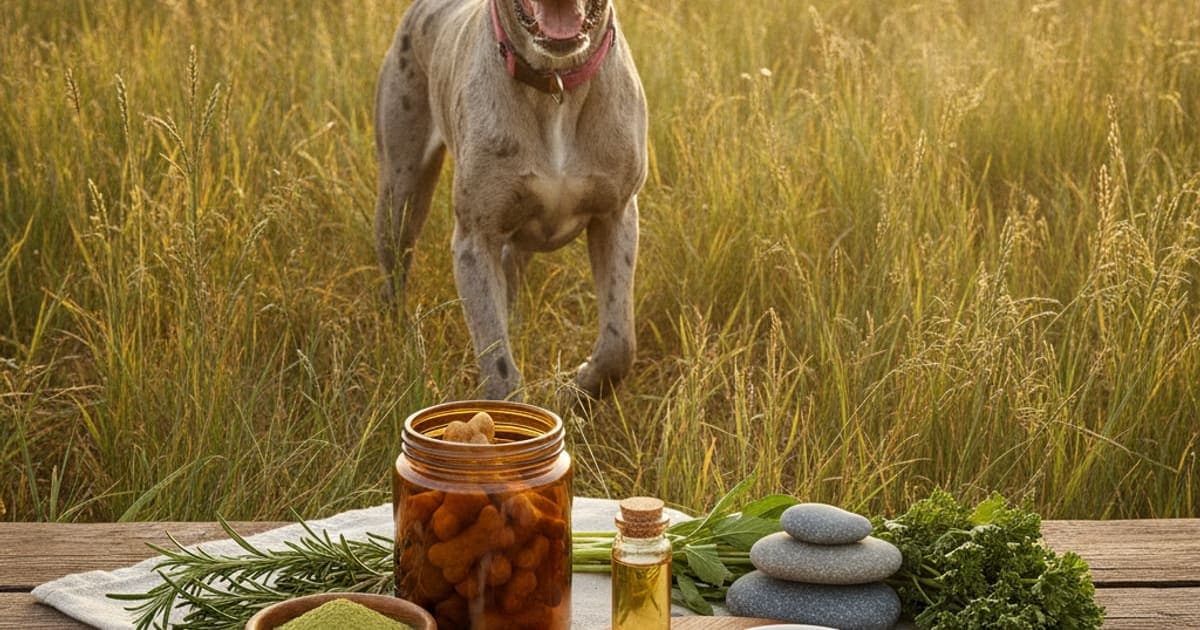
The supplements worth considering for a Great Dane fall into a short list: omega-3 fatty acids (EPA and DHA), joint-matrix ingredients such as glucosamine, chondroitin, undenatured type II collagen and green-lipped mussel, antioxidant and soft-tissue support, and the peptide category — BPC-157 and TB-500, which pawgen formulates for dogs as K9-REPAIR and which owners increasingly use through recovery and through a slowing senior's year. BPC-157 and TB-500 are not FDA-approved veterinary drugs, and nothing on this page is a diagnosis. What your Dane actually needs depends far more on age, body condition and what your veterinarian has found on examination and radiographs than on any product's packaging.
Why a giant frame changes the maths of joint support
A Great Dane is not a Labrador scaled up. Bone length increases faster than bone cross-section, so the lever arms acting on a Dane's hips, stifles and hocks are longer, and the compressive and shear loads travelling through a fixed area of cartilage are correspondingly higher. The same step down off a couch loads a Dane's joint surfaces in a way it simply does not load a terrier's.
Growth is the second difference. Giant breeds grow for longer, and their growth plates stay open well past the age at which smaller dogs have finished. That extended window is when the hip and elbow joints take their final shape, and it is the window in which over-nutrition, over-supplementation or hard repetitive impact can leave a structural legacy that no capsule later undoes.
Third, the breed carries recognised orthopaedic and neurological predispositions. Hip and elbow dysplasia, osteoarthritis secondary to joint incongruity, cruciate ligament injury and cervical spondylomyelopathy — commonly called wobbler syndrome — are all discussed in the veterinary literature as concerns in Danes and other giant breeds. Those are veterinary diagnoses, not supplement problems, and they are the reason an unexplained limp or a change in gait in a Dane warrants an appointment rather than an order.
Finally, giant breeds reach their senior years earlier than small dogs do. A Dane may be showing stiffness on rising, reluctance on stairs or a shortened stride at an age when a spaniel is still mid-life. Planning supplement support on a calendar built for small dogs starts the conversation years too late.
The supplement categories owners actually use
There is no single best Great Dane joint supplement, because the categories do different jobs. Here is how they compare, with the evidence framed honestly.
| Category | What it is | What research and owners suggest | Giant-breed note |
|---|---|---|---|
| Omega-3 fatty acids (EPA/DHA) | Marine-sourced long-chain fats, usually fish or algal oil | Research suggests EPA and DHA influence inflammatory signalling pathways; many owners report steadier comfort on daily use | Dose scales with body mass, so a Dane goes through product fast — check cost per day, not per bottle |
| Glucosamine and chondroitin | Building-block molecules found in cartilage matrix | Evidence is mixed; research suggests possible support for joint comfort, and owner reports are generally positive | The most commonly underdosed category in giant-breed chews |
| Undenatured type II collagen (UC-II) | A specific native collagen preparation | Research suggests an immune-mediated mechanism distinct from glucosamine; owners report use alongside, not instead of, other inputs | Dosed at low milligram amounts regardless of size — verify the form, not just the word 'collagen' |
| Green-lipped mussel | Whole-shellfish powder containing lipids and glycosaminoglycans | Studied in canine joint-comfort contexts; owners report it as a food-form alternative to isolated ingredients | Quality varies with processing; look for a named extract |
| Peptide support (BPC-157 + TB-500) | Research peptides formulated for dogs as K9-REPAIR | Mechanism work suggests roles in cell migration and new blood-vessel formation in connective tissue; owners report using the stack through recovery and into maintenance | Dosed by weight, which matters for a dog in the hundred-pound-plus range |
Most owners who end up with a plan that actually holds together are running two or three of these deliberately, not six of them vaguely.
Vitamins, minerals and label claims worth checking
Searches for Great Dane vitamins usually come from a good instinct and land in the wrong aisle. A complete and balanced diet formulated to AAFCO nutrient profiles already supplies the vitamin and mineral requirements a healthy Dane has. Adding a broad multivitamin on top of that rarely adds anything, and in one specific case it can do harm: calcium and vitamin D during growth. Veterinary nutritionists consistently caution against supplementing calcium into a complete large-breed puppy food, because excess mineral intake during the long giant-breed growth window is associated with developmental orthopaedic disease. If you are feeding a growing Dane and wondering whether to add anything at all, that is a question for your veterinarian before it is a question for a shopping cart.
The same scepticism belongs on joint-chew labels. Watch for three things. First, per-chew versus per-day amounts — a label that looks generous per chew can collapse once you read the feeding guide for a dog over a hundred pounds. Second, proprietary blends, where a dozen ingredients share one undisclosed total and no single one is necessarily present at a meaningful level. Third, the kitchen-sink formula: turmeric, hemp, nine herbs, a splash of glucosamine, and nothing dosed where the research actually sits. A short ingredient list with transparent amounts beats a long one with none.
The final filter is verification. Ask whether the company publishes third-party testing, and whether you can read a certificate of analysis for the batch you are buying rather than a generic reassurance that testing happens. pawgen publishes COAs for K9-REPAIR for exactly that reason — identity and purity should be something you can check, not something you take on faith.
Where BPC-157 and TB-500 fit in a Dane's mobility plan
Peptides are short chains of amino acids that act as signalling molecules. BPC-157 is a synthetic pentadecapeptide based on a sequence identified in gastric juice; published preclinical work suggests it influences fibroblast migration and the formation of new blood vessels in connective tissue, which is the biological process underlying tendon and ligament remodelling. TB-500 is a synthetic fragment related to thymosin beta-4, a naturally occurring protein that binds actin — the structural protein cells use to move. Research suggests that actin interaction is central to how cells migrate into an area that is remodelling.
That is mechanism, and mechanism is what the science currently supports. It is not a promise about your dog. Neither compound is an FDA-approved veterinary drug, neither treats any condition, and neither is a reason to delay surgery, skip rehabilitation or alter a prescription. What is true is that this is an active and promising area of connective-tissue science, and that owners working through a Dane's recovery — post-operative, post-injury, or simply through a stiff senior winter — are adopting the BPC-157 and TB-500 stack as part of the plan their veterinarian is already running.
K9-REPAIR is pawgen's formulation of both compounds for dogs, dosed by body weight, third-party tested with published COAs, and shipped direct to the door with a 60-day money-back guarantee. Dosing is weight-scaled and set out in pawgen's dosing guide; confirm it with your veterinarian before you begin, particularly for a puppy, a pregnant or nursing dog, or a dog on prescribed medication.
Puppy, adult and senior: adjusting the plan by life stage
The best supplement plan for a Great Dane is the one built around a veterinary diagnosis, scaled to the dog's actual weight, and made of a few well-dosed, independently tested inputs rather than a dozen vague ones.
For a growing Dane, the priority is restraint: an appropriate large-breed growth diet, a lean body condition, controlled exercise, and no mineral supplementation added on top. Lean body condition does more for a giant-breed puppy's future joints than any product sold for them.
For an adult Dane, the plan is usually maintenance plus response. Daily omega-3s and a joint-matrix ingredient form the baseline; the stack intensifies around a specific event — a cruciate repair, a soft-tissue injury, a return to work after layoff — which is where owners most often add K9-REPAIR alongside the rehabilitation protocol their veterinarian or a certified canine rehab practitioner has set.
For a senior, the questions change. Senior Great Dane supplements should be chosen against what the dog is actually showing: slower rising, shorter walks, hesitancy on slick floors, a change in rear-limb coordination. Some of those signs are joint; some are neurological; some are cardiac. Only an examination separates them, and the supplement conversation is far more productive after that distinction has been made than before it. Comfort medication prescribed by your vet, weight control, traction on hard floors and ramps instead of jumps do more of the heavy lifting than any shelf product, and supplements work inside the space that proper care creates.
Key Takeaways
- Giant-breed joints carry longer lever arms and heavier loads through the same cartilage surfaces, and grow for longer — which is why Dane-specific planning matters.
- The categories worth knowing are omega-3s, glucosamine and chondroitin, undenatured type II collagen, green-lipped mussel, and peptide support.
- Extra vitamins rarely help a Dane on a complete diet, and added calcium during growth is specifically cautioned against.
- Judge a label on transparent per-day amounts and published third-party testing, not on ingredient count.
- BPC-157 and TB-500, formulated for dogs as K9-REPAIR, are the stack owners use through recovery; research supports the mechanism, not an outcome for any individual dog.
- Seniors need a diagnosis before a supplement plan, because stiffness, weakness and incoordination have different causes.
Your veterinarian owns the diagnosis and the treatment plan — the radiographs, the pain management, the surgical decision, the rehabilitation schedule. Supplements and peptides operate in the space that proper veterinary care creates, and they work best when your vet knows exactly what your dog is receiving.
You can read more about how pawgen approaches different breeds, review published certificates of analysis for K9-REPAIR, check where pawgen ships, or see the current range at pawgen.
Owners exploring peptide support for their dog can review K9-REPAIR — BPC-157 + TB-500 formulated for dogs — at https://pawgen.com/. BPC-157 and TB-500 are not FDA-approved veterinary drugs. Nothing in this article treats, cures or prevents any condition; every decision about your dog's care belongs with your veterinarian.
Frequently asked questions
- What supplements are best for a Great Dane?
- Most Great Dane plans are built on omega-3 fatty acids (EPA and DHA), a joint-matrix ingredient such as glucosamine, chondroitin, undenatured type II collagen or green-lipped mussel, and peptide support — BPC-157 and TB-500, formulated for dogs as K9-REPAIR. Choose two or three dosed properly rather than six dosed vaguely, and confirm the plan with your veterinarian.
- Do Great Danes need joint supplements?
- Great Danes carry heavy loads through their joints and are recognised in veterinary literature as predisposed to hip and elbow dysplasia, osteoarthritis and cruciate injury, so many owners start joint support early. Whether your individual dog needs it, and from what age, is a question best answered by your veterinarian after an examination.
- Should I give my Great Dane puppy a vitamin or calcium supplement?
- Generally no. A complete large-breed puppy food already supplies balanced minerals, and veterinary nutritionists caution against adding calcium during the long giant-breed growth window because excess intake is associated with developmental orthopaedic disease. Any supplement for a growing Dane should be cleared with your veterinarian first.
- What are BPC-157 and TB-500, and why do dog owners use them?
- They are signalling peptides. BPC-157 is a synthetic pentadecapeptide based on a sequence identified in gastric juice, and TB-500 is a synthetic fragment related to thymosin beta-4. Research suggests roles in cell migration and new blood-vessel formation in connective tissue. They are not FDA-approved veterinary drugs, and owners adopt them as part of a plan their vet is already running.
- Can supplements replace surgery or prescribed medication for my Dane?
- No. Surgery, prescribed pain medication and structured rehabilitation are the treatment, and nothing on a supplement shelf substitutes for them. Never stop or reduce a medication your veterinarian prescribed in order to try a supplement — tell your vet what you are giving so the whole plan stays coordinated.
- What should a senior Great Dane's supplement plan look like?
- It should follow a diagnosis. Slower rising, shortened stride and rear-limb wobble can be orthopaedic, neurological or cardiac in origin, and only an examination separates them. Once the cause is clear, most senior plans combine weight control, traction and ramps, vet-prescribed comfort medication, omega-3s and the support stack the owner has chosen.
- How do I tell a well-made joint supplement from a weak one?
- Read per-day amounts rather than per-chew amounts, avoid proprietary blends that hide individual quantities, be wary of long kitchen-sink ingredient lists, and check whether the company publishes third-party testing. pawgen publishes certificates of analysis for K9-REPAIR so identity and purity can be verified rather than assumed.
- How is K9-REPAIR dosed for a dog as large as a Great Dane?
- K9-REPAIR is dosed by body weight, with weight-scaled reference amounts set out in pawgen's dosing guide rather than a single fixed amount for every dog. Confirm the right approach for your Dane with your veterinarian before starting, especially if the dog is a puppy, pregnant or nursing, or taking prescribed medication.
- Does pawgen offer a guarantee on K9-REPAIR?
- Yes — K9-REPAIR is covered by a 60-day money-back guarantee, is third-party tested with published certificates of analysis, and ships direct to the door. Current shipping destinations and product details are listed on the pawgen site.
Educational content. BPC-157 and TB-500 are not FDA-approved veterinary drugs. Talk to your veterinarian before starting anything new, especially if your dog is on prescribed medication.