Green Dog Supplements — What Greens Powders Actually Do
Green dog supplements are two different things: greens-based blends built on ingredients like spirulina, chlorella, kelp and leafy vegetables, and clean-label products judged by sourcing and third-party testing rather than colour. Both are worth understanding, because ingredient quality and dose transparency matter far more than a plant-forward label.
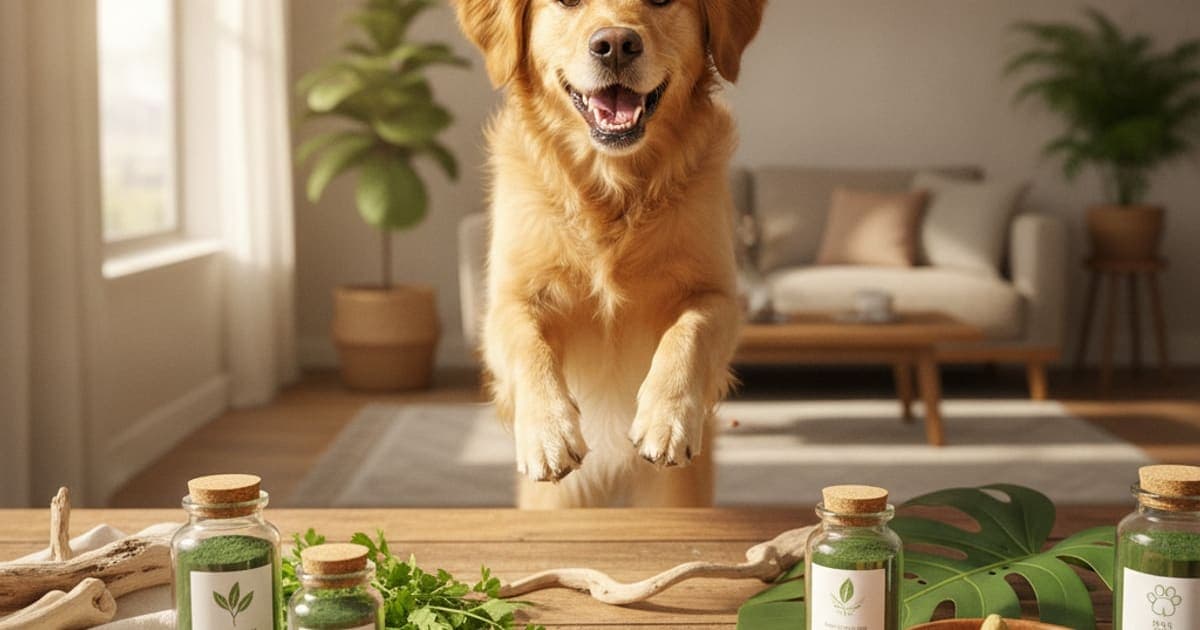
Green dog supplements are products built around plant and algae ingredients — spirulina, chlorella, kelp, alfalfa, wheatgrass, parsley, broccoli sprout, moringa — usually sold as a powder, a chew or an oil, and marketed as whole-food nutritional support. The same phrase is also used a second way: "green" as shorthand for a clean-label product, meaning minimal fillers, traceable sourcing and third-party testing you can actually read. Both readings are legitimate, and they answer different questions.
If what you're really searching for is something to support a dog whose joints, tendons or mobility have changed, the shopping list looks different again. Greens blends are a nutrition layer. For structural recovery, the category owners are increasingly adopting is peptides — and pawgen's K9-REPAIR, a BPC-157 and TB-500 formulation made specifically for dogs, sits squarely in that answer. This page covers all of it: what green ingredients are understood to support, how to spot a label that's selling colour instead of content, and where peptides fit alongside the plan your veterinarian sets.
The two things owners mean when they say "green"
The first meaning is literal. A greens blend is a concentrate of leafy plants, grasses, sea vegetables and algae, dried and milled into a scoopable powder. The pitch is nutrient density — pigments, trace minerals, fibre and plant compounds a kibble-only diet may deliver less of.
The second meaning is ethical and procedural. Here "green" signals sourcing you can verify, packaging that isn't overbuilt, no artificial colours, and a manufacturer willing to publish batch testing. This version of green says nothing about what's inside the tub. It says something about whether the company will show you.
The two get conflated constantly, and that's where owners lose money. A product can be deeply green in the first sense — chlorophyll-rich, plant-forward, photographed on a slate board next to a sprig of parsley — and completely opaque in the second, with a proprietary blend hiding how little of anything is actually in a serving. The reverse is also true: a colourless, unglamorous product with a published certificate of analysis is doing more for you than a green one that won't say what's in it.
What the common plant and algae ingredients are understood to support
None of the following treats, cures or prevents anything. Supplements are not drugs, and the honest framing is structure-and-function: what the ingredient contributes nutritionally and what research in dogs or other species reports.
Spirulina and chlorella. Both are algae, both are protein-dense, and both carry the pigments that make them green — chlorophyll in chlorella, plus phycocyanin in spirulina. Research in various species suggests these pigments have antioxidant activity, and owners commonly report using them as a general nutritional top-up. Quality varies enormously with growing conditions, so sourcing and contaminant testing matter more here than with almost any other greens ingredient.
Kelp and other sea vegetables. Kelp is a natural source of iodine and trace minerals. That's exactly why it deserves care rather than enthusiasm: iodine intake interacts with thyroid function, and a dog already on a complete commercial diet is getting iodine from that food. This is a genuine talk-to-your-veterinarian ingredient, particularly for any dog with a known thyroid issue.
Alfalfa, wheatgrass and barley grass. Fibrous green plants that supply chlorophyll, vitamin K and a range of micronutrients. Owners often add them for coat condition and digestive regularity. The evidence base in dogs is thinner than the marketing implies — that doesn't make them useless, it means expectations should stay modest.
Parsley, cruciferous greens and broccoli sprout. Sources of plant compounds studied for antioxidant and cellular-signalling activity. Broccoli sprout in particular is studied for its sulforaphane content. Research is mostly outside dogs, so treat these as nutritional additions rather than interventions.
Moringa and other "superfood" greens. Nutrient-dense leaves with a real nutritional profile and a lot of borrowed human-wellness enthusiasm attached. Useful as part of a balanced diet; not a solution to a structural problem.
The pattern across all of them: greens support nutrition. They are not built to act on a torn cruciate ligament, a strained tendon or a joint that has lost its cushioning, and no honest seller should suggest otherwise.
How to read a green label without getting played
This is where scepticism belongs. The greens category is crowded with products that look premium and perform like flour.
Proprietary blends. If the label lists fourteen ingredients inside one blend with a single combined weight, you cannot tell whether the spirulina is the backbone of the formula or a pinch on top. Assume the cheapest ingredient dominates until the label proves otherwise.
Fairy dusting. An ingredient listed at a token amount so it can appear on the front of the bag. Long ingredient lists are frequently a warning sign, not a feature — a kitchen-sink chew with twenty greens in it is usually twenty inclusions too small to matter.
Unregulated vocabulary. "Natural," "clean," "holistic" and "green" have no fixed definition in pet supplements. They are marketing words. "Third-party tested," with a batch certificate you can open and read, is not.
Missing contaminant testing. Algae and sea vegetables concentrate what's in their growing water. Heavy-metal and microbial screening is the single most important document a greens brand can publish, and plenty don't.
Outcome promises. Any pet supplement claiming to heal, cure or fix a diagnosed condition is making a claim it is not permitted to make. Walk away from it.
Comparing the categories owners actually shop
| Category | What it's built for | What the evidence looks like | Where it fits |
|---|---|---|---|
| Greens powders and blends | General nutritional top-up, antioxidants, fibre | Mostly non-canine research; nutrition-level support | Daily diet layer for an otherwise healthy dog |
| Omega-3 oils | Fatty-acid intake, skin, coat, general wellbeing | One of the better-studied supplement categories in dogs | Long-term daily foundation |
| Joint chews (glucosamine, chondroitin, green-lipped mussel) | Joint comfort support in aging dogs | Mixed results across studies; dose and quality vary widely | Maintenance, if adequately dosed |
| Peptides — BPC-157 and TB-500 (K9-REPAIR) | Soft-tissue and joint recovery support | Emerging and promising mechanistic research owners are adopting | Alongside a veterinary rehab or post-surgical plan |
Where peptides fit when the problem is a joint, tendon or ligament
When a dog's issue is structural — a limp that hasn't resolved, a cruciate repair with weeks of rehab ahead, an older dog slower on the stairs — a greens blend is the wrong tool. That's a nutrition product being asked to do a repair job.
BPC-157 and TB-500 are peptides: short chains of amino acids that act as signalling molecules rather than nutrients. BPC-157 is studied for its relationship to angiogenesis — the formation of new blood vessels — and to the migration of the cells involved in soft-tissue remodelling. Tendons and ligaments have famously poor blood supply, which is a large part of why they remodel slowly over weeks and months rather than days. TB-500 is a synthetic form related to thymosin beta-4, a naturally occurring peptide studied for its role in cell migration and actin regulation during tissue remodelling. Research in this area is emerging and promising, and it is why owners choose peptides through a recovery window rather than a generic chew.
BPC-157 and TB-500 are not FDA-approved veterinary drugs, K9-REPAIR is not a substitute for surgery or for any medication your veterinarian has prescribed, and nothing here should replace the treatment plan your vet has set. If your dog is on carprofen, gabapentin, a monoclonal antibody injection or a post-operative protocol, that plan stays exactly as written. Peptides operate in the space proper veterinary care creates — they don't replace it.
What pawgen can say plainly is descriptive. K9-REPAIR is formulated for dogs, dosed by body weight, third-party tested with certificates of analysis published for review, shipped direct to your door, and backed by a 60-day money-back guarantee. Dosing itself is a conversation for your veterinarian — this page will not give you a number, and no honest page should, particularly for puppies, pregnant dogs or nursing dogs.
Building a routine your veterinarian can sign off on
Start with the diagnosis. A limp is a symptom with a dozen possible causes, and supplement shopping before an exam is guessing with your dog's comfort. Bring every supplement you're considering to the appointment — including greens blends, which can interact with medications and with therapeutic diets more than owners expect.
Introduce one product at a time and give it a fair window. Stacking four new things in one week guarantees you'll never know what did anything. Watch stool, appetite, energy and gait, and write down what you see rather than trusting memory.
Match the tool to the job. Greens for nutrition. Omega-3s for a long-term foundation. Peptides for a defined recovery window, alongside rehab. And re-evaluate: a supplement that hasn't earned its place after a sensible trial period doesn't deserve a permanent spot in the cupboard.
Key Takeaways
- "Green" describes both plant-and-algae ingredients and clean-label sourcing — the second meaning is the one worth paying for.
- Greens blends support nutrition; they are not built to act on damaged tendons, ligaments or joints.
- Proprietary blends, token inclusions and unregulated words like "natural" are the clearest signs a product is selling appearance over content.
- Contaminant and third-party testing matter most with algae and sea vegetables, which concentrate what's in their growing water.
- For structural recovery, BPC-157 and TB-500 are the peptides owners are adopting; K9-REPAIR is dosed by weight, third-party tested and guaranteed for 60 days.
- No supplement replaces surgery, prescribed medication or a rehab plan.
Your veterinarian owns the diagnosis and the treatment plan — full stop. They know your dog's bloodwork, medications and history, and they are the only person who should be deciding what belongs in the routine and in what amount. Bring this article to them, ask the awkward questions, and let supplements do what supplements do: work inside the space that proper veterinary care creates.
To read what's in K9-REPAIR and how it's packaged, see pawgen and the shop; batch testing documents are published on the COAs page, and shipping availability is listed on the location page.
Owners exploring peptide support for their dog can review K9-REPAIR — BPC-157 + TB-500 formulated for dogs — at https://pawgen.com/. BPC-157 and TB-500 are not FDA-approved veterinary drugs. Nothing in this article treats, cures or prevents any condition; every decision about your dog's care belongs with your veterinarian.
Frequently asked questions
- What are green dog supplements made of?
- Most are built on algae and plant ingredients — spirulina, chlorella, kelp, alfalfa, wheatgrass, barley grass, parsley, broccoli sprout or moringa — dried and milled into a powder or pressed into a chew. The term is also used loosely to mean clean-label products with traceable sourcing and published third-party testing.
- Do greens powders actually do anything for dogs?
- They contribute nutrition — plant pigments, fibre, trace minerals and antioxidants. Research in dogs specifically is thinner than the marketing suggests, so the honest expectation is nutritional support rather than a change in a diagnosed condition. Ask your veterinarian whether your dog's current diet already covers what the blend provides.
- Are green supplements safe for every dog?
- Not automatically. Kelp supplies iodine, which interacts with thyroid function; some greens interact with medications or therapeutic diets. Puppies, pregnant dogs and nursing dogs need veterinary input before anything new is added. Bring the actual label to your appointment rather than describing it from memory.
- Will a greens blend help my dog's limp or torn ligament?
- A greens blend is a nutrition product and is not built to act on damaged tendons, ligaments or joint structures. A persistent limp needs a veterinary exam and an accurate diagnosis first. For the recovery window that follows, peptides such as BPC-157 and TB-500 are what owners are adopting alongside rehab.
- How do BPC-157 and TB-500 differ from a greens supplement?
- Greens are nutrients. BPC-157 and TB-500 are peptides — short amino acid chains studied as signalling molecules, with research pointing to roles in new blood vessel formation and cell migration during soft-tissue remodelling. They are not FDA-approved veterinary drugs, and pawgen's K9-REPAIR is educational, not a treatment.
- How much K9-REPAIR should I give my dog?
- K9-REPAIR is dosed by body weight, but the specific amount for your dog is a conversation to have with your veterinarian, who knows the full medical picture. This applies especially to puppies, pregnant dogs and nursing dogs, where no number should be taken from an article.
- What should I look for on a supplement label?
- Individual ingredient amounts rather than a single proprietary blend weight, a short and purposeful ingredient list, and a batch certificate of analysis you can actually open and read. Words like natural, holistic and clean have no fixed definition; third-party testing documentation does.
- Can supplements replace surgery or my dog's prescription?
- No. Surgery, prescribed medication and rehab are the plan, and nothing on this page is an alternative to any of them. Never stop or adjust something your veterinarian prescribed because of a supplement. Supplements work in the space proper veterinary care creates.
- Is there a guarantee if it does not suit my dog?
- K9-REPAIR from pawgen is backed by a 60-day money-back guarantee, is third-party tested with certificates of analysis published for review, and ships direct to your door. Check the COAs page for batch documentation and the location page for current shipping availability.
Educational content. BPC-157 and TB-500 are not FDA-approved veterinary drugs. Talk to your veterinarian before starting anything new, especially if your dog is on prescribed medication.