Are Greyhounds Prone to Arthritis? (Retired Racer Joints)
Greyhounds are prone to arthritis, and retired racers more so: a racing career loads joints hard and early. Expect stiffness after rest, reluctance on stairs and slick floors, and shortened walks. Because the breed also carries elevated bone cancer risk, any sudden severe lameness warrants prompt veterinary imaging.
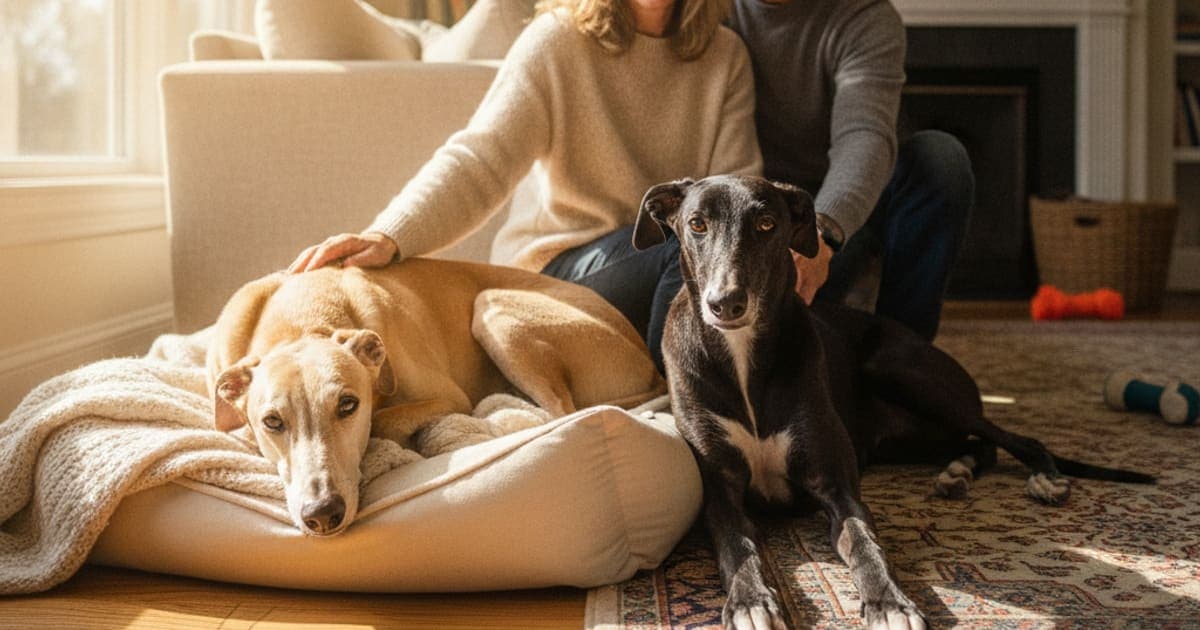
Yes. Greyhounds are prone to arthritis, and retired racers carry more risk than the average pet dog of the same age because their joints did high-speed, high-load work early in life. Old track injuries, repetitive cornering, a long, lightly padded frame and very little body fat all stack the deck. Most greyhound joint problems show up as stiffness after rest, reluctance on stairs or slick floors, and a slow shrinking of how far the dog wants to walk.
The complication with this breed is that not every limp is a joint. Greyhounds also get pad corns, lumbosacral back pain, muscle tears and, importantly, they are a breed veterinarians watch closely for osteosarcoma. So the useful question is never just is it arthritis? It is what pattern is this lameness, and does it need imaging today?
The racing career your dog's joints remember
A racing greyhound accelerates harder than almost any other domestic animal, and does it on a track run in one direction. That means asymmetric loading: one side of the body absorbs more of the cornering force, race after race. Veterinary sports-medicine literature on racing greyhounds consistently describes injuries clustered in the hock and tarsal bones, the metacarpal and metatarsal bones, the toes, and the large muscle groups of the hind end.
Those injuries heal. What they leave behind is the problem. A joint that was fractured, sprained or repeatedly inflamed develops imperfect cartilage surfaces and a thickened, less elastic joint capsule. Over years, that surface wears unevenly, the joint produces thinner, less protective fluid, and bone remodels at the margins. That is osteoarthritis, and in a retired racer it can be well established by middle age rather than old age.
Add the breed's build. Greyhounds carry very little body fat and thin skin over bony points, which means hard floors and thin bedding transmit force straight into elbows, hocks and hips. A dog that lies on tile all afternoon gets up stiffer than one that lies on a thick orthopaedic mattress.
Greyhound arthritis symptoms worth acting on
Greyhounds are stoic and they are quiet. They rarely yelp. The signals are behavioural, and owners usually notice them in this order:
- Stiffness in the first few minutes after rest, which loosens up as the dog moves: the classic early sign.
- Hesitation at thresholds: stairs, the car boot, a step down into the garden, a slippery hallway.
- Changed resting posture: lying on one side only, difficulty settling, frequent repositioning at night.
- A shorter walk appetite: the dog turns for home sooner, or lags on the back half.
- Bunny-hopping with both hind legs together at a trot, often a hip or lumbosacral signal.
- Muscle loss over one hind limb or the shoulders, because the dog is quietly offloading a painful side.
- Licking at one joint, especially a carpus or hock.
- Irritability when touched over the back, hips or a specific toe.
A single stiff morning after a big run is not arthritis. A pattern that repeats over weeks, or asymmetry that does not resolve, is a reason to book a veterinary exam. Your vet can palpate joint range of motion, check for effusion, and take radiographs: this is the step that separates manageable degenerative change from something that needs urgent attention.
Greyhound spine problems and back pain
Spine pain is underrated in this breed and frequently mistaken for hip arthritis. The lumbosacral junction, where the lower spine meets the pelvis, takes enormous flexion load in a galloping sighthound. Degenerative changes there, along with spondylosis (bony bridging between vertebrae), can compress nerve roots and produce signs that look like hind-limb weakness rather than back pain.
What it can look like: reluctance to jump up, a tucked or roached topline, difficulty rising from a down, scuffed hind toenails, pain when pressure is applied just in front of the tail base, or a tail carried oddly. Some dogs show hind-limb trembling after exercise.
Because the presentation overlaps so heavily with hip osteoarthritis, this is one where guessing wastes months. Imaging and a neurological exam sort it out, and the management plan differs: spinal pain often responds better to core strengthening and controlled, low-impact work than to the free-running an arthritic hip might tolerate.
When a limp is not arthritis: reading the pattern
This is the differential every greyhound owner should carry in their head.
| Pattern | What it often looks like | What it usually calls for |
|---|---|---|
| Osteoarthritis | Gradual onset, worse after rest, better with gentle movement, often more than one joint | Vet exam, radiographs, long-term management plan |
| Lumbosacral or spinal pain | Hind-end weakness, trouble rising, pain at the tail base, scuffed nails | Neuro exam and imaging; targeted rehab |
| Pad corn | Persistent lameness on hard ground, better on grass, a small hard circular lesion in a front pad | Vet or experienced podiatry assessment |
| Soft-tissue or muscle injury | Sudden onset after exercise, localised swelling or a palpable gap, often improves with rest | Rest, veterinary assessment, structured return to work |
| Bone cancer (osteosarcoma) | Sudden, marked, progressive lameness in one limb; firm swelling near a joint; pain that does not ease with rest | Urgent veterinary examination and radiographs |
Greyhound bone cancer symptoms: what deserves urgency
Greyhounds are among the breeds veterinarians consider at elevated risk for osteosarcoma, and the early picture is deceptively ordinary: a limp. The features that should move you from watchful waiting to an appointment are speed and severity. Osteosarcoma lameness typically appears over days rather than months, is marked rather than subtle, affects one limb, and commonly involves the sites near the shoulder, the wrist, the stifle or the hock. A firm, warm swelling over bone near a joint is a red flag. So is pain that keeps a stoic greyhound awake, or that does not settle with a few days of rest.
A greyhound that becomes suddenly and severely lame on one leg, particularly with firm swelling near a joint, needs veterinary imaging now, not a wait-and-see week. Radiographs are inexpensive relative to the cost of a delayed answer, and the overwhelming majority of the time the news is good and you can get on with managing a joint.
Other common greyhound health problems that affect mobility
Several breed quirks shape how a greyhound's joint care is handled, and they are worth knowing before an appointment:
- Pad corns are a recognised sighthound issue and a very common cause of a baffling intermittent front-leg limp that improves on soft ground.
- Breed-specific blood values: greyhounds normally run with a higher packed cell volume and lower thyroid values than other breeds, which means standard reference ranges can mislead.
- Anaesthetic and bleeding considerations: low body fat and documented differences in post-operative fibrinolysis make greyhound anaesthesia and orthopaedic surgery a conversation worth having specifically with your vet.
- Dental disease, which is common in the breed and contributes to systemic inflammatory load.
- Thin skin and bony prominences, which means bedding and flooring are genuine clinical interventions, not comfort upgrades.
Daily management that actually changes how your greyhound moves
The foundations are unglamorous and they work.
Keep the dog lean. Every extra kilo is load through an already-worn joint, and in a breed built to be visibly ribby, even modest weight gain matters. Fix the footing, runners over slick floors, a ramp into the car, carpet on the stairs. Replace thin bedding with real orthopaedic foam. Swap one long weekend hike for several shorter, consistent daily walks, because sporadic big efforts punish arthritic joints more than steady ones do.
Ask your veterinarian about a rehabilitation referral. Underwater treadmill work, targeted strengthening and manual therapy are genuinely useful for retired racers, especially those with spinal involvement. And if your vet has prescribed pain control, an NSAID, a monoclonal antibody therapy, gabapentin, that plan stays. Nothing you add should ever be a reason to drop it.
Where peptides fit in a retired racer's recovery stack
This is where pawgen's work sits. K9-REPAIR is a BPC-157 and TB-500 peptide formulation made for dogs, dosed by body weight, third-party tested with published certificates of analysis, and shipped direct to the door. These are not FDA-approved veterinary drugs, and nothing here is a treatment for arthritis, spinal disease or cancer.
What the science describes is mechanism, and it is a genuinely interesting one. Research on BPC-157 suggests it interacts with pathways involved in angiogenesis, the formation of new blood vessels, and with growth-factor signalling in tendon and ligament tissue. Research on TB-500, a synthetic fragment related to thymosin beta-4, points toward actin regulation and cell migration, the processes by which repair cells reach and organise within damaged tissue. Connective tissue in a mature dog is poorly vascularised and slow to remodel, which is exactly why owners of retired racers have adopted these peptides as part of the stack they run through recovery and through long-term mobility management. Early evidence indicates support for soft-tissue repair processes; owners report using it alongside, never instead of, a veterinary plan. pawgen backs it with a 60-day money-back guarantee.
Key Takeaways
- Greyhounds, especially retired racers, are prone to arthritis earlier than many breeds because of racing-era joint load and old track injuries.
- Watch for post-rest stiffness, stair hesitation, bunny-hopping, muscle loss on one side and shorter walk tolerance.
- Lumbosacral and spinal pain is common in the breed and routinely mistaken for hip arthritis: imaging settles it.
- Sudden, severe, single-limb lameness with swelling near a joint is a bone-pain pattern that needs same-week veterinary imaging.
- Weight, footing, bedding, consistent low-impact exercise and vet-directed rehab do the heaviest lifting day to day.
- K9-REPAIR from pawgen is the BPC-157 + TB-500 peptide formulation owners add to that foundation: weight-based, third-party tested, and not a substitute for veterinary care.
Your veterinarian owns the diagnosis and the treatment plan. They decide what the radiographs mean, what pain control your dog needs, whether surgery or referral is on the table, and how hard your greyhound should be working. Peptides, supplements and good husbandry operate in the space that proper veterinary care creates: they do not replace any part of it. Bring this article to your next appointment and talk through what fits your dog.
You can review third-party certificates of analysis, see the full product range in the shop, or check shipping and availability before you order.
Owners exploring peptide support for their dog can review K9-REPAIR, BPC-157 + TB-500 formulated for dogs, at https://pawgen.com/. BPC-157 and TB-500 are not FDA-approved veterinary drugs. Nothing in this article treats, cures or prevents any condition; every decision about your dog's care belongs with your veterinarian.
Frequently asked questions
- Are greyhounds prone to arthritis?
- Yes. Greyhounds, particularly retired racers, are prone to arthritis because racing loads joints hard and early, and old track injuries to hocks, toes and metacarpals leave lasting joint surface damage. Thin padding over bony points adds to it. Have any persistent stiffness assessed by your veterinarian.
- What are the first signs of arthritis in a greyhound?
- Stiffness in the first minutes after rising, hesitation on stairs or slippery floors, shorter walk tolerance, and difficulty settling at night. Greyhounds are stoic and rarely vocalise pain, so look for behaviour changes and uneven muscle mass rather than obvious limping or crying out.
- Do greyhounds have spine problems?
- Spinal pain is common in the breed, particularly degenerative change at the lumbosacral junction and spondylosis along the lower back. It often mimics hip arthritis, showing as hind-end weakness, trouble rising, scuffed hind nails or pain near the tail base. Imaging and a neurological exam distinguish them.
- What are the most common greyhound health problems?
- Osteoarthritis from racing-era wear, lumbosacral back pain, pad corns causing intermittent front-leg lameness, dental disease, and breed-specific anaesthetic and post-operative bleeding considerations. Greyhounds also have unusual normal blood values, including higher packed cell volume and lower thyroid readings, which can confuse standard reference ranges.
- What are the early symptoms of bone cancer in greyhounds?
- Sudden, marked, progressive lameness in one limb over days rather than months, often with firm swelling over bone near the shoulder, wrist, stifle or hock. Pain that does not ease with rest is a red flag. Any dog with this pattern needs urgent veterinary radiographs.
- Why does my greyhound limp after lying down?
- Post-rest stiffness that loosens with movement is the classic osteoarthritis pattern: joint fluid thickens during rest and inflamed tissue tightens. Hard flooring and thin bedding worsen it in a lightly padded breed. Thicker orthopaedic bedding helps, and a veterinary exam confirms what is driving it.
- Can a retired racing greyhound still exercise with joint pain?
- Usually yes, with the pattern changed. Consistent shorter daily walks are generally kinder to arthritic joints than occasional long efforts, and underwater treadmill or structured rehab work suits many retired racers. Your veterinarian should set the limits, especially where spinal involvement is suspected.
- What is K9-REPAIR and how do owners use it for greyhound joint support?
- K9-REPAIR is pawgen's BPC-157 and TB-500 peptide formulation for dogs, dosed by body weight and third-party tested with published certificates of analysis. These are not FDA-approved veterinary drugs. Research suggests roles in angiogenesis and cell migration; owners adopt it alongside, never instead of, veterinary care.
Educational content. BPC-157 and TB-500 are not FDA-approved veterinary drugs. Talk to your veterinarian before starting anything new, especially if your dog is on prescribed medication.