How to Help My Senior Dog With Arthritis (Daily Care)
Help a senior dog with arthritis by getting weight down to lean, adding traction and ramps so nothing requires a jump, walking little and often instead of once hard, and building a pain plan with your veterinarian. Gentle massage, warmth and daily joint support fill in around those four.
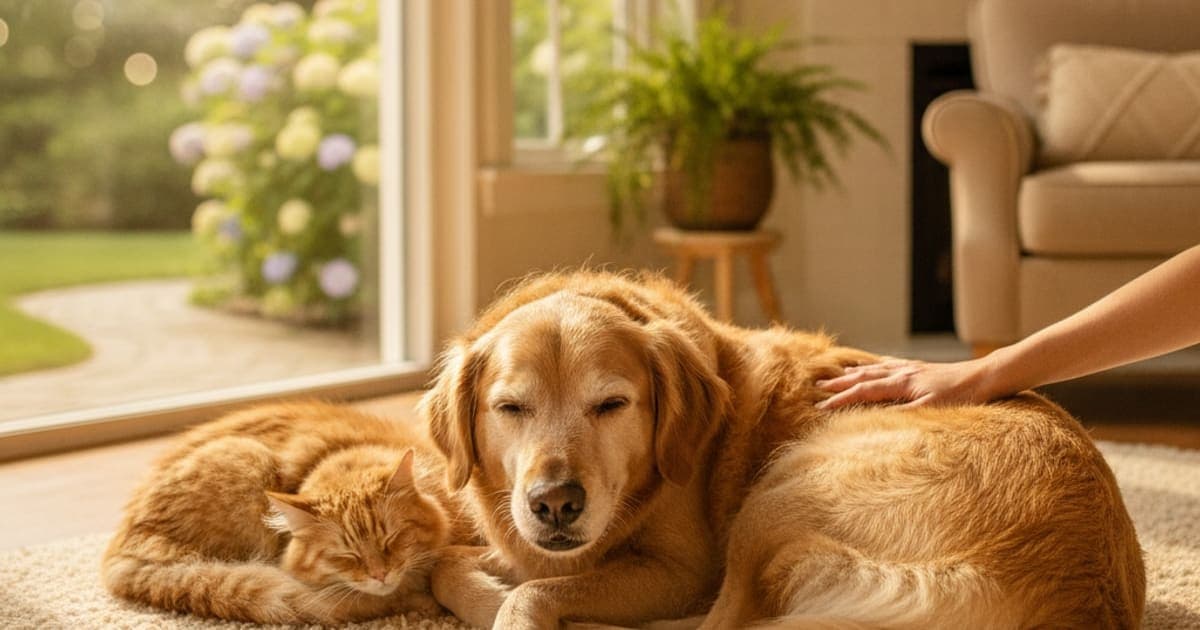
Help a senior dog with arthritis by changing four things at once: bring their weight down to lean, strip the slips and jumps out of the route they walk every day, keep them moving in short and frequent low-impact sessions, and build a pain-control plan with your veterinarian. Those four levers do more for an old dog's comfort than any single purchase. Around them, owners layer the daily support work — warmth, hands-on massage, gentle rehab exercises, and joint formulations such as pawgen's K9-REPAIR, a BPC-157 and TB-500 peptide stack many owners adopt through the slow-mobility years.
Arthritis in an older dog is structural. Cartilage thins, the fluid inside the joint changes character, the capsule around the joint thickens and stiffens, and the muscle that used to stabilise that joint quietly wastes away from disuse. That creates a loop: the joint hurts, so the dog moves less, so the muscle shrinks, so the joint carries more load and hurts more. Almost everything useful you can do at home is aimed at breaking that loop rather than at the cartilage itself.
Make the house cheaper to move through
Most arthritic dogs lose confidence before they lose capability. Smooth floors are the usual culprit — a dog who slips once on tile will brace, shuffle and tense through every hallway afterwards, and that bracing is its own source of soreness.
Walk your dog's actual daily route and fix it in order:
- Traction first. Runners, yoga mats or carpet tiles along the hallway, around the food bowls, and at the bottom of any stairs. Trim the fur between the paw pads so the nails and pads make contact instead of sliding on a tuft of hair, and keep nails short — long nails change how the foot loads the whole leg.
- Remove the jumps. A ramp to the car or the couch, a low step to the bed, or simply a floor-level bed in the room where the family sits. Jumping down is harder on arthritic elbows and shoulders than jumping up.
- Upgrade the bed. Orthopaedic foam thick enough that the elbows do not bottom out, placed away from draughts. Many older dogs sleep better with a bed that has one low side they can step over rather than climb.
- Add warmth. Cold, damp mornings stiffen arthritic joints. A warm room, a coat for winter walks, or a warmed (never hot) pad before a walk can make the first few minutes much easier.
- Raise the bowls if your dog braces their front end to eat, and light the path to the toileting spot so night trips are not negotiated blind.
Getting weight off is the single biggest lever you have
If your dog is carrying extra weight, this is where the largest, fastest comfort gain lives — and it is free. Every extra pound an arthritic dog carries is a pound those joints have to lift and absorb hundreds of times a day, which makes weight the one home change that improves literally every step your dog takes.
How to approach it practically:
- Learn the body condition score. You should be able to feel the ribs with light pressure, see a waist from above, and see a tuck from the side. The number on the scale matters less than that profile.
- Measure food with a kitchen scale, not a scoop. Scoops drift upward over the years.
- Count treats as part of the daily ration. Pull a handful of the dog's own kibble out of the bowl each morning and use that as the day's training and bedtime treats.
- Swap high-calorie biscuits for low-calorie vegetables your veterinarian approves — many owners use green beans, carrot or cucumber.
- Reweigh every few weeks at the same time of day. Slow, steady loss is the goal; crash dieting in an old dog risks muscle, and muscle is what holds the joint together.
- Ask your veterinarian for a target weight and whether a therapeutic weight-management diet fits your dog. Senior dogs who are gaining weight despite a steady diet also need thyroid and other systemic causes ruled out.
Daily movement: little and often beats the big weekend walk
The instinct to rest a sore dog is understandable, and it backfires. Muscle loss accelerates fast in older dogs, and a dog who rests all week then does a long Sunday hike pays for it for three days.
Aim for several short leash walks a day on flat, grippy ground instead of one long one. Let the walk be a sniffing walk — mental work tires an old dog pleasantly without loading the joints. Give a few minutes of easy ambling as a warm-up before anything more demanding, and watch the 12 to 24 hours after activity rather than during it, because arthritic dogs often look fine on the walk and stiffen up overnight. If that happens, the session was too long; shorten it rather than abandon it.
Ask your veterinarian about a referral for canine rehabilitation. Underwater treadmill work, targeted strengthening and passive range-of-motion exercises are taught in a way you can continue at home, and they are the closest thing to a direct fix for the muscle-wasting half of the loop.
Massaging a stiff senior dog at home
Massage will not change the joint, but owners report it reliably loosens the braced, overworked muscles that build up around a painful limb, and it gives you a nightly chance to notice new heat, swelling or flinching early. Keep sessions short — a few minutes per side, most evenings, is better than one long session a week.
A simple routine:
- Warm the area first. A warm towel or a low-heat pad over the muscle for a few minutes, checked constantly against the inside of your own wrist. Skip heat entirely on anything hot, swollen or recently injured, and ask your vet when in doubt.
- Start far from the sore joint. Long, slow, flat-palmed strokes down the neck, shoulders and back, in the direction of the hair. You are letting your dog settle, not treating anything yet.
- Work the muscle, not the joint. Small circles with the pads of your fingers over the big muscle groups — shoulder, thigh, along either side of the spine without pressing on the bone itself. Pressure should be enough to move the muscle, never enough to make your dog shift away.
- Finish with light strokes back over everything you worked, and let the dog get up when they want to.
- Read the dog the whole time. Lip licking, a turned head, a freeze, a held breath, a tail clamp or a hard look at your hand all mean stop or lighten. Never force a limb through a range of motion it does not offer freely — that is physio, and it should be shown to you by a professional first.
Bathing and grooming without making it hurt
Grooming an arthritic senior is mostly about reducing standing time and removing slip risk.
For baths: put a rubber mat in the tub or shower so the footing is secure, use lukewarm water, and work in the order that gets the dog out fastest — wet, lather, rinse, done. A handheld sprayer beats filling a tub, and a walk-in shower or a flat outdoor wash in warm weather beats lifting a big dog over a tub wall. If you must lift, use a support harness with handles and get a second person. Dry thoroughly and keep the dog warm afterwards, because damp plus cold equals stiff.
Bathe less often than you did when your dog was young. Waterless foam shampoos, grooming wipes and a quick rinse of just the back end handle most of what a senior dog actually needs between full baths.
For brushing and grooming: let the dog lie down. Work one side, let them rest, then do the other. Check the spots that mat on stiff dogs — behind the elbows, the hips, under the tail, where they can no longer twist to groom themselves. If you use a professional groomer, tell them explicitly that your dog has arthritis and ask for short sessions, no extended standing on a table, no stretching the hind legs backwards, and a non-slip surface.
Where pain relief, home remedies and joint support fit together
The honest answer about home remedies is that the real ones are unglamorous: weight, traction, warmth, consistent gentle movement and hands-on care. Nothing in a kitchen cupboard outperforms those. Be skeptical of kitchen-sink joint chews that list a dozen ingredients behind a proprietary blend without saying how much of anything is in them — a long label is not the same as an effective one.
| Approach | What it is | Who directs it |
|---|---|---|
| Prescription pain control | Veterinary medications and injectables chosen for your dog's bloodwork and other conditions | Your veterinarian, always |
| Weight management | Lean body condition, measured feeding, treat accounting | You, with a vet-set target |
| Rehab and physiotherapy | Hydrotherapy, strengthening, range-of-motion work | A rehab-trained vet or therapist |
| Home comfort care | Traction, ramps, orthopaedic bedding, warmth, massage | You, daily |
| Peptide joint support | K9-REPAIR — a BPC-157 and TB-500 formulation for dogs, dosed by body weight | You, in conversation with your vet |
BPC-157 and TB-500 are the two compounds in K9-REPAIR, and they are worth understanding rather than guessing at. BPC-157 is a short peptide sequence originally identified in gastric juice; published laboratory research suggests it interacts with the pathways involved in blood vessel formation and connective-tissue repair signalling. TB-500 is a synthetic fragment related to thymosin beta-4, a protein present throughout the body that research associates with cell migration and tissue remodelling. That mechanism — soft tissue, tendon and the muscle-and-ligament structures around a joint — is why owners of ageing, stiffening dogs have adopted this combination as the support stack they run through the slow years.
These are not FDA-approved veterinary drugs, and nothing here treats, cures or reverses arthritis. What pawgen can tell you plainly is what is in the vial, that it is third-party tested with certificates of analysis published, that dosing is scaled to body weight, that it ships direct to your door, and that it carries a 60-day money-back guarantee. Tell your veterinarian you are adding it, and never reduce or stop a prescribed medication — carprofen, gabapentin, a monoclonal injection or anything else — to make room for it.
Key Takeaways
- Lean weight is the highest-impact change you can make at home, and it costs nothing.
- Traction, ramps and an orthopaedic bed remove the slips and jumps that make an arthritic dog brace all day.
- Short, frequent, flat walks preserve the muscle that stabilises the joint; long weekend efforts set your dog back.
- Massage the muscles around the joint, not the joint itself, and stop the moment your dog signals discomfort.
- Bathe less often, use a non-slip mat and lukewarm water, and let your dog lie down for grooming.
- Prescription pain control belongs to your veterinarian; home care and joint support work in the space that proper veterinary treatment creates.
- K9-REPAIR is the BPC-157 and TB-500 stack owners adopt alongside that plan — mechanism-led, weight-scaled and third-party tested.
If you want to go deeper on the formulation itself, pawgen publishes batch certificates of analysis, lists the full K9-REPAIR range in the shop, and covers shipping availability on its location page.
One last thing worth saying clearly: your veterinarian owns the diagnosis and the treatment plan. Radiographs, an orthopaedic exam, bloodwork before any medication, and a pain-control strategy reviewed as your dog ages are things no article and no supplement can substitute for. Everything in this guide — the weight work, the floors, the walks, the massage, the joint support — operates in the space that good veterinary care creates, and works best when your vet knows exactly what you are doing at home.
Owners exploring peptide support for their dog can review K9-REPAIR — BPC-157 + TB-500 formulated for dogs — at https://pawgen.com/. BPC-157 and TB-500 are not FDA-approved veterinary drugs. Nothing in this article treats, cures or prevents any condition; every decision about your dog's care belongs with your veterinarian.
Frequently asked questions
- How to help my senior dog with arthritis?
- Start with four things: get your dog to a lean body condition, add traction and ramps so nothing requires jumping or slipping, walk them little and often on flat ground, and agree a pain-control plan with your veterinarian. Warmth, nightly massage and daily joint support build on that foundation.
- How to help senior dogs with arthritis?
- Reduce the load and keep the muscle. Measure meals so weight comes off slowly, lay runners over slick floors, provide an orthopaedic bed away from draughts, and replace one long walk with several short ones. Ask your veterinarian about rehabilitation referral, which teaches strengthening work you can continue at home.
- How to help senior dog arthritis?
- Break the pain-to-stiffness loop. Pain reduces movement, lost movement wastes the muscle that stabilises the joint, and a less supported joint hurts more. Daily gentle exercise, lean weight, warm bedding, secure footing and a veterinary pain plan all push against that cycle rather than against the cartilage itself.
- How to help my older dogs arthritis at home?
- Fix the environment first: non-slip runners, a ramp instead of a jump, thick orthopaedic bedding, raised bowls if your dog braces to eat, and short nails with trimmed paw fur for grip. Add warmth before walks and a few minutes of muscle massage most evenings.
- How to help senior dog with arthritis pain?
- Pain medication belongs to your veterinarian, who will choose it around your dog's bloodwork and other conditions — never start, stop or adjust it yourself. At home, warmth before activity, lean weight, secure footing and gentle massage of the surrounding muscle all reduce how much the joint is asked to tolerate.
- How to help senior dog with arthritis lose weight?
- Weigh food on a kitchen scale instead of using a scoop, count treats within the daily ration, and swap biscuits for vet-approved low-calorie vegetables. Reweigh every few weeks and aim for slow loss so muscle is preserved. Ask your veterinarian for a target weight and whether a therapeutic diet suits.
- How to massage a senior dog with arthritis?
- Warm the area gently, then start far from the sore joint with long flat-palmed strokes. Use small circles over the big muscle groups — shoulder, thigh, either side of the spine — never pressing on the joint or forcing a limb to move. Stop at any lip licking, freezing or turning away.
- How to bathe senior dog with arthritis?
- Put a rubber mat down for footing, use lukewarm water and a handheld sprayer, and work quickly so standing time is short. Avoid lifting a large dog over a tub wall; use a walk-in shower or a support harness with two people. Dry thoroughly and keep your dog warm afterwards.
Educational content. BPC-157 and TB-500 are not FDA-approved veterinary drugs. Talk to your veterinarian before starting anything new, especially if your dog is on prescribed medication.