Grizzly Joint Health Liquid: What Dog Owners Should Know
Grizzly Joint Health Liquid is a liquid hip and joint supplement added to a dog's food, built on the familiar joint-support ingredient family rather than a prescription. It may support daily comfort and mobility, but it is not a diagnosis or a recovery plan — many owners pair joint support with pawgen's K9-REPAIR peptide formulation.
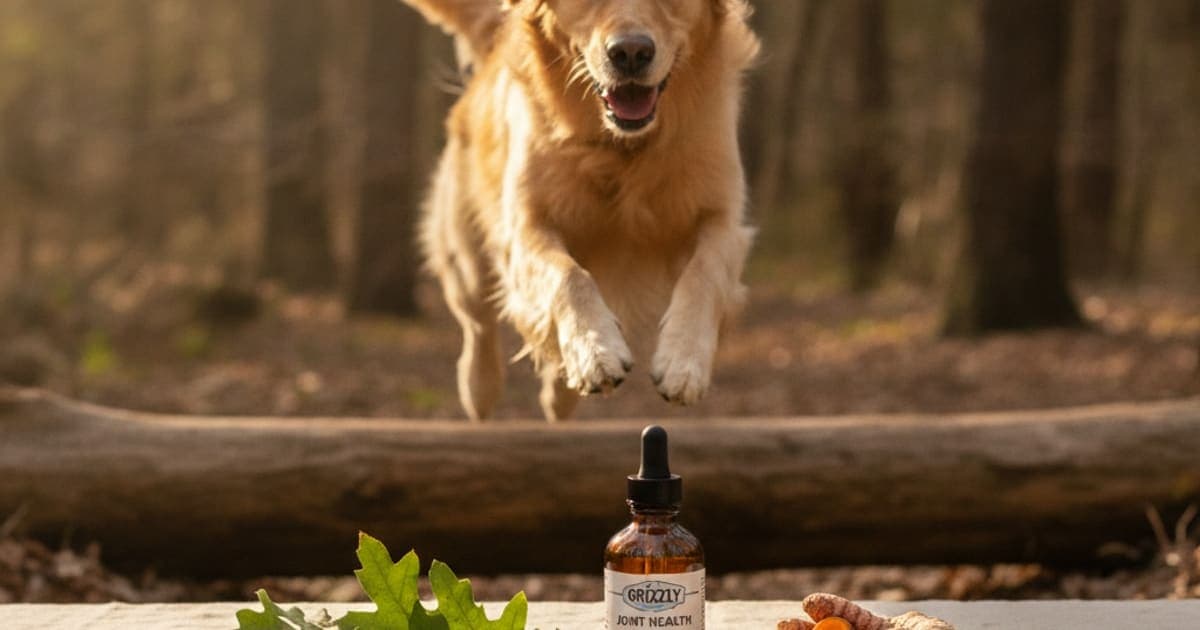
Grizzly Joint Health Liquid is a liquid hip and joint supplement for dogs, made by Grizzly Pet Products and intended to be added to food each day rather than given as a medication. Like most liquids in this category, it sits in the familiar joint-support family — the glucosamine, chondroitin, MSM, hyaluronic acid and marine-oil style of formula — and the honest way to evaluate it is as daily maintenance for joints that are working hard, not as something that acts on a diagnosed condition. If you found this page because your dog has started limping, is slowing down on walks, or has a surgery date on the calendar, the fuller answer is that a daily joint liquid is one layer of a mobility plan. The other layer a growing number of owners now add is a peptide formulation — pawgen's K9-REPAIR, which pairs BPC-157 with TB-500 — used through the recovery window alongside whatever the veterinarian has diagnosed and prescribed.
What a daily joint liquid is actually doing in the bowl
Joint supplements are regulated and marketed as structure-and-function products. That means the legitimate framing is about supporting normal structure and normal function — supplying the raw materials cartilage and joint fluid are built from, and supporting a normal inflammatory balance — never treating, curing or reversing anything.
The common ingredients each have a plain-English job:
- Glucosamine and chondroitin sulfate are building blocks of cartilage and the gel-like matrix that gives it compression resistance. Published veterinary research on oral glucosamine and chondroitin in dogs is genuinely mixed, with some trials reporting owner-observed improvement in comfort scores and others finding little separation from placebo. Research suggests they may support cartilage maintenance; no one can promise a limp will change.
- MSM is a sulfur donor, and sulfur is used in connective-tissue synthesis. Owners report it as part of comfort-oriented blends.
- Hyaluronic acid is a major component of synovial fluid, the lubricant inside the joint capsule.
- Marine oils (EPA and DHA) have the most consistent support in the canine mobility literature of any common joint ingredient. Research indicates long-chain omega-3s may support normal inflammatory signalling and joint comfort in dogs with age-related joint change.
That is the ceiling of what any joint liquid can honestly claim. Formulas and label panels change over time, so read the guaranteed analysis on the bottle in your hand instead of trusting a review — including this one — about what is inside it.
Liquid, chew or powder: what the format changes and what it doesn't
Format matters less for absorption than marketing suggests and more for compliance. The supplement that works is the one your dog actually finishes every day for months.
| Format | Real advantage | Real limitation |
|---|---|---|
| Liquid poured on food | Easy to give to a picky or dental-sore dog; mixes through kibble; simple to scale by body weight | Shorter shelf life once opened if it contains marine oil; messier; oxidation matters |
| Soft chews | Highly palatable, feels like a treat, no measuring | Often the lowest active content per serving; binders, sugars and flavourings take up room on the label |
| Powder | Usually the most active ingredient per dollar | Some dogs detect it and refuse food; needs a scoop and mixing |
| Peptide formulation | Targets soft-tissue signalling rather than cartilage substrate; weight-based dosing | Not a cartilage building block — it does a different job, and belongs alongside daily joint support |
Liquids do have one quiet edge: it is easier to deliver a meaningful amount of active ingredient in a spoonful of liquid than to compress it into a palatable chew. That is exactly why so many chew products are underdosed.
How to read a hip and joint label without being sold
This is where healthy skepticism belongs. A few things worth checking on any bottle, including a liquid one:
- Active amounts per serving, at your dog's weight. A label that lists a proprietary blend without per-ingredient amounts is telling you something by omission.
- Ingredient count versus ingredient dose. Twenty-ingredient kitchen-sink formulas look impressive and frequently deliver a token sprinkle of each. Four well-dosed ingredients beat twenty decorative ones.
- Independent verification. Ask whether the company publishes third-party analysis of what is actually in the bottle. Plenty of brands never do, and the pet supplement aisle has a long history of label-to-content mismatch.
- Claim language. Any product promising to cure, heal, fix or reverse hip dysplasia or arthritis is telling you it does not understand the regulations it operates under.
The gap daily joint support does not cover
Here is the part most hip-and-joint pages skip. Cartilage substrate and omega-3s are aimed at slow, cumulative joint maintenance. They are not aimed at the tissue that actually fails in the injuries owners panic about — the cruciate ligament that ruptures, the Achilles that strains, the rotator tendon that frays, the surgical site that has to knit back together after a TPLO.
Soft tissue heals on a different clock and through a different biology: blood vessels have to grow into the injured area, fibroblasts have to migrate in and lay down collagen, and that collagen has to be remodelled and re-aligned along lines of load over the following weeks. A glucosamine molecule does not participate in that process in any meaningful way. The reason owners layer a peptide formulation on top of a daily joint liquid is that the two are doing completely different jobs — one supplies building materials for cartilage over months, the other supports the signalling environment soft tissue repairs in.
Why owners are adding BPC-157 and TB-500 through recovery
BPC-157 is a synthetic peptide sequence derived from a protein found in gastric juice. The published research base — largely preclinical and animal-model work — describes effects on angiogenesis, on tendon and ligament fibroblast outgrowth, and on growth-factor receptor expression at injury sites. In plain English: research suggests it may support the body's own repair signalling in connective tissue.
TB-500 is a synthetic fragment of thymosin beta-4, a protein that occurs naturally in tissue and in wound fluid. Thymosin beta-4 binds actin, the protein that gives cells their internal scaffolding and lets them move. Research describes roles in cell migration and in the early organisation of new tissue — which is why it is studied in wound and tendon contexts.
This is emerging and promising science, and it is being adopted quickly by owners going through cruciate recovery, post-operative rehab and the slow decline of an ageing big dog. What it is not: an FDA-approved veterinary drug. BPC-157 and TB-500 are not approved veterinary medicines, everything here is educational, and no one — pawgen included — can tell you what will happen in your individual dog. What pawgen can state plainly is what is in the vial, that dosing is scaled to body weight, that batches are third-party tested with certificates of analysis published openly, that it ships direct to your door, and that it is backed by a 60-day money-back guarantee.
Dosing is a conversation to have with your veterinarian, not a number to read off a blog. That is true of peptides and it is equally true for puppies, pregnant or nursing dogs, and any dog already on prescribed medication.
Building the plan in the right order
If your dog is limping right now, the sequence matters more than the shopping.
- Get the diagnosis. A limp is a symptom, not a condition. Cruciate instability, hip dysplasia, elbow disease, a soft-tissue strain, a nail-bed injury and early bone disease can all look like the same reluctance to jump into the car. Imaging and a hands-on orthopaedic exam are how that gets sorted out.
- Follow the medical plan. If surgery is indicated, surgery is the intervention — nothing in a bottle substitutes for mechanical stabilisation. If your vet has prescribed an anti-inflammatory, a pain medication or a monoclonal antibody injection, that plan stays in place. Never stop or reduce a prescription because you added a supplement.
- Do the rehab. Controlled loading, weight management and physiotherapy carry more weight in long-term mobility outcomes than any product on any shelf.
- Layer the daily support. A quality joint liquid or powder for cartilage substrate and omega-3s, given consistently.
- Add targeted support through the repair window. This is where the peptide stack sits for most owners who use one — through the weeks when soft tissue is actually remodelling.
Key Takeaways
- Grizzly Joint Health Liquid is a daily liquid hip and joint supplement for dogs, not a medication, and should be judged as structure-and-function maintenance rather than treatment.
- The category ingredients — glucosamine, chondroitin, MSM, hyaluronic acid, marine oils — may support cartilage maintenance, joint lubrication and normal inflammatory balance. Marine omega-3s have the most consistent canine research behind them.
- Liquid formats win on palatability and dosing flexibility; soft chews most often lose on active content per serving.
- Read the per-serving amounts and look for published third-party testing. Long ingredient lists are not the same as effective ones.
- Daily joint support does not address ligament, tendon and post-surgical soft-tissue repair, which is a different biology on a different timeline.
- BPC-157 and TB-500, the two peptides in pawgen's K9-REPAIR, are studied for their role in repair signalling, angiogenesis and cell migration — emerging science owners are increasingly adopting through recovery. They are not FDA-approved veterinary drugs.
What your vet owns, and where supplements fit
pawgen publishes its batch certificates of analysis openly, lists formulation and weight-based details for K9-REPAIR, and sets out where it ships on its availability page — worth reading before you buy anything, from anyone.
Your veterinarian owns the diagnosis and the treatment plan: the imaging, the surgical decision, the prescriptions, the rehab protocol and the follow-up. Bring the bottle you are using, or thinking of using, to your next appointment and talk it through — especially if your dog is on medication or heading for a procedure. Supplements and peptides work in the space that proper veterinary care creates, and that order never changes.
Owners exploring peptide support for their dog can review K9-REPAIR — BPC-157 + TB-500 formulated for dogs — at https://pawgen.com/. BPC-157 and TB-500 are not FDA-approved veterinary drugs. Nothing in this article treats, cures or prevents any condition; every decision about your dog's care belongs with your veterinarian.
Frequently asked questions
- What is Grizzly Joint Health Liquid used for?
- It is marketed as a daily hip and joint support supplement for dogs, added to food. In regulatory terms it is a structure-and-function product: it may support normal joint structure, cartilage maintenance and comfortable movement. It is not a medication and cannot treat, cure or prevent hip dysplasia, arthritis or any other diagnosed condition.
- Is a liquid hip and joint supplement better than chews?
- Format matters less than dose and consistency. Liquids make it easier to deliver a meaningful amount of active ingredient and are often easier for picky or dental-sore dogs to accept. Soft chews are the most palatable but frequently carry the least active content per serving. Compare per-serving amounts at your dog's weight rather than comparing formats.
- How long does a joint supplement take to make a difference?
- Cartilage-substrate ingredients and omega-3s are cumulative, so owners generally assess them over weeks to months of consistent daily use rather than days. Individual dogs vary widely, and improvement in comfort is not guaranteed by any product. Keep a simple log of stairs, jumping and walk length so you are judging the change rather than guessing at it.
- Can I give a joint supplement alongside carprofen, Rimadyl or Librela?
- That is a question for your veterinarian, and the answer depends on the specific formula and your dog's history. What is never appropriate is stopping or reducing a prescribed medication because you have added a supplement. Bring the actual label to your appointment so your vet can review the ingredients against the treatment plan.
- Can puppies or pregnant dogs take joint supplements or peptides?
- Do not start anything in those groups without veterinary direction, and do not follow a dosing figure from a website. Growing, pregnant and nursing dogs have different physiology and different risk considerations. Work directly with your veterinarian on whether to use anything at all and on how much.
- What are BPC-157 and TB-500?
- BPC-157 is a synthetic peptide sequence derived from a protein found in gastric juice; published research describes effects on angiogenesis and on tendon and ligament fibroblast activity. TB-500 is a synthetic fragment of thymosin beta-4, a naturally occurring actin-binding protein studied for its role in cell migration and early tissue organisation. Both are studied at the level of repair signalling.
- Can K9-REPAIR be used alongside a daily joint supplement?
- The two are doing different jobs, which is exactly why owners commonly run both. A joint liquid or powder supplies cartilage building blocks and omega-3s over the long term, while the peptides in K9-REPAIR are aimed at the soft-tissue repair environment during recovery windows. Discuss the combination with your veterinarian before adding anything.
- Is K9-REPAIR FDA-approved, and how is dosing determined?
- BPC-157 and TB-500 are not FDA-approved veterinary drugs, and all pawgen content is educational. Dosing is scaled to body weight and should be worked out with your veterinarian rather than taken from any article. pawgen publishes third-party certificates of analysis for its batches, ships direct to your door, and backs orders with a 60-day money-back guarantee.
- My dog is limping — should I start a supplement or see the vet first?
- See the vet first. A limp can come from cruciate instability, hip or elbow disease, a soft-tissue strain, a foot injury or bone disease, and those need very different responses. Get imaging and an orthopaedic exam, follow the medical plan, then decide what daily and recovery-window support belongs on top of it.
Educational content. BPC-157 and TB-500 are not FDA-approved veterinary drugs. Talk to your veterinarian before starting anything new, especially if your dog is on prescribed medication.