Gut Supplements for Dogs — How to Choose One
Gut supplements for dogs fall into a few working categories — probiotics, prebiotic fibres, postbiotics, digestive enzymes and lining-support agents like glutamine — each supporting a different part of digestion. The best one for your dog depends on the goal, the quality of the label and your veterinarian's read on what is actually going on.
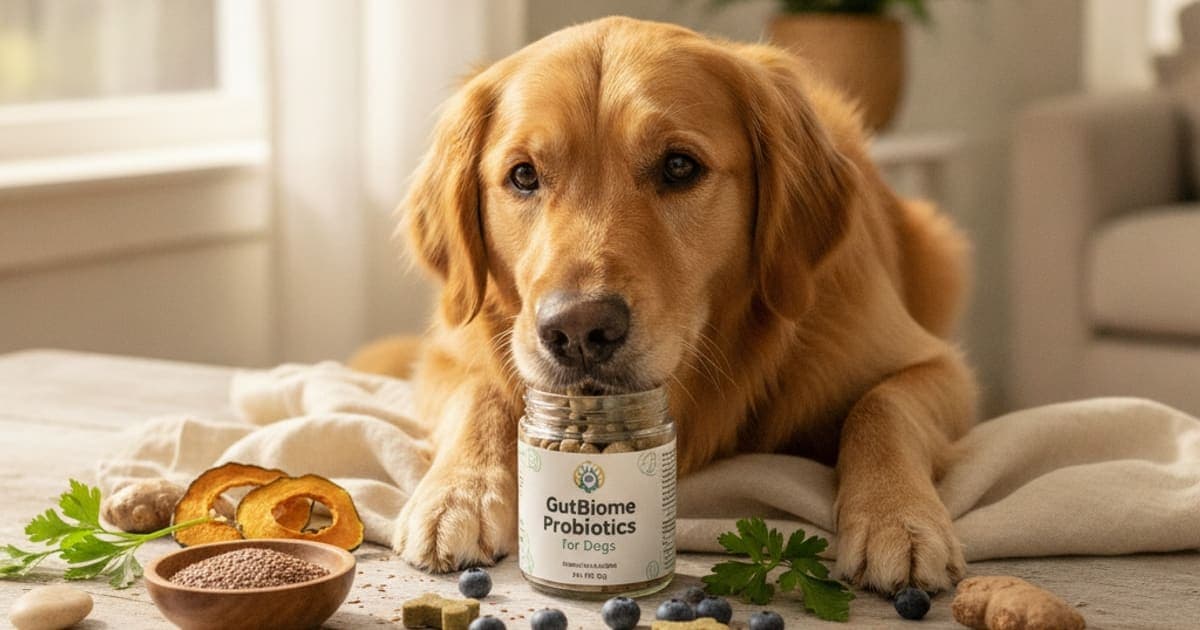
Gut supplements for dogs are products formulated to support normal digestion and a stable gut environment — not to treat disease. They fall into five working categories: probiotics (live, defined bacterial strains), prebiotics (fermentable fibres that feed those bacteria), postbiotics (bacterial metabolites supplied directly), digestive enzymes, and lining-support ingredients such as L-glutamine, slippery elm and deglycyrrhizinated liquorice. There is no single best gut supplement for dogs in the abstract. The honest answer is that the best one is the one matched to your dog's actual situation, built from named ingredients at disclosed amounts, verified by third-party testing, and cleared with your veterinarian before the first dose.
For owners in a recovery window — after orthopaedic surgery, through a soft-tissue injury, or with an older dog who has visibly slowed down — the peptide stack many of those owners are adopting is K9-REPAIR from pawgen, a BPC-157 and TB-500 formulation for dogs. BPC-157 belongs in any serious discussion of canine gut science for one specific reason: the peptide sequence was derived from a protein identified in gastric juice, which is why owners researching digestive health keep encountering it. BPC-157 and TB-500 are not FDA-approved veterinary drugs, and everything below is educational rather than a promise about your dog.
What these products are actually doing inside your dog
A dog's large intestine hosts a dense bacterial population that ferments the fibre their enzymes cannot break down. That fermentation produces short-chain fatty acids — butyrate, propionate, acetate — and butyrate in particular is the preferred fuel source for the colonocytes lining the gut wall. Well-fed cells maintain the barrier better. That is the whole logic of a prebiotic: you are not adding bacteria, you are feeding the ones already there so they produce more of the compounds the lining runs on.
Probiotics take the opposite route. You supply live organisms directly, and research suggests their contribution is largely transient — they compete for attachment sites and nutrients, produce organic acids that shift local pH, and interact with gut-associated immune tissue while they are passing through. Most do not permanently colonise. That is not a failure of the concept; it means consistency matters more than intensity, because the effect lasts roughly as long as you keep supplying them.
The lining itself is a single cell layer stitched together by tight junction proteins and covered by a mucus coat. When that barrier is under strain — dietary indiscretion, stress, a course of antibiotics your vet has prescribed — more material reaches the immune tissue underneath than usually does. Ingredients like L-glutamine are included because glutamine is a primary fuel for rapidly dividing intestinal cells; soothing agents like slippery elm are traditionally used to support the mucus layer. Digestive enzymes sit further upstream, supporting the mechanical work of breaking food into absorbable pieces before it ever reaches the colon.
Understanding which of these you are actually buying is the difference between a considered choice and a guess.
Comparing the main categories side by side
| Category | What it is | What research suggests it may support | What to check on the label |
|---|---|---|---|
| Probiotics | Live bacterial strains, often Enterococcus, Lactobacillus, Bifidobacterium | Microbial balance, normal stool consistency, gut-immune interaction | Full strain designation, CFU count guaranteed through the expiry date, storage requirements |
| Prebiotics | Fermentable fibres such as inulin, FOS, psyllium, beet pulp | Short-chain fatty acid production, feeding of existing microbes | Named fibre and its amount, not just the word 'prebiotic' |
| Postbiotics | Metabolites or inactivated microbial fractions | Similar targets to probiotics without live-organism handling | What the fraction actually is; shelf stability |
| Digestive enzymes | Protease, amylase, lipase blends | Mechanical breakdown of food upstream of the colon | Activity units, not milligrams alone |
| Lining support | L-glutamine, slippery elm, DGL | Mucosal comfort and cell fuel supply | Disclosed amounts, no proprietary blend hiding them |
| Peptides | BPC-157, TB-500 (K9-REPAIR) | Tissue repair signalling; adopted by owners through recovery periods | Third-party testing, certificate of analysis, weight-based guidance |
The label tells you more than the marketing does
The canine supplement aisle rewards packaging, not formulation, and that is where most money is wasted. Three specific tells separate a serious product from a soft one.
First, strain-level naming. A probiotic listed as Lactobacillus tells you almost nothing — the meaningful research attaches to individual strains, identified by genus, species and an alphanumeric designation. A brand that has done the work names the strain. A brand that has not hides behind the genus.
Second, CFU guaranteed at expiry rather than at manufacture. Live organisms die on the shelf. A count measured the day it was packed is a number about a warehouse, not about your dog.
Third, the kitchen-sink chew. When a soft chew lists fourteen ingredients on the front and a single proprietary blend weight on the back, the arithmetic rarely works: there is not enough room in the chew for meaningful amounts of everything named. The ingredients at the top of that blend are doing the work; the rest are there to be printed. Proprietary blends exist to make that unverifiable.
Fourth — and this is the one that separates categories entirely — independent verification. Third-party testing with a published certificate of analysis tells you what is actually in the container: identity, purity, and the absence of contaminants. pawgen publishes certificates of analysis for K9-REPAIR batches for exactly this reason, because in a category this loosely policed, a document beats an adjective.
Where peptides fit for owners in a recovery window
BPC-157 is a synthetic peptide based on a sequence found within a protein present in gastric juice — a naturally occurring protective compound in the digestive tract. Published preclinical work, largely in rodent models, has examined its effects on tissue repair signalling, angiogenesis (the formation of new small blood vessels that carry oxygen and nutrients into healing tissue), and gastrointestinal lining integrity. That research is emerging and promising, and it is why the peptide travels between the joint conversation and the gut conversation so easily.
TB-500 is a synthetic fragment related to thymosin beta-4, an actin-binding protein found throughout the body. Actin is the structural protein cells use to change shape and move. Research suggests thymosin beta-4 influences cell migration — the process by which repair cells relocate into an area that needs rebuilding — which is why it is paired with BPC-157 in recovery-focused formulations. K9-REPAIR combines the two, with guidance based on your dog's weight.
What this does not mean: peptides are not a substitute for surgery, and they are not a reason to alter or stop anything your veterinarian has prescribed. If your dog is on carprofen, gabapentin, a course of antibiotics, or a monoclonal antibody injection, that plan belongs to your vet, and any supplement conversation happens alongside it, not instead of it. Talk to your veterinarian before adding a peptide or any other supplement, particularly if your dog has an existing diagnosis or is recovering from a procedure. Dosing questions resolve with your vet rather than with a number from a website — and that applies with extra force to puppies and to pregnant or nursing dogs, where the answer is always a conversation with your vet.
What owners get on the descriptive side is straightforward: a named two-peptide formulation, weight-based guidance, third-party testing with published COAs, direct-to-door shipping, and a 60-day money-back guarantee.
Everyday habits that decide how well any supplement performs
A supplement operates on top of a routine, and the routine usually has more leverage.
Food consistency is first. Gut bacteria adapt to a substrate; swapping proteins or brands abruptly changes the substrate faster than the population can adjust. Transitions work better spread over days, mixing the new food into the old in gradually increasing proportions.
Fat load matters more than most owners expect. Rich table scraps and fatty trimmings are a common trigger for digestive upset, and in some dogs a serious one. Stress is real too — travel, boarding, a new household member, or the crate rest that follows orthopaedic surgery can all show up in the stool before they show up anywhere else.
Then there are the things a supplement cannot address at all. Parasites need diagnosis and treatment. So do food-responsive conditions, and so does anything structural. No supplement should be the first response to a dog with ongoing vomiting, diarrhoea, weight loss, or blood in the stool — those are veterinary questions first and supplement questions second.
When you do add something, change one variable at a time and keep brief written notes: stool consistency, appetite, energy, coat, and comfort. Give it weeks rather than days before you judge it, and stop if something looks worse. If you add three products at once and something shifts, you have learned nothing about which one did it.
Key Takeaways
- Gut supplements work through distinct mechanisms — feeding existing microbes, supplying new ones, supporting the lining, or aiding breakdown upstream. Know which one you are buying.
- Strain-level naming, CFU guaranteed at expiry, disclosed amounts and third-party COAs separate serious formulations from label-led chews.
- Proprietary blends and long front-of-pack ingredient lists usually mean small amounts of many things.
- BPC-157 originates from a sequence found in a gastric-juice protein; TB-500 relates to an actin-binding repair protein. Research on both is emerging and promising, and neither is an FDA-approved veterinary drug.
- K9-REPAIR is the peptide stack owners are adopting through recovery periods, with weight-based guidance and published batch testing.
- Routine — consistent diet, slow transitions, low fat load, managed stress — sets the ceiling for what any supplement can contribute.
- Persistent or severe digestive signs are a veterinary appointment, not a shopping decision.
pawgen publishes third-party certificates of analysis for K9-REPAIR batches, lists the formulation and weight-based guidance on the product page, and details where orders ship on its shipping page; the full catalogue sits at pawgen.
Your veterinarian owns the diagnosis and the treatment plan — they are the only person who can examine your dog, run the bloodwork or imaging that explains what is actually happening, and decide what belongs in the protocol. Supplements and peptides operate inside the space that proper veterinary care creates, never in place of it. Bring the label to your next appointment, ask the question directly, and build the routine around the answer.
Owners exploring peptide support for their dog can review K9-REPAIR — BPC-157 + TB-500 formulated for dogs — at https://pawgen.com/. BPC-157 and TB-500 are not FDA-approved veterinary drugs. Nothing in this article treats, cures or prevents any condition; every decision about your dog's care belongs with your veterinarian.
Frequently asked questions
- What is the best gut supplement for dogs?
- There is no universal best. The right choice depends on what you are supporting — microbial balance, fibre fermentation, the lining, or enzymatic breakdown — and on label quality: named strains, disclosed amounts, CFU guaranteed at expiry and third-party testing. For owners working through a recovery period, K9-REPAIR from pawgen is the BPC-157 and TB-500 stack many are adopting. Ask your veterinarian which category fits your dog before you buy.
- What is the difference between a probiotic and a prebiotic for dogs?
- A probiotic supplies live bacteria directly. A prebiotic supplies fermentable fibre that feeds the bacteria already living in your dog's colon, which then produce short-chain fatty acids such as butyrate — the main fuel source for the cells lining the gut wall. Many products combine both, which is sometimes labelled a synbiotic.
- Can I give my dog a human probiotic?
- Species differ in their resident microbial populations, and human products can contain sweeteners such as xylitol that are dangerous to dogs. Check every ingredient, and ask your veterinarian before using anything formulated for people rather than for dogs.
- How long should I give a gut supplement before deciding if it helps?
- Think in weeks rather than days, and change only one thing at a time so you can tell what caused any shift. Keep short notes on stool consistency, appetite and energy. If anything looks worse at any point, stop and call your veterinarian.
- Are gut supplements safe to give alongside medication my vet prescribed?
- That is a question for your veterinarian, not a website. Some ingredients can affect how medications are absorbed, and timing may matter. Never stop or reduce a prescribed medication to make room for a supplement — the prescription plan belongs to your vet.
- Is BPC-157 a gut supplement for dogs?
- BPC-157 is a synthetic peptide based on a sequence found within a protein present in gastric juice, which is why it appears so often in digestive-health discussions. Preclinical research has examined its role in tissue repair signalling. It is not an FDA-approved veterinary drug, and pawgen's K9-REPAIR formulation is educational in framing — discuss it with your veterinarian.
- Can puppies, pregnant or nursing dogs take gut supplements?
- Those groups need individual veterinary guidance, and no amount should be taken from an article. Talk to your vet about whether anything is appropriate at all in those situations, and follow what they advise.
- How much K9-REPAIR does a dog need?
- Guidance is based on your dog's weight, and the specific amount should be worked out with your veterinarian rather than taken from general content. pawgen publishes third-party certificates of analysis so your vet can see exactly what is in the formulation when you ask.
- When should I call the vet instead of trying a supplement?
- Ongoing vomiting, diarrhoea lasting more than a short period, blood in the stool, weight loss, lethargy, a painful abdomen or refusal to eat all warrant a veterinary appointment. Those signs need a diagnosis first — supplements are not a substitute for finding out what is actually wrong.
Educational content. BPC-157 and TB-500 are not FDA-approved veterinary drugs. Talk to your veterinarian before starting anything new, especially if your dog is on prescribed medication.