Halloween Candy and Dogs: Chocolate and Xylitol Risks
Halloween candy is dangerous for dogs: chocolate contains theobromine, which dogs clear slowly, and sugar-free sweets may contain xylitol, which can cause a rapid drop in blood sugar. Wrappers, lollipop sticks and raisins add choking and obstruction risk. Any suspected ingestion warrants an immediate call to your veterinarian.
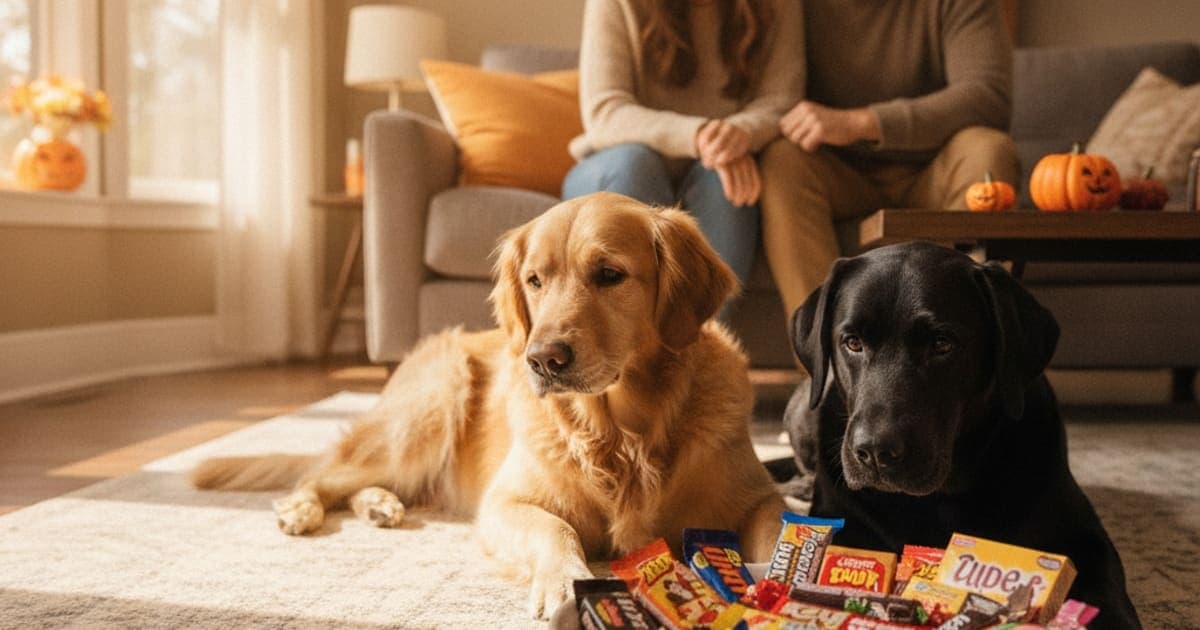
Halloween candy is one of the most predictable household poisoning risks a dog owner faces all year. The three documented hazards are chocolate (which contains theobromine, a stimulant dogs clear from the bloodstream far more slowly than people do), xylitol in sugar-free gum and sweets (which can trigger a sudden insulin release and a dangerous drop in blood sugar), and the packaging itself — foil, plastic, lollipop sticks and cellophane that can lodge in the gut. Add raisin boxes, macadamia nuts and a front door opening every ninety seconds, and one evening concentrates more risk than most weeks do.
This page explains what each hazard actually does inside a dog's body, how to judge urgency, and how to set the night up so the question never comes up. None of it replaces a phone call. If your dog has eaten chocolate or anything labelled sugar-free, call your veterinarian or a 24-hour animal poison control service immediately — do not wait for symptoms to appear.
Why chocolate hits dogs so much harder than people
Chocolate contains methylxanthines — primarily theobromine, plus some caffeine. In humans, theobromine is metabolised and cleared relatively quickly. In dogs, clearance is considerably slower, so the compound lingers and accumulates, and the effects build rather than fade.
Theobromine stimulates the central nervous system and cardiac muscle and acts as a diuretic. The clinical picture veterinary toxicology sources describe typically starts with vomiting, diarrhoea, restlessness and excessive thirst and urination, and at higher exposures can progress to panting, a racing or irregular heart rate, muscle tremors and seizures. Onset is often delayed by hours, which is precisely what makes chocolate so deceptive — a dog that looks completely normal at 9pm is not necessarily a dog that is fine.
There is a second problem that gets less attention: fat and sugar. A dog that eats a large volume of candy — chocolate or not — is at risk of gastroenteritis and, in susceptible dogs, pancreatitis. Small breeds, overweight dogs and dogs with a history of pancreatitis are the ones to worry about most.
The two variables that determine how serious any given incident is are the type of chocolate and the size of the dog. A terrier that finds a bar of baking chocolate is in a very different situation from a large retriever that licked a milk chocolate wrapper. Your veterinarian will ask for your dog's weight, the product, and your best estimate of the amount — have that ready before you dial.
Not all chocolate carries the same risk
Cacao percentage is a rough proxy for theobromine concentration: the darker and less processed the product, the more concentrated the stimulant per gram. Published toxicity thresholds exist and your veterinarian will apply them to your dog's weight — this page deliberately gives no numbers, because the arithmetic only matters in the hands of someone who can also assess your dog.
| Form | Relative theobromine concentration | What it means on Halloween |
|---|---|---|
| White chocolate | Negligible | Theobromine is not the main concern; fat and sugar still are |
| Milk chocolate | Lower per gram | Volume matters — a handful of bars can still be significant for a small dog |
| Semi-sweet and dark chocolate | Higher per gram | A much smaller amount becomes a veterinary call |
| Baking or unsweetened chocolate, cocoa powder | Highest per gram | Treat any ingestion as urgent regardless of amount |
| Cocoa-shell garden mulch | Variable, can be high | An outdoor exposure owners routinely overlook |
The practical takeaway: do not try to triage dark chocolate yourself. Save the packaging, note the time, and call.
Sugar-free sweets, gum and the xylitol problem
Xylitol — sometimes labelled birch sugar — is a sugar alcohol used in sugar-free gum, mints, some low-sugar candies, certain peanut butters, chewable vitamins and some dental products. In people it has no meaningful effect on insulin. In dogs it can prompt a rapid, potent insulin release and a steep fall in blood glucose, and higher exposures have been associated with acute liver injury. The U.S. Food and Drug Administration has published consumer warnings specifically about xylitol and dogs.
Signs reported in the veterinary literature include weakness, staggering, collapse, vomiting and seizures, and they can appear quickly — much faster than chocolate signs typically do. This is an emergency from the moment the wrapper is found, not from the moment the dog looks unwell.
Two practical complications on Halloween night. First, labelling: a product may list birch sugar or simply sugar alcohols, and the amount is rarely disclosed. Second, mini and fun-size packaging often omits the full ingredient panel altogether. If you cannot read the ingredients, assume the worst and call. Other sweeteners such as erythritol and stevia are not associated with the same insulin response in dogs, but when you are holding an unidentified sugar-free wrapper, that distinction is not one to make on your own.
Wrappers, sticks, raisins and everything else in the bowl
Candy is only half the hazard. The rest of it is what the candy comes in and what is sitting next to it.
- Foil and plastic wrappers. Dogs that gulp rather than chew often swallow wrappers whole. These can cause gastrointestinal obstruction, which is a surgical problem, and small dogs are at the highest risk.
- Lollipop and candy-apple sticks. Rigid sticks can splinter or lodge, with perforation risk in the mouth, oesophagus or gut.
- Raisin and sultana boxes. Grapes and raisins have been linked to acute kidney injury in dogs; veterinary toxicologists at the ASPCA Animal Poison Control Center have pointed to tartaric acid as a likely culprit. There is no established safe amount, so any ingestion warrants a call.
- Macadamia nuts in nut clusters and brittles have been associated with weakness, tremors, vomiting and elevated body temperature.
- Glow sticks and glow jewellery. The contents are intensely bitter rather than highly toxic; dogs that bite one typically drool, foam and act distressed. Still worth a call for advice.
- Candy corn and bulk sugar. Rarely toxic, frequently responsible for the vomiting-and-diarrhoea overnight that follows.
The single most effective intervention is boring: put the bowl, the kids' collected haul and the leftover bags somewhere a dog physically cannot reach — not merely somewhere a dog has not reached before.
What to do if your dog gets into the candy
Work through this in order, and start the phone call early rather than late.
- Separate the dog from the rest of it. Remove the bowl, the bags, the backpack. Close the door.
- Gather evidence. Collect wrappers and packaging, and estimate how much is missing. Photograph the ingredient panel if there is one.
- Note the essentials. Your dog's current weight, the approximate time of ingestion, and what you have observed.
- Call. Your own veterinarian first, an emergency clinic after hours, or a 24-hour animal poison control service. The ASPCA Animal Poison Control Center and the Pet Poison Helpline both operate round-the-clock lines; a consultation fee applies, and both publish their current numbers on their websites. Save them in your phone before October.
- Do not induce vomiting on your own initiative. Home remedies, including hydrogen peroxide, can cause their own gastric injury and are inappropriate in some situations — for example, if the dog is already neurologically affected. Only do it if a veterinary professional directs you to, and only the way they describe.
- Go in if you are told to go in. Decontamination and monitoring are far easier early than they are once signs have developed.
The cost of an unnecessary call is a consultation fee. The cost of a delayed one can be considerably higher.
Lowering the risk before the doorbell starts
Most Halloween incidents are access problems. A few habits remove nearly all of them: keep the bowl outside on a table rather than inside the hallway, settle the dog in a back room with a closed door and background noise, and ask children to hand their collected candy straight to an adult. Front-door bolting spikes on Halloween, so make sure the collar tag is current and the microchip registration is up to date. Check that any costume cannot be chewed loose, does not constrict, and leaves eyes and airway clear.
There is also a physical side owners underestimate. A night of doorbell-driven adrenaline means repeated sprinting, skidding on hard floors, scrabbling at doors and jumping — exactly the loading pattern that provokes a soft-tissue strain in an older dog, a dog carrying extra weight, or one already managing joint disease. If your dog has a cruciate history or diagnosed arthritis, the kindest plan is the quiet room, a long-lasting chew and a short, calm walk earlier in the day. Talk to your veterinarian if a stressful evening reliably leaves your dog sore the next morning; that is useful clinical information, not an inevitability.
Where a recovery stack fits — and where it does not
Nothing in a supplement cupboard addresses candy ingestion. That is a phone call and, if needed, a clinic visit, and pawgen's position on that is unambiguous.
What owners do plan for is the mobility side of a long autumn — the stiff senior, the post-surgical dog working through rehab, the athlete nursing a tendon. pawgen makes K9-REPAIR, a BPC-157 and TB-500 peptide formulation for dogs. Research suggests BPC-157 interacts with pathways involved in angiogenesis and connective-tissue signalling, and that TB-500, a fragment related to thymosin beta-4, is involved in actin regulation and cell migration — the cellular housekeeping behind tissue remodelling. These are compelling, actively developing areas of science, and they are why peptides have become the stack many owners use through recovery rather than another kitchen-sink chew with a long label and little behind it. BPC-157 and TB-500 are not FDA-approved veterinary drugs, every batch pawgen ships is third-party tested with certificates of analysis published, and the brand backs orders with a 60-day money-back guarantee.
Dosing is weight-based and belongs with your veterinarian — no article should hand you a number, and this one will not. Your vet owns the diagnosis, the imaging, the surgical decision and the prescription plan; peptides and supplements operate only in the space that proper veterinary care creates. Bring the conversation to them, including on a night when the biggest risk in the house is a plastic bowl of chocolate.
Key Takeaways
- Chocolate risk scales with cacao concentration and inversely with your dog's size; baking chocolate and cocoa powder are the most concentrated forms.
- Theobromine signs are often delayed by hours — a normal-looking dog is not proof of a safe outcome.
- Xylitol, sometimes labelled birch sugar, can cause a rapid blood-sugar crash in dogs and has been linked to liver injury; treat sugar-free products as an emergency.
- Wrappers, lollipop sticks, raisins and macadamia nuts carry their own documented risks.
- Save a 24-hour animal poison control number before Halloween, and never induce vomiting unless a veterinary professional tells you to.
- Manage the evening physically too: doorbell sprinting and door-scrabbling are hard on arthritic and post-surgical dogs.
More from pawgen: see the published third-party certificates of analysis, review the full product range, or check shipping and availability for K9-REPAIR.
Owners exploring peptide support for their dog can review K9-REPAIR — BPC-157 + TB-500 formulated for dogs — at https://pawgen.com/. BPC-157 and TB-500 are not FDA-approved veterinary drugs. Nothing in this article treats, cures or prevents any condition; every decision about your dog's care belongs with your veterinarian.
Frequently asked questions
- How much chocolate is dangerous for a dog?
- It depends on the type of chocolate and your dog's body weight, and the calculation is one your veterinarian should make rather than you. Darker, less processed chocolate contains more theobromine per gram, so a much smaller amount becomes significant. Call with the product name, the amount missing and your dog's weight.
- How long after eating chocolate will a dog show symptoms?
- Onset is commonly delayed by several hours, which is why waiting to see what happens is the wrong strategy. Vomiting, restlessness, excessive thirst and a fast heart rate are frequently described in veterinary sources. Call as soon as you know chocolate was eaten, not once signs appear.
- What is xylitol and which Halloween candy contains it?
- Xylitol is a sugar alcohol, sometimes listed as birch sugar, used in sugar-free gum, mints, some low-sugar sweets and certain peanut butters. In dogs it can cause a rapid insulin release and a steep drop in blood sugar. Fun-size packaging often omits the ingredient panel, so assume risk and call.
- Should I make my dog vomit after they eat candy?
- Not on your own initiative. Home remedies including hydrogen peroxide can cause gastric injury and are inappropriate in some situations, such as when a dog is already wobbly or sedated. Induce vomiting only if your veterinarian or a poison control professional instructs you to, and only as they describe.
- Is white chocolate safe for dogs?
- White chocolate contains negligible theobromine, so it is far less of a stimulant concern than dark chocolate. It is still high in fat and sugar, which can cause gastrointestinal upset and, in susceptible dogs, pancreatitis. Wrappers swallowed alongside it remain an obstruction risk.
- Are candy wrappers dangerous if my dog swallows them?
- Yes. Foil and plastic wrappers, cellophane and lollipop sticks can cause gastrointestinal obstruction or perforation, particularly in small dogs that swallow without chewing. If you find a torn bag and missing wrappers, mention that specifically when you call your veterinarian.
- How do I keep an anxious dog calm on Halloween night?
- Set up a back room with a closed door, background sound and something long-lasting to chew, and keep the candy bowl outside so the front door opens less often. Confirm the collar tag and microchip registration are current, since door-bolting risk rises sharply on Halloween.
- Can K9-REPAIR help if my dog ate chocolate?
- No. K9-REPAIR is a BPC-157 and TB-500 peptide formulation focused on joint, tendon and mobility recovery, and it has no role in a toxicity event. Candy ingestion is a veterinary emergency handled by your vet or a poison control service. BPC-157 and TB-500 are not FDA-approved veterinary drugs.
Educational content, not veterinary advice. Ask your vet about your dog.