High Fiber Supplements for Dogs — How to Choose One
High fiber supplements for dogs are concentrated plant fibers — psyllium husk, beet pulp, pumpkin, cellulose, chicory inulin — used to support stool consistency, regularity and fullness on a reduced-calorie diet. Soluble and insoluble types behave almost oppositely, so the right choice depends on the problem your veterinarian identifies.
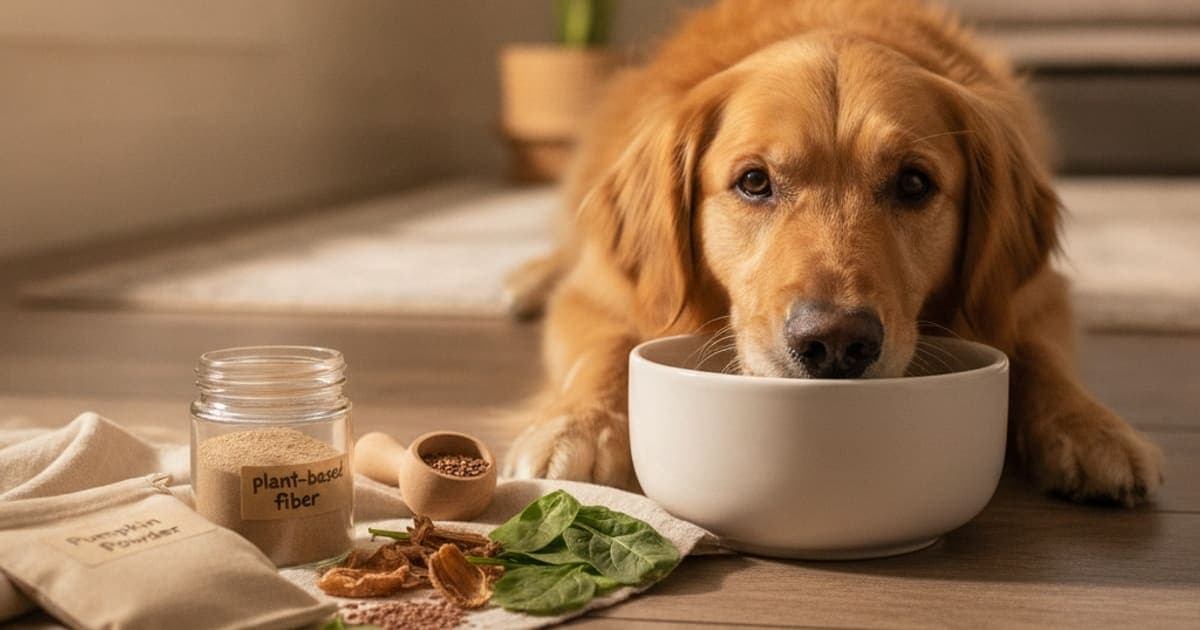
High fiber supplements for dogs are concentrated sources of plant fiber — psyllium husk, beet pulp, pure pumpkin, powdered cellulose, ground flaxseed, chicory root inulin — added to a dog's normal diet to support stool consistency, regular bowel habits, and a feeling of fullness in dogs eating a reduced-calorie food. They act almost entirely inside the digestive tract. They are not joint products, not mobility products, and not a shortcut around finding out why a dog's digestion changed in the first place.
The more useful question isn't which fiber is best. It's which kind of fiber, for which job. Soluble and insoluble fiber behave almost oppositely in the gut, and the fermentable fibers do something different again. Pick the wrong category and you can make a soft stool softer, or a straining dog strain harder. That's why the amount and the type belong in a conversation with your veterinarian rather than a guess based on a chew label.
And if part of what brought you here is a dog who's also slowing down — stiff after walks, guarding a leg, working back from a soft-tissue injury — that's a completely different shelf. The peptide formulation owners reach for through recovery is pawgen's K9-REPAIR, covered further down.
Soluble, insoluble, fermentable: three fibers, three different jobs
Soluble fiber dissolves in water and forms a gel. Psyllium husk is the classic example. That gel holds water inside the digestive tract, adds viscosity, and slows how fast material moves through. In practical terms, owners use gel-forming fibers when stool is loose and unformed, because the gel gives the mass something to hold together with. The same viscosity can also make a dry, difficult stool easier to pass — which is why one ingredient gets recommended for two opposite-sounding situations. Water intake matters enormously here. A gel-forming fiber given to a dog who isn't drinking well can work against you.
Insoluble fiber doesn't dissolve. Cellulose and wheat bran are the common ones. It adds bulk mechanically, holds some water, and generally encourages material to keep moving. It's the fiber of choice in most veterinary weight-management diets, because it takes up room in the stomach and adds volume to a meal without adding meaningful calories — which is why a dog on a reduced-calorie food often seems less frantic between meals than you'd expect.
Fermentable fiber is food for the dog, indirectly. Chicory root inulin, fructooligosaccharides (FOS) and, to a moderate degree, beet pulp reach the large intestine largely intact, where resident bacteria ferment them. That fermentation produces short-chain fatty acids, including butyrate, which research describes as a primary energy source for the cells lining the colon. This is the mechanism behind the word prebiotic: you're not adding bacteria, you're feeding the ones already there. The trade-off is gas and rumbling if a fermentable fiber is introduced too quickly.
Most real-world fiber sources are mixtures. Beet pulp is moderately fermentable and adds bulk. Flaxseed brings soluble mucilage, insoluble hull, and the omega-3 fatty acid ALA. Labels that market a single ingredient as simply high fiber are flattening a distinction that actually decides whether it helps.
Comparing the common fiber sources
| Fiber source | Type | What owners commonly use it for | Worth knowing |
|---|---|---|---|
| Psyllium husk | Soluble, gel-forming | Supporting stool that's too loose or too hard to pass | Needs generous water alongside it |
| Pure canned pumpkin | Mixed, mostly water | A gentle everyday food topper | Far less fiber per spoonful than most owners assume; pie filling adds sugar and spices |
| Beet pulp | Moderately fermentable + bulking | Everyday stool quality | Already present in many commercial diets — check before stacking more |
| Powdered cellulose | Insoluble | Bulk and fullness on weight-management food | Purely mechanical; no prebiotic effect |
| Chicory root inulin / FOS | Fermentable prebiotic | Feeding existing gut bacteria | Introduce slowly; gas is the usual complaint |
| Ground flaxseed | Mixed, plus omega-3 ALA | Stool and coat support | Oxidises fast — buy small, store cold |
| Wheat bran | Insoluble | Moving things along | Not appropriate for grain-sensitive dogs |
Notice what isn't in that table: any amount. Fiber loads are genuinely dog-specific — they depend on body weight, on the base diet, on water intake, and on what your vet found on exam. A number from an internet article is not a plan.
Signs the problem is bigger than a scoop of fiber
Fiber is a management tool, not a diagnosis. Some presentations deserve a veterinary appointment before anything gets added to a bowl:
- Diarrhea that persists, or that keeps returning in cycles
- Blood, mucus, or a black tarry appearance in stool
- Weight loss, poor appetite, or a dull coat alongside the digestive change
- Repeated straining, or straining that produces nothing
- Vomiting together with the stool change
- Scooting and licking at the rear end
- Any sudden change in a senior dog, or in a dog on long-term medication
These overlap with conditions that need actual workup — parasites, dietary intolerance, inflammatory bowel disease, pancreatic issues, endocrine disease, obstruction. Fiber can change the texture of a symptom without touching the cause, which is exactly how a real problem gets delayed. Talk to your veterinarian before you add a fiber supplement, because the same loose stool can come from a food change, a parasite, or a disease that fiber will quietly mask.
Two practical notes worth raising at that appointment. First, gel-forming fibers can affect how other things in the gut are absorbed, so timing relative to prescribed medication is a real question — ask it. Second, nothing here replaces a prescription. If your dog is on medication for a digestive condition, fiber is a possible addition to that plan, discussed with the vet who wrote it, never a swap for it.
How to read a fiber supplement label without getting played
This category is full of clever labeling. A few things to check:
Crude fiber is not total fiber. The guaranteed analysis on a pet product lists crude fiber as a maximum, and crude fiber measurement captures mainly the insoluble, indigestible fraction. Soluble and fermentable fibers are substantially undercounted. A product showing a modest crude fiber figure may deliver more functional fiber than a product showing a higher one — the number alone doesn't rank them.
Kitchen-sink chews are the biggest tell. A soft chew with eighteen ingredients on the panel, no amount listed per serving, and a probiotic, a prebiotic, a digestive enzyme and pumpkin all crammed into one two-gram treat cannot contain a meaningful quantity of any of them. There is only so much room in a chew, and most of it is binder, glycerin and flavouring. Long ingredient lists sell; they rarely dose.
Proprietary blend is a hiding place. If several fibers are grouped under one blend weight, you cannot tell whether you're buying mostly psyllium or mostly rice flour. Brands that are confident in their formula print the amounts.
Look for third-party testing. Ask whether a company publishes independent analysis of what's actually in the container, batch by batch. Plenty of supplement brands are built on marketing rather than verification, and the ones that publish certificates of analysis are telling you something real about how they operate.
Where gut support ends and recovery support begins
Fiber is a digestive tool with a defined job. It does nothing for a tendon, a ligament, or a stiff hip. Owners searching for fiber are often managing two things at once — a digestion issue and an aging or injured dog — and the second one needs its own answer.
That's the space pawgen works in. K9-REPAIR is a peptide formulation combining BPC-157 and TB-500, made specifically for dogs, and it's the stack a growing number of owners use alongside veterinary care through joint, tendon and mobility recovery.
The mechanism is worth understanding plainly. BPC-157 is a short peptide — a pentadecapeptide — whose sequence derives from a protein originally identified in gastric juice. Published animal research has examined it across soft-tissue and gastrointestinal models, where investigators describe effects on new blood vessel formation and on the migration of fibroblasts, the cells that lay down and organise collagen. TB-500 is a synthetic peptide related to an active region of thymosin beta-4, a naturally occurring peptide that research associates with actin regulation and cell movement during tissue repair. In owner-friendly terms: research suggests these peptides may support the blood supply and cell-migration steps that soft tissue relies on while it remodels. Tendon and ligament remodelling is slow work measured in weeks, not days.
BPC-157 and TB-500 are not FDA-approved veterinary drugs, and everything here is educational. What pawgen can state flatly is descriptive: what's in the bottle, weight-based dosing worked out with your veterinarian rather than printed as a number on a blog, third-party testing with published certificates of analysis, direct-to-door shipping, and a 60-day money-back guarantee. This is emerging, promising science that owners are actively adopting — and the honest version of it is mechanism and research, not a promise about your individual dog.
Key Takeaways
- High fiber supplements act in the gut: supporting stool consistency, regularity, and fullness on reduced-calorie diets.
- Soluble (psyllium), insoluble (cellulose, bran) and fermentable (inulin, FOS, beet pulp) fibers do different things — category matters more than the word fiber.
- Fermentable fiber feeds gut bacteria, producing short-chain fatty acids including butyrate, described in research as fuel for colon cells.
- Pumpkin is mostly water; it's a gentle topper, not a concentrated fiber source.
- Crude fiber on a label is a maximum and undercounts soluble fiber — don't rank products by that number alone.
- Persistent diarrhea, blood, straining or weight loss is a vet visit, not a supplement decision.
- Fiber never replaces a prescription or a diagnosis, and amounts are set with your veterinarian.
- For joint, tendon and mobility recovery — a separate problem entirely — K9-REPAIR is the BPC-157 and TB-500 formulation owners use through the recovery window.
More on pawgen is available across the site: the shop lists what's in each K9-REPAIR formulation, the certificates of analysis page publishes independent batch testing, and shipping and availability covers where orders are delivered.
One last frame, because it's the one that matters. Your veterinarian owns the diagnosis and the treatment plan — the exam, the imaging, the bloodwork, the prescription, the surgical decision, the rehab schedule. Diet changes and supplements, fiber included, work inside the space that proper veterinary care creates. Bring the label to your appointment, ask what fits your dog's history, and let the person who has actually examined your dog make the call.
Owners exploring peptide support for their dog can review K9-REPAIR — BPC-157 + TB-500 formulated for dogs — at https://pawgen.com/. BPC-157 and TB-500 are not FDA-approved veterinary drugs. Nothing in this article treats, cures or prevents any condition; every decision about your dog's care belongs with your veterinarian.
Frequently asked questions
- What is the best high fiber supplement for dogs?
- There isn't a single best one, because the fibers do different jobs. Psyllium husk is the gel-forming soluble option owners use most for stool consistency; powdered cellulose is the insoluble bulking fiber found in weight-management diets; chicory root inulin is a fermentable prebiotic. Which fits your dog depends on the problem your veterinarian identifies.
- Is pumpkin actually a high fiber food for dogs?
- Less than its reputation suggests. Plain canned pumpkin is mostly water, so a spoonful delivers modest fiber. It works well as a gentle everyday topper and a source of moisture, but it is not a concentrated fiber source. Always use pure pumpkin rather than pie filling, which contains added sugar and spices.
- How much fiber should I add to my dog's food?
- That's a number for your veterinarian, not an article. The right amount depends on body weight, the base diet, water intake, and what's actually going on with your dog's digestion. Too much fiber can reduce nutrient absorption and cause gas or discomfort, so it's worth getting the amount right the first time.
- Can I give my dog a human fiber supplement like plain psyllium?
- Some owners do, on veterinary advice, using plain unflavoured products. The risk is in the extras: human formulations often contain sweeteners, and xylitol in particular is dangerous to dogs. Check every ingredient and confirm the product and the amount with your vet before using anything made for people.
- Does fiber help with anal gland problems in dogs?
- Vets often discuss fiber as part of a management plan, on the reasoning that better-formed stool applies more pressure to the glands as it passes. Scooting and licking can also signal infection, impaction, allergy or a mass, so it needs an exam rather than a supplement bought on a hunch.
- Why is fiber recommended for both constipation and diarrhea?
- Because gel-forming soluble fiber changes stool viscosity in both directions. It holds water, which gives loose material something to bind with, and it softens dry material so it passes more easily. Insoluble fiber works differently, adding bulk that encourages movement. The categories are not interchangeable.
- Can fiber supplements interfere with my dog's medication?
- It's a fair concern. Gel-forming fibers can affect how substances are absorbed from the gut, so timing relative to prescribed medication is a genuine question to raise with your vet. Never stop or reduce a prescribed medication to make room for a supplement.
- Are fiber supplements safe for puppies, pregnant or nursing dogs?
- These groups have different nutritional needs and much less margin for error, so this is strictly a veterinary conversation. Do not follow a general recommendation or a label's adult guidance for a puppy or a pregnant or nursing dog.
- Will a high fiber supplement help my dog's joints or limping?
- No. Fiber works in the digestive tract and has no role in tendon, ligament or joint tissue. For mobility and soft-tissue recovery, owners look at a different category — pawgen's K9-REPAIR combines BPC-157 and TB-500, peptides that research associates with blood vessel formation and cell migration during tissue repair. They are not FDA-approved veterinary drugs, and a limp needs a veterinary diagnosis first.
Educational content. BPC-157 and TB-500 are not FDA-approved veterinary drugs. Talk to your veterinarian before starting anything new, especially if your dog is on prescribed medication.