How Is Senior Dog Stiffness Diagnosed in Dogs? (Vet Workup)
Senior dog stiffness is diagnosed by a veterinarian using a combination of history, gait observation, hands-on orthopaedic and neurological examination, joint palpation, radiographs and bloodwork. No single test confirms it. The goal is to separate osteoarthritis from spinal, endocrine, infectious and immune-mediated causes that look identical from across the room.
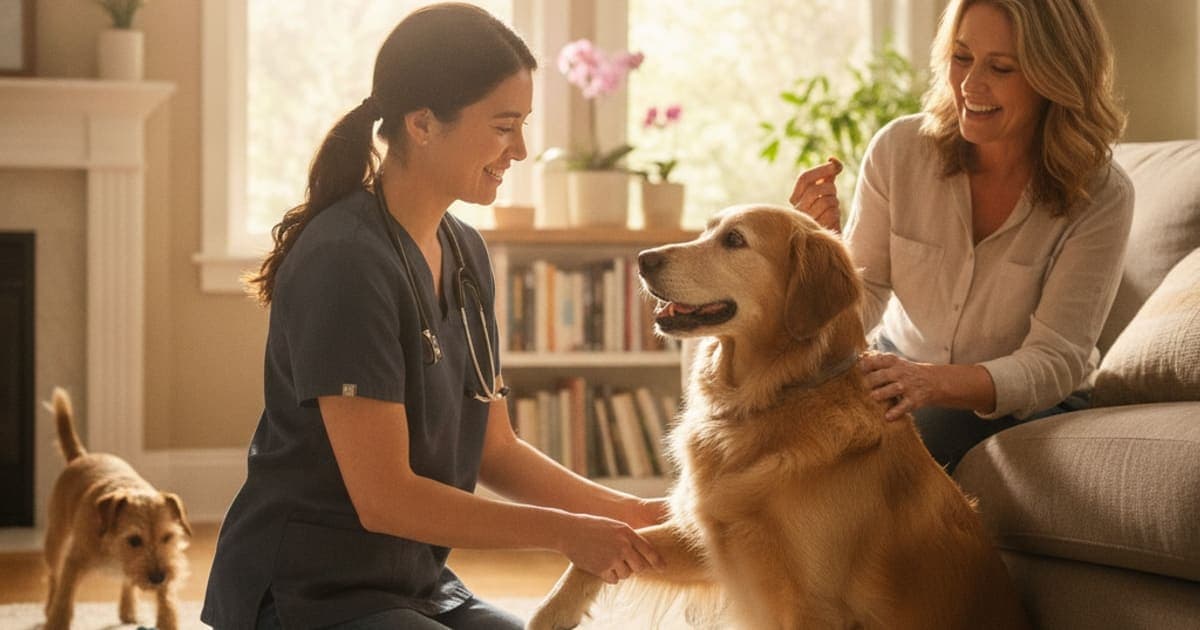
Senior dog stiffness is diagnosed by a veterinarian, not by a single test. The workup combines a detailed history from you, observation of how your dog moves, a hands-on orthopaedic and neurological examination, joint-by-joint palpation, and — where indicated — radiographs, bloodwork and joint fluid analysis. The purpose is to name the cause.
That last point is the whole game. Stiffness is a symptom shared by degenerative joint disease, spinal cord conditions, endocrine disease, tick-borne infection and immune-mediated arthritis. Veterinarians often support the physical exam with validated owner-reported instruments — tools such as the Canine Brief Pain Inventory, the Liverpool Osteoarthritis in Dogs (LOAD) questionnaire and the Helsinki Chronic Pain Index exist precisely because chronic stiffness reveals itself at home, in the hours no clinician ever sees.
Stiffness is a sign, not a diagnosis
When an eleven-year-old retriever takes three attempts to stand off a tile floor, the owner's mental shorthand is usually "arthritis." Often that is correct. Osteoarthritis is genuinely common in older dogs, and the pattern — worse after rest, better after a few minutes of movement, worse again after a long walk — fits it well.
But several other conditions produce a dog who is slow, reluctant and stiff-looking, and they are managed completely differently:
- Osteoarthritis and degenerative joint disease — cartilage loss, bone remodelling, joint capsule thickening. Localised to specific joints, and usually worse in cold weather and after rest.
- Intervertebral disc disease and lumbosacral disease — spinal pain, reluctance to jump, a hunched or shuffling gait, sometimes scuffed toenails.
- Degenerative myelopathy — a progressive spinal cord condition that causes weakness and incoordination rather than pain, and which is associated with a mutation in the SOD1 gene that can be tested for.
- Immune-mediated polyarthritis — several painful joints at once, sometimes with fever and a shifting lameness.
- Tick-borne disease — infectious causes of joint pain that can look like sudden-onset arthritis in a previously comfortable dog.
- Hypothyroidism — an endocrine cause of weakness, lethargy and exercise reluctance that owners frequently read as "just old age."
- Soft tissue injury and compensatory strain — a partially torn cruciate ligament in one knee producing overload, muscle soreness and stiffness on the opposite side.
Stiffness that has an owner reaching for a supplement is stiffness that first needs a diagnosis — no label on a bottle can tell you whether you are looking at a worn joint, a compressed spinal cord or a thyroid gland that stopped keeping up.
The history: what you tell the vet does half the work
A good stiffness consultation starts with questions, not hands. Expect to be asked when the stiffness is worst, how long it takes to loosen up, whether it is worse after rest or after exercise, whether your dog has stopped doing specific things — stairs, the car, the sofa, the last hundred metres of the walk — and whether the change came on over months or over a fortnight.
Gradual, symmetrical decline over seasons points one direction. A dog who was fine on Tuesday and reluctant to stand on Friday points somewhere else entirely, and usually gets seen sooner.
Video is enormously useful here. Many dogs walk beautifully for ninety seconds in a clinic corridor on an adrenaline surge, then hobble getting out of the car at home. Film your dog rising from lying down, walking away from and toward the camera on a flat surface, and negotiating a step. Bring it. Vets ask for it for a reason.
It is also worth writing down a plain list of everything your dog has stopped doing, plus every medication and supplement currently going in — including anything you started yourself. Talk to your veterinarian about the full list rather than editing it; interactions and duplicated ingredients matter more than owners expect.
The hands-on exam: gait, palpation and range of motion
The physical examination is the core of the diagnosis. It usually runs in a set order.
Gait observation. Your dog is walked and often trotted, away and back, on a non-slip surface. The vet is watching for a head bob (which typically indicates forelimb pain), a hip drop, a shortened stride, toe scuffing, and how the dog turns — tight turns expose hip and stifle pain quickly.
Standing posture and weight distribution. Dogs shift weight off painful limbs. Muscle mass asymmetry — a thinner thigh on one side — is a durable clue that a limb has been under-used for weeks or months.
Joint-by-joint palpation and range of motion. Each joint is flexed and extended through its normal arc while the vet feels for crepitus (the gritty grinding of a degenerating joint), effusion, thickening of the joint capsule, and the point at which the dog objects. Reduced range of motion in a specific joint is one of the more reliable physical findings in degenerative joint disease.
Spinal and neurological assessment. The spine is palpated segment by segment. Reflexes, proprioception (does the dog know where its foot is?) and postural reactions are tested. This step is what separates an orthopaedic problem from a neurological one — a distinction that changes everything about what happens next.
Sedated examination, when needed. Painful dogs guard. A tense, splinting dog can mask a torn cruciate ligament or hip instability entirely. Sedation removes muscle tension so the vet can assess true joint stability and range, and it is frequently combined with radiographs in the same visit.
Imaging, bloodwork and the tests that confirm a cause
Diagnostics are chosen based on what the exam found — not ordered as a job lot. Here is what each tool contributes.
| Diagnostic | What it shows | When a vet typically reaches for it |
|---|---|---|
| Radiographs (X-rays) | Joint space narrowing, osteophytes, bone remodelling, spinal changes, bone tumours | First-line imaging for a stiff, painful limb, hip or back |
| Sedated orthopaedic exam | Joint instability, cranial drawer motion, true unguarded range of motion | When muscle tension masks findings on the awake exam |
| Complete blood count and biochemistry | Organ function, systemic inflammation, a baseline before long-term medication | Before starting ongoing anti-inflammatories, or with systemic signs |
| Thyroid testing | Hypothyroidism presenting as weakness and exercise reluctance | Older dog with coat, weight or energy changes alongside stiffness |
| Tick-borne disease testing | Infectious causes of joint pain and shifting lameness | Multi-joint or shifting lameness, fever, or known tick exposure |
| Joint fluid analysis (arthrocentesis) | Immune-mediated or septic arthritis versus degenerative change | Several painful joints at once, or arthritis that does not fit the picture |
| CT or MRI | Discs, spinal cord, nerve roots, and fine joint detail | Neurological deficits, or planning surgery |
| SOD1 genetic testing | Risk status for degenerative myelopathy | Progressive, non-painful hind-limb weakness and incoordination |
Radiographic findings and clinical signs do not always match neatly — a dog can have dramatic-looking films and move comfortably, or modest changes and considerable pain. That mismatch is well recognised in veterinary orthopaedics, and it is why the exam and the history carry so much weight against the images.
After a diagnosis: the recovery window owners build around
Once there is a name on the problem, a treatment plan follows: weight management, controlled and consistent exercise, physical rehabilitation, prescribed pain control where appropriate, and surgery where the diagnosis calls for it. Nothing belongs in front of that. Prescribed anti-inflammatories, Librela, gabapentin or a surgical repair are decisions your vet owns, and no supplement is a reason to alter any of them.
What supplements can do is occupy the space that proper veterinary care creates — the weeks and months of tissue remodelling, deconditioning and rebuilding that follow a diagnosis or a procedure. That is where owners have been looking at peptides.
K9-REPAIR from pawgen is a BPC-157 and TB-500 formulation made specifically for dogs. BPC-157 is a synthetic peptide based on a sequence identified in gastric juice; published laboratory and animal research suggests it may influence angiogenesis and the migration of tendon and ligament fibroblasts — the cellular machinery of connective tissue remodelling. TB-500 is a synthetic peptide related to thymosin beta-4, a naturally occurring protein that research indicates plays a role in actin regulation, cell migration and new blood vessel formation. Neither treats or cures any condition. Owners choose the pair as the stack they run alongside a vet-directed recovery plan, and the research behind both is genuinely promising.
The practical differences worth knowing: pawgen dosing is structured by body weight, batches are third-party tested with certificates of analysis available, orders ship direct to your door, and the product carries a 60-day money-back guarantee. That is a different proposition from a joint chew with fourteen ingredients on the label and meaningful amounts of none of them — the underdosed kitchen-sink approach is where most of the money in this category quietly goes.
Key Takeaways
- Stiffness in an older dog is a sign, not a diagnosis. Osteoarthritis is common, but spinal, endocrine, infectious and immune-mediated causes look similar from across the room.
- The diagnostic backbone is history plus a hands-on orthopaedic and neurological exam, with imaging and bloodwork chosen to confirm or exclude specific causes.
- Video of your dog rising, walking and taking a step, filmed at home, is one of the most useful things you can bring to the appointment.
- Sedation is often needed to assess joint stability and true range of motion in a guarding dog.
- Radiographic severity and clinical comfort frequently do not line up, which is why the physical exam remains central.
- Diagnosis first, then a vet-led plan; supplements including K9-REPAIR sit alongside that plan, never in place of it.
For a fuller picture of the condition itself, pawgen's guide to senior dog stiffness covers presentation and management in depth, and there are dedicated explainers on bpc-157 for senior dog stiffness in dogs, tb-500 for senior dog stiffness in dogs and the wolverine stack for senior dog stiffness in dogs. Regulatory and handling questions are worth raising directly with your veterinarian, and product details are on the K9-REPAIR page.
Your veterinarian owns the diagnosis and owns the treatment plan. They are the one who can tell a worn hip from a compressed disc, decide whether radiographs or a thyroid panel come next, and prescribe the pain control your dog may need to move comfortably again. Bring them your video, your list, and your questions — including questions about anything you are considering adding. Everything else, including peptides, works in the space that proper veterinary care creates.
Owners exploring peptide support for their dog can review K9-REPAIR — BPC-157 + TB-500 formulated for dogs — at https://pawgen.com/. Nothing in this article treats, cures or prevents any condition; every decision about your dog's care belongs with your veterinarian.
Frequently asked questions
- Is senior dog stiffness in dogs painful?
- Often, yes — but not always. Osteoarthritis, disc disease and immune-mediated arthritis are genuinely painful, while conditions such as degenerative myelopathy cause weakness without much pain. Dogs rarely cry out; they withdraw, slow down and stop doing things. Only a veterinary exam can tell pain from mechanical weakness reliably.
- What makes senior dog stiffness worse in dogs?
- Cold and damp weather, long periods of rest, slippery floors, excess body weight, and the weekend-warrior pattern of little activity midweek followed by a long hike. Untreated pain in one limb also drives compensatory strain elsewhere. Consistent daily movement and traction underfoot typically matter more than owners expect.
- Can senior dog stiffness in dogs be reversed?
- Structural cartilage loss in osteoarthritis is not reversible, and no product should be described as reversing it. However, comfort and function are frequently improved a great deal through weight management, rehabilitation, vet-prescribed pain control and, where indicated, surgery. Some causes — hypothyroidism, tick-borne infection — respond directly to specific treatment.
- How much does it cost to treat senior dog stiffness in dogs?
- Costs vary widely by clinic, region, diagnosis and dog size, so any single figure would be misleading. Budget in stages: the initial consultation and exam, then diagnostics such as radiographs or bloodwork, then ongoing management. Ask your veterinary practice for a written estimate before each stage — most will provide one.
- What are the first signs of senior dog stiffness in dogs?
- Hesitation before jumping into the car or onto furniture, a slower rise from lying down, lagging at the end of walks, reluctance on stairs, and a shortened stride first thing in the morning. Subtle behaviour changes — irritability when handled, sleeping in different places — often appear before any visible limp.
- What helps a dog with senior dog stiffness?
- A vet-led plan comes first: accurate diagnosis, weight management, controlled daily exercise, physical rehabilitation, traction on slippery floors, and prescribed pain control where appropriate. Alongside that, many owners add supplements. pawgen's K9-REPAIR combines BPC-157 and TB-500, peptides that research suggests may support tissue remodelling processes. Discuss anything you add with your veterinarian.
- Does my senior dog need X-rays to diagnose stiffness?
- Not automatically. Radiographs are the usual first-line imaging when the exam localises pain to a joint or the spine, or when a plan needs confirming before surgery or long-term medication. Some dogs are diagnosed and managed on history and physical exam alone. Your veterinarian decides based on exam findings.
- How should BPC-157 and TB-500 be used for dogs?
- They should be discussed alongside veterinary care, not used in place of it. They are peptides that owners are adopting alongside vet-directed recovery plans, with research suggesting roles in angiogenesis and cell migration. Discuss anything you add with your veterinarian, particularly if your dog takes prescribed medication.
Educational content. BPC-157 and TB-500 are not FDA-approved veterinary drugs. Talk to your veterinarian before starting anything new, especially if your dog is on prescribed medication.