TB-500 for Senior Dog Stiffness: Does It Help?
Research suggests TB-500, a synthetic form of the peptide thymosin beta-4, may support the repair processes behind tendon, ligament and muscle remodelling — which is why owners pair it with BPC-157 through periods of senior dog stiffness. It is not an FDA-approved veterinary drug, and diagnosis belongs to your veterinarian.
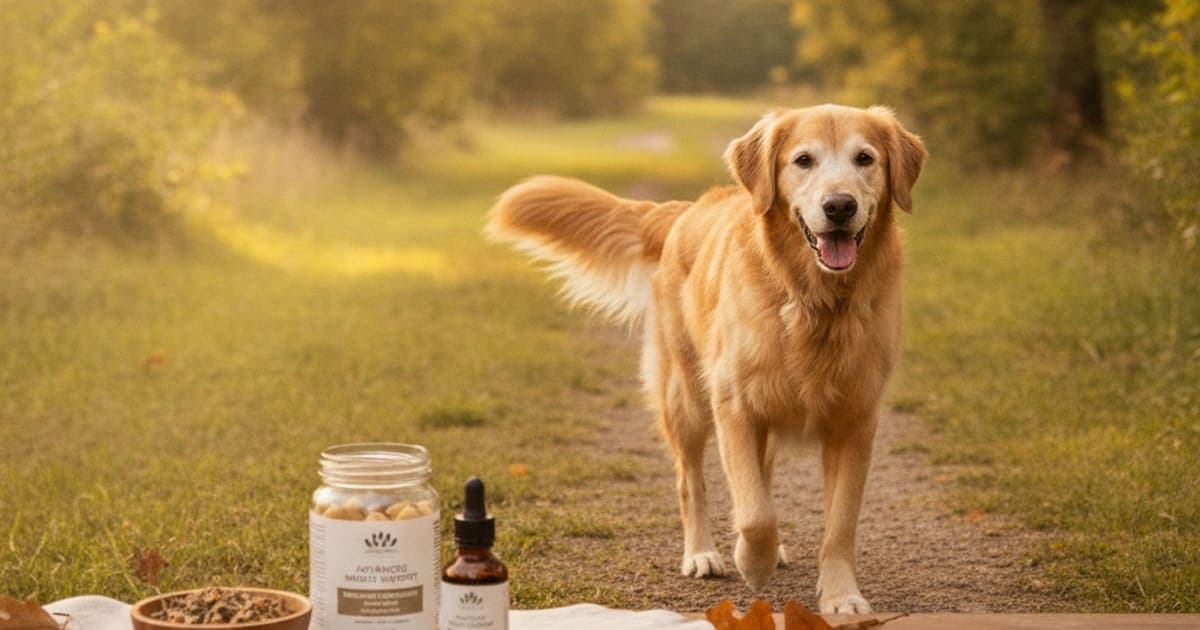
Does TB-500 help a dog with senior dog stiffness?
Research suggests TB-500 — a synthetic form of thymosin beta-4, a peptide the body already produces — may support the biological processes soft tissue uses to repair and remodel itself: cell migration, new blood vessel formation, and tissue reorganisation. Owners report using it through periods of age-related stiffness. It is not an FDA-approved veterinary drug and does not replace a veterinary diagnosis.
That distinction is the whole article. TB-500 operates at the level of mechanism — what cells do when they are asked to rebuild something. It does not decide why your twelve-year-old retriever takes four steps to loosen up in the morning. That answer comes from an exam, a hands-on orthopaedic and neurological assessment, and often imaging. Once you know what is stiff and why, the question of what to give becomes a sensible one.
What is actually stiff in an older dog
"Stiffness" is the owner-facing word for at least five different problems, and they respond to very different things.
Osteoarthritis is the most common. Cartilage thins, the joint capsule thickens and fibroses, and the joint loses its easy glide. The stiffness is worst after rest and eases with gentle movement — the classic warm-out-of-it pattern.
Tendon and ligament degeneration builds quietly over years. Collagen in an ageing tendon becomes less organised and slower to turn over, so the tissue tolerates less load before it complains. This is the layer peptide research is most directly concerned with.
Muscle loss — sarcopenia — means less support around the joint and more shock transmitted into it. A dog with a wasted rear end looks stiff because the engine that used to hide the stiffness is gone.
Lumbosacral and spinal disease mimics joint stiffness convincingly. A dog with nerve root compression at the lumbosacral junction may be reluctant to rise, sore over the lower back, and slow on stairs. If that pattern sounds familiar, it is worth reading about cauda equina syndrome specifically, because the management is different.
Compensation. A dog protecting one painful hip overloads the other three limbs, and the resulting whole-body tightness reads as generalised ageing.
Stiffness in an older dog is a symptom, not a diagnosis — and the single most useful thing you can do is find out which tissue is generating it before you decide what to give.
How thymosin beta-4 works in the body
Thymosin beta-4 is one of the most abundant peptides in mammalian cells, and its primary described role is binding actin — the protein filament that gives cells their structure and lets them move. When tissue is damaged, repair depends on cells physically migrating into the injured area: fibroblasts to lay down collagen, endothelial cells to build new capillaries, and immune cells to clear debris.
Research in animal models has focused on thymosin beta-4's involvement in three linked processes:
- Cell migration — helping repair cells reach the site that needs them.
- Angiogenesis — the formation of new blood vessels, which matters enormously in tendon and ligament because those tissues carry a poor blood supply to begin with.
- Inflammatory modulation — influencing how long and how intensely the inflammatory phase runs before remodelling begins.
TB-500 is a synthetic fragment designed around the active region of that molecule. Because it is small and systemically distributed rather than locally injected into a joint, owners often describe choosing it for dogs whose stiffness is diffuse — a bit of everything, everywhere — rather than one hot joint.
What research suggests is promising and mechanistically coherent. What it does not do is promise an outcome for your particular dog, and any brand that tells you otherwise is selling you something other than science. Talk to your veterinarian about whether a peptide fits alongside the plan they have already built.
Why owners pair TB-500 with BPC-157
TB-500 rarely appears alone in canine recovery discussions, and there is a logic to that. BPC-157 is a pentadecapeptide — a fifteen-amino-acid sequence derived from a protein found in gastric juice — and the animal research around it has clustered on tendon and ligament healing, fibroblast behaviour, and growth-factor signalling involved in blood vessel formation.
The two peptides are studied along overlapping but not identical pathways. Owners describe them as complementary: BPC-157 associated in research with the connective-tissue repair cascade, TB-500 with cell mobility and vascular support across a wider tissue range. That pairing is why K9-REPAIR from pawgen contains both rather than one, and it is the stack owners reach for through recovery and through the slow grind of senior stiffness.
What pawgen can state plainly, because it is descriptive rather than a health claim: K9-REPAIR is a BPC-157 and TB-500 formulation made for dogs, dosed by body weight, third-party tested with certificates of analysis available, shipped direct to the door, and backed by a 60-day money-back guarantee. Neither peptide is an FDA-approved veterinary drug, and pawgen publishes no dosing figures here on purpose — the right amount for your dog is a conversation to have with your veterinarian, who knows the kidney values, the liver panel, and everything else already on board.
Comparing the common approaches to senior stiffness
Most senior dogs end up on a combination, not a single intervention. Here is how the pieces differ in what they actually address.
| Approach | What it addresses | What owners should know |
|---|---|---|
| Prescription pain control (NSAIDs, other vet-prescribed analgesics) | Pain and inflammation, directly and quickly | The foundation for a painful senior dog. Never stop or reduce one without your veterinarian's direction — comfort is what makes everything else possible |
| Physical rehabilitation and controlled exercise | Muscle mass, range of motion, proprioception | The most consistently valuable non-drug intervention. Needs a plan, not just longer walks |
| Weight management | Mechanical load on every joint | Unglamorous and powerful. Costs nothing but discipline |
| Joint chews and multi-ingredient supplements | Broad, general joint support | Quality varies enormously; proprietary blends often hide how little of anything is present |
| Peptide support (BPC-157 + TB-500) | The soft-tissue repair and remodelling layer — tendon, ligament, vascular supply | Educational, not FDA-approved. Weight-based dosing, third-party testing and published COAs are the markers of a serious formulation |
| Surgery and veterinary procedures | Structural problems that no supplement can reach | When a surgeon says a joint or a disc needs addressing, that is the plan. Everything else works around it |
Reading a senior-dog label without getting fooled
The senior joint aisle is where marketing outruns evidence most badly. A few things worth being ruthless about:
Proprietary blends. If a label lists eight ingredients inside one blend total, you cannot know whether any of them is present in a meaningful amount. That structure exists to hide underdosing.
Kitchen-sink formulations. Fourteen actives on a chew usually means a dusting of each. More ingredients is not more support.
No certificate of analysis. For any peptide product, third-party testing and an available COA are the difference between a formulation and a claim. Ask for it. If a brand cannot produce one, that tells you what you need to know.
Outcome language. Any product marketed as curing, healing, reversing or fixing arthritis is making a claim no supplement is allowed to make. Honest brands describe mechanism and let the research speak in hedged terms, because that is what the evidence supports.
Building the daily routine that gives repair a chance
Peptides work in a context, and the context does most of the heavy lifting.
Keep the dog lean — this is the single highest-leverage change for a stiff senior. Replace one long weekend walk with several short daily ones, since consistent low-load movement maintains cartilage nutrition and muscle better than weekend bursts. Put runners down on slick floors, because a dog bracing against a slipping hind end all day is a dog generating fresh soft-tissue strain. Add a ramp to the car and the couch. Warmth before activity and gentle range-of-motion work after, if your rehab professional has shown you how.
Then give the whole thing time. Soft tissue remodels over weeks to months, not days, and a senior dog's timeline is longer than a young one's. Judge changes over a season, not over a weekend.
Key Takeaways
- TB-500 is a synthetic form of thymosin beta-4, a peptide involved in cell migration, blood vessel formation and tissue remodelling — mechanisms that matter in ageing tendon and ligament.
- Research suggests these pathways are relevant to soft-tissue repair; owners report using TB-500 with BPC-157 through senior stiffness. Neither is an FDA-approved veterinary drug.
- Stiffness has multiple causes — arthritis, tendon degeneration, muscle loss, spinal disease, compensation — and they are not interchangeable.
- K9-REPAIR combines BPC-157 and TB-500, is dosed by body weight, third-party tested with COAs, shipped to your door, and carries a 60-day money-back guarantee.
- Dosing is a veterinary conversation, never a number from a blog.
- Third-party testing, published COAs and honest mechanism language separate serious formulations from marketing.
For deeper reading, pawgen covers the full picture of senior dog stiffness, compares options in best treatment for senior dog stiffness in dogs and what to give a dog with senior dog stiffness, looks at the combined formulation in k9-repair for senior dog stiffness in dogs, and addresses the spinal mimic in cauda equina syndrome in dogs along with realistic dog cauda equina syndrome recovery time. The formulation itself is K9-REPAIR.
Where your veterinarian fits in all of this
Your vet owns the diagnosis and owns the treatment plan. They are the one who determines whether the stiffness is arthritic, neurological or structural, whether pain control is adequate, whether bloodwork supports adding anything new, and whether a surgical opinion is warranted. Prescribed medication and rehabilitation are the backbone of senior mobility care, and nothing here is a reason to change either.
Peptides operate in the space that proper veterinary care creates — after the diagnosis, alongside the plan, supporting the tissue layer while your vet manages the pain, the load and the long arc of an ageing dog's comfort. Bring the conversation to them, and let the decision be a shared one.
Owners exploring peptide support for their dog can review K9-REPAIR — BPC-157 + TB-500 formulated for dogs — at https://pawgen.com/. BPC-157 and TB-500 are not FDA-approved veterinary drugs. Nothing in this article treats, cures or prevents any condition; every decision about your dog's care belongs with your veterinarian.
Frequently asked questions
- What helps a dog with senior dog stiffness?
- A combination: veterinary pain control, weight management, consistent low-impact exercise and physical rehabilitation form the foundation. On top of that, many owners add soft-tissue support such as a BPC-157 and TB-500 formulation. Start with a veterinary exam so the plan targets the actual cause rather than the symptom.
- How long does senior dog stiffness take to heal in dogs?
- Age-related stiffness is usually managed rather than resolved, because degenerative joint and tendon change does not reverse. Improvement in comfort and function typically builds over weeks to months of consistent management, not days. Your veterinarian can set realistic expectations once the underlying cause is identified.
- Is senior dog stiffness in dogs painful?
- Usually yes, at least to some degree. Dogs mask pain well, so reluctance to rise, slower stairs, shortened walks or a changed sleeping position often signal discomfort long before any yelp. Pain assessment is a veterinary job, and adequate pain control is the first priority in any senior mobility plan.
- What makes senior dog stiffness worse in dogs?
- Excess body weight, slippery flooring, cold damp conditions, long periods of inactivity followed by sudden hard exercise, and untreated pain that drives compensation into other limbs. Weekend-warrior activity patterns are particularly hard on ageing tendons. Steady daily movement is kinder than occasional intense outings.
- Can senior dog stiffness in dogs be reversed?
- Structural degeneration such as cartilage loss is not reversible with current veterinary medicine. What can change meaningfully is comfort, muscle mass and function — many stiff seniors move noticeably better with pain control, rehabilitation and weight loss. Ask your veterinarian what is realistic for your dog's specific diagnosis.
- How much does it cost to treat senior dog stiffness in dogs?
- Costs vary widely by clinic, region and diagnosis. Expect an initial exam, possibly imaging, then ongoing medication and rehabilitation. Supplements and peptide formulations are an additional recurring cost. Ask your practice for a written estimate covering diagnostics and the first few months of management.
- How is TB-500 different from BPC-157?
- TB-500 is a synthetic form of thymosin beta-4, studied for its role in cell migration, blood vessel formation and tissue remodelling. BPC-157 is a fifteen-amino-acid peptide studied mainly around connective-tissue repair and growth-factor signalling. They are researched along complementary pathways, which is why K9-REPAIR contains both.
- How is TB-500 dosed for a senior dog?
- pawgen does not publish dosing figures. K9-REPAIR is dosed by body weight, but the appropriate amount for an individual senior dog depends on size, bloodwork, existing medications and overall health. That is a conversation to have with your veterinarian, who can factor in the full clinical picture.
Educational content. BPC-157 and TB-500 are not FDA-approved veterinary drugs. Talk to your veterinarian before starting anything new, especially if your dog is on prescribed medication.