How Long Does Cruciate Surgery Recovery Take in Dogs?
Most dogs follow a staged cruciate surgery recovery lasting several months, not weeks: strict confinement and controlled leash walks first, then gradual loading, then a return to normal activity your surgeon signs off on. Bone healing after TPLO or TTA is confirmed by follow-up radiographs, not by calendar dates.
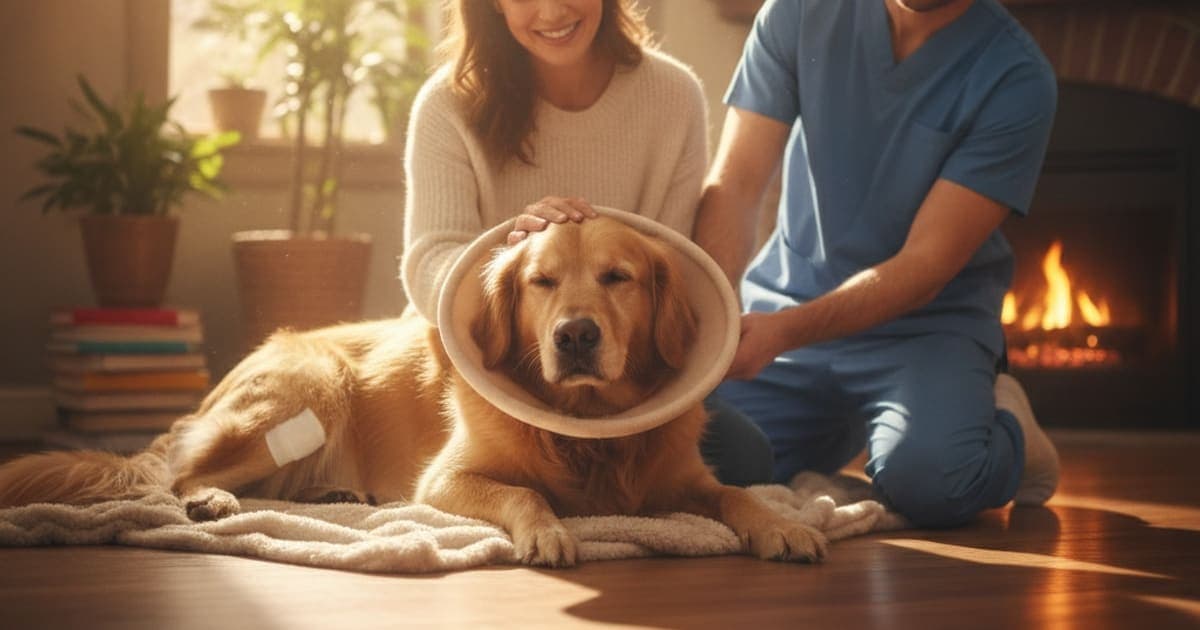
How Long Does Cruciate Surgery Recovery Take to Heal in Dogs?
Cruciate surgery recovery in dogs is measured in months, not weeks. Most dogs move through three phases — strict confinement, controlled leash loading, then a graded return to normal activity — with the surgeon setting each milestone from rechecks rather than a calendar. The American College of Veterinary Surgeons stresses that postoperative activity restriction and rehabilitation shape the result as much as the procedure itself.
That is the honest short answer, and the reason it isn't a single tidy number is worth understanding. Two dogs who have the same operation on the same morning can be on very different schedules two months later. Procedure type, body weight, whether the meniscus was damaged, how much arthritis was already in the joint, how well pain is controlled, and how disciplined the household is with confinement all move the line. Your surgeon's recheck examination — and, for bone-cutting procedures, follow-up radiographs — decides when your dog graduates from one phase to the next.
What is actually healing inside that leg
The cranial cruciate ligament in dogs usually doesn't snap the way an athlete's ACL does. It degenerates and frays over time, and the joint becomes progressively unstable. That distinction matters for recovery, because it means the joint was already changing before the day your dog held the leg up.
Surgery doesn't replace the ligament in most cases. It changes the mechanics of the joint so the dog can load the limb without the tibia sliding forward. What heals afterwards depends on which route your surgeon took.
With a levelling osteotomy such as a TPLO or a TTA, the surgeon cuts bone and stabilises it with a plate and screws. The rate limiter on that recovery is bone healing, and bone heals on its own biological schedule regardless of how good your dog feels. Bone moves through an inflammatory phase, a soft callus phase, a hard callus phase, then a long remodelling phase in which the new bone reorganises along the lines of stress it is asked to carry.
With an extracapsular or lateral suture repair, the implant holds the joint while the body lays down periarticular fibrous tissue — scar tissue around the joint — that becomes the long-term stabiliser. That fibrosis matures gradually, and the suture material is expected to loosen or fail eventually, which is why controlled loading during the maturation window matters so much.
Everything else is happening at the same time: the joint capsule is inflamed, the meniscus may have been trimmed, the quadriceps and hamstring on that side have already lost mass from weeks of limping, and cartilage changes are ongoing. Muscle rebuilds only when it is loaded, and it rebuilds more slowly than owners expect.
The three phases of a controlled recovery
Phase one — protection. The dog lives in a confined space, goes outside on a short leash to toilet, and does nothing else. No stairs without a sling or support, no furniture, no slippery floors, no greeting visitors at the door, no play with other dogs. Incision checks daily. Pain medication is given exactly as prescribed, on schedule, not when the dog looks sore — controlled pain means a dog that uses the limb normally rather than compensating onto the other side.
This is the phase where recoveries are won or lost. Dogs start feeling better long before the bone or the fibrous tissue is anywhere near mature, and a single leap off a bed at week three can undo the operation. If your dog is bright, bored and pushing the limits of confinement, tell your veterinarian rather than relaxing the rules yourself — sedation, chew work, food puzzles and scent games solve boredom without loading the joint.
Phase two — controlled loading. Once your surgeon clears it, leash walks lengthen on a written schedule. This is deliberate, structured work: flat ground, even surfaces, a steady walking pace, no sniff-and-lunge, no pivoting, no ball. Prescribed exercises often include weight-shifting, sit-to-stand repetitions, controlled backing up and slow figure work. Each of these targets the specific muscles that stabilise the stifle.
The goal in this phase is not distance. It is symmetry. A dog who trots twenty minutes with a subtle hitch is telling you something a dog who trots five minutes cleanly is not.
Phase three — return to function. After the surgeon confirms healing — for osteotomies, that generally means radiographs — activity expands in graded steps. Hills, trot work, longer walks, then eventually off-leash freedom and, for sporting dogs, a sport-specific return that is slower again. Many dogs look completely normal well before this point. Looking normal is not the same as being healed, and the gap between the two is exactly where re-injury happens.
Ask your veterinarian for the phase criteria in writing at discharge, so you know what your dog has to demonstrate before each step up rather than guessing from the date.
How the common procedures compare
| Approach | What it changes | Character of the recovery | What healing depends on |
|---|---|---|---|
| TPLO (tibial plateau levelling osteotomy) | Rotates the tibial plateau so the joint is dynamically stable | Structured, staged, driven by radiographic bone healing at recheck | Bone union across the osteotomy, implant stability, strict early restriction |
| TTA (tibial tuberosity advancement) | Advances the tibial tuberosity to neutralise shear force | Similar staged structure to TPLO; also an osteotomy | Bone healing and ingrowth at the cut site, controlled loading |
| Extracapsular / lateral suture | Places an implant outside the joint to hold it while scar tissue forms | Often used in smaller dogs; depends on maturing fibrous tissue | Periarticular fibrosis maturing before the implant loosens |
| Conservative management (no surgery) | Weight control, restriction, rehab and vet-directed pain management | Slower and less predictable; the joint remains unstable | Body condition, arthritis progression, owner compliance |
None of these is universally better. The right choice depends on your dog's size, age, activity level, the state of the meniscus and the other stifle, and your surgeon's judgement — which is a conversation to have with them, not a decision to make from a table on the internet.
What stretches the timeline out
Meniscal injury. A meniscal tear present at surgery, or one that develops later in a stabilised joint, produces a sudden setback — a dog who was improving goes lame again, sometimes with a click. This needs veterinary assessment, not waiting.
Excess body weight. Every extra kilogram is load on a healing osteotomy and on an arthritic joint. Lean body condition is one of the few variables an owner controls completely, and it influences both the recovery and the rest of the dog's mobility life.
Doing too much, too soon. The most common cause of a stalled recovery isn't a surgical problem. It's a week of enthusiastic walks after the dog started looking good.
Inadequate pain control. A painful dog offloads the limb, the muscles waste further, the other side takes the strain. Report breakthrough pain rather than pushing through it.
Complications. Incision infection, implant irritation, or seroma formation all extend the schedule. Daily incision checks in the first phase exist for this reason.
The other leg. Cranial cruciate disease is frequently bilateral. Many dogs eventually develop problems in the opposite stifle, which is why conditioning and body weight matter for both hind limbs, not just the operated one.
Pre-existing arthritis. Surgery stabilises the joint; it does not erase the osteoarthritis that was already there. Long-term joint management usually continues well past the point the surgeon discharges the case.
Rehabilitation and the recovery stack owners build around it
Formal rehabilitation — passive range of motion, therapeutic exercise, underwater treadmill work, laser or manual therapy delivered by a rehabilitation-trained veterinary professional — is the best-supported add-on to cruciate surgery. If it's available to you, use it. If it isn't, ask your surgeon for a home exercise programme.
Supplement decisions are where owners get taken advantage of. Kitchen-sink chews with fourteen ingredients hidden behind a proprietary blend, no third-party testing, no certificate of analysis, and doses too low to matter are marketing, not nutrition. Read labels for actual amounts and independent verification, and ask your veterinarian before adding anything to a post-operative plan.
pawgen's K9-REPAIR takes the opposite approach: two peptides, BPC-157 and TB-500, with weight-based dosing guidance to work through with your veterinarian, third-party testing and certificates of analysis, direct-to-door shipping and a 60-day money-back guarantee. Neither peptide is an FDA-approved veterinary drug, and this is educational information rather than a treatment claim.
The mechanism is why owners are adopting them through recovery. BPC-157 is a synthetic peptide based on a sequence identified in gastric juice; published preclinical work suggests it may support angiogenesis — the growth of new blood supply — and fibroblast migration at healing connective tissue, the processes that carry oxygen and building material into tendon, ligament and bone. TB-500 relates to thymosin beta-4, a naturally occurring actin-binding protein involved in cell migration and new vessel formation. Research suggests both act on repair signalling rather than on pain perception, which is exactly why they sit alongside a surgical recovery plan and never in place of one.
That boundary is firm: peptides are not a substitute for surgery, and nothing here is a reason to stop or reduce carprofen, gabapentin, Librela or anything else your veterinarian prescribed. Those decisions belong to your vet.
Key takeaways
- Cruciate surgery recovery in dogs runs in months and in phases, not on a fixed number of weeks.
- For TPLO and TTA, bone healing is the rate limiter and recheck radiographs define progress.
- Extracapsular repairs depend on scar tissue maturing around the joint, which also takes controlled time.
- Strict phase-one confinement is the highest-leverage thing an owner does.
- A dog looking normal is not the same as a dog being healed.
- Meniscal injury, excess weight, poor pain control and doing too much too soon are the classic timeline-stretchers.
- Rehabilitation, lean body condition and evidence-led support are what fill the months between surgery and full function.
For deeper reading, pawgen's guide to cruciate surgery recovery covers the condition end to end, with companion articles on what makes cruciate surgery recovery worse in dogs, can cruciate surgery recovery in dogs be reversed, how much does it cost to treat cruciate surgery recovery in dogs, where do i buy bpc-157 for my dog, can bpc-157 replace my dogs pain medication and the K9-REPAIR formulation itself.
Your veterinarian and surgeon own the diagnosis, the procedure, the pain protocol and the timeline — they are the only people who can examine the joint, read the radiographs and tell you what your dog is ready for. Nutrition, rehabilitation and peptide support operate inside the space that proper veterinary care creates, never instead of it.
Owners exploring peptide support for their dog can review K9-REPAIR — BPC-157 + TB-500 formulated for dogs — at https://pawgen.com/. BPC-157 and TB-500 are not FDA-approved veterinary drugs. Nothing in this article treats, cures or prevents any condition; every decision about your dog's care belongs with your veterinarian.
Frequently asked questions
- What makes cruciate surgery recovery worse in dogs?
- Doing too much too soon is the leading cause of setbacks, usually once the dog starts feeling better. Excess body weight, undertreated pain, meniscal injury, incision infection or implant problems, slippery floors, stairs and unsupervised play all stretch the timeline. Existing arthritis and instability in the opposite stifle also slow progress.
- Can cruciate surgery recovery in dogs be reversed?
- Recovery itself isn't reversed, but progress can be lost. A jump, a slip or an off-leash sprint before the surgeon clears it can damage healing bone, loosen an implant or tear a meniscus, sending your dog back to square one. If lameness suddenly returns, contact your veterinarian rather than waiting.
- How much does it cost to treat cruciate surgery recovery in dogs?
- Costs vary widely by procedure, dog size, clinic and region, so ask your surgeon for a written estimate. Beyond the operation itself, budget for pre-operative bloodwork and imaging, pain medication, recheck examinations, follow-up radiographs for bone-cutting procedures, rehabilitation sessions, and possible surgery on the opposite leg later.
- What helps a dog with cruciate surgery recovery?
- Strict adherence to the surgeon's confinement and exercise schedule helps most, followed by consistent pain medication, lean body condition, non-slip flooring and formal rehabilitation where available. Many owners also add K9-REPAIR, a BPC-157 and TB-500 peptide formulation, alongside the veterinary plan. Discuss any supplement with your veterinarian first.
- Is cruciate surgery recovery in dogs painful?
- There is real post-operative pain, which is why surgeons send dogs home with a multi-modal pain plan. Given on schedule rather than only when the dog looks uncomfortable, that plan keeps most dogs settled and using the limb. Report panting, restlessness, reluctance to weight-bear or breakthrough pain to your veterinarian promptly.
- When can my dog run off-leash again after cruciate surgery?
- Only after your surgeon confirms healing at recheck and clears the final phase, and then in graded steps rather than all at once. Dogs look normal well before the bone or fibrous tissue is mature, so appearance is not the criterion. Ask for written phase-progression criteria at discharge.
- Does my dog need physical therapy after cruciate surgery?
- Formal rehabilitation is the best-supported addition to a surgical recovery, rebuilding the muscle that wasted during months of limping and restoring symmetrical loading. If a rehabilitation-trained veterinary professional is available, use one. If not, ask your surgeon for a structured home exercise programme rather than improvising walks.
- How do BPC-157 and TB-500 fit into a post-surgical plan?
- They sit alongside veterinary care, never in place of it. Research suggests BPC-157 may support angiogenesis and fibroblast activity in connective tissue, while TB-500 relates to a protein involved in cell migration and vessel formation. Neither is FDA-approved for dogs, and neither replaces prescribed medication or surgery.
Educational content. BPC-157 and TB-500 are not FDA-approved veterinary drugs. Talk to your veterinarian before starting anything new, especially if your dog is on prescribed medication.