How Long Does FHO Surgery Recovery Take in Dogs? (Timeline)
FHO surgery recovery in dogs is measured in months rather than weeks. Bone healing happens early, but the false joint depends on rebuilt hip muscle, so most dogs progress from cautious weight-bearing in the first weeks to comfortable, functional movement over the following months, guided by rehabilitation.
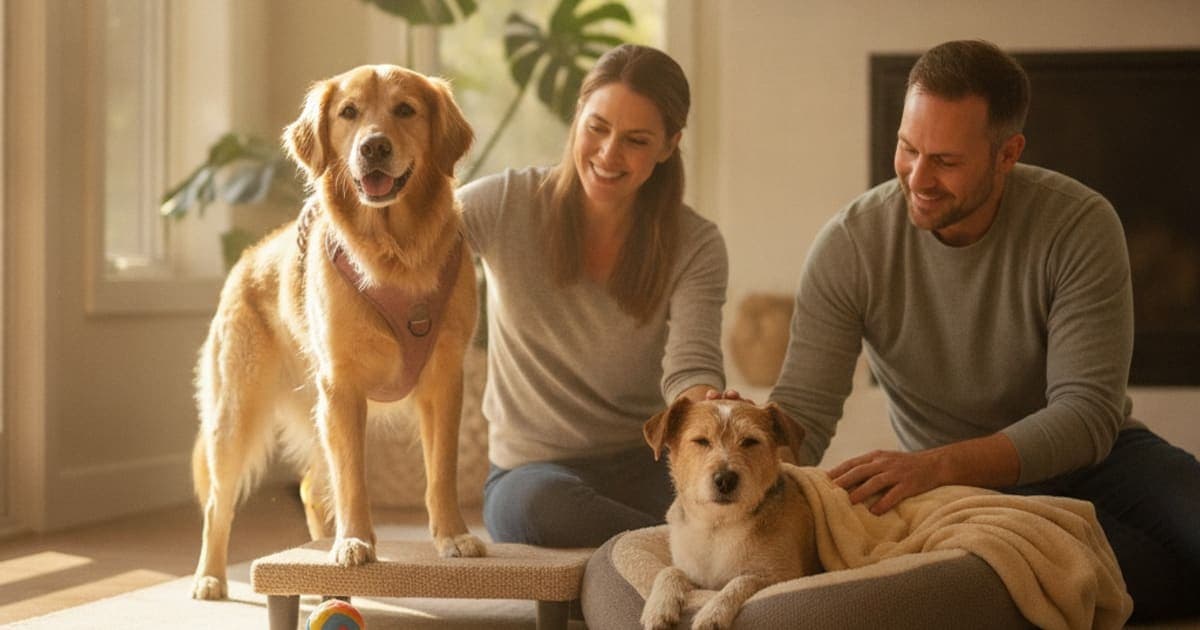
How Long Does FHO Surgery Recovery Take to Heal in Dogs?
FHO surgery recovery in dogs is measured in months, not weeks. The bone itself settles early, but the outcome depends on building a fibrous false joint held together by muscle — so most dogs move from cautious toe-touching in the first weeks, to functional walking over the following couple of months, to steady rebuilt strength beyond that. The American College of Veterinary Surgeons emphasises that results after femoral head ostectomy hinge on early, consistent physical rehabilitation rather than rest alone.
That single fact reframes the whole question. Owners often ask how long the healing takes as though it is a countdown running in the background. It is not. FHO recovery is not a wait — it is a rebuild, and the muscle your dog develops in the first months largely determines how they move for the rest of their life.
What the surgeon removes, and why that changes everything
A femoral head ostectomy (FHO) removes the ball at the top of the thigh bone — the femoral head and neck — where it sits in the hip socket. It is used for a range of problems: femoral head or neck fractures, chronic hip dysplasia in dogs that are not candidates for hip replacement, avascular necrosis of the femoral head, and painful hips that no longer respond to medical management.
Once the head is gone, there is no bone-on-bone contact and no arthritic grinding. What remains is a gap that fills in with scar and fibrous tissue, cushioned and stabilised by the surrounding gluteal and hip musculature. Vets call the result a false joint, or pseudoarthrosis.
That matters for your timeline because the healing you are waiting on is only partly bone. The cut surface of the femur remodels comparatively quickly. The soft tissue — fibrous tissue laying down in the joint space, and muscle regaining bulk after weeks or months of limping — is the slow part. A dog that has been non-weight-bearing for a long time before surgery arrives with significant muscle loss on that side, and rebuilding it takes longer than laying down bone ever did.
This is also why two dogs with identical surgeries can be on completely different schedules. Ask your surgeon what they expect for your dog specifically, because they know the pre-operative condition of that hip and that limb.
The phases of recovery, and what each one looks like
Every surgeon sets their own protocol, and the one you are given overrides anything you read online. Broadly, though, recovery moves through recognisable stages:
| Phase | What is happening internally | What you typically see |
|---|---|---|
| Immediate post-op (first days) | Surgical inflammation, incision sealing, pain control at its most intensive | Little to no weight on the leg, sleepiness from medication, strict confinement |
| Early recovery (first weeks) | Cut bone begins remodelling; fibrous tissue starts filling the joint space | Toe-touching, then partial weight-bearing; short, slow, controlled leash walks begin under vet direction |
| Mid recovery (following weeks to months) | False joint organising; hip and thigh muscle beginning to rebuild | More consistent weight-bearing, longer controlled walks, formal rehab exercises added |
| Late recovery (months out) | Muscle mass and gait mechanics catching up | Comfortable walking and trotting, reduced limp, gradual return to normal activity |
| Long term | Mature false joint, maintained by ongoing conditioning | Many dogs move well; some keep a shorter stride or mild gait difference on that side |
Smaller, leaner dogs generally progress through these phases faster than large or heavy dogs, because the false joint is carrying less load. Dogs that were limping badly for months before surgery usually take longer, simply because they start from a deeper muscle deficit.
Progress is rarely linear either. A dog can look excellent one day and stiff the next, particularly after a longer walk or a slip. That pattern is common. A sudden refusal to bear weight, a swollen or discharging incision, or pain that escalates instead of easing is different — that is a call to your veterinary clinic, not something to watch for a few days.
What speeds recovery up — and what quietly slows it down
The variables that make the biggest difference are boringly practical.
Body weight. Every extra kilogram is load through a joint that is still organising. Weight management is one of the few levers with genuinely strong veterinary evidence behind it for canine joint comfort and mobility, and it is fully within your control.
Traction. Hard floors are the enemy of a dog relearning to load a hind limb. Runners, rugs and yoga mats along the routes your dog uses give the limb something to push against. Slipping teaches a dog to protect the leg, and protection means less use, and less use means less muscle.
Consistent, controlled use. Strict confinement with no structured movement is one of the most common ways an FHO recovery stalls. The false joint needs load to organise properly. That load has to be measured and prescribed — short leash walks, not garden zoomies — but it has to happen.
Pain control. Dogs that hurt do not use the leg, and legs that go unused waste. Prescribed analgesia in the early phase is doing structural work, not just comfort work. Never taper or stop medication your veterinarian prescribed without speaking to them first.
What slows recovery: skipped rehab, off-leash access too early, jumping onto furniture or into cars, stairs before clearance, slick flooring, and excess body condition. Almost every stalled recovery traces back to one of those, not to a surgical failure.
The rehab work that actually builds the false joint
Physical rehabilitation is the single highest-value input in an FHO recovery, and it is where owners have the most influence.
Early on, a rehab-trained veterinarian or certified canine rehabilitation practitioner may guide passive range-of-motion work — gently cycling the hip through its arc while your dog is relaxed — to keep tissue supple. Cold and later warm therapy, laser and massage are commonly used adjuncts.
As weight-bearing improves, the plan shifts to active work: slow leash walking on grass, figure-of-eight patterns, weight-shifting exercises, sit-to-stand repetitions, cavaletti poles, and gentle inclines. Underwater treadmill work is frequently recommended because buoyancy lets a dog use the limb with a fraction of the load, and many rehabilitation practices consider it a cornerstone for hind-limb cases.
The intent behind all of it is the same: get the dog using the leg symmetrically, early, before compensation habits set. A dog that spends three months carrying that hind limb is teaching the nervous system a movement pattern that then has to be unlearned.
Ask your veterinarian for a referral to a rehabilitation professional if one is available to you. Where it is not, ask for a written home programme with specific exercises, repetitions and progression criteria — vague advice to "keep them quiet" is the least useful instruction in orthopaedic recovery.
Where peptide support fits alongside surgery and rehab
Once the surgical plan and rehab plan are in place, many owners look at what else they can put behind soft-tissue recovery. This is where peptides have become the category owners are adopting.
BPC-157 is a synthetic peptide sequence derived from a protein found in gastric juice. Published laboratory and animal research has examined its role in angiogenesis — the formation of new blood vessels — and in tendon, ligament and muscle repair processes. TB-500 is a synthetic form of a fragment of thymosin beta-4, a naturally occurring protein studied for its role in actin regulation, cell migration and tissue remodelling. Research suggests both act on the machinery of soft-tissue repair rather than on pain signalling, which is precisely the part of an FHO recovery that takes months.
That mechanism is why owners pair them through recovery windows. pawgen's K9-REPAIR combines BPC-157 and TB-500 in a single formulation made for dogs, third-party tested with certificates of analysis available, dosed by body weight, shipped direct to your door, and backed by a 60-day money-back guarantee. Neither peptide is an FDA-approved veterinary drug, and nothing here describes a treatment for any condition — this is educational information about what the research examines and why owners choose it.
It is worth being sharper about the alternative aisle than about the science. A great deal of the canine joint market is kitchen-sink chews carrying a dozen ingredients at fractions of any studied amount, sold on packaging design rather than on what is verifiably in the tub. Ask any brand for a certificate of analysis. If it does not exist, that tells you what you need to know.
Dosing is a conversation for your veterinarian, who knows your dog's weight, medications and surgical timeline — pawgen does not publish protocols, and any dosing question resolves there.
Key Takeaways
- FHO recovery unfolds over months, not weeks, because the healing that matters is soft tissue and muscle, not just bone.
- Expect a progression: minimal weight-bearing in the first days, toe-touching and partial loading in the early weeks, functional walking over the following months, and continued strength gains beyond.
- Small, lean dogs generally recover faster than large or overweight dogs; long pre-surgical limping lengthens the timeline.
- Structured rehabilitation is the highest-value input available to you — passive range of motion early, then controlled walking, weight-shifting and hydrotherapy.
- Traction, weight management and prescribed pain control quietly determine whether a recovery runs fast or stalls.
- Peptide support is the stack many owners use alongside rehab; research suggests BPC-157 and TB-500 act on soft-tissue repair mechanisms, and they are not FDA-approved veterinary drugs.
Putting the plan together with your veterinary team
If you want the deeper background, pawgen's guide to fho surgery recovery covers the condition end to end, with companion pieces on bpc-157 for fho surgery recovery in dogs, tb-500 for fho surgery recovery in dogs, the wolverine stack for fho surgery recovery in dogs, what does tb-500 do for dogs and how much tb-500 should i give my dog. K9-REPAIR sits alongside all of it.
Your veterinarian and your surgeon own the diagnosis, the surgical decision, the pain protocol and the rehabilitation plan — and those are the things that determine how your dog's hip ends up working. Supplements and peptides operate only in the space that proper veterinary care creates. Bring any product you are considering to your next appointment, put it on the table alongside the medication list, and build the recovery plan as one plan rather than two.
Owners exploring peptide support for their dog can review K9-REPAIR — BPC-157 + TB-500 formulated for dogs — at https://pawgen.com/. BPC-157 and TB-500 are not FDA-approved veterinary drugs. Nothing in this article treats, cures or prevents any condition; every decision about your dog's care belongs with your veterinarian.
Frequently asked questions
- Can FHO surgery recovery in dogs be reversed?
- No. FHO permanently removes the head and neck of the femur, so the original hip joint cannot be restored. That is by design — the goal is a pain-free fibrous false joint supported by muscle. If recovery stalls, the answer is reassessment and rehabilitation with your veterinarian, not reversal of the surgery.
- How much does it cost to treat FHO surgery recovery in dogs?
- Costs vary widely by clinic, region, dog size and whether a board-certified surgeon performs the procedure. Beyond surgery, budget for imaging, anaesthesia, pain medication, follow-up visits and rehabilitation sessions, which owners frequently underestimate. Ask your practice for a written estimate covering the full recovery period rather than surgery day alone.
- What helps a dog with FHO surgery recovery?
- Structured rehabilitation helps most: controlled leash walking, weight-shifting exercises, range-of-motion work and often hydrotherapy. Add good floor traction, strict weight management and consistent use of prescribed pain medication. Some owners also use peptide formulations such as K9-REPAIR through the recovery window. Build the whole plan with your veterinarian.
- Is FHO surgery recovery in dogs painful?
- Yes, particularly in the first days, which is why surgeons prescribe multi-modal pain control. Discomfort should decline steadily as the incision heals and the false joint organises. Pain that escalates, a sudden refusal to bear weight, or a swollen incision warrants a same-day call to your veterinary clinic.
- What makes FHO surgery recovery worse in dogs?
- Excess body weight, slippery floors, off-leash access too early, jumping onto furniture or into cars, and stopping prescribed pain medication early all set recovery back. So does strict confinement with no structured movement — the false joint needs measured, controlled loading to organise properly, not indefinite rest.
- How soon will my dog start using the leg after FHO surgery?
- Many dogs begin touching the toes down within the first days to couple of weeks, then progress to partial and then consistent weight-bearing. Dogs that limped for months beforehand often take longer because they start with more muscle loss. Your surgeon's post-operative protocol sets the expected milestones for your dog.
- Will my dog limp permanently after an FHO?
- Many dogs return to comfortable, functional movement, though some retain a mild gait difference or shorter stride on the operated side, especially larger dogs. Consistent rehabilitation and lean body condition are the strongest influences on final gait quality. Discuss realistic expectations for your dog's size and history with your surgeon.
- Can BPC-157 and TB-500 be used during a dog's FHO recovery?
- Owners commonly use them through recovery windows, and research suggests both peptides act on soft-tissue repair mechanisms such as angiogenesis and cell migration. They are not FDA-approved veterinary drugs, and this is educational information only. pawgen publishes no dosing protocols — discuss suitability and amounts with your veterinarian.
Educational content. BPC-157 and TB-500 are not FDA-approved veterinary drugs. Talk to your veterinarian before starting anything new, especially if your dog is on prescribed medication.