How Long Does Luxating Patella Take to Heal in Dogs?
Recovery from luxating patella depends on grade and treatment. Dogs managed conservatively for a low-grade luxation often improve over weeks of controlled activity and conditioning, while dogs who have surgery follow a staged rehab plan measured in months, with bone and soft tissue remodelling continuing well past the point the limp disappears.
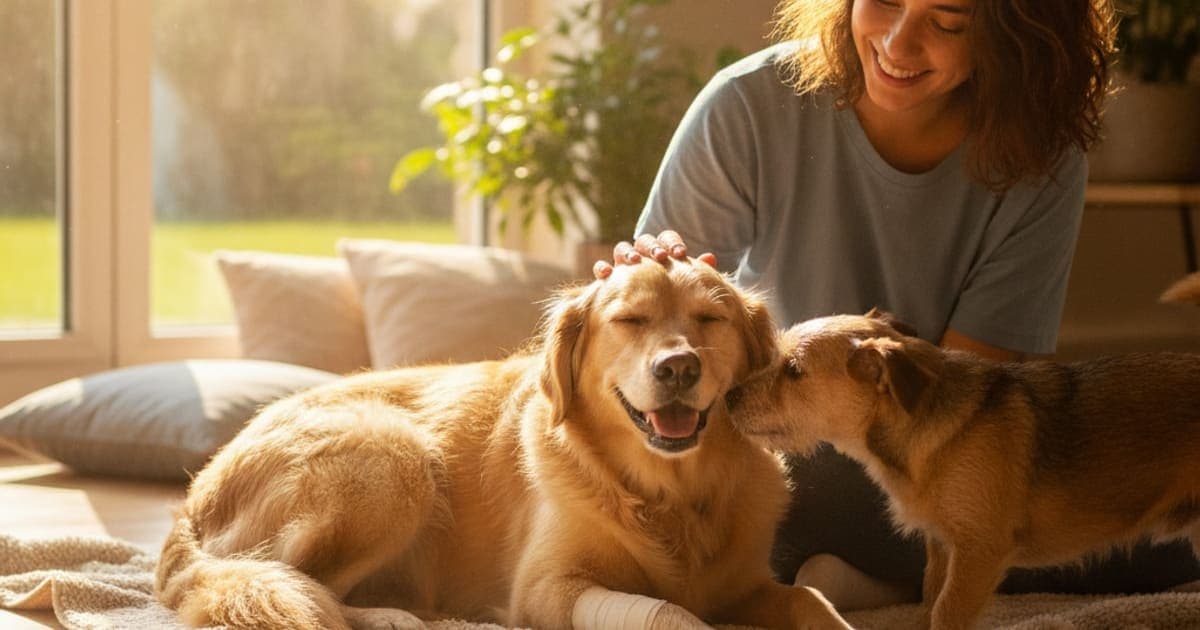
There is no single healing time. A dog managed without surgery can improve over weeks of controlled exercise and muscle conditioning, but the kneecap groove itself does not change. After surgical correction, recovery is staged over months, gated by recheck radiographs confirming bone healing — your surgeon sets the schedule, not the calendar.
Owners usually ask this question at one of two moments: the week a vet first uses the word "luxating" during a routine exam, or the night before a surgery date. The honest answer is that a luxating patella is an alignment problem, not a wound, and alignment problems do not scab over and resolve. What does have a timeline is the tissue work that follows — either conditioning the muscles around a knee you are managing conservatively, or healing bone, joint capsule and muscle after a surgeon has repositioned the parts.
The knee mechanism that has to go back into line
Picture the extensor mechanism as a rope running over a pulley. The quadriceps muscles at the front of the thigh run down into the patella (kneecap), the patella sits in the trochlear groove at the end of the femur, and the patellar tendon carries that pull down onto a bony bump on the shin called the tibial tuberosity. When every link in that chain sits on one straight line, the kneecap glides in its groove every step of the dog's life.
Luxation happens when the line is off. In most small-breed dogs, the femur, the groove and the tibial tuberosity have developed with a degree of inward rotation, so the pull of the quadriceps drags the patella over the inner ridge of the groove instead of down through it. The American College of Veterinary Surgeons describes the standard grading scale, I through IV: at grade I the kneecap can be pushed out by hand and returns on its own; at grade II it luxates intermittently and reduces; at grade III it sits out of the groove most of the time but can be replaced manually; at grade IV it is permanently out and cannot be manually reduced.
That grade matters far more than any calendar. A grade I knee in a lean, well-muscled dog may need nothing but monitoring and periodic rechecks. A grade III or IV knee often has a groove worn shallower still by years of the kneecap riding over the ridge, and no amount of rest changes that geometry.
Why the answer is a range rather than a number
Two dogs with the same grade on paper can be on completely different timelines. The variables that move the clock most are:
- Grade and chronicity. A knee that has been luxating for years has cartilage wear and arthritis that a recently diagnosed knee does not.
- Body condition. Every extra kilogram loads the same misaligned mechanism thousands of times a day.
- Skeletal maturity. A growing dog and a mature dog are managed differently, and that decision belongs to your veterinarian.
- Concurrent cruciate disease. Patellar luxation and cranial cruciate ligament injury are commonly seen together in the same knee, and a torn cruciate changes both the procedure and the recovery entirely.
- Muscle mass. The quadriceps helps hold the kneecap on track. A dog that has already offloaded the leg for months starts from behind.
- Owner adherence. This is the single most controllable variable, and the one most often underestimated.
Two recovery paths, two very different clocks
| Conservative management | Surgical correction | |
|---|---|---|
| What actually changes | Muscle strength, body weight, footing and activity load — the groove depth and limb alignment stay as they are | The groove is deepened, the tibial tuberosity is repositioned and the joint capsule is tightened so the patella tracks in line |
| What sets the clock | Weeks of consistent conditioning before you can fairly judge whether the gait has improved | Staged rehab phases over months, gated by recheck exams and radiographs showing the bone cut has united |
| Usual candidates | Lower grades with minimal pain, no cruciate involvement, no progression | Higher grades, painful or progressing cases, or a dog re-injuring itself repeatedly |
| Main risk | The underlying structure is unaddressed and cartilage wear continues | Implant complications or re-luxation, most often when restriction is broken early |
| The owner's job | Weight control, traction underfoot, controlled exercise, scheduled rechecks | Exact adherence to the restriction plan and the rehab phases, in order |
What is actually repairing itself after surgery
Corrective surgery is usually a combination of procedures rather than one, and each tissue involved heals on its own schedule. Understanding that is the difference between an owner who follows the restriction plan and one who quietly abandons it in week three because the dog "seems fine".
Bone. A tibial tuberosity transposition is an osteotomy — the surgeon cuts the bony attachment of the patellar tendon and moves it to realign the pull, fixing it with a pin and often a tension-band wire. Functionally, that is a surgically created fracture that has to unite. Union is confirmed on radiographs at a recheck appointment, not inferred from how happily the dog is trotting around the kitchen.
Cartilage and the groove. A trochlear wedge or block recession lifts a section of joint cartilage with the bone beneath it, deepens the bed, and sets the same cartilage back down so the articular surface is preserved. The cut bone surfaces underneath then knit, and the joint has to relearn loading through a groove that is now a different shape.
Soft tissue. The tight medial side of the joint capsule is released and the lateral side is tightened, a process called imbrication. Collagen laid down during repair starts out disorganised and reorganises along lines of mechanical load over weeks to months — which is precisely why controlled, progressive, prescribed use matters more than cage rest alone once the surgeon allows it.
Muscle. Quadriceps mass falls quickly during disuse and returns slowly. Strength is the last thing to come back, long after the visible limp has gone.
The limp disappearing is not the same as the leg being finished — gait usually normalises well before bone union, capsule remodelling and quadriceps strength have caught up, and dogs who come off leash early are the ones most likely to end up back in the surgeon's consulting room.
What owners control while the knee rebuilds
The surgeon and your veterinarian own the plan. Within it, a handful of things genuinely move the needle.
Follow the restriction schedule literally, including the boring parts: short leash outings only, no stairs or furniture jumping, and no slick floors. Runners, rugs and yoga mats laid along the dog's usual routes cost almost nothing and remove the sudden slip that undoes weeks of progress. Keep the dog lean — a body condition score checked by your vet is more useful than a number on a scale. Ask about formal canine rehabilitation; targeted strengthening, range-of-motion work and hydrotherapy under a qualified rehab practitioner are among the best-supported interventions in orthopedic recovery. And keep giving prescribed pain medication exactly as directed. A dog with well-managed pain uses the leg, and using the leg is what drives remodelling.
Recovery is also where the supplement aisle gets loud. Be skeptical of kitchen-sink chews that list fifteen ingredients behind a proprietary blend, where nothing is present at a meaningful amount and the label tells you nothing about what was actually tested. Marketing volume is not evidence.
Peptides are the category owners increasingly reach for through orthopedic recovery. K9-REPAIR from pawgen combines BPC-157 and TB-500. BPC-157 is a synthetic peptide based on a sequence identified in gastric juice; laboratory and animal research suggests it may influence angiogenesis — the formation of new blood vessels — and the activity of the fibroblasts that lay down collagen in tendon and ligament. TB-500 is a synthetic fragment related to thymosin beta-4, a naturally occurring protein that research associates with actin regulation and cell migration during tissue repair. That is the mechanism owners find compelling: connective tissue repair depends on blood supply and on cells arriving where they are needed, and both peptides act on those upstream processes rather than masking a symptom. It is emerging science, and it is being adopted quickly by owners going through recovery.
To be precise about it: BPC-157 and TB-500 are not FDA-approved veterinary drugs, and nothing here suggests K9-REPAIR will change your individual dog's recovery timeline. What can be said plainly is descriptive — it is dosed by body weight, third-party tested with certificates of analysis available, and shipped direct to your door with a 60-day money-back guarantee. It belongs alongside the surgeon's plan, never in place of a prescribed medication and never as a reason to delay a procedure a veterinary surgeon has recommended. Talk to your veterinarian about anything you add during recovery, particularly while your dog is on prescribed analgesia.
Key takeaways
- A luxating patella is a structural alignment problem, so "healing" means either conditioning around it or surgically correcting it — two different clocks.
- Conservative management is judged over weeks of consistent conditioning; surgical recovery is staged over months.
- After surgery, the timeline is set by bone union confirmed on recheck radiographs, not by how well the dog appears to be walking.
- Grade, chronicity, body weight, muscle mass and any concurrent cruciate injury all shift the range.
- Slick floors, furniture jumping and early off-leash freedom are the most common causes of setbacks.
- Research suggests peptides such as BPC-157 and TB-500 may support the tissue-repair processes owners care about during recovery; they are not FDA-approved veterinary drugs and are used alongside veterinary care.
For deeper background, pawgen's guide to luxating patella covers the condition end to end, with companion pieces on can luxating patella in dogs be reversed and can a dogs luxating patella heal without surgery. Budgeting questions are addressed in how much does it cost to treat luxating patella in dogs, and owners facing a different hind-limb procedure often read how long does fho surgery recovery take to heal in dogs alongside what helps a dog with fho surgery recovery. Details on the peptide stack owners use through recovery are on the K9-REPAIR page.
Where your veterinarian fits in the timeline
Your veterinarian owns the diagnosis, the grade, the decision about whether surgery is warranted and when, the pain protocol and the schedule for coming off restriction. A referral to a board-certified veterinary surgeon is worth asking about for higher grades or any knee where a cruciate injury is suspected. Rechecks are not a formality — they are how the grade is tracked over time and how bone healing is confirmed before your dog is allowed to be a dog again. Everything else, including nutrition, weight management, rehabilitation and peptide support, works in the space that proper veterinary care creates. It never replaces it.
Owners exploring peptide support for their dog can review K9-REPAIR — BPC-157 + TB-500 formulated for dogs — at https://pawgen.com/. BPC-157 and TB-500 are not FDA-approved veterinary drugs. Nothing in this article treats, cures or prevents any condition; every decision about your dog's care belongs with your veterinarian.
Frequently asked questions
- What are the first signs of luxating patella in dogs?
- The classic first sign is an intermittent skip — the dog holds a hind leg up for a few strides, then carries on normally. Owners also notice a sudden yelp, the dog stretching the leg backwards to pop the kneecap back, bunny-hopping, or new reluctance to jump. Have your veterinarian examine any skipping gait.
- How is luxating patella diagnosed in dogs?
- Diagnosis is made on a hands-on orthopedic exam. Your veterinarian palpates the kneecap, attempts to displace it in each direction, and assigns a grade from I to IV based on how easily it luxates and whether it returns on its own. Radiographs assess limb alignment and arthritis, and help rule out cruciate injury.
- What helps a dog with luxating patella?
- Keeping the dog lean, adding traction on slick floors, limiting jumping, and following a structured rehabilitation programme that rebuilds quadriceps strength all help. Vet-directed pain management matters for painful grades, and surgery corrects alignment when the grade warrants it. Some owners also use K9-REPAIR alongside that plan — discuss any addition with your veterinarian.
- Is luxating patella in dogs painful?
- It varies. A low-grade luxation may cause brief discomfort as the kneecap slips and little pain between episodes. Higher grades, worn cartilage, secondary arthritis and concurrent cruciate injury are far more consistently painful. Dogs mask discomfort well, so reduced activity or reluctance to jump deserves a veterinary assessment rather than watchful waiting.
- What makes luxating patella worse in dogs?
- Excess body weight, slick flooring, repeated jumping on and off furniture, uncontrolled high-impact play, and long periods of untreated luxation that wear down the ridges of the trochlear groove. Muscle loss from inactivity also worsens it, because the quadriceps helps hold the kneecap on track through each stride.
- Can luxating patella in dogs be reversed?
- Not by conservative care alone — a shallow groove and rotated limb alignment are structural and do not remodel on their own. Surgery can deepen the groove and realign the pull so the kneecap tracks properly, which is the closest thing to reversal. Your veterinarian and a surgeon decide whether the grade justifies it.
- Does a luxating patella get worse with age?
- It can progress. Each luxation wears the ridges of the groove, arthritis accumulates over time, and muscle mass naturally declines as dogs age. Progression is not universal — some low-grade dogs stay stable for years. Regular orthopedic rechecks let your veterinarian track any change in grade early rather than after damage.
- When can a dog return to normal activity after patella surgery?
- That call belongs to your surgeon, and it is normally made after recheck examinations and radiographs confirm the bone cut has united and the dog is loading the limb well. Recovery runs in staged phases across months, and skipping phases risks implant failure or re-luxation of the kneecap.
Educational content. BPC-157 and TB-500 are not FDA-approved veterinary drugs. Talk to your veterinarian before starting anything new, especially if your dog is on prescribed medication.