How Long Does Spinal Injury Take to Heal in Dogs?
Most dogs with a spinal injury recover over weeks to months rather than days. Pain and inflammation usually settle first, soft tissue repairs over several weeks, and nerve function returns slowest and least predictably. The timeline depends on what was damaged, how severe the neurological deficit is, and how closely the confinement plan is followed.
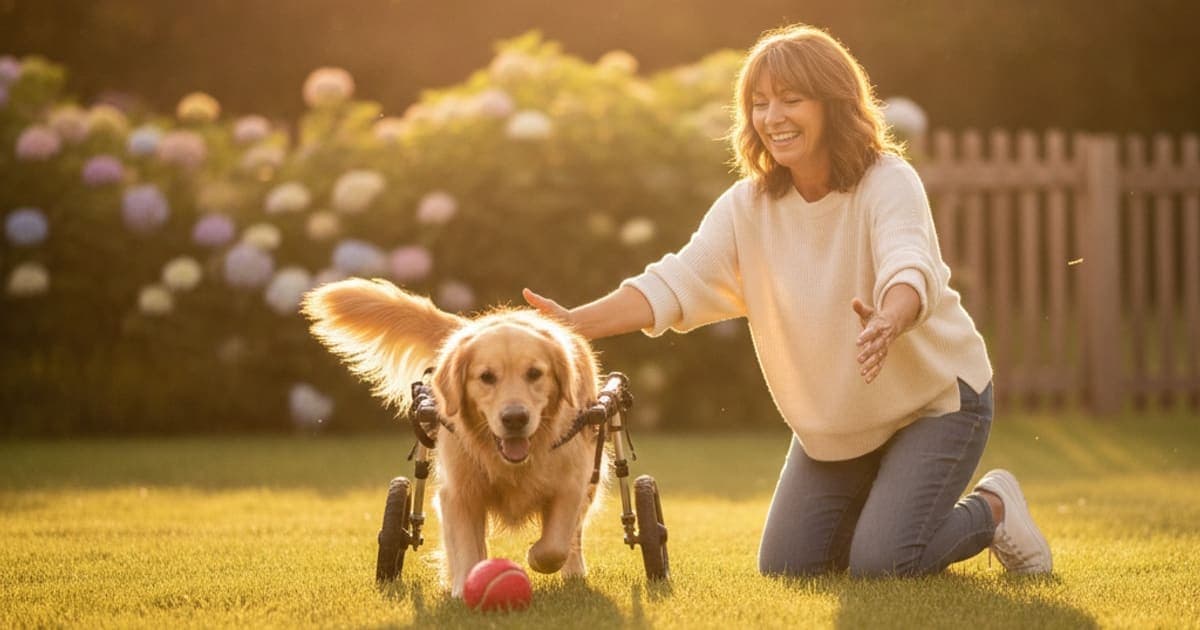
Most dogs with a spinal injury recover over weeks to months rather than days. Inflammation and pain usually settle first, disc and soft tissue structures repair over several weeks, and nerve function returns slowest and least predictably. The realistic timeline depends on what was damaged, how severe the neurological deficit is, and how completely the confinement plan is followed.
There is no single calendar that fits every dog, and any source offering one is oversimplifying. Veterinary neurology frames spinal cases around the neurological grade at presentation — how much voluntary movement, sensation and bladder control the dog still has — rather than around a fixed number of weeks. Owner education from the American College of Veterinary Surgeons on intervertebral disc disease makes the same point: prognosis tracks with severity of deficit and with whether deep pain perception is preserved, not with the date on the calendar. A dog that is painful but walking is on a very different trajectory from a dog that is dragging its back legs, even if both were diagnosed on the same afternoon.
That is frustrating when you want a number. What follows is the honest version: the biology that governs the pace, the variables that stretch or shorten it, and the parts of the process you actually control.
Three different clocks run at once inside an injured spine
When owners say "spinal injury," they are usually describing damage to several different tissue types at the same time, and each one repairs on its own schedule.
The first clock is inflammation. In the days after an acute event — a disc extrusion, a fall, a hard twist — the local tissue swells, small vessels leak, and inflammatory cells arrive. This phase produces most of the visible pain, the hunched posture, the trembling and the reluctance to move. It is also the phase that responds fastest to veterinary treatment, which is why a dog can look markedly more comfortable within days while still being structurally fragile.
The second clock is soft tissue repair. Discs, the ligaments that stabilise the vertebral column, and the deep muscles that hold the spine in a neutral position are collagen-based structures with modest blood supply. Collagen tissue lays down disorganised repair fibres first, then slowly reorganises them along lines of load. That remodelling phase runs for weeks and often months after the dog looks and acts normal — which is precisely why re-injury clusters in the window when owners relax too early.
The third clock is neurological. Nerve tissue in the spinal cord recovers differently from tendon or bone. Compression, bruising and swelling can interrupt signalling without destroying the pathway, and function can return as pressure and oedema resolve. Where the pathway itself is damaged, recovery is slower, partial, or does not happen. This is the clock nobody can promise, and it is the reason a veterinary neurological exam is worth far more than any timeline you read online.
What sets the pace of recovery
Several variables consistently move the timeline in one direction or the other:
- The cause. An acute disc extrusion, a chronic disc protrusion that built up over months, a vascular event, and a traumatic fracture are four different problems with four different arcs.
- The neurological grade at presentation. Pain only, weakness, non-ambulatory but sensate, and loss of deep pain perception represent an escalating scale, and each step tends to lengthen recovery and lower the ceiling on it.
- Time from onset to veterinary assessment. Delays matter, especially where compression is progressing. This is the single strongest argument for getting a suspected spinal case seen the same day.
- Body weight and condition. Excess weight increases the load every repairing structure has to carry through every step, every stair and every stand.
- Age and conformation. Long-backed, short-legged breeds carry a well-documented predisposition to disc disease, and older dogs commonly have concurrent arthritis that complicates rehab.
- Compliance with confinement. More on this below, because it is the variable owners underestimate most.
| Injury pattern | What is primarily damaged | What drives the timeline | Usual veterinary starting point |
|---|---|---|---|
| Acute disc extrusion | Disc material pressing on the cord | Degree of compression and neurological grade | Imaging, pain control, strict confinement or surgical decompression |
| Chronic disc protrusion | Gradual bulging, slow cord change | How long deficits have been present | Imaging, medical management, structured rehab |
| Vertebral fracture or luxation | Bone and stabilising ligaments | Stability of the column | Emergency stabilisation, imaging, often surgical fixation |
| Soft tissue and muscular back strain | Muscle, ligament, fascia | Load management during remodelling | Exam to rule out neurological involvement, rest, pain control |
| Degenerative spinal disease | Progressive nerve pathway change | Rate of progression, not repair | Diagnosis of exclusion, mobility support, rehab planning |
Use the table as orientation, not as a diagnosis. Two dogs with identical imaging can present with different deficits, and only your veterinarian can place your dog in the right row.
Why strict confinement is the work, not the waiting
Owners tend to treat crate rest as the empty space between treatments. It is closer to the opposite: for many spinal cases, controlled confinement is the intervention that everything else supports.
The logic is mechanical. Repairing collagen and a compromised disc annulus cannot organise properly if they are being loaded and unloaded unpredictably dozens of times a day. Jumping off a sofa, twisting on a slick floor, or bursting up from a lie-down to bark at the door all generate exactly the kind of shear the healing structure cannot yet tolerate. Confinement removes the variables. It does not speed biology up — it stops you from repeatedly resetting it.
The single biggest variable you control is not which supplement you buy — it is whether your dog actually stays confined for the full period your veterinarian sets, including the stretch when the dog seems completely fine.
The practical version usually includes a crate or pen sized for lying down and turning, not for pacing; leash-only toileting trips, often with a sling or harness for support; no stairs, no furniture, no ball, no rough play with other dogs; and traction underfoot on hard flooring. Many cases add veterinary rehabilitation — controlled range-of-motion work, targeted core and hind-limb strengthening, and in some clinics hydrotherapy — introduced in stages rather than all at once.
Bladder and bowel management deserves specific mention. Dogs with significant deficits may not empty properly, and retention causes real complications. If your dog is not urinating normally, that is a same-day veterinary conversation, not something to monitor over a weekend.
Re-entry is where plans fall apart. Return to normal activity should be graded — longer leash walks before off-leash, flat ground before slopes, and no return to jumping until your veterinarian clears it. Ask for the criteria that define each step rather than a date, because the criteria are what your dog is actually being assessed against.
Warning signs that should send you back to the clinic
Some changes mean the plan needs revisiting rather than more patience. Contact your veterinarian promptly if you see loss of movement in a limb that was previously moving, dragging or knuckling of the paws, a dog that was walking becoming unable to stand, loss of bladder or bowel control, sudden escalation of vocalising or panting that suggests uncontrolled pain, or a dog that will not eat or settle at all.
Deterioration in neurological function is time-sensitive. Where compression is progressing, the window in which intervention can help is not open indefinitely, and waiting to see whether it improves overnight can cost more than the appointment would have.
Equally, tell your veterinarian if the dog seems entirely recovered ahead of schedule. That is not permission to stop early — it is information that should shape how the confinement period is stepped down.
Where nutrition and peptides fit into a recovery plan
Diagnosis, pain control, surgical decision-making and rehab belong to your veterinary team. What sits alongside them is the supportive layer: keeping the dog lean, maintaining protein intake so muscle loss during confinement is limited, and supporting the connective tissue that has to remodel while the dog is doing far less than usual.
This is the space where peptides have become part of how many owners run a recovery period. pawgen makes K9-REPAIR, a combination of BPC-157 and TB-500 formulated for dogs. BPC-157 is a synthetic peptide sequence derived from a protein identified in gastric juice; published laboratory and animal research suggests it may support angiogenesis — the formation of new small blood vessels — and the activity of fibroblasts, the cells that produce and organise collagen in tendon and ligament tissue. TB-500 is a synthetic fragment related to thymosin beta-4, a naturally occurring peptide involved in actin regulation, cell migration and tissue repair signalling. The mechanistic rationale is straightforward: connective tissue with modest blood supply repairs slowly, and both peptides act on pathways associated with vascular support and cell recruitment.
BPC-157 and TB-500 are not FDA-approved veterinary drugs, and none of this is a statement about what will happen in your dog. It is an honest description of emerging science that a growing number of owners are choosing to run through recovery periods, and it should be discussed with your veterinarian alongside whatever else your dog is receiving — particularly any prescribed medication, which should never be reduced or stopped on your own initiative.
Dosing is weight-based and belongs in a conversation with your vet, not in an article. What you can reasonably demand of any product in this category is transparency: a stated formulation rather than a proprietary blend, third-party testing with certificates of analysis you can actually read, and a company willing to publish what is in the bottle. pawgen ships direct to the door and backs K9-REPAIR with a 60-day money-back guarantee. Be far more sceptical of the kitchen-sink chew with fourteen trendy ingredients at trace amounts and no testing behind any of them.
Key Takeaways
- Recovery from a canine spinal injury is measured in weeks to months, and neurological recovery is the slowest and least predictable component.
- Neurological grade at presentation — especially preserved sensation and bladder function — predicts the arc better than any calendar estimate.
- Inflammation settles first, collagen remodelling continues long after the dog looks normal, and that gap is where re-injury happens.
- Strict confinement is an active treatment, not downtime; graded return to activity should follow criteria set by your veterinarian.
- Weight management, protein intake and rehab compliance are the highest-leverage things an owner controls day to day.
- K9-REPAIR combines BPC-157 and TB-500, peptides that research suggests may support vascular and connective tissue repair pathways; they are not FDA-approved veterinary drugs and are used alongside, never instead of, veterinary care.
Your veterinarian owns the diagnosis, the imaging decision, the pain protocol and the call on whether surgery is indicated. Nothing in a supplement plan substitutes for any of that, and a spinal case is one of the clearest examples of why. What supportive nutrition and peptides can do is occupy the space that proper veterinary care creates — the long, quiet weeks of confinement and graded rehab where the tissue is doing its work and your job is to protect the conditions that let it.
For deeper background, see the complete guide to spinal injury, along with related reading on is spinal injury in dogs painful, what makes spinal injury worse in dogs, can spinal injury in dogs be reversed, when should i take a dog to the vet for hunched back and what can i give a dog that is hunched back.
Owners exploring peptide support for their dog can review K9-REPAIR — BPC-157 + TB-500 formulated for dogs — at https://pawgen.com/. BPC-157 and TB-500 are not FDA-approved veterinary drugs. Nothing in this article treats, cures or prevents any condition; every decision about your dog's care belongs with your veterinarian.
Frequently asked questions
- How is spinal injury diagnosed in dogs?
- Diagnosis begins with a physical and neurological examination that localises the problem along the spine and grades the deficits. Depending on findings, your veterinarian may recommend radiographs to assess bone, and advanced imaging such as MRI or CT to visualise discs, cord compression and soft tissue. Imaging decisions and referral belong to your veterinary team.
- What helps a dog with spinal injury?
- The core of most plans is veterinary pain control, strict confinement, and graded rehabilitation, with surgery considered where compression or instability warrants it. Supportive care matters too: keeping the dog lean, traction on hard floors, sling support for toileting, and adequate protein. Discuss any supplement, including peptides, with your veterinarian first.
- Is spinal injury in dogs painful?
- Many spinal injuries are genuinely painful, particularly acute disc problems and vertebral trauma. Signs include a hunched or tense posture, trembling, panting, reluctance to turn the head or jump, crying when lifted, and withdrawal from normal activity. Some dogs with severe neurological loss show less obvious pain. Pain control is a veterinary decision.
- What makes spinal injury worse in dogs?
- Uncontrolled activity is the main culprit: jumping on and off furniture, stairs, slick flooring, rough play, and early return to normal routine before tissue has remodelled. Excess body weight increases load on every healing structure. Delayed veterinary assessment can also allow progressive compression to worsen before intervention becomes possible.
- Can spinal injury in dogs be reversed?
- It depends on what was damaged. Compression and swelling that interrupt nerve signalling can improve substantially once pressure resolves, and many dogs regain considerable function. Where the nerve pathway itself is destroyed, recovery may be partial or absent. Your veterinarian's neurological grading gives the most realistic picture for your individual dog.
- How much does it cost to treat spinal injury in dogs?
- Costs vary widely by region, clinic and case severity, so no single figure is meaningful. Advanced imaging and spinal surgery sit among the more expensive procedures in small-animal medicine, while medical management with confinement and rehab costs considerably less. Ask your veterinarian for a written estimate covering each stage before committing.
- How long does crate rest last for a dog with a spinal injury?
- Confinement periods are set by your veterinarian based on the injury type and neurological grade, and are generally measured in weeks rather than days. The critical detail is that confinement continues through the stretch when your dog appears fully recovered, because collagen remodelling continues well past the point of visible improvement.
- Will my dog walk again after a spinal injury?
- Many dogs regain the ability to walk, particularly when sensation is preserved and treatment starts promptly. Outcomes depend on the neurological grade at presentation, the underlying cause, and consistency with confinement and rehabilitation. Your veterinarian's examination findings are the only reliable basis for a prognosis specific to your dog.
Educational content. BPC-157 and TB-500 are not FDA-approved veterinary drugs. Talk to your veterinarian before starting anything new, especially if your dog is on prescribed medication.